
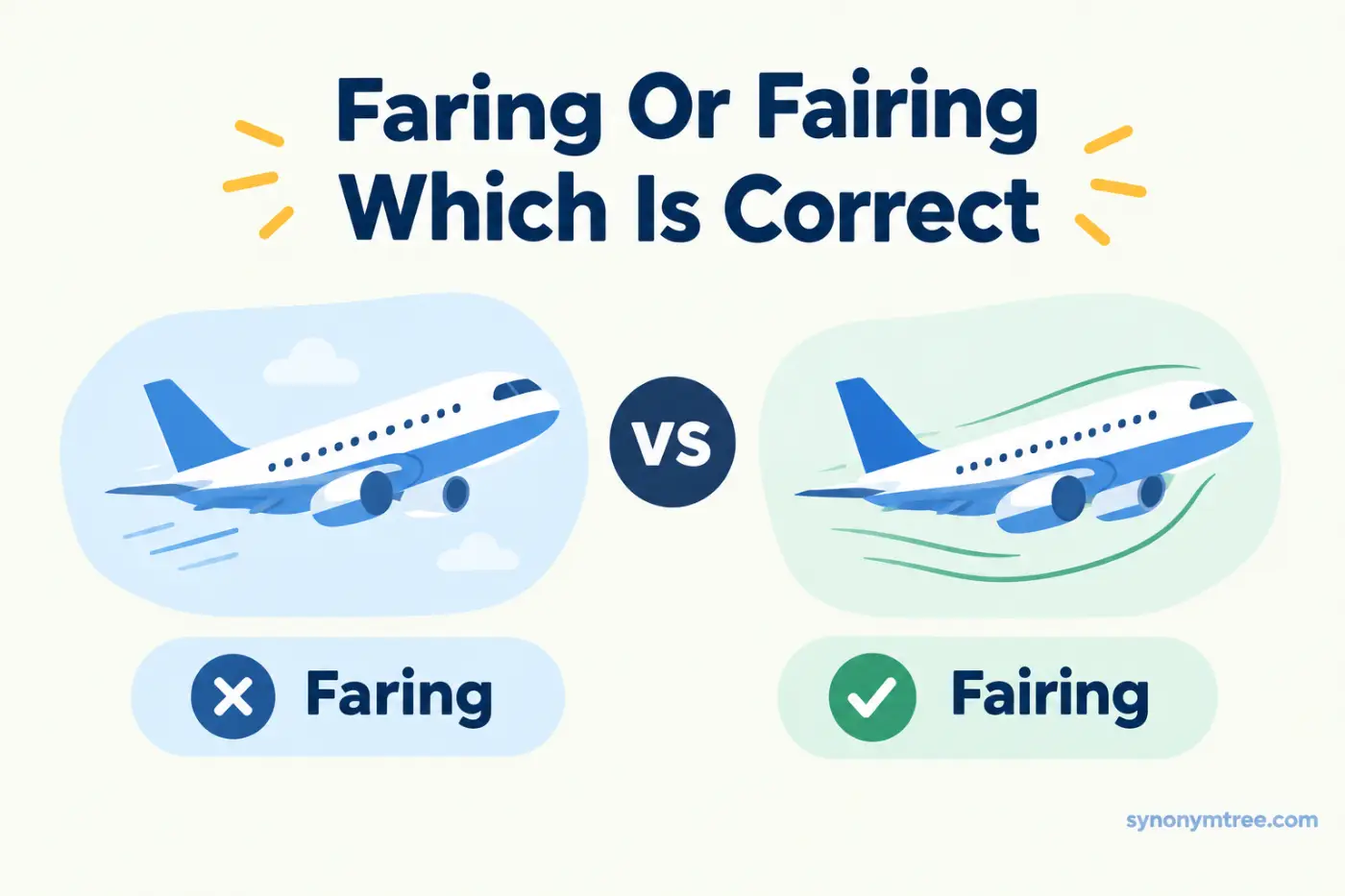
If you are confused about faring or fairing, the correct spelling depends on what you mean. Faring is usually the present participle of the verb fare, which means to perform or get along in a situation. Fairing is a noun that usually refers to a smooth cover or structure added to an object to reduce drag or improve its shape.
These two words sound alike, but they have different meanings and uses. That makes them easy to mix up in writing. The key is to look at the word you are trying to describe. If you are talking about how someone or something is doing, use faring. If you are talking about a physical covering or streamlined part, use fairing.
For example, you can write, How are you faring after the move? Here, faring means doing or managing. You can also write, The mechanic replaced the damaged fairing on the motorcycle. In that sentence, fairing refers to a physical part.
This guide explains both words with simple definitions, real sentence examples, common mistakes, related words, and easy memory tips. By the end, you will know exactly when to use each spelling.
Quick Definition
Faring is the present participle of fare. It means doing, progressing, or managing in a particular situation.
Fairing is usually a noun for a smooth cover or structure that changes the shape of an object. It is often used with motorcycles, bicycles, aircraft, boats, and other machines.
Direct Answer
Use faring when you mean doing or progressing, as in How are you faring? Use fairing when you mean a smooth protective or streamlined covering, as in The motorcycle needs a new fairing.
Comparison Table
| Word | Meaning | Example Sentence | When To Use It |
|---|---|---|---|
| Faring | Doing or progressing | How are you faring at your new job? | Use it when talking about performance or progress |
| Fairing | A smooth cover or structure | The mechanic repaired the motorcycle fairing. | Use it for a physical covering or streamlined part |
The difference is mainly about meaning. Faring comes from fare, while fairing comes from fair in the sense of making something smoother or more streamlined.
What Does Faring Mean
Faring is the present participle form of the verb fare. The verb fare can mean to perform, progress, manage, or get along in a particular situation.
When you ask someone How are you faring? you are asking how that person is doing. You may be asking about their health, work, studies, adjustment to a new place, or general progress.
For example, a manager might ask an employee, How are you faring in your new position? The question asks how well the employee is managing or progressing.
A teacher might ask, How are the students faring this semester? The question asks about the students’ progress.
A friend might say, I hope you are faring well after the move. Here, faring means getting along or managing.
The word often appears with words such as well, poorly, better, worse, or best.
She is faring well in her new role.
The team is faring better this season.
The company is faring poorly in the new market.
The students are faring worse than expected.
Each example deals with progress or performance. That is the main clue that faring is the correct spelling.
How Faring Comes From Fare
To understand faring, it helps to understand fare first.
Fare is a verb that can mean to perform or progress. Its forms include fare, fares, fared, and faring.
The present form appears in sentences such as, I usually fare well under pressure.
The third person form appears in, She fares well in difficult situations.
The past form appears in, They fared better than expected.
The present participle appears in, They are faring better this year.
This pattern is similar to other common verbs.
Care becomes caring.
Share becomes sharing.
Prepare becomes preparing.
Fare becomes faring.
The spelling changes because the final silent e is dropped before the ending ing is added. This gives us faring rather than fareing.
That spelling rule is useful because some people may try to form the word by simply adding ing to fare. The correct form is faring.
What Does Fairing Mean
Fairing is a noun that usually refers to a smooth cover or structure placed over part of a machine or vehicle.
A fairing can help create a smoother shape. In many designs, that shape helps reduce air resistance or water resistance. Fairings are common in motorcycles, bicycles, aircraft, rockets, boats, and other vehicles.
For example, a motorcycle may have plastic or fiberglass fairings around parts of its body. These pieces can protect components and give the motorcycle a smoother shape.
An aircraft can also have fairings. A fairing may cover a joint or other part of the aircraft to create a smoother outer surface.
The word is especially common in technical writing, transportation, engineering, and mechanical discussions.
For example, The aircraft received a new fairing before the next flight.
The cyclist removed the front fairing to reduce the bike’s weight.
The motorcycle fairing was damaged in the accident.
The engineer designed a new fairing for the exposed section.
In each sentence, fairing refers to a physical object or structure.
Why These Words Are Confusing
The main reason people confuse these words is pronunciation. Faring and fairing sound alike in standard American English.
They are homophones. Homophones are words that have the same pronunciation but different spellings and meanings.
Other common examples include pair and pear, right and write, and sea and see.
Faring and fairing create the same kind of problem. When you hear the word spoken, you cannot tell which spelling the speaker means. You need the context to understand the intended meaning.
Consider this sentence.
How are you faring?
The context tells you that the speaker is asking about someone’s progress. The correct spelling is faring.
Now consider this sentence.
The fairing is cracked.
Here, the sentence refers to a physical part. The correct spelling is fairing.
The meanings are very different even though the words sound the same.
Faring Means Doing Or Progressing
A simple way to understand faring is to replace it with doing or progressing.
How are you faring?
can become
How are you doing?
The team is faring well.
can become
The team is doing well.
The company is faring better this year.
can become
The company is doing better this year.
This replacement test works in many everyday sentences.
If doing or progressing makes sense, faring is probably the word you need.
For example, She is faring well in college means She is doing well in college.
The new employee is faring better than expected means The new employee is doing better than expected.
This does not work with fairing.
The motorcycle fairing is damaged cannot become The motorcycle doing is damaged.
That tells you the word has a different function and meaning.
Fairing Refers To A Physical Part
Fairing is usually something you can see and touch. It is a physical structure designed to cover, protect, or streamline part of an object.
A motorcycle fairing may cover the engine or other mechanical components.
An aircraft fairing may cover a joint or connection.
A bicycle fairing may help reduce air resistance.
A rocket fairing may cover a payload during part of a launch.
The exact design depends on the machine and its purpose. Some fairings are mainly used to improve airflow. Others also provide protection or help create a cleaner outer shape.
This physical meaning gives you a strong clue. If the sentence describes a component, cover, panel, or streamlined structure, fairing is probably correct.
Faring In Everyday Conversation
Faring is useful in everyday conversation when you want to ask about someone’s progress or situation.
How are you faring?
This is a natural question, although How are you doing? is more common in casual American English.
You might use faring when the situation has some challenge or change involved.
How are you faring with your new schedule?
How are you faring at your new school?
These questions all ask about how someone is managing.
The word can also appear in friendly statements.
I hope you are faring well.
I am glad to hear that you are faring better.
They seem to be faring well after the change.
The tone can sound slightly more formal than doing well, but the meaning is clear.

Faring In Professional Writing
Faring is also useful in professional and academic writing when discussing performance or progress.
For example, a business report might say, The company is faring well despite higher operating costs.
A school report might say, Students are faring better after the new study program was introduced.
A research paper might discuss how different groups are faring under similar conditions.
The word can make a sentence concise because it combines the idea of performance and progress.
Instead of writing, The company is doing better in the new market, you can write, The company is faring better in the new market.
Both sentences are correct.
Faring Better
Faring better means doing better or progressing better than another person, group, time, situation, or expected result.
For example, The second group is faring better than the first group.
This tells us that the second group is producing better results.
You can also use faring better without directly stating the comparison.
She is faring better now.
The sentence means her situation or performance has improved.
Faring better often appears with than, with, or under.
The students are faring better than they did last year.
He is faring better with the new treatment plan.
The business is faring better under its new management.
In each example, the word describes progress.
Faring Well
Faring well means doing well or progressing successfully.
For example, The new employee is faring well in the department.
This sentence means the employee is managing the new position successfully.
Faring well can describe many subjects.
The students are faring well in their classes.
The business is faring well this quarter.
The project is faring well so far.
The plants are faring well in the warmer weather.
The expression does not always refer to people. Anything that can progress or perform can sometimes be described as faring well.
Faring Poorly
Faring poorly is the opposite of faring well.
It means doing badly or progressing in an unsuccessful way.
For example, The company is faring poorly in that market.
The sentence says that the company is not performing well there.
You can use the phrase for people, groups, businesses, plans, or other situations.
The team is faring poorly this season.
Some students are faring poorly in the advanced class.
The old system is faring poorly under heavy demand.
The project is faring poorly because of repeated delays.
Again, the meaning is about progress or performance.
Faring Worse
Faring worse means doing worse or having a poorer result.
For example, The older model is faring worse than the newer model.
You can also say, The team is faring worse this season.
The word worse creates a comparison. It tells the reader that the performance or progress is below another point of reference.
This is different from fairing because fairing does not describe performance.
Faring Best
Faring best means performing better than the other options being discussed.
For example, Of the three designs, the smaller model is faring best.
The phrase can describe performance in many areas.
The students with regular study schedules are faring best.
Among the stores in the region, this location is faring best.
The newer software is faring best under heavy use.
The important point is that faring always connects to the verb fare.
Fairing On A Motorcycle
One of the most common uses of fairing is related to motorcycles.
A motorcycle fairing is a body panel or covering that surrounds parts of the motorcycle. Depending on the design, it may cover the engine, front section, or other components.
Fairings can serve several purposes. They can help protect parts of the motorcycle, improve airflow, and give the vehicle a smoother shape.
You may hear terms such as front fairing, side fairing, full fairing, and fairing panel.
For example, The rider replaced the cracked side fairing.
Here, fairing clearly refers to a physical motorcycle component.
The word does not describe how the rider is doing. If you wanted to discuss the rider’s progress, you would use faring.
The rider is faring well after the accident.
The motorcycle needs a new fairing.
Those sentences show the difference clearly.
Fairing On An Aircraft
Aircraft also use fairings.
An aircraft fairing can cover areas where two structures meet or where a smoother outer surface is useful. By creating a cleaner shape, a fairing can help manage airflow around the aircraft.
The exact type and purpose of an aircraft fairing can vary.
For example, a fairing may cover a connection between parts of the aircraft. It can help reduce drag and protect components.
You might read a sentence such as, The damaged fairing was replaced before the aircraft returned to service.
The word fairing is correct because the sentence describes a physical component.
Fairing On A Bicycle
Bicycle fairings are designed to improve the shape of the bicycle and rider combination.
Some specialized bicycles use fairings to reduce air resistance. A smoother outer surface can help the bicycle move through the air more efficiently.
For example, The cyclist tested a new fairing during the race.
This use is less common in everyday conversation than motorcycle fairing, but the basic meaning stays the same.
Fairing refers to the physical structure. Faring refers to performance or progress.
Fairing In Engineering
The word fairing has a technical meaning in engineering.
Engineers use fairings to create smoother shapes around structures. A fairing can cover a joint, connection, gap, or exposed part.
The goal can include reducing drag, improving airflow, protecting a component, or creating a cleaner outer surface.
For example, engineers may design a fairing around an aircraft connection to reduce airflow disruption.
In mechanical and aerospace contexts, the word is often connected with streamlined design.
This technical use is one reason you may see fairing in manuals, engineering documents, repair guides, and vehicle specifications.
Fairing In Boats And Watercraft
Fairings are not limited to objects moving through the air.
Some boats and other watercraft use fairings to create smoother shapes and manage water flow around certain parts.
For example, a fairing may be used around an underwater component. Its shape can help reduce resistance as the water moves around the structure.
A technical sentence might read, The new fairing improved the shape around the underwater sensor.
Here again, fairing is a noun for a physical structure.
Fairing As A Streamlined Cover
The central idea behind fairing is shape.
A fairing usually changes the outer shape of an object so that air or water can move around it more smoothly. It can also protect the part underneath.
This meaning connects the word with terms such as streamlined, aerodynamic, protective cover, body panel, outer shell, and drag reduction.
You do not need to understand engineering to use the word correctly. Just remember that fairing refers to a physical part.
If you can point to the object or imagine holding the component, fairing may be the word you need.
The Word Fair And Its Connection To Fairing
Fairing is related to the word fair, but its technical meaning developed from the idea of making a surface smooth or bringing parts into a smooth shape.
In technical contexts, to fair a surface means to make it smooth and even. A fairing can therefore be understood as a structure that helps create a smooth outer form.
This is different from the common meanings of fair as just or reasonable.
For most everyday writers, the easiest distinction is still based on context.
Faring is about doing.
Fairing is about a physical structure.
That simple difference will solve most spelling questions.
Common Mistakes With Faring
One common mistake is using fairing when you mean doing or progressing.
For example, How are you fairing at your new job? is incorrect if the question asks about someone’s performance.
The correct sentence is, How are you faring at your new job?
Another mistake is writing fareing instead of faring.
Fare becomes faring because the final e is dropped before ing is added.
A third mistake is confusing faring with fairing simply because the words sound alike.
The solution is to focus on meaning instead of sound.
If the sentence describes someone’s situation, performance, or progress, faring is likely correct.
Common Mistakes With Fairing
The most common mistake with fairing is using faring for a physical part.
For example, The motorcycle needs a new faring is incorrect if you mean the body panel.
The correct sentence is, The motorcycle needs a new fairing.
Another example is, The aircraft fairing was damaged.
Here, fairing is clearly a physical component.
You can also encounter the word in technical descriptions of bicycles, boats, rockets, and other machines.
If the word names a cover or streamlined structure, use fairing.
Faring Or Fairing In A Sentence
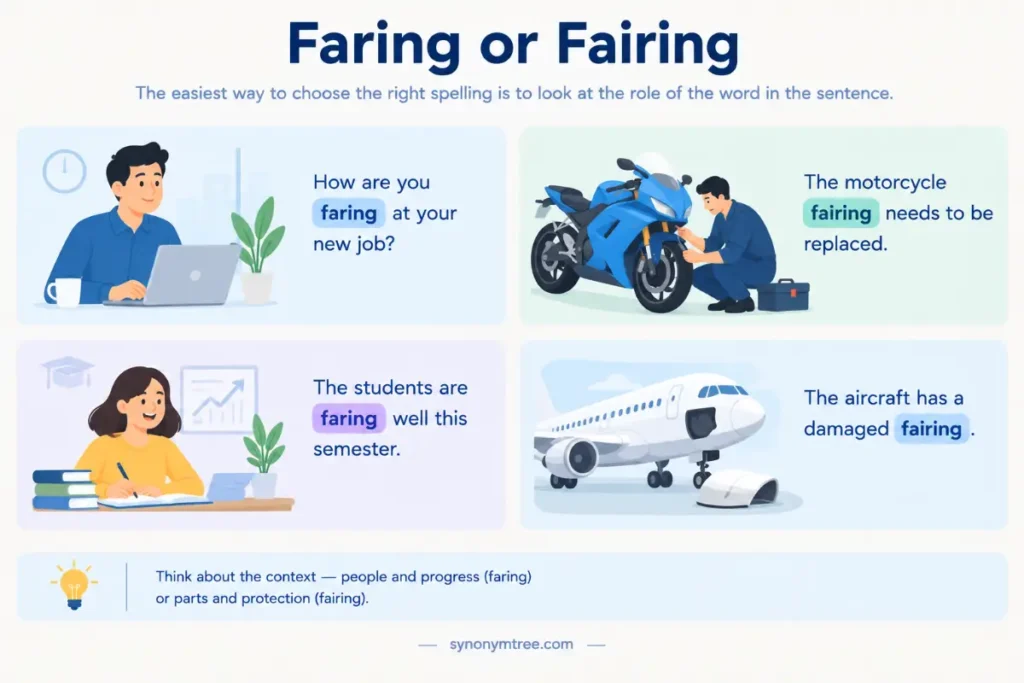
The easiest way to choose the right spelling is to look at the role of the word in the sentence.
Consider these examples.
How are you faring at your new job?
The motorcycle fairing needs to be replaced.
The students are faring well this semester.
The aircraft has a damaged fairing.
The company is faring better than expected.
The mechanic repaired the front fairing.
These sentences alternate between the two words. The first, third, and fifth sentences describe progress or performance. The second, fourth, and sixth sentences describe physical parts.
That difference is more useful than trying to memorize isolated spellings.
Faring And Fairing In Questions
Questions often make the difference easy to see.
How are you faring?
This asks about your condition, progress, or performance.
What happened to the fairing?
This asks about a physical part.
How is the team faring?
This asks about the team’s performance.
Is the fairing damaged?
This asks about the condition of a physical structure.
The sentence pattern often gives you enough information to select the correct spelling.
Faring And Fairing In Past Tense
Faring itself is a present participle, so it often appears with forms of be.
The team is faring well.
She is faring better now.
They were faring poorly at first.
The word fare changes to fared when you need the simple past.
The team fared well last year.
She fared better after the change.
Fairing does not work this way because it is generally a noun.
The fairing was damaged.
The mechanic replaced the fairing.
The new fairing looks better.
This difference in grammar can help you identify the correct word.
Faring And Fare
Faring is directly connected to fare.
Fare can function as a verb meaning perform or progress.
For example, How did you fare? asks how you did.
Faring is the ing form.
How are you faring? asks how you are doing.
The company is faring well means the company is doing well.
This connection is worth remembering because it explains the spelling.
If you know that fare becomes faring, you can recognize the correct form without relying on sound.
Fairing And Fair
Fairing is connected to fair in the sense of making a surface smooth or shaping something into a smooth form.
However, most people encounter fair in its more common meanings.
Fair can mean just.
The rules are fair.
It can mean reasonable.
That is a fair price.
It can mean acceptable or average.
His performance was fair.
It can describe appearance.
She has fair hair.
It can describe weather.
We had fair weather.
It can refer to an event.
We went to the county fair.
Fairing has a much narrower meaning. It usually refers to a physical structure.
A Useful Memory Trick
The simplest memory trick is to connect the ending of faring with fare.
Ask yourself if you could replace the word with doing.
If yes, use faring.
How are you faring?
How are you doing?
The team is faring well.
The team is doing well.
The company is faring better.
The company is doing better.
Now think about fairing as a thing.
A motorcycle fairing is a thing.
An aircraft fairing is a thing.
A bicycle fairing is a thing.
A damaged fairing is a thing.
This gives you an easy mental test.
Faring describes an action or progress.
Fairing names a physical structure.
Related Confusing Word Pairs
English has many pairs that sound alike but have different meanings. Learning how to check context can help with all of them.
Faring and fairing are one example.
Fare and fair are another.
Fare can mean perform or transportation cost. Fair can mean just, reasonable, acceptable, or a public event.
Right and write also sound alike but have different meanings. Right can describe correctness or direction, while write refers to putting words on a page.
Pair and pear have the same pronunciation. Pair refers to two matching things, while pear is a type of fruit.
Their and there are often confused in writing. Their shows possession, while there usually refers to a place or introduces something.
The lesson is the same in each case. Sound alone does not tell you the spelling. Meaning and sentence context matter.
How To Proofread The Word
When proofreading, look at the words around faring or fairing.
If the sentence includes well, poorly, better, worse, or a phrase about progress, faring is probably correct.
For example, The students are faring well.
The business is faring better.
The team is faring worse.
If the sentence includes words such as motorcycle, aircraft, panel, body, damaged, replaced, repaired, or installed, fairing may be correct.
For example, The mechanic repaired the motorcycle fairing.
The aircraft fairing was replaced.
The new fairing was installed yesterday.
This quick context check can catch many spelling mistakes.
Faring Or Fairing In Formal Writing
Both words are legitimate, but they belong to different contexts.
Faring can appear in formal writing when discussing results or progress.
For example, The study examined how participants were faring after the program.
Fairing can appear in technical writing when describing physical structures.
For example, The engineers redesigned the fairing to improve airflow.
Neither word is informal or incorrect. The important issue is choosing the spelling that matches the meaning.
Faring Or Fairing In Everyday Writing
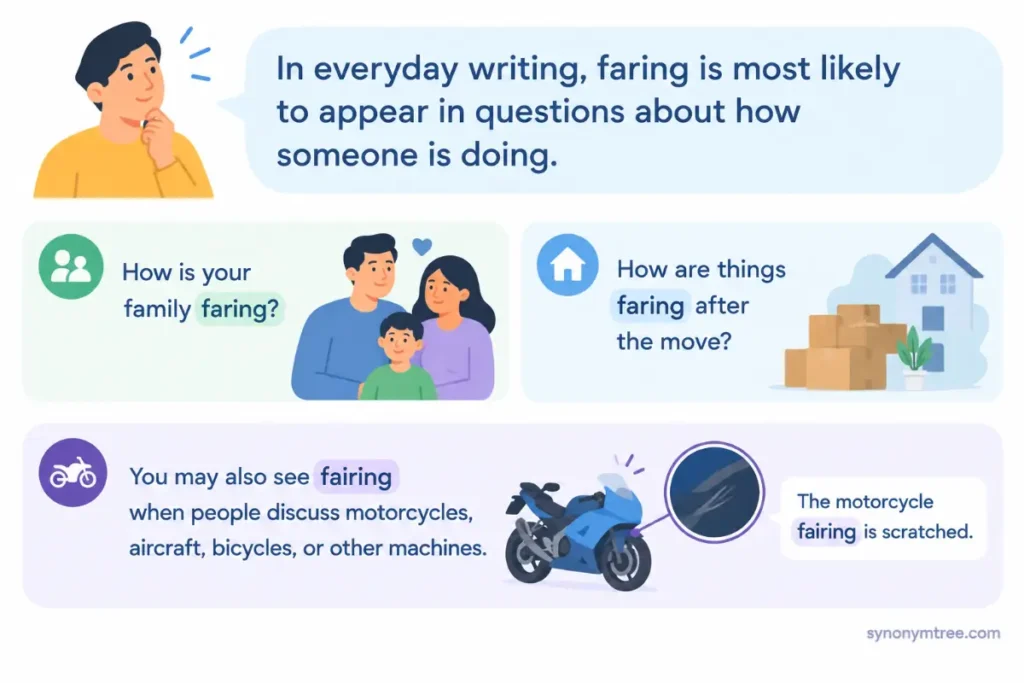
In everyday writing, faring is most likely to appear in questions about how someone is doing.
How is your family faring?
How are things faring after the move?
You may also see fairing when people discuss motorcycles, aircraft, bicycles, or other machines.
The motorcycle fairing is scratched.
The new fairing looks better.
The mechanic ordered a replacement fairing.
If you keep the meanings separate, the spelling is easy.
When Faring Is The Better Choice
Choose faring when the subject is going through a situation and you want to describe the result or progress.
A student can fare well in school.
A business can fare poorly in a market.
A team can fare better after changing its strategy.
A person can fare worse under difficult conditions.
When you turn these ideas into an ing form, you get faring.
The student is faring well.
The business is faring poorly.
The team is faring better.
The person is faring worse.
The common idea is performance.
When Fairing Is The Better Choice
Choose fairing when you are naming a physical structure that covers or streamlines part of an object.
A motorcycle can have a front fairing.
An aircraft can have a wing fairing.
A bicycle can use a fairing to reduce air resistance.
A boat can have a fairing around an underwater component.
The common idea is a physical covering or streamlined structure.
What About Fairing As A Verb
Fairing is most often used as a noun in modern technical English. However, related technical uses of fair can involve making a surface smooth or shaping parts so they join smoothly.
For most readers, this does not change the basic spelling rule.
If you are writing about someone doing well, use faring.
If you are naming a physical cover or streamlined structure, use fairing.
In technical writing, the exact meaning can depend on the field. Context still provides the best clue.
Examples To Remember
Here are some simple sentences that show the difference naturally.
I hope you are faring well in your new position.
The motorcycle has a large front fairing.
The students are faring better this year.
The mechanic removed the damaged fairing.
How are you faring after the move?
The aircraft fairing was replaced.
The business is faring poorly this quarter.
The engineer designed a lighter fairing.
She is faring well in college.
The bike has a new aerodynamic fairing.
These examples cover the two main meanings. Faring describes progress. Fairing names a physical structure.
A Final Grammar Check
When you see a sentence with this spelling problem, do not choose the word based on pronunciation.
First, ask what the sentence is talking about.
If it talks about how someone or something is doing, use faring.
If it talks about a physical cover or streamlined part, use fairing.
Next, check the grammar.
Faring usually appears with a form of be in phrases such as is faring, are faring, was faring, and were faring.
Fairing commonly appears as a noun after words such as the, a, new, damaged, front, side, or motorcycle.
For example, The team is faring well uses faring as part of the verb phrase.
The motorcycle has a damaged fairing uses fairing as a noun.
This grammar check gives you another way to spot the correct spelling.
Conclusion
The difference between faring or fairing comes down to meaning. Faring is the ing form of fare and means doing, progressing, or managing. Fairing is usually a noun for a smooth cover or streamlined structure used on motorcycles, aircraft, bicycles, boats, and other machines.
Use faring when you are talking about performance or progress. You can say that a student is faring well, a business is faring better, or a team is faring poorly. In these sentences, you could often replace faring with doing or progressing.
Use fairing when you can point to a physical part. A motorcycle fairing can be repaired, an aircraft fairing can be replaced, and a bicycle fairing can change the way air moves around the bike. When proofreading, ask one simple question: am I describing how something is doing, or am I naming a physical structure? That quick check will usually give you the right spelling.
FAQs
Is faring or fairing correct?
Both faring and fairing are correct words, but they have different meanings. Faring means doing or progressing, while fairing usually means a smooth cover or streamlined structure on a machine or vehicle.
How do you spell faring when you mean doing?
Use faring when you mean doing, progressing, or managing. For example, How are you faring? means How are you doing?
What is the difference between faring and fairing?
Faring comes from the verb fare and describes progress or performance. Fairing is usually a noun that refers to a physical covering or streamlined part.
Is faring the same as doing?
In many sentences, faring has a meaning close to doing or progressing. How are you faring? is similar to How are you doing?
What is a fairing on a motorcycle?
A motorcycle fairing is a body panel or covering that surrounds part of the motorcycle. It can protect components and help create a smoother shape for airflow.
Is fairing a real word?
Yes. Fairing is a standard English word. It is commonly used for a smooth cover or streamlined structure on vehicles and machines.
Is faring the present tense of fare?
Faring is the present participle form of fare. The verb fare means to perform or progress, and faring appears in phrases such as is faring well and are faring better.
Can faring be used for a business?
Yes. A business can be faring well, poorly, better, or worse. For example, The company is faring well in the new market describes the company’s progress or performance.
