
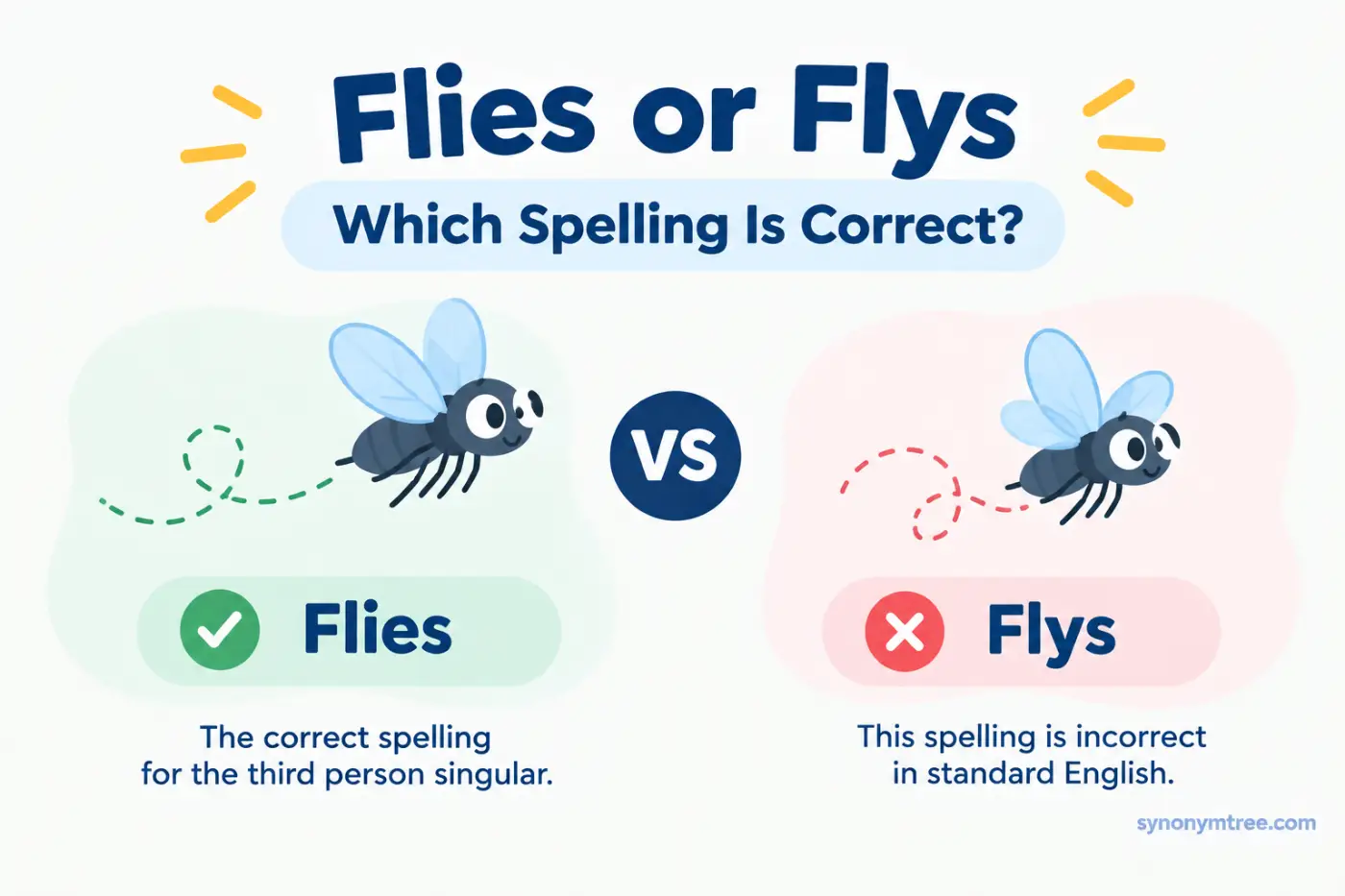
If you are stuck between flies or flys, the correct spelling is flies. The word flys is not standard English when you mean more than one fly or the third person singular form of the verb fly.
The confusion comes from a common English spelling rule. Many nouns become plural by simply adding s. For example, one book becomes two books and one car becomes two cars. Words that end in a consonant followed by y often work differently. The y changes to i before the ending is added.
The same spelling change appears with verbs. You can write that the bird flies over the house because the subject is singular. You can also write that several flies are near the window because you are talking about more than one insect.
Once you understand this pattern, the spelling becomes much easier. This guide explains the correct form, the grammar behind it, common mistakes, related words, and practical examples you can use in everyday writing.
Quick Definition
Flies is the correct spelling. It can be the plural form of the noun fly, meaning more than one insect. It can also be the third person singular form of the verb fly.
Flys is not the standard spelling for these uses. In normal American English writing, use flies instead.
Direct Answer
The correct spelling is flies. Flys is incorrect in standard English.
Why Flies Is The Correct Spelling
The reason comes down to a common spelling pattern involving words that end in y.
When a word ends in a consonant followed by y, English often changes the y to i before adding an ending. The word fly follows this pattern.
The base word is fly. When you need the plural noun, it becomes flies. When you need the third person singular form of the verb, it also becomes flies.
The same pattern appears in many familiar words. A baby becomes babies. A city becomes cities. A story becomes stories. A party becomes parties. A family becomes families.
You can see the same change in verbs. Try becomes tries. Cry becomes cries. Carry becomes carries. Study becomes studies. Reply becomes replies.
This is why fly does not become flys. The final y changes to i before the ending is added.
The spelling can seem strange if you are thinking only about adding s. English has many spelling patterns that do not follow the simplest possible rule. Learning the pattern is much easier than trying to memorize every word separately.
The Basic Spelling Pattern
A useful rule is to look at the letter that comes before the final y.
When a consonant comes before y, the y usually changes to i when you add the relevant ending. That is what happens with fly.
The word fly ends with l and y. The l is a consonant. So the y changes to i and the word becomes flies.
You can see the same pattern with words such as try, cry, carry, study, and reply.
Try becomes tries. Cry becomes cries. Carry becomes carries. Study becomes studies. Reply becomes replies.
This pattern is useful because it gives you a reason for the spelling. You do not have to guess which letters belong in the word.
There is another pattern to learn as well. If a vowel comes before the final y, the y usually stays when you add s.
For example, boy becomes boys. Toy becomes toys. Day becomes days. Key becomes keys. Enjoy becomes enjoys.
That difference is worth remembering. The letter before y helps you choose the correct spelling.
When To Use Flies As A Noun
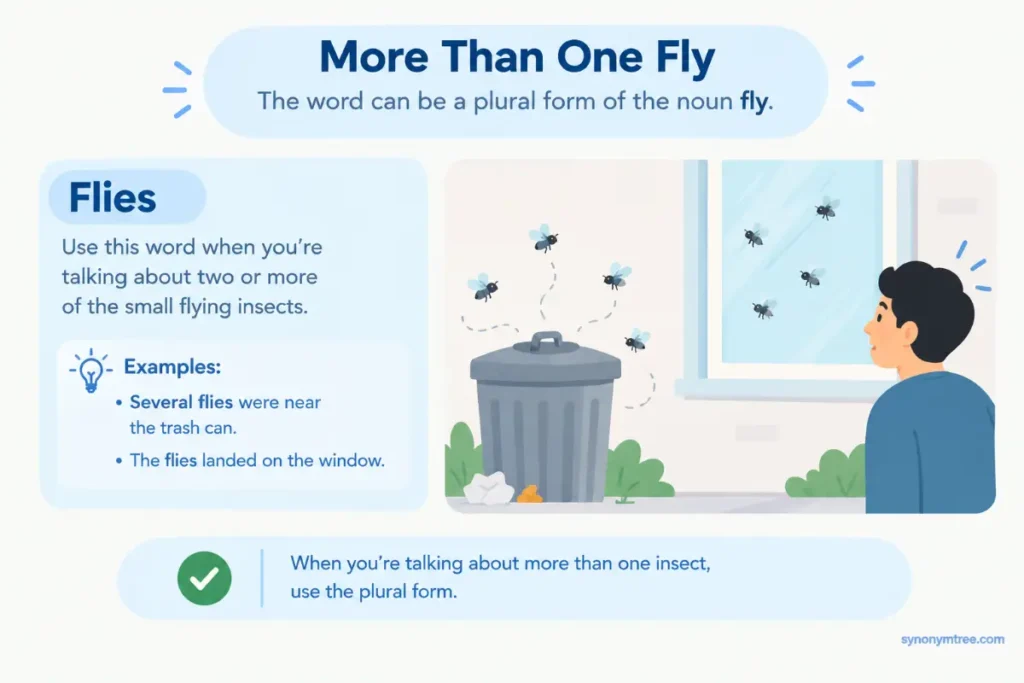
The word flies can be the plural form of the noun fly.
A fly is a small flying insect. When you are talking about two or more of these insects, you use flies.
For example, you might write that there are several flies near the trash can. You could also write that the flies landed on the window.
In both sentences, flies refers to more than one insect.
The singular form is fly. You would say that a fly landed on the table. You would not say that a flies landed on the table.
The difference between singular and plural forms is easy to see when you compare sentences.
You can write that one fly is on the wall. When there is more than one, you can write that two flies are on the wall.
You can also say that a fly landed on your arm. If several insects landed there, you could write that several flies landed on your arm.
The noun changes from fly to flies because the number changes from one to more than one.
Singular And Plural Examples
The singular form is used when you mean one insect. For example, there is a fly in the kitchen.
The plural form is used when you mean more than one. For example, there are flies in the kitchen.
You can also use the words with different articles and quantities. One fly was sitting near the door. Several flies were sitting near the door. A few flies got inside through the open window.
The grammar around the word also changes. A singular noun usually takes a singular verb. A plural noun takes a plural verb.
That gives you another useful clue.
You can say that the fly is on the wall. You can say that the flies are on the wall.
The word itself tells you how many insects you mean.
When To Use Flies As A Verb
Flies can also be a verb.
The base verb is fly. It means to move through the air or travel by air. When the subject is he, she, it, or another singular noun, the verb becomes flies.
For example, the bird flies over the lake. The subject is the bird. Since the bird is singular, the verb takes the third person singular form flies.
You can also say that she flies to Chicago every Monday. The subject is she, so the verb is flies.
Another example is that the plane flies over the mountains. The plane is singular, so flies is the correct verb form.
The same rule applies to animals and objects. You could say that the butterfly flies from flower to flower. You could also write that the kite flies high above the field.
The important point is that flies does not always refer to insects. The word can describe an action.
Compare The Verb Forms
The verb changes according to the subject.
You say that I fly to Dallas every summer. You say that you fly to Dallas every summer. You say that we fly to Dallas every summer. You say that they fly to Dallas every summer.
However, you say that he flies to Dallas every summer. You also say that she flies to Dallas every summer. You can say that the plane flies to Dallas every summer.
The difference comes from the subject.
I, you, we, and they use the base verb fly.
He, she, it, and singular nouns use flies.
This pattern appears in many other English verbs. You say I try but she tries. You say they carry but he carries. You say we study but she studies.
The spelling of flies follows the same basic grammar pattern.
Why Flys Is Incorrect
The spelling flys may look reasonable because many English words form plurals by adding s.
A book becomes books. A chair becomes chairs. A phone becomes phones. A car becomes cars.
The same simple idea works with many verbs. Run becomes runs. Jump becomes jumps. Walk becomes walks.
However, English has different spelling rules for words ending in consonant plus y.
For those words, you usually change y to i before adding the ending.
That gives you fly to flies.
The same thing happens with baby to babies, city to cities, and story to stories.
The spelling flys ignores this pattern. That is why it is considered incorrect in standard English.
Why The Mistake Is Easy To Make
The mistake is understandable because the basic idea behind it seems logical.
A writer may think that the plural needs s, so s should simply be added to fly. That creates flys.
The problem is that English spelling has an additional rule for this ending.
The final y does not simply stay in place when a consonant comes before it. The y changes to i.
Once you know that rule, the correct form becomes much easier to remember.
The same thing happens with verbs. Someone may think that the bird needs the verb fly plus s. That thought leads to flys.
The correct form is flies because the spelling rule changes the y to i.
Flies In Everyday Sentences
Seeing the word in normal sentences is one of the best ways to understand it.
You might write that the flies kept buzzing around the kitchen. Here, flies is a plural noun because you are talking about several insects.
You could say that the bird flies across the lake every morning. Here, flies is a verb because it describes what the bird does.
You could write that several flies landed on the food. The word refers to multiple insects.
You could also say that my sister flies home on Friday. In this sentence, flies describes travel by air.
Another example is that the kite flies high above the field. The word describes movement through the air.
These examples show why context matters. The same spelling can serve two different grammatical purposes.
The surrounding words make the meaning clear.
Flies And Fly In Verb Sentences
A common grammar mistake happens when writers choose flies simply because the sentence contains one person or object. The key is to look at the subject and the structure of the sentence.
You can write that I fly home tomorrow. You can also write that she flies home tomorrow.
You can write that they fly home every summer. You can also write that he flies home every summer.
The form changes because the subject changes.
This rule is especially useful when you are writing quickly. Instead of trying to remember the spelling by itself, check the subject first.
If the subject is he, she, it, or a singular noun, use flies.
If the subject is I, you, we, or they, use fly.
For example, the pilot flies every weekend is correct. The pilots fly every weekend is also correct.
The first sentence has one pilot. The second has more than one pilot.
Related Words That Follow The Same Pattern
The spelling of flies becomes easier when you connect it to other familiar words.
Consider try and tries.
You say that I try to help. You say that she tries to help.
The same change happens with cry and cries. You can write that the baby cries at night. You can also write that the babies cry at night.
Carry and carries follow the same pattern. You can say that I carry my bag. You can say that he carries his bag.
Study and studies work the same way. You can write that they study after school. You can write that she studies after school.
These examples show that flies is not an isolated spelling. It belongs to a larger pattern in English.
Once you understand the pattern, you can apply it to many words you encounter.
Try And Tries
Try is the base form of the verb. When the subject is singular in the third person, it becomes tries.
You can write that I try to arrive early. You can also write that she tries to arrive early.
The y changes to i before the ending is added.
This is the same change you see in fly and flies.
Cry And Cries
Cry follows the same rule.
You can say that the baby cries when she is tired. You can also say that the babies cry when they are tired.
The singular form takes cries. The plural subject takes cry.
This gives you another simple comparison to remember.
Carry And Carries
Carry also follows the pattern.
You can write that I carry my books to school. You can write that he carries his books to school.
The y changes to i in the third person singular form.
Study And Studies
Study follows the same pattern.
You can write that they study every evening. You can write that she studies every evening.
The word changes from study to studies.
These examples make the spelling of flies easier to understand because they show the same rule in different words.
When A Word Ending In Y Keeps The Y
Not every word ending in y changes to i.
The important difference is the letter before the y.
If a vowel comes before y, the y usually stays when you add s.
For example, boy becomes boys.
Toy becomes toys.
Day becomes days.
Key becomes keys.
Enjoy becomes enjoys.
The y stays in these words because the letter before it is a vowel.
Now compare them with fly.
The letter before y is l. That is a consonant.
So fly becomes flies.
This is a useful spelling check. Look at the letter immediately before the final y.
If it is a consonant, the y often changes to i before the ending.
If it is a vowel, the y usually stays.
This rule explains many common spelling patterns.
Flies Or Flys In A Sentence
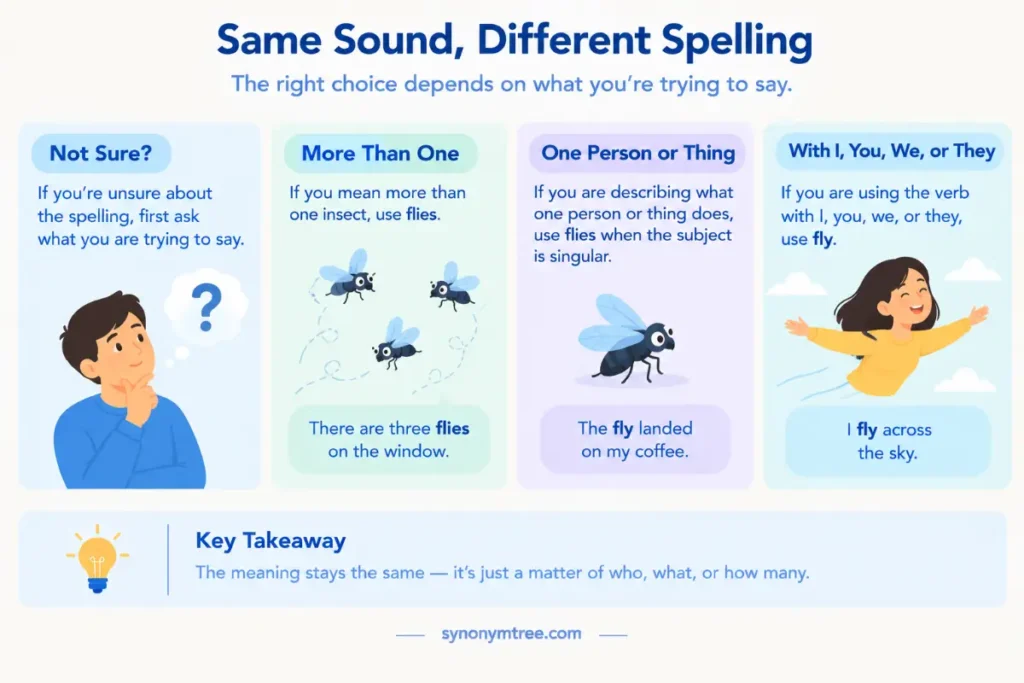
If you are unsure about the spelling, first ask what you are trying to say.
If you mean more than one insect, use flies.
If you are describing what one person or thing does, use flies when the subject is singular.
If you are using the verb with I, you, we, or they, use fly.
The spelling flys does not work in these standard forms.
For example, five flies are on the wall is correct.
The eagle flies over the trees is also correct.
They fly over the city every morning is correct as well.
The surrounding grammar helps you choose the right form.
Common Mistakes With Flies
One common mistake is writing flys when talking about more than one insect.
For example, there are three flys in the room is incorrect. The correct sentence is there are three flies in the room.
Another mistake is using flys as a verb.
For example, the bird flys over the house is incorrect. The correct sentence is the bird flies over the house.
Writers also sometimes use flies with a plural subject.
For example, they flies over the city every morning is incorrect. The correct sentence is they fly over the city every morning.
The opposite mistake can happen too. A writer may use fly with a singular subject.
For example, she fly to work every day is incorrect. The correct sentence is she flies to work every day.
The best way to avoid these mistakes is to check the subject before choosing the verb.
A Simple Memory Trick
One easy way to remember the spelling is to connect fly with try.
You already know that try becomes tries.
That gives you the same pattern.
Fly becomes flies.
Cry becomes cries.
Carry becomes carries.
Study becomes studies.
Reply becomes replies.
Another small trick is to notice that flies contains the letters f and lies. Thinking of the spelling as f plus lies can help you remember the letters when you are typing quickly.
The grammar rule is still the best way to understand the word. A memory trick simply gives you a quick backup when you are in a hurry.
Is Flies Always Related To The Insect
No. Flies can have two very common grammatical uses.
As a noun, flies means more than one fly. For example, the flies are near the window.
As a verb, flies describes something moving through the air or traveling by air. For example, the plane flies over the city.
Context tells you which meaning applies.
This is common in English. One spelling can have different meanings depending on the role it plays in a sentence.
The word flies is a good example because the noun and verb forms happen to look exactly the same.
Flies In Different Types Of Writing
The spelling does not change based on the type of writing you are doing.
You can use flies in school assignments, emails, reports, stories, websites, text messages, and everyday conversation.
A formal sentence might say that several flies were found near the food preparation area.
A casual sentence might say that there are flies in the kitchen again.
A story might say that the flies buzzed around the old barn.
A travel sentence might say that she flies to Seattle twice a year.
The tone changes from sentence to sentence, but the spelling stays the same.
Correct spelling helps readers understand your writing quickly. It also makes your work look polished and reliable.
How Grammar Helps You Choose The Right Form
Grammar can often solve this spelling question before you even think about the letters.
Start by asking what the word is doing in the sentence.
If it is a noun and means more than one insect, use flies.
If it is a verb and the subject is singular, use flies.
If it is a verb and the subject is I, you, we, or they, use fly.
Consider these three sentences.
The flies are outside.
The bird flies outside.
They fly outside.
The first sentence uses flies as a plural noun.
The second sentence uses flies as a verb with a singular subject.
The third sentence uses fly as a verb with a plural subject.
This approach makes the choice much easier because you are using grammar instead of guessing.
Flies In Questions
The same grammar rules apply when you ask questions.
You can ask why does the bird fly so high.
You can ask why does she fly home every week.
You can ask where do the flies come from.
Notice something important in the first two questions.
You do not write why does the bird flies so high.
You write why does the bird fly so high.
The helping verb does already carries the third person singular grammar. Because of that, the main verb returns to its base form.
The same rule applies to she.
You write does she fly every week.
You do not write does she flies every week.
This is a useful grammar point because it explains why the same verb can appear as fly in one sentence and flies in another.
Flies In Negative Sentences
Negative sentences follow the same pattern.
You can say that she does not fly on weekends.
You can say that they do not fly at night.
The base verb fly comes after does not and do not.
Compare the positive sentence with the negative sentence.
She flies on weekends.
She does not fly on weekends.
The first sentence uses flies because she is the subject and there is no helping verb.
The second sentence uses fly because does carries the grammatical information.
This pattern applies to many English verbs.
You say that he tries to help.
You say that he does not try to help.
You say that she studies every night.
You say that she does not study every night.
The same principle works with fly and flies.
Flies In Past Tense
The past tense of fly is not flies.
The simple past form is flew.
For example, the bird flew across the yard yesterday.
You could also write that she flew to Miami last week.
The past participle is flown.
For example, she has flown to Miami before.
You could also write that the bird had flown away before we arrived.
These forms are different from flies because they serve different grammatical purposes.
The basic verb family is easy to remember once you see the pattern.
The base form is fly.
The third person singular present form is flies.
The simple past form is flew.
The past participle is flown.
Learning these forms together can prevent confusion when you write about flying in different time frames.
Flies And Other Common Spelling Questions
People often have similar questions about words that end in consonant plus y.
For example, writers may wonder about try or tries. They may also wonder about cry or cries. The same question can come up with carry and carries.
These words follow the same basic spelling pattern.
Try becomes tries.
Cry becomes cries.
Carry becomes carries.
Study becomes studies.
Reply becomes replies.
Apply becomes applies.
The pattern is useful because it lets you recognize the spelling instead of memorizing each word one at a time.
You can also see the pattern with nouns.
Lady becomes ladies.
Country becomes countries.
Company becomes companies.
Story becomes stories.
The rule does not cover every possible English word. English contains exceptions and words borrowed from other languages. Still, it works for many common words and gives you a strong starting point.
Why English Spelling Has These Changes
English spelling developed over a long period from several languages and writing traditions. That history explains why English does not always use one simple spelling system.
For everyday writing, you do not need to know the history behind the rule.
You only need to recognize the pattern.
When fly takes the relevant ending, the y changes to i.
That gives you flies.
The same spelling change appears in many familiar words, so learning the pattern saves you time.
Instead of memorizing flies as a completely separate word, connect it to the base word fly.
When you see the ending, remember the spelling change.
How To Check The Spelling Quickly
If you are writing an email, assignment, report, or message and suddenly wonder about the spelling, you can solve the problem in a few seconds.
First, check the meaning.
If you mean more than one insect, use flies.
If you mean the action of moving through the air, look at the subject.
Next, check the subject.
If the subject is he, she, it, or a singular noun, use flies.
If the subject is I, you, we, or they, use fly.
Finally, look at the ending.
The base word fly ends with a consonant plus y. When the relevant ending is added, the y changes to i.
That gives you flies.
This quick process is more reliable than simply choosing the form that looks familiar.
Examples Of Flies Or Flys For School And Work
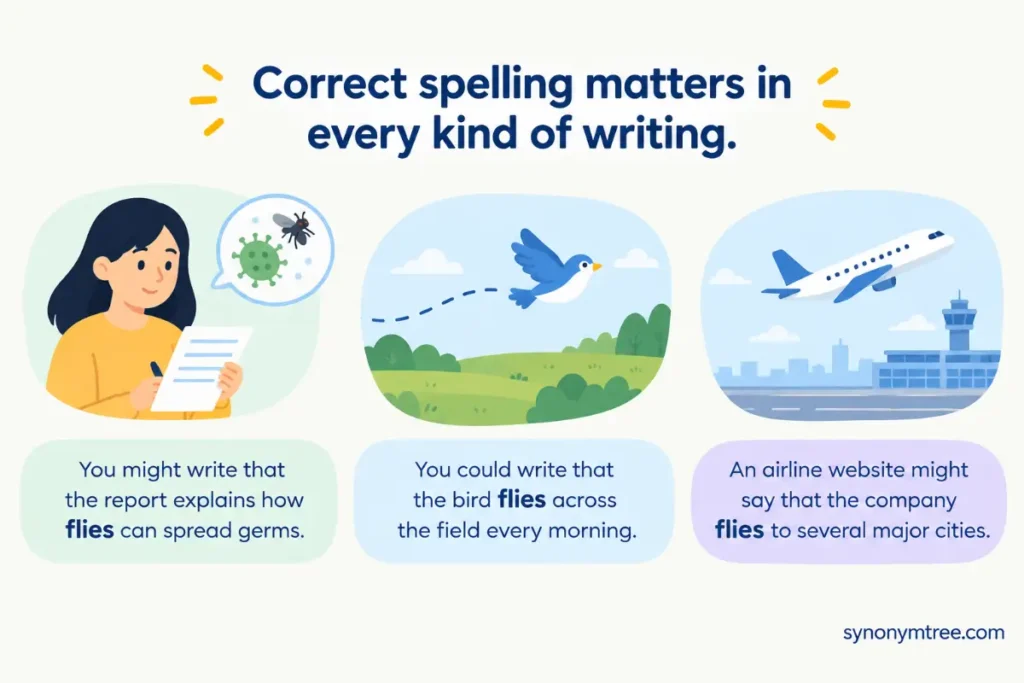
Correct spelling matters in every kind of writing.
You might write that the report explains how flies can spread germs.
You could write that the bird flies across the field every morning.
An airline website might say that the company flies to several major cities.
A workplace report could say that several flies were found near the open window.
Someone writing about travel might say that she flies to Los Angeles for work each month.
A science assignment might say that the research team studied how flies respond to light.
These examples show that the word can appear in many settings.
The meaning changes with context, but the spelling remains the same.
Examples From Everyday Conversation
You do not need formal writing to use these forms correctly.
Someone might say that there are flies in the garage.
Another person might say that she flies home every Sunday.
You might ask why flies always find the food.
You could say that the bird flies really fast.
Someone talking about travel might say that I fly home tonight.
A person talking about an animal might say that the butterfly flies from flower to flower.
These sentences sound natural because the grammar matches the subject and meaning.
A Quick Rule To Remember
The easiest rule to remember is simple.
Fly becomes flies when you need the plural noun or the third person singular present verb.
You never need flys for these standard uses.
If you mean one insect, use fly.
If you mean more than one insect, use flies.
If you are describing what he, she, it, or a singular noun does, use flies.
If you are describing what I, you, we, or they do, use fly.
That gives you the basic rule for almost every everyday situation involving this word.
Conclusion
The correct answer to flies or flys is simple. Use flies. The spelling works as the plural noun for fly and as the third person singular form of the verb fly.
The key spelling rule is also easy to remember. When a word ends in a consonant followed by y, the y often changes to i before the ending is added. That gives you fly to flies.
Grammar gives you another quick way to check the word. Use flies for more than one insect and with a singular subject such as he, she, or it. Use fly with I, you, we, and they when it works as a verb.
Keep one practical rule in mind. Fly becomes flies, not flys. Once you remember that change, this spelling question becomes much easier to handle in school, work, and everyday writing.
FAQs
Is flies or flys correct?
Flies is correct in standard English. You use it as the plural form of fly or as the third person singular form of the verb fly. The spelling flys is not standard.
Why is fly spelled flies in the plural?
The word fly ends with a consonant followed by y. In this pattern, the y usually changes to i before the ending is added. That gives you flies instead of flys.
Is flys a real word?
Flys is not the standard English spelling for the common noun or verb forms discussed here. In normal American English writing, use flies.
What is the plural of fly?
The plural of fly is flies. For example, you can say that several flies were near the window. The y changes to i before the plural ending.
Is flies a verb or a noun?
Flies can be either a noun or a verb. As a noun, it means more than one fly. As a verb, it describes what one person, animal, object, or other singular subject does.
Do you say she fly or she flies?
You say she flies. The subject she takes the third person singular form of the verb. For example, she flies to Boston every month.
Do you say they fly or they flies?
You say they fly. The subject they takes the base form of the verb. For example, they fly home every summer.
What is the past tense of fly?
The past tense of fly is flew. For example, the bird flew across the yard yesterday. The past participle is flown, as in the bird has flown away.

1 thought on “Flies or Flys Which Spelling Is Correct”