
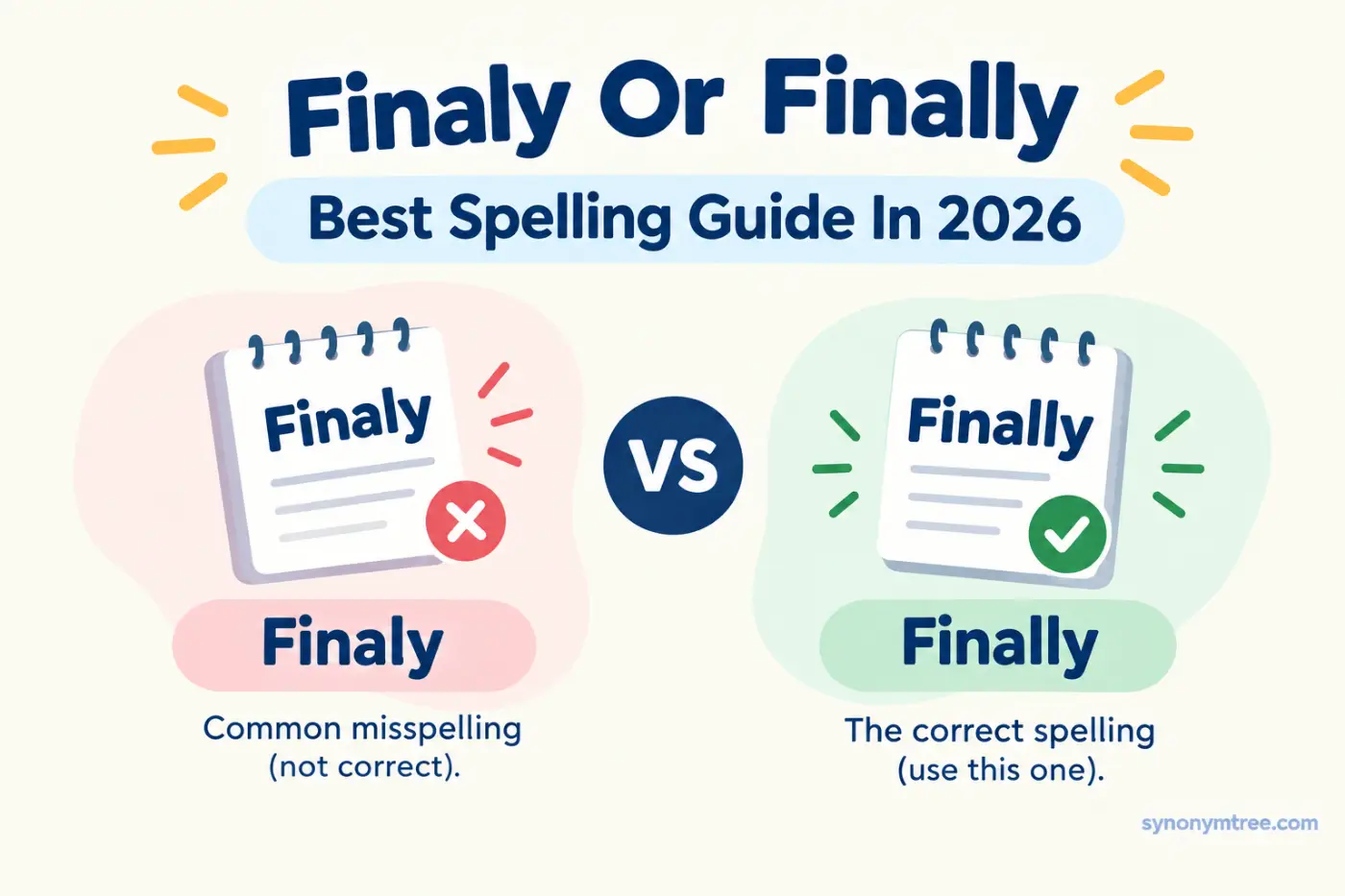
If you’re writing an email, school assignment, work message, or social post, you may stop when you reach the word finaly and wonder if something looks wrong. The confusion is easy to understand because the word sounds the same when you say it aloud. The problem becomes clear when you compare finaly or finally in writing.
The correct spelling is finally. It has two l letters before the y. Finaly is a common spelling mistake and isn’t the standard spelling in English. The word finally usually means after a long wait, at the last point, or as the last thing in a series.
The correct spelling is finally. Finaly is incorrect in standard English.
This guide explains why the extra l matters, how the word is formed, how to use it in real sentences, and why people often leave out one letter. You’ll also see common mistakes, related words, pronunciation tips, and simple ways to remember the correct spelling.
Quick Definition
Finally is an adverb that means at last, in the end, or as the last step. It often describes something that happens after waiting, after several events, or at the end of a process.
Finaly is a misspelling of finally. You shouldn’t use it in standard English writing.
Direct Answer
Finally is the correct spelling. The word has two l letters: f i n a l l y.
Finaly has only one l and is considered incorrect in standard English.
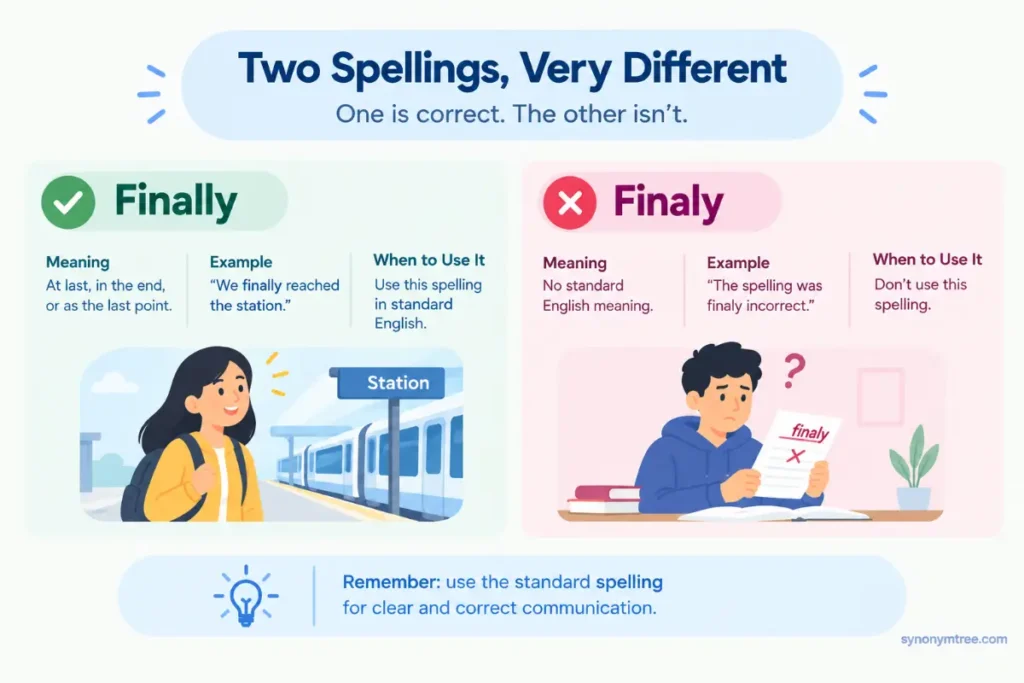
Finaly Or Finally In A Simple Comparison
| Word | Meaning | Example Sentence | When to Use It |
|---|---|---|---|
| Finally | At last, in the end, or as the last point | We finally reached the station. | Use this spelling in standard English. |
| Finaly | No standard English meaning | The spelling was finaly incorrect. | Don’t use this spelling. |
The easiest way to remember the difference is to look at the base word final. When you turn final into finally, the two l letters remain. You don’t remove one of them before adding y.
Why Finally Has Two L Letters
The spelling becomes easier to understand when you look at the word final. Final is an adjective that means last or coming at the end. For example, you can have a final exam, a final decision, or a final chance.
Finally is formed from final by adding the adverb ending ly. The important point is that the word final already ends with l. Adding ly gives you finally, which contains ll in the middle.
The spelling can look unusual at first because English has many words that change when endings are added. However, this one is quite simple once you see the parts.
Final + ly = finally.
The first l comes from final. The second l begins the ly ending. Nothing needs to be removed.
This explains why finaly looks tempting. When people say the word, they hear a single l sound. English spelling doesn’t always match pronunciation letter for letter. In this case, the written form keeps both l letters.
Consider the related words final and finally together. You might write, The final answer was clear. Then you could say, She finally gave her answer. Both words keep the same final spelling before the ending.
That connection gives you a useful spelling clue. If you know how to spell final, you already know the main part of finally.
What Does Finally Mean
Finally has several closely related meanings. The exact meaning depends on the sentence, but the central idea is connected to an ending or something that happens after a delay.
One common meaning is at last. We use it when something happens after waiting for some time.
For example, you might say, I finally finished my homework. This tells the reader that the homework took time or that you had been waiting to finish it.
Another meaning is in the end. This use often describes the result of a situation.
You could write, After several meetings, the team finally agreed on a plan. The word shows that agreement came after earlier discussion.
Finally can also introduce the last point in a series. This use is common in essays, presentations, speeches, and instructions.
For example, a writer might say, Finally, check your work before submitting it. Here, finally means that checking your work is the last step.
The word can also show relief or satisfaction. When someone says, We finally made it home, the word may suggest that the journey seemed long or difficult.
So, while finally has more than one use, each meaning connects to the idea of reaching the last stage.
How The Word Finally Is Formed
English often creates adverbs by adding ly to adjectives. Final is an adjective, and finally is the related adverb.
The adjective final describes something that comes last.
Examples include final exam, final chapter, final decision, final payment, and final version.
The adverb finally tells us how an action or event relates to the end.
Examples include finally finished, finally arrived, finally decided, and finally understood.
This pattern is useful because it helps you see why the spelling stays intact.
Final does not become fina when ly is added. The whole word remains.
Final + ly becomes finally.
You can use the same idea with several other words. For example, normal becomes normally. Usual becomes usually. Complete becomes completely. In each case, the spelling of the base word helps guide the final form.
English does have exceptions and spelling changes in other words. Still, you don’t need a complicated rule to remember finally. Just keep the base word final visible in your mind.
Why People Spell Finally Incorrectly
The most common reason is pronunciation. When people hear finally, the two l letters don’t sound like two separate l sounds. The word is pronounced roughly as FIN uh lee.
Because the spoken word contains only one clear l sound, a writer may naturally type one l. This produces finaly.
Typing quickly can also cause the mistake. When you’re writing a message or taking notes, you may remember the sound of the word instead of its spelling.
Another reason is visual confusion. English has many words with similar endings, and writers sometimes assume that final should lose a letter when ly is added.
That isn’t what happens here.
A useful habit is to connect finally with final. If you remember the base word, the spelling becomes much harder to forget.
How To Use Finally In A Sentence
Finally can appear in several places within a sentence. Its position can slightly change the rhythm or emphasis.
At the beginning of a sentence, finally often introduces the last point or highlights a result.
Finally, we reached the correct answer.
In the middle of a sentence, finally can appear before the main verb.
She finally understood the instructions.
It can also come after the subject and helping verb.
We have finally completed the project.
Finally can appear at the end in some sentences.
They arrived finally.
This last pattern is grammatically possible, but it often sounds less natural in everyday American English. In most situations, placing finally before the main verb creates a smoother sentence.
For example, She finally arrived sounds more natural than She arrived finally.
The word can also appear after a form of be.
The results are finally available.
That sentence tells us that the results have become available after some delay.
When Finally Means At Last
One of the most common uses of finally is to show that something happened after waiting.
Imagine you’ve been waiting for a bus for thirty minutes. When it arrives, you might say, The bus finally arrived.
The word gives the sentence extra meaning. Without finally, The bus arrived simply reports what happened. With finally, the sentence suggests that the arrival took longer than expected.
The same idea works in many situations.
I finally found my keys.
She finally called me back.
We finally got the answer.
He finally finished the book.
They finally opened the store.
Each sentence suggests some kind of wait, delay, effort, or expectation.
That doesn’t mean the delay always has to be long. The speaker simply needs to view the event as something that took time or came after anticipation.
You could say, The package finally arrived this morning. If you expected it yesterday, finally makes perfect sense.
When Finally Means The Last Step
Finally can also mean that something comes last in a sequence.
This use is especially common when explaining a process.
First, wash the vegetables. Next, cut them into small pieces. Finally, place them in the bowl.
Here, finally doesn’t mean that the writer waited for the vegetables to arrive. It marks the final action in the instructions.
The same pattern works in academic and professional writing.
First, review the data. Next, compare the results. Finally, write your recommendation.
This use makes the order easy to follow. It tells the reader that no major step comes after the action being introduced.
Finally can also mark the final point in an argument.
First, the plan saves time. Second, it reduces costs. Finally, it gives the team more flexibility.
This is one reason the word appears often in essays and presentations.
Finally In Formal Writing
Finally is completely acceptable in formal writing. You can use it in school assignments, business reports, professional emails, research writing, and presentations.
The key is to use it for a clear purpose.
If you’re listing points, finally can introduce the last point.
Finally, the report should explain how the results affect future planning.
If you’re describing a result after a process, it can show that the result came at the end.
After months of testing, the company finally approved the design.
The word isn’t too casual or too formal. It’s a normal English adverb that works across many settings.
Still, don’t add finally just because a sentence needs a transition. If the word doesn’t show an ending, last step, or delayed result, another word may work better.
For example, The manager finally explained the policy sounds natural if people had been waiting for the explanation. If the manager simply explained the policy without any delay, The manager explained the policy may be clearer.
Good writing depends on meaning, not just grammar.
Finally In Everyday Conversation
Finally is very common in spoken English. People use it to show relief, impatience, surprise, or satisfaction.
You might say, Finally, you’re here.
That sentence can sound warm, relieved, annoyed, or playful depending on the speaker’s voice.
You could also say, I finally got some free time.
Here, finally shows that free time was difficult to get.
Another common example is, Did you finally finish the project.
In this sentence, the speaker assumes the project took a while or had been discussed before.
Finally can also sound positive.
We finally won the game.
After weeks of practice, she finally played the song perfectly.
The word helps show that an event marks the end of a period of waiting or effort.
Examples Of Finally In Real Sentences
Here are natural examples from everyday life, school, work, travel, and conversation.
I finally finished my report before the deadline.
After three hours of driving, we finally reached the hotel.
She finally replied to my message.
The teacher finally explained the difficult question.
We finally found a restaurant that was still open.
He finally made a decision after several days of thought.
The rain finally stopped in the afternoon.
I finally understood why the answer was wrong.
After several attempts, they finally fixed the computer.
The package finally arrived on Friday.
First, save the file. Next, check the details. Finally, send it to your manager.
She finally got the job she wanted.
We finally agreed on a date for the meeting.
After waiting outside for twenty minutes, the doors finally opened.
The students finally completed the assignment.
The team finally reached its goal.
He finally admitted that he had made a mistake.
The movie finally ended after midnight.
I finally remembered where I had put my wallet.
Each sentence uses the word for a reason. Some show a delay. Others mark the last step. A few describe the end of a long process.
Finally Versus At Last
Finally and at last often have similar meanings, but they don’t always create the same tone.
Finally is neutral and flexible. It can describe a simple sequence, a delayed event, or the last point in a list.
At last often carries a stronger sense of relief, satisfaction, or emotion.
Compare these sentences.
We finally reached the station.
At last, we reached the station.
Both sentences are correct. The second one can sound more dramatic. It may suggest that the journey was difficult or that the speaker was very relieved.
Finally also works naturally in instructions.
Finally, press the save button.
At last would sound strange in that sentence because there is no emotional wait. You’re simply describing the last step.
So, finally is usually the safer choice when you want a neutral word.
Finally Versus Eventually
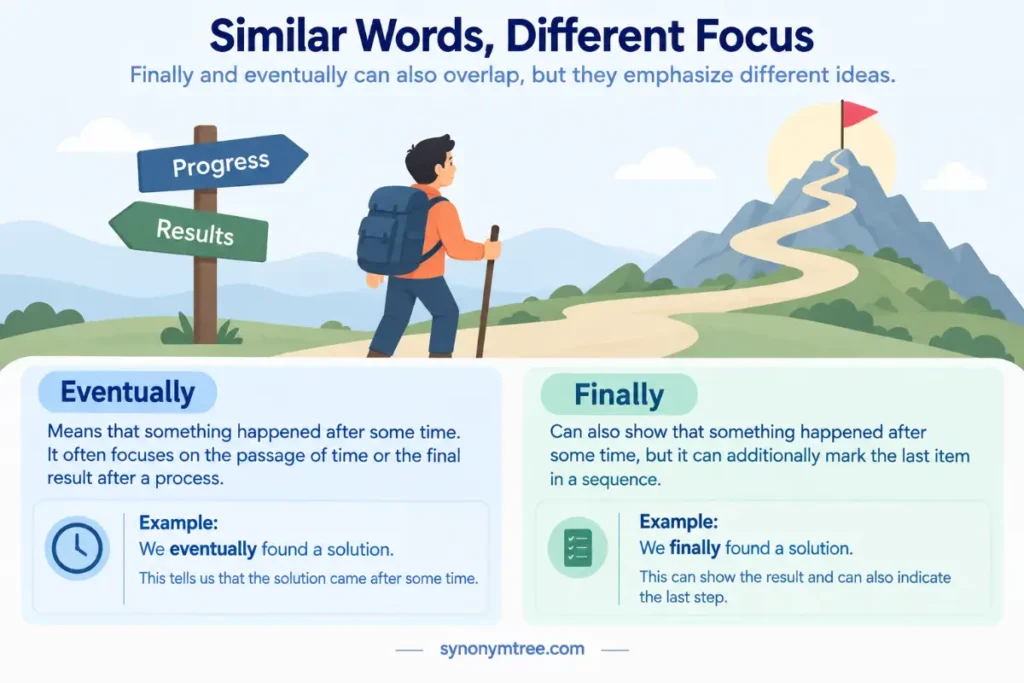
Finally and eventually can also overlap, but they emphasize different ideas.
Eventually means that something happened after some time. It often focuses on the passage of time or the final result after a process.
Finally can also show this idea, but it can additionally mark the last item in a sequence.
Consider this example.
We eventually found a solution.
This tells us that the solution came after some time.
Now consider this sentence.
Finally, we tested the solution.
Here, finally marks the last step in a process.
The words aren’t always interchangeable.
She eventually agreed to help.
This suggests that she resisted or took time before agreeing.
Finally, she agreed to help.
This can also suggest a delay, but it may carry more emotion or impatience.
The right choice depends on the meaning you want to highlight.
Finally Versus Lastly
Finally and lastly can both introduce the final item in a list.
For example, you could write, Finally, remember to save your work.
You could also write, Lastly, remember to save your work.
Both can work, but finally is more common and more flexible in everyday English.
Lastly usually has a narrow job. It introduces the last point in a sequence.
Finally has that function too, but it can also mean at last.
For example, She finally came home describes a delayed arrival. She lastly came home does not sound natural.
That difference makes finally the more useful word in most situations.
Common Spelling Mistakes With Finally
The biggest mistake is leaving out one l.
A writer may type finaly instead of finally. This usually happens because the pronunciation doesn’t make the double l obvious.
Another mistake is changing the word into other incorrect forms.
Common errors include finaly, finalley, and finially.
The standard spelling is finally.
It’s worth paying attention to this word because spell check may catch the mistake in many writing programs. Still, relying only on automatic correction isn’t a great habit. Learning the spelling yourself makes writing faster and more accurate.
The base word gives you the best clue.
Final contains one l at the end.
Adding ly creates finally.
Remembering that pattern is more reliable than trying to memorize the finished word as a random collection of letters.
How To Remember The Correct Spelling
A simple memory trick is to say final plus ly in your head.
Final.
Ly.
Finally.
You can also picture the word as two parts.
FINAL + LY.
The final l and the first l of ly sit together. That gives you ll.
Another trick is to connect finally with other forms of the word.
Final answer.
Final exam.
Final decision.
Finally finished.
Seeing these words together reinforces the spelling.
You can also remember a short sentence.
I finally reached the final answer.
That sentence uses both final and finally. The connection makes the spelling easier to recall.
If you often type the incorrect form, write finally correctly a few times. Then use it in a few original sentences. Repeated exposure helps your brain recognize the correct pattern.
When You Should Not Use Finally
Finally isn’t needed in every sentence about an ending.
For example, The meeting ended at five is already clear. You don’t need to say The meeting finally ended at five unless you want to suggest that the meeting took too long or that people had been waiting for it to end.
The same idea applies to other examples.
The movie ended at ten.
The movie finally ended at ten.
The first sentence simply gives information. The second suggests that the movie lasted longer than expected or that the speaker was ready for it to finish.
This small difference matters.
Adding finally can change the tone of a sentence. It can suggest relief, impatience, effort, delay, or anticipation.
Good writers choose it when that extra meaning helps.
Does Finally Always Mean Something Took A Long Time
No. Finally doesn’t always describe a long period.
It can simply mark the final point in a sequence.
For example, Finally, click the submit button doesn’t suggest that clicking the button took a long time. It tells the reader that this is the last step.
Still, when finally means at last, it usually suggests some delay or expectation.
I finally found my phone.
This sentence implies that the speaker had been looking for it.
The length of the search isn’t stated. It could have taken two minutes or two hours. The important point is that the speaker sees the finding as the end of a search.
Is Finally An Adverb
Yes. Finally is an adverb.
An adverb can modify a verb, adjective, another adverb, or an entire statement. In everyday terms, finally often tells us when something happened or how an event relates to the end of a process.
In She finally arrived, the word modifies the verb arrived by showing that the arrival came after some waiting.
In Finally, we can start the meeting, it helps frame the whole statement.
Knowing the grammatical label isn’t necessary to spell the word correctly. Still, it helps explain why finally behaves differently from final.
Final is an adjective.
Finally is an adverb.
For example, The final chapter was exciting uses final to describe chapter.
The story finally ended uses finally to describe how the ending came after the events that came before it.
Related Words That Can Help You Learn Finally
Learning related words can make spelling easier because your brain starts to see patterns.
Final means last or coming at the end.
Finalize means to make something final or complete.
Finalized means that something has been made final.
Finally means at last or as the last step.
These words share the same base idea.
For example, The final report is ready.
We need to finalize the report today.
The manager finalized the report yesterday.
Finally, we can send the report.
The spelling changes slightly because English adds different endings, but the base final remains easy to recognize.
This is useful when you’re unsure how to spell the adverb. Think about the family of words rather than only the sound.
Finaly Or Finally In School Writing
Students often use finally in essays to introduce the last point.
A basic essay structure might include first, next, and finally.
For example, a student could write, First, the story introduces the main character. Next, it explains the main conflict. Finally, it shows how the character solves the problem.
This makes the order clear.
Finally can also describe a result.
After several attempts, the character finally finds the missing letter.
When writing an essay, don’t use finally just to make the paragraph sound more formal. Use it when the idea really comes last or follows a delay.
Clear writing is stronger than fancy writing.
Finaly Or Finally In Emails
Professional emails often use finally when describing the last step in a task.
For example, you might write, Finally, please review the attached document before Friday.
You could also use it when explaining a delayed result.
We finally received the updated figures from the sales team.
The word works well in both situations.
However, email writing should stay direct. If finally doesn’t add useful meaning, leave it out.
Instead of writing, Finally, I am sending the file you requested, simply write, I’m sending the file you requested.
The shorter sentence is clearer if there was no special delay or sequence.
Finaly Or Finally In Text Messages
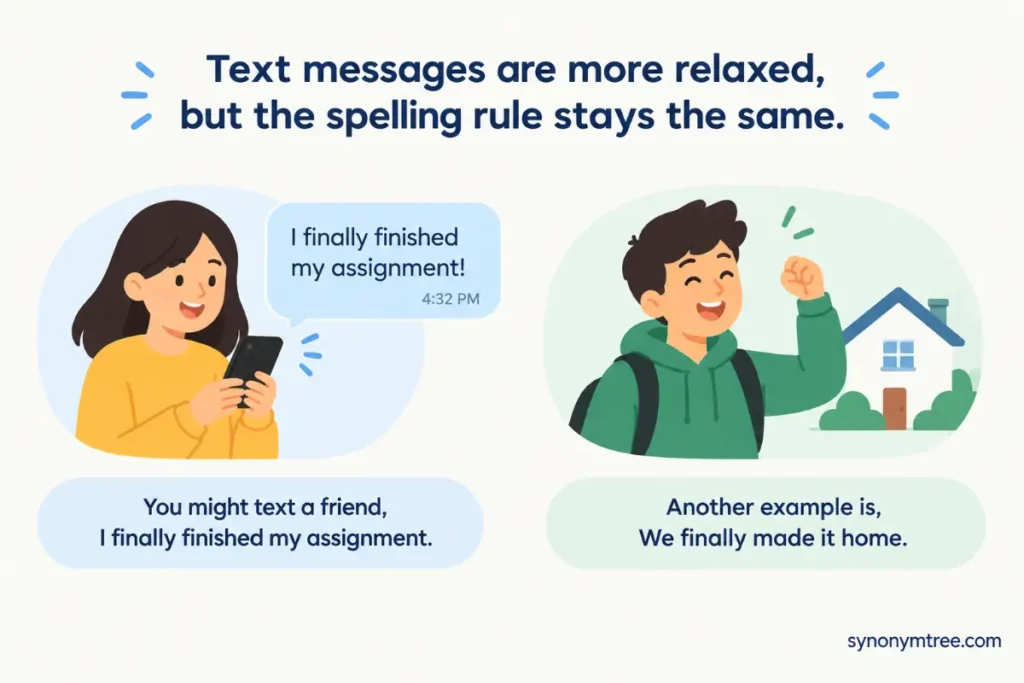
Text messages are more relaxed, but the spelling rule stays the same.
You might text a friend, I finally finished my assignment.
Another example is, We finally made it home.
People sometimes shorten words in casual messages, but finally should still be spelled correctly when you’re using standard English.
If you type finaly in a text, most readers will understand you. Still, understanding a mistake doesn’t make it correct.
The correct spelling remains finally.
How Pronunciation Can Mislead You
Pronunciation is one of the main reasons spelling mistakes happen.
Finally is commonly pronounced like FIN uh lee. The written ll doesn’t produce two separate l sounds.
English has many examples of spelling that cannot be predicted perfectly from sound alone. That means listening carefully isn’t always enough.
When spelling finally, rely on the written base word instead.
Think final first.
Then add ly.
Final + ly.
Finally.
This approach works better than trying to hear every letter.
A Simple Editing Test
If you’re unsure about the spelling, remove ly mentally.
Ask yourself what the base word is.
If you get final, you know the base word ends with l.
Then add ly.
Final becomes finally.
This quick test can help during proofreading.
For example, if you wrote, She finaly arrived, stop and look at the word finaly. Remove y mentally and consider the base form. The word you’re working from is final.
That immediately points you toward the correct spelling.
Common Sentences With The Correct Spelling
Here are more examples you can use as models.
I finally understand the problem.
She finally answered the question.
We finally completed the project.
The store finally reopened.
He finally told us the truth.
They finally reached an agreement.
The teacher finally arrived.
I finally found my missing notebook.
The team finally won the championship.
We finally have enough information.
Finally, check every answer before you submit the test.
Finally, turn off the lights before leaving.
After several revisions, the writer finally finished the article.
After months of planning, the family finally moved into their new home.
The repair was finally completed yesterday.
The children finally fell asleep.
The weather finally improved.
The company finally announced the results.
After several delays, the flight finally left the airport.
She finally decided which dress to buy.
These examples show the two major uses clearly. Some describe something that happened after waiting. Others use finally to introduce the last step or point.
What Is The Opposite Of Finally
The exact opposite depends on the meaning.
If finally means at last, an opposite idea might be still, not yet, or previously.
For example, compare these sentences.
She finally arrived.
She hasn’t arrived yet.
If finally introduces the last step, the opposite idea might be first or initially.
First, open the document. Finally, save the changes.
These words help describe order.
First tells the reader what comes at the beginning. Finally tells the reader what comes at the end.
Why Spelling Matters
A single missing letter can make a word look incorrect even when the meaning is obvious.
Finaly is a good example. Most readers can understand what the writer meant, but the spelling still doesn’t meet standard English rules.
Correct spelling helps your writing look polished and trustworthy. This matters in school assignments, job applications, business emails, reports, and other situations where readers expect careful writing.
The good news is that this particular spelling is easy to fix.
Remember the base word final.
Add ly.
Keep both l letters.
That’s all you need.
Conclusion
The correct spelling in finaly or finally is finally. The word contains two l letters because it comes from final plus the adverb ending ly. Finaly is a common spelling mistake and should be avoided in standard English.
Finally can mean at last, in the end, or as the last step in a sequence. It works naturally in casual speech, school writing, professional emails, reports, and everyday messages.
When you aren’t sure how to spell it, return to the base word final. Then add ly without removing the existing l. This gives you the correct form every time.
Keep one simple pattern in mind: final plus ly equals finally. That small spelling check can save you from one of the most common mistakes with this useful English word.
FAQs
Is finaly or finally correct?
Finally is correct. Finaly is a misspelling because the standard word contains two l letters before the y.
Why does finally have two l letters?
Finally keeps the l from final and adds the ly ending. The result is final plus ly, which gives you finally.
What does finally mean?
Finally usually means at last, in the end, or as the last step in a series. The meaning depends on the sentence.
Is finally a formal word?
Finally works in both casual and formal English. You can use it in conversations, text messages, essays, emails, reports, and presentations.
How do you remember the spelling of finally?
Think of the word as final plus ly. Since final ends with l and ly starts with l, the finished word contains ll.
Can I use finally at the beginning of a sentence?
Yes. Finally can begin a sentence when it introduces the last point or step. For example, Finally, check your answers before submitting the test.
Does finally mean the same thing as eventually?
They can have similar meanings when describing something that happens after time has passed. Finally can also introduce the last point in a list, while eventually focuses more on the result after a period of time.
