
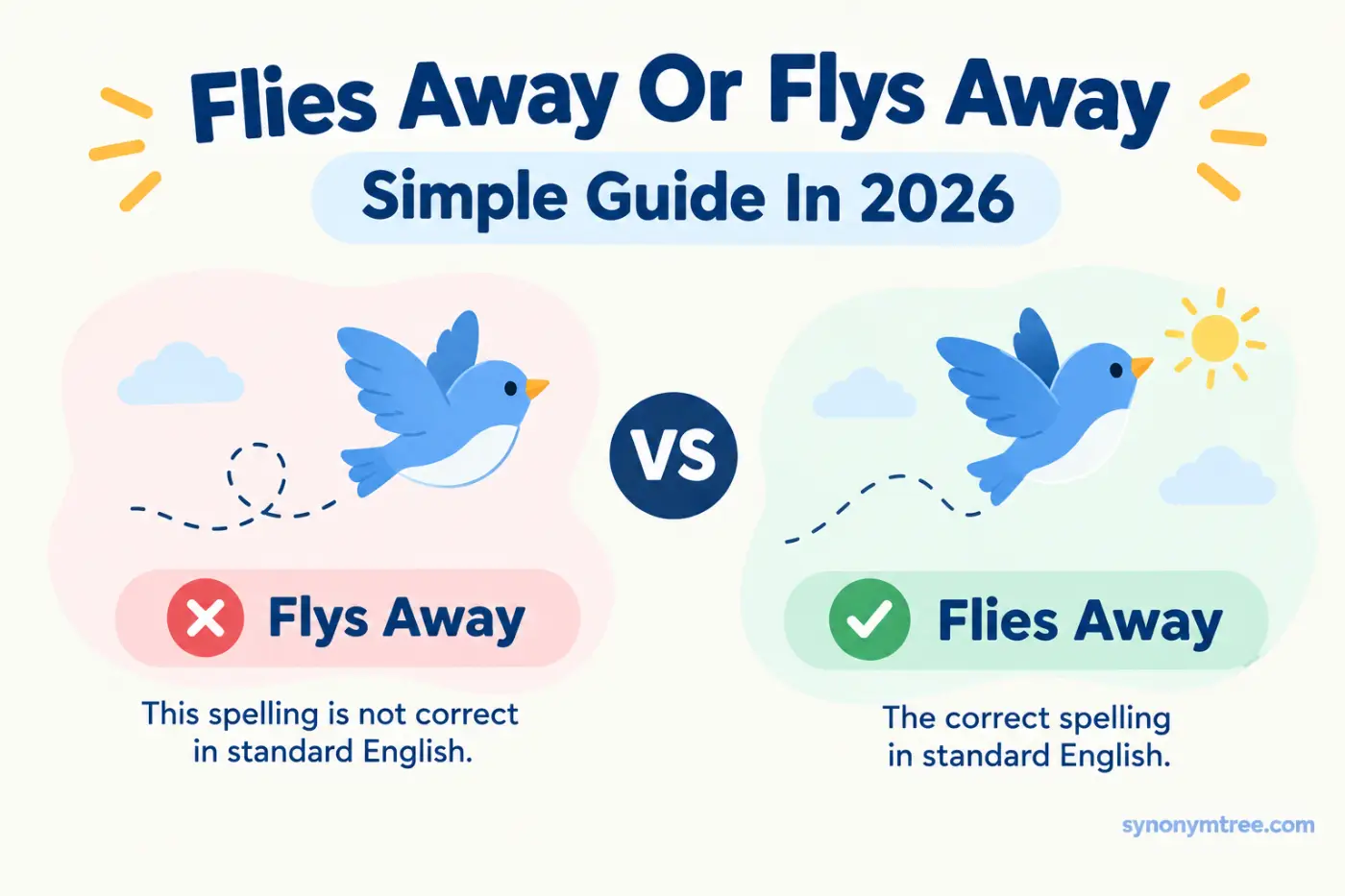
If you’re writing a sentence like The bird flies away or The bird flys away, you may wonder which spelling is correct. The confusion comes from the way the verb fly changes when it is used with he, she, or it. The correct form in this case is flies away.
Flies away is correct when the subject is he, she, or it. Flys away is incorrect in standard English.
The word flies comes from the verb fly. When a verb ends in a consonant followed by y, the y usually changes to i before the ending es is added. That gives us flies rather than flys.
This guide explains the rule in simple terms. You’ll learn why the spelling changes, how to use flies away in real sentences, when to use fly away instead, and how this pattern works with other verbs ending in y.
Quick Definition
Flies away is the third person singular form of fly away. It means that one person, animal, bird, insect, object, or other singular subject moves through the air and gets farther from a place.
Flys away is not the standard spelling. The correct form is flies away.
Direct Answer
Flies away is correct. Flys away is incorrect in standard English.
Use flies away with he, she, or it, such as The bird flies away. Use fly away with I, you, we, and they, such as The birds fly away.
Flies Away Or Flys Away In A Simple Comparison
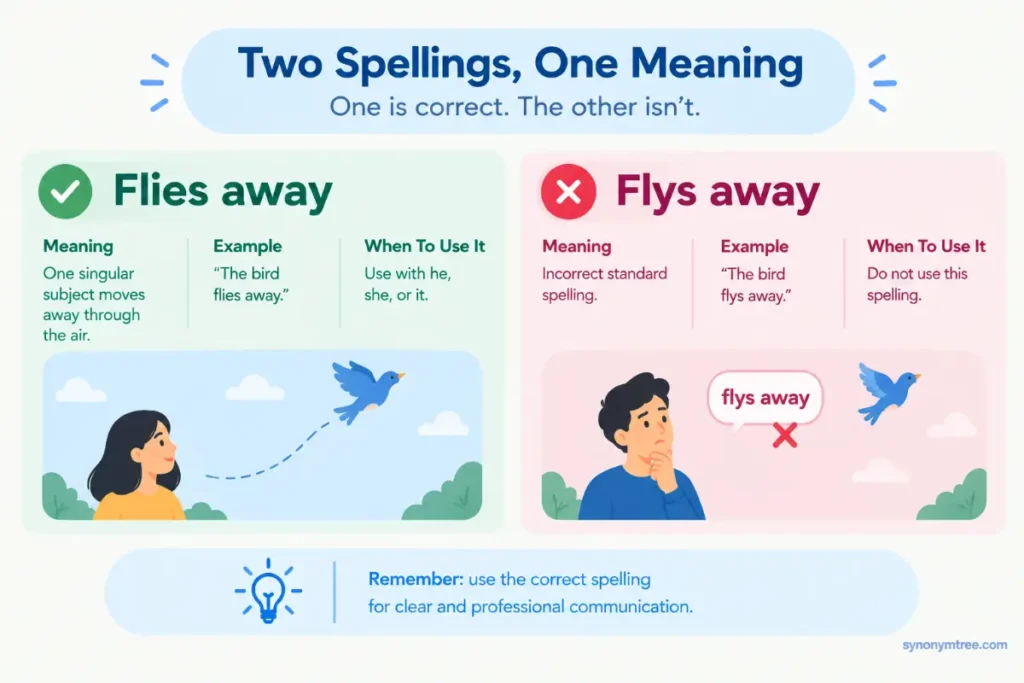
| Phrase | Meaning | Example Sentence | When To Use It |
|---|---|---|---|
| Flies away | One singular subject moves away through the air | The bird flies away. | Use with he, she, or it. |
| Flys away | Incorrect standard spelling | The bird flys away. | Do not use this spelling. |
| Fly away | Base form of the verb | The birds fly away. | Use with I, you, we, and they. |
The key difference is not the word away. The change happens in the verb fly.
Fly becomes flies when the subject is third person singular.
Why Flies Has An I Instead Of A Y
The spelling rule is the main reason writers get this word wrong.
The verb fly ends with a consonant followed by y.
When you add s to make the third person singular form, English changes the y to i and adds es.
Fly becomes flies.
Cry becomes cries.
Try becomes tries.
Study becomes studies.
Carry becomes carries.
The same pattern appears across many common English verbs.
That is why flys is incorrect. English does not normally form the third person singular of fly by simply adding s.
You don’t write fly plus s as flys.
You change the y to i and add es.
Fly becomes flies.
This rule is especially useful because it gives you a way to solve the spelling problem instead of simply memorizing one word.
How The Verb Fly Changes
Fly is an irregular verb in some of its forms, but its present tense third person singular form follows the spelling rule for verbs ending in consonant plus y.
Here is the basic pattern.
I fly.
You fly.
We fly.
They fly.
He flies.
She flies.
It flies.
Notice what happens with the singular third person forms. Only he, she, and it use flies in the simple present tense.
The same rule applies when away follows the verb.
I fly away.
You fly away.
We fly away.
They fly away.
He flies away.
She flies away.
It flies away.
The word away doesn’t change the grammar. The verb still has to agree with its subject.
What Does Flies Away Mean
Flies away means moves through the air and goes farther from the current location.
The most common subject is a bird.
For example, The bird flies away.
That sentence tells us that one bird moves away through the air.
The phrase can also describe insects.
The butterfly flies away when I get too close.
It can describe people in certain situations.
The superhero flies away into the sky.
It can also describe something that moves through the air in a figurative or playful way.
The balloon flies away in the wind.
In every case, the phrase describes movement away from a place.
The exact meaning depends on the subject and context.
When Should You Use Flies Away
Use flies away when the subject is singular and refers to he, she, or it.
The bird flies away.
The eagle flies away.
The butterfly flies away.
The plane flies away.
The balloon flies away.
The superhero flies away.
A singular noun can also take flies away.
My parrot flies away whenever the cage is open.
The subject is my parrot. Since that is one animal, the verb becomes flies.
A person’s name can also take flies away when the meaning makes sense.
Daniel flies away every summer for work.
Here, Daniel is one person, so flies is correct.
The subject determines the verb form.
When Should You Use Fly Away
Use fly away when the subject is I, you, we, or they.
I fly away tomorrow.
You fly away on Friday.
We fly away next week.
They fly away every winter.
The plural noun form also uses fly.
The birds fly away.
The butterflies fly away.
The planes fly away.
The balloons fly away.
This difference is easy to remember once you connect the verb to the subject.
One subject in the third person takes flies.
Other subjects use fly.
Why Flys Away Looks Correct
Flys away looks logical if you think the rule is simply add s to the verb.
Many verbs do work that way.
Run becomes runs.
Walk becomes walks.
Jump becomes jumps.
Read becomes reads.
So a learner may naturally think fly becomes flys.
English has a special spelling rule for words that end in consonant plus y. The y changes before the ending is added.
That creates flies.
The same thing happens with several common verbs.
Try becomes tries.
Cry becomes cries.
Reply becomes replies.
Apply becomes applies.
Identify becomes identifies.
Once you recognize this pattern, flys starts to look less convincing.
The Consonant Plus Y Rule
The most useful spelling rule here is simple.
When a verb ends in a consonant plus y, change y to i and add es for the third person singular present form.
For example.
Fly becomes flies.
Try becomes tries.
Cry becomes cries.
Carry becomes carries.
Study becomes studies.
Worry becomes worries.
Hurry becomes hurries.
Reply becomes replies.
The spelling change happens because English uses ies in these forms.
This is why flies is correct.
There is another important pattern, though. If a word ends in a vowel plus y, the y usually stays.
For example, play becomes plays.
Enjoy becomes enjoys.
Stay becomes stays.
Obey becomes obeys.
The difference comes from the letter before y.
Fly has l before y. L is a consonant, so the y changes.
Play has a before y. A is a vowel, so the y stays.
That distinction can help you understand the spelling instead of memorizing each verb separately.
Fly Versus Play
Fly and play look similar because both end in y. Their third person singular forms are different.
Fly becomes flies.
Play becomes plays.
Why?
Fly ends in consonant plus y.
Play ends in vowel plus y.
The same pattern appears in other words.
Try becomes tries.
Enjoy becomes enjoys.
Cry becomes cries.
Stay becomes stays.
Carry becomes carries.
Obey becomes obeys.
This is one of the most useful spelling comparisons for English learners.
If you remember the letter before y, you can often predict the correct form.
Flies Away In Present Tense
Flies away is a simple present tense form.
The simple present often describes habits, repeated actions, facts, or things that happen regularly.
For example, The bird flies away whenever I open the window.
This means the bird has a repeated habit.
Another example is The eagle flies away at sunset.
That sentence describes a regular or expected action.
You can also use the simple present for a general statement.
A frightened bird often flies away quickly.
The phrase can describe something that happens from time to time.
The simple present is different from the present continuous form.
The bird flies away.
The bird is flying away.
The first sentence describes a general action or repeated event.
The second describes an action happening around the current moment.
Both are correct, but they express different ideas.
Flies Away In The Present Continuous
The present continuous form is flying away.
You don’t say is flies away.
You say is flying away.
For example, The bird is flying away.
This means the bird is currently moving through the air and getting farther away.
Compare these sentences.
The bird flies away when I approach.
The bird is flying away right now.
The first describes a repeated behavior.
The second describes an action happening at this moment.
This difference is useful because learners sometimes confuse flies with flying.
Flies is the simple present form for a singular third person subject.
Flying is the present participle form.
Flies Away In The Past
The past tense of fly is flew.
So the past form of fly away is flew away.
You would say, The bird flew away.
You would not say, The bird flies away yesterday.
The correct sentence is The bird flew away yesterday.
Here are some more examples.
The eagle flew away before we could take a picture.
The butterfly flew away when the child touched the branch.
My parrot flew away last summer.
The plane flew away from the storm.
The balloon flew away in the wind.
The past form does not use flies.
The basic forms are fly, flew, and flown.
Fly is used for the base form and several present tense subjects.
Flew is the simple past form.
Flown is used with helping verbs such as has, have, and had.
Flies Away In The Perfect Tense
The past participle of fly is flown.
This gives us forms such as has flown away, have flown away, and had flown away.
For example, The bird has flown away.
This means the bird moved away at some point before now, with the action connected to the present situation.
You can also say, The birds have flown away.
For a past situation, you might say, The bird had flown away before we arrived.
These forms are different from flies away.
Flies is the simple present third person singular form.
Flown is the past participle.
Keeping these forms separate will help you avoid tense mistakes.
Flies Away Or Flys Away In A Sentence
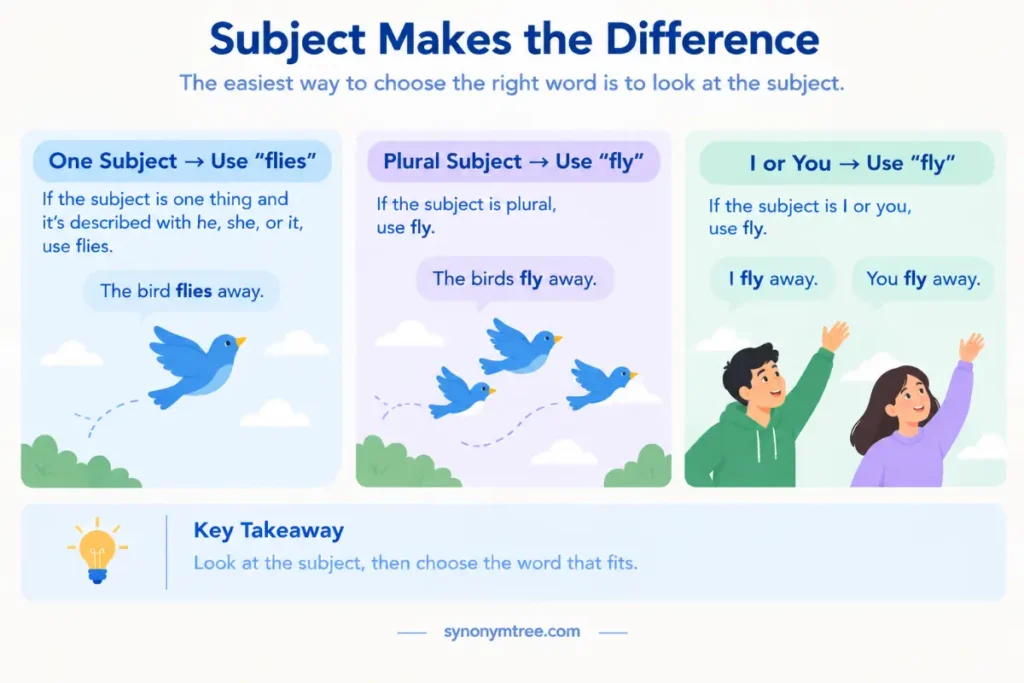
The easiest way to test the phrase is to look at the subject.
If the subject is one thing and it is described with he, she, or it, use flies.
The bird flies away.
If the subject is plural, use fly.
The birds fly away.
If the subject is I or you, use fly.
I fly away.
You fly away.
If the subject is we or they, use fly.
We fly away.
They fly away.
This subject test is more useful than looking at the word away.
Away has nothing to do with the spelling change.
The verb changes because of the subject.
Examples With Singular Subjects
Here are natural examples using flies away with singular subjects.
The bird flies away when the door opens.
The eagle flies away from the nest.
The butterfly flies away before I can take a photo.
The bee flies away after the flower moves.
My parrot flies away whenever it hears a loud noise.
The balloon flies away if you don’t hold the string.
The plane flies away into the clouds.
The superhero flies away after saving the city.
The kite flies away in strong wind.
The insect flies away when the light turns on.
Each subject is singular, so flies is the correct form.
Notice that the subjects don’t have to be people. Any singular noun can take the third person singular form when the sentence requires it.
Examples With Plural Subjects
Plural subjects use fly.
The birds fly away at sunset.
The butterflies fly away when people approach.
The planes fly away one after another.
The balloons fly away in the wind.
The bees fly away from the garden.
The children watch as the birds fly away.
The superheroes fly away at the end of the story.
The insects fly away when the light changes.
The kites fly away over the field.
This is a simple contrast.
One bird flies.
Several birds fly.
One butterfly flies.
Several butterflies fly.
The noun changes from singular to plural, and the verb changes with it.
Examples With Pronouns
Pronouns make the rule even clearer.
I fly away.
You fly away.
He flies away.
She flies away.
It flies away.
We fly away.
They fly away.
Only he, she, and it use flies in the simple present.
That is one of the most important patterns to remember.
You can apply the same pattern to many other verbs.
I try.
He tries.
We carry.
She carries.
They study.
He studies.
I reply.
She replies.
The grammar pattern stays the same.
Examples From Everyday Situations
Imagine a bird sitting on a fence.
You could say, The bird flies away when I walk closer.
Now imagine several birds.
You would say, The birds fly away when I walk closer.
The difference is caused by the subject.
Another example involves a balloon.
The balloon flies away when the child lets go.
But if several balloons escape, you would say, The balloons fly away when the wind gets stronger.
The same rule works with travel.
The plane flies away from the airport.
The planes fly away from the airport.
The first sentence has one plane. The second has more than one.
You can also use the phrase figuratively.
The character flies away into the sunset.
The characters fly away into the sunset.
Again, the verb changes because of the subject.
Common Mistakes With Flies Away
The most obvious mistake is writing flys away.
The correct form is flies away.
Another common mistake is using flies with a plural subject.
The birds flies away is incorrect.
The correct sentence is The birds fly away.
You may also see people write he fly away.
That is incorrect in the simple present.
The correct form is He flies away.
Another mistake occurs when writers use flies for I or you.
I flies away is incorrect.
The correct form is I fly away.
You flies away is also incorrect.
The correct form is You fly away.
These mistakes all come from the same issue. The writer isn’t matching the verb with the subject.
The Difference Between Fly And Flies
Fly is the base form of the verb.
Flies is the third person singular present form.
You use fly after I, you, we, and they.
You use flies after he, she, and it.
Here is the pattern.
I fly.
You fly.
He flies.
She flies.
It flies.
We fly.
They fly.
This is the same subject and verb agreement rule that applies to many regular English verbs.
I walk.
He walks.
They walk.
She walks.
The ending changes only for the third person singular in the simple present.
The Difference Between Flies And Flew
Flies is present tense.
Flew is past tense.
The bird flies away every morning.
The bird flew away yesterday.
The first sentence describes a current habit or repeated action.
The second describes an action that already happened.
Using the wrong form can change the time of the event.
If you’re talking about something that happened last week, flew is usually the form you need.
If you’re describing what happens regularly, flies may be correct.
The Difference Between Flies And Flying
Flies and flying are different verb forms.
The bird flies away.
The bird is flying away.
The first is simple present.
The second is present continuous.
You can use flies for habits or general facts.
The eagle flies over the mountains every spring.
You can use flying when the action is happening now.
Look. The eagle is flying over the mountains.
The two forms shouldn’t be mixed.
Why The Word Away Does Not Change The Rule
Some learners may think fly away is a special phrase that follows different grammar rules.
It doesn’t.
Fly away is a verb followed by an adverb.
The verb still changes according to the subject.
I fly away.
He flies away.
They fly away.
The word away stays exactly the same.
You can see the same pattern with other verbs.
She runs away.
They run away.
He walks away.
We walk away.
The second word doesn’t control the verb.
The subject does.
That is why the correct spelling is flies away rather than flys away.
Fly Away As A Phrasal Verb
Fly away can function as a phrasal verb.
A phrasal verb combines a verb with another short word to create a meaning that works as a unit.
Fly away means to leave by moving through the air.
For example, The bird flew away.
The phrase can be literal.
The butterfly flew away from the flower.
It can also appear in imaginative or figurative language.
Her thoughts seemed to fly away during the boring lecture.
In that sentence, thoughts don’t literally have wings. The phrase creates an image of thoughts leaving or becoming difficult to hold.
The grammar still follows the verb fly.
Fly Away In Songs And Stories
Fly away appears often in songs, poems, children’s stories, and fiction because it creates a clear image of movement and freedom.
A character may fly away from danger.
A bird may fly away from a tree.
A magical creature may fly away into the sky.
In creative writing, the phrase can also represent leaving, escaping, or becoming free.
For example, The young hero dreamed of the day he could fly away and start a new life.
Here, the phrase has a literal image but a broader emotional meaning.
When writing creatively, the grammar still stays the same.
The bird flies away.
The birds fly away.
The hero flies away.
The heroes fly away.
Creative writing does not change standard subject and verb agreement.
How To Remember Flies Away
A simple memory trick is to connect flies with tries.
You wouldn’t normally write he try.
You write he tries.
Fly follows the same spelling pattern.
He flies.
She flies.
It flies.
Think of the pair.
Try becomes tries.
Fly becomes flies.
Both change y to i and add es.
You can also remember the phrase as a complete unit.
The bird flies away.
That common sentence gives you a visual model.
If you see flys, stop and ask which subject comes before it.
If the subject is he, she, or it, change the spelling to flies.
A Second Memory Trick
Think about the word fly as having a y at the end.
When one person or thing does the action in the simple present, the y changes.
Fly becomes flies.
Cry becomes cries.
Try becomes tries.
This pattern gives you a small group of words to remember together.
You don’t have to learn every word separately.
Once you understand the pattern, you can apply it to new words.
When You Should Use Fly Away
Use fly away when the subject is I, you, we, or they.
I will fly away tomorrow.
You can fly away whenever you want.
We fly away every summer.
They fly away before winter.
You also use fly after modal verbs such as can, could, will, would, should, and might.
The bird can fly away.
The birds can fly away.
The eagle will fly away soon.
They might fly away before sunset.
Notice that even he, she, and it use the base form after a modal.
The bird flies away.
The bird can fly away.
You don’t say The bird can flies away.
This is another useful grammar rule.
After a modal verb, use the base form.
Why Modal Verbs Use Fly
Modal verbs include words such as can, could, will, would, should, may, might, and must.
After these words, English uses the base form of the main verb.
That means you write.
He can fly away.
She will fly away.
It might fly away.
The bird should fly away.
You don’t write.
He can flies away.
She will flies away.
It might flies away.
The correct form after the modal is always fly.
This can seem confusing because the subject is still he, she, or it. The modal changes the grammar pattern.
Learning this rule helps you use fly away correctly in more advanced sentences.
Flies Away In Questions
Questions also follow the subject and helping verb pattern.
Does the bird fly away?
Does the eagle fly away every morning?
When does the bird fly away?
The important detail is that after does, you use the base form fly.
You don’t say, Does the bird flies away?
That is incorrect.
The correct form is Does the bird fly away?
The same pattern applies to other verbs.
Does she cry?
Does it carry the box?
The helping verb does carries the tense and agreement, so the main verb returns to its base form.
Flies Away In Negative Sentences
Negative sentences with does also use the base form.
The bird does not fly away.
She does not fly away.
It doesn’t fly away.
You don’t write, The bird does not flies away.
That is incorrect.
The correct form is The bird does not fly away.
Again, does already handles the third person singular form.
This rule is worth remembering because it explains why flies appears in some sentences but fly appears in others.
Compare these examples.
The bird flies away.
The bird does not fly away.
Does the bird fly away?
The first sentence uses flies.
The second and third use fly because of does.
A Full Grammar Pattern For Fly Away
You can see the whole system in one group of examples.
I fly away.
You fly away.
He flies away.
She flies away.
It flies away.
We fly away.
They fly away.
I flew away.
He flew away.
They flew away.
I have flown away.
She has flown away.
They have flown away.
The forms may look different, but each one has a specific grammatical job.
Fly is the base form.
Flies is the third person singular present form.
Flew is the simple past form.
Flown is the past participle.
Flying is the present participle.
Understanding this family makes the original spelling question much easier.
Similar Words That Follow The Same Rule
Fly isn’t the only verb that changes y to ies.
Try becomes tries.
Cry becomes cries.
Dry becomes dries.
Hurry becomes hurries.
Worry becomes worries.
Carry becomes carries.
Marry becomes marries.
Reply becomes replies.
Study becomes studies.
Apply becomes applies.
Identify becomes identifies.
These examples show the same basic spelling pattern.
The final y changes to i, and es is added.
You can use this rule whenever a verb ends in a consonant followed by y.
Words That Keep The Y
Not every verb ending in y changes to ies.
If a vowel comes before y, the y usually stays.
Play becomes plays.
Stay becomes stays.
Enjoy becomes enjoys.
Employ becomes employs.
Obey becomes obeys.
Pray becomes prays.
This gives you a useful comparison.
Fly becomes flies.
Play becomes plays.
Try becomes tries.
Enjoy becomes enjoys.
Cry becomes cries.
Stay becomes stays.
The letter immediately before y helps determine the spelling.
A Practical Editing Check
If you’re unsure about the phrase, look at the subject first.
Ask, Who or what flies away?
If the answer is he, she, or it, use flies.
If the answer is I, you, we, or they, use fly.
For example, Who flies away?
The bird flies away.
Who flies away?
She flies away.
Who flies away?
The birds fly away.
This question can quickly solve the problem.
You can also replace the subject with a pronoun.
If you can replace it with he, she, or it, use flies.
If you can replace it with they, use fly.
That simple test works in many sentences.
Finaly Or Finally Style Spelling Confusion
Spelling questions often happen because English pronunciation doesn’t show every written letter clearly. The same general issue can happen with flies.
A writer hears the word and tries to spell it from sound alone.
That approach isn’t always reliable.
Flies sounds close to flyz in ordinary speech. The pronunciation doesn’t tell you that the written form uses ies.
The better approach is to remember the spelling rule.
Fly ends in consonant plus y.
Change y to i.
Add es.
The result is flies.
This method gives you a reason for the spelling instead of requiring pure memorization.
What Is The Opposite Of Fly Away
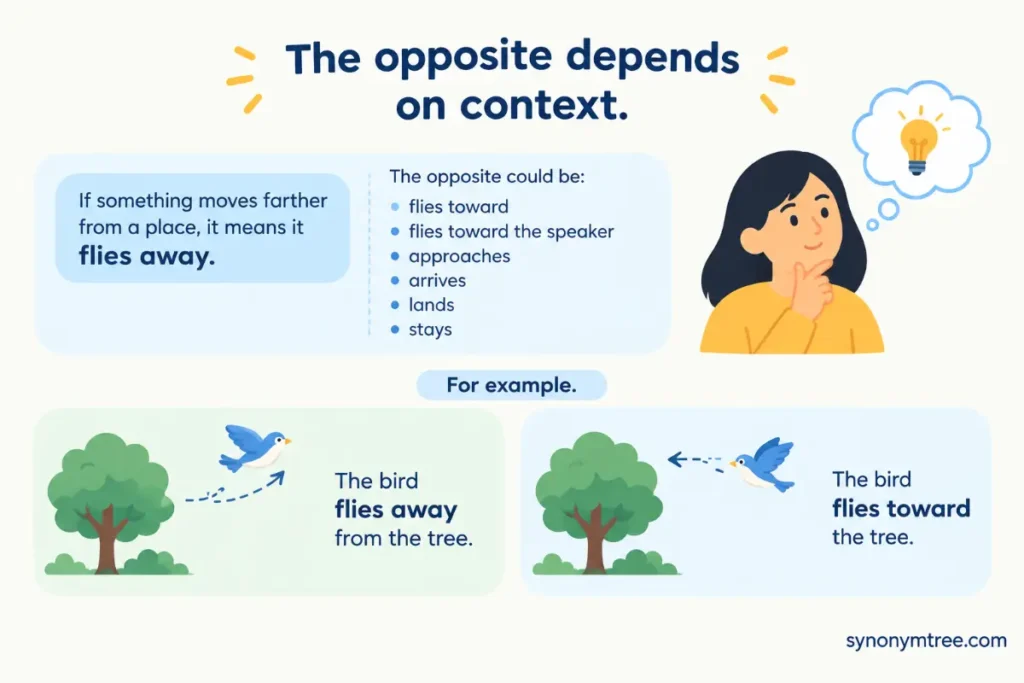
The opposite depends on context.
If something flies away, it moves farther from a place.
The opposite could be flies toward, flies toward the speaker, approaches, arrives, lands, or stays.
For example.
The bird flies away from the tree.
The bird flies toward the tree.
The first describes movement away.
The second describes movement closer.
If the bird lands, it stops flying.
The bird lands on the branch.
These words help describe different kinds of movement.
Conclusion
The correct form is flies away when a singular third person subject performs the action in the simple present. You can write The bird flies away or She flies away. The spelling flys away is not correct in standard English.
The reason is the spelling rule for verbs ending in consonant plus y. When the verb fly takes the third person singular ending, the y changes to i and es is added. Fly becomes flies.
Remember the subject as your quickest check. He, she, and it use flies. I, you, we, and they use fly. After words such as does, can, will, and should, use the base form fly.
The next time you hesitate between flies away or flys away, look at the subject first. If it is one person or thing described by he, she, or it, write flies away. That simple habit will help you get the spelling right every time.
Common Questions About The Phrase
Is flies away or flys away correct?
Flies away is correct in standard English. The form flys away is a spelling mistake because fly changes to flies in the third person singular present tense.
Why does fly change to flies?
Fly changes to flies because verbs ending in a consonant plus y usually change y to i and add es when used with he, she, or it. This gives you flies instead of flys.
Do I say the bird flies away or the bird fly away?
You say the bird flies away. Bird is a singular noun, so the third person singular form flies is required in the simple present.
Is it the birds fly away or the birds flies away?
The correct sentence is the birds fly away. Birds is plural, so the base form fly is used instead of flies.
What is the past tense of fly away?
The past tense is flew away. For example, The bird flew away yesterday.
Is it does the bird fly away or does the bird flies away?
The correct form is does the bird fly away. After does, use the base form fly rather than flies.
Can I say the bird will flies away?
No. The correct sentence is the bird will fly away. After will, use the base form of the verb.
What is the difference between flies and flying?
Flies is the simple present form used with a singular third person subject. Flying is used in continuous forms, such as The bird is flying away.
