
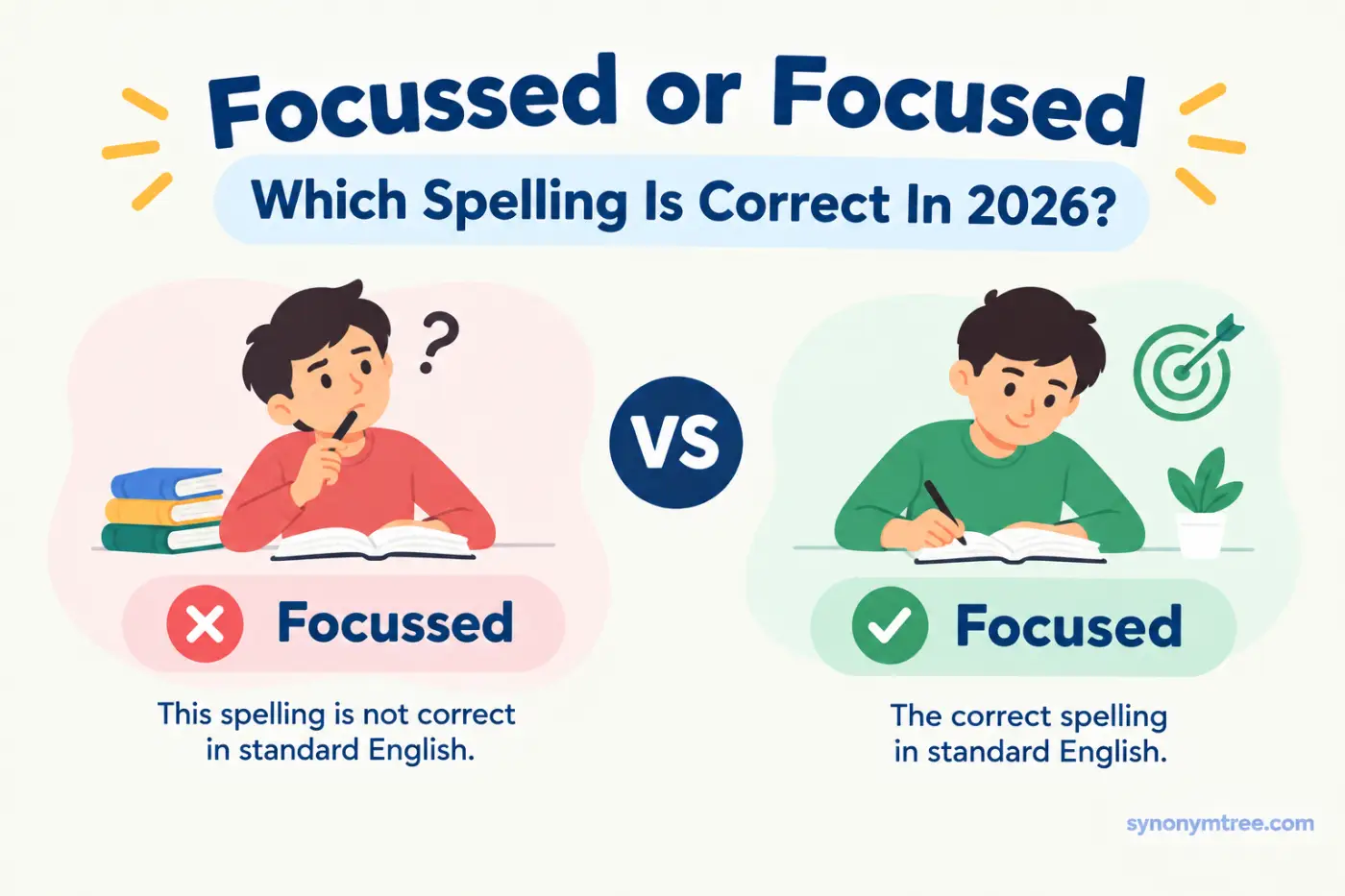
If you are unsure about focussed or focused, the answer depends on the variety of English you are using. In American English, focused is the standard spelling. Focussed is also used, mainly in British English and some other varieties of English.
The two forms have the same meaning. They are different spellings of the past tense and past participle of the verb focus. You can use either form in some English varieties, but American readers will normally expect focused.
This spelling difference often causes confusion because many English verbs double their final consonant before adding an ending. The word focus does not always follow the pattern people expect. The difference also comes from regional spelling conventions.
This guide explains the difference between the two forms, shows you which spelling to use in American English, explains the grammar rule, and gives you plenty of examples. You will also see how the spelling works in words such as focusing and focussed, along with common mistakes that can make your writing look inconsistent.
Quick Definition
Focused is the standard spelling in American English. It means giving close attention to something or having a clear aim or purpose.
Focussed has the same meaning and is accepted in British English and some other varieties. The main difference is regional spelling rather than meaning.
Direct Answer
In American English, use focused. Focussed is a valid spelling in British English and some other forms of English, but focused is the usual choice for US writing.
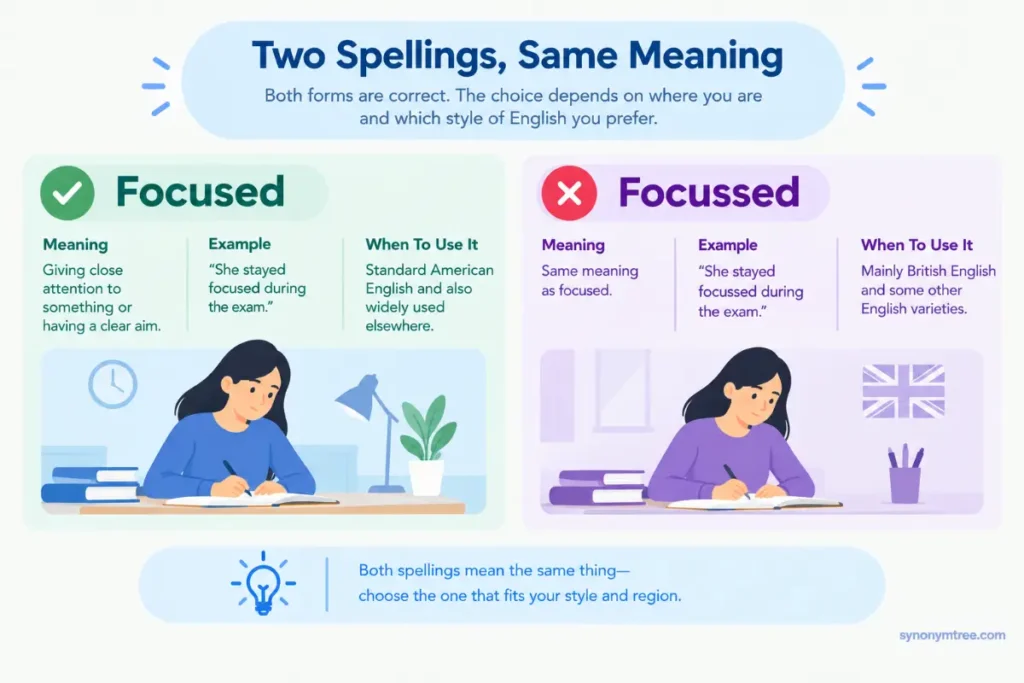
Comparison Of Focused Or Focussed
| Word | Meaning | Example Sentence | When To Use It |
|---|---|---|---|
| Focused | Giving close attention to something or having a clear aim | She stayed focused during the exam. | Standard American English and also widely used elsewhere |
| Focussed | Same meaning as focused | She stayed focussed during the exam. | Mainly British English and some other English varieties |
The important point is that neither spelling changes the meaning of the word. The difference comes from spelling conventions.
If you are writing for a US audience, focused is the safer and more natural choice. If you are following British English, focussed can be appropriate.
Why The Two Spellings Exist
The word focus comes from Latin and entered English centuries ago. Modern English developed different spelling preferences in different regions.
American English often prefers a simpler spelling for this word. That gives us focused.
British English has traditionally allowed the doubled consonant form focussed. Both forms can be found in British writing, although focused is also widely used there.
This means the difference is not really about correct versus incorrect English in every situation. It is mainly about the spelling system and style used by the writer.
The same kind of regional difference appears in many other English words. American English often uses forms such as traveled, canceled, and labeled, while British English commonly uses travelled, cancelled, and labelled.
The word focus creates a slightly different situation because both focused and focussed are found in English writing.
For an American reader, focused will usually look more familiar. That is why it is the preferred spelling in US English.
The Meaning Does Not Change
Both forms describe the same idea.
You can say that a student is focused on an exam. You can also find the spelling focussed in British writing with exactly the same meaning.
The word can describe attention, concentration, goals, plans, or a clear purpose.
For example, she remained focused during the meeting means that she kept her attention on the task.
The same sentence with focussed has the same meaning in a variety of English that uses that spelling.
The difference is in the letters, not the definition.
What Does Focused Mean
Focused is the past tense and past participle of focus. It can also work as an adjective.
As a verb, it describes the action of directing attention toward something.
For example, the team focused on improving customer service.
Here, focused tells us what the team did. Their attention was directed toward improving customer service.
The word can also describe concentration.
For example, Daniel stayed focused while studying for his test.
In this sentence, focused describes Daniel’s ability to keep his attention on his studies.
The word can also describe a person with a clear goal.
For example, she is focused on building her business.
Here, focused suggests that her attention and effort are directed toward a particular goal.
Focused As A Verb
When used as a verb, focused usually appears with the word on.
For example, the teacher focused on the main problem.
The company focused on reducing costs.
The students focused on the difficult chapter.
The doctor focused on the patient’s symptoms.
The photographer focused on the subject before taking the picture.
In each sentence, focused tells us where attention or effort was directed.
You can also use focus without focused when talking about the present.
For example, I focus on one task at a time.
She focuses on customer needs.
They focus on quality.
The form changes based on the tense and subject, but the central meaning stays the same.
Focused As An Adjective
Focused can also describe a person, group, plan, or activity.
For example, she is a focused student.
The company has a focused strategy.
He gave a focused answer.
The meeting was short and focused.
In these examples, focused describes something that has clear attention or direction.
The adjective is common in school, work, sports, business, and everyday conversation.
You might describe an athlete as focused before a competition. You might describe a meeting as focused if it stays on the main topic.
Why Focused Is Preferred In American English
American English generally uses focused rather than focussed.
That means you should normally choose focused for US school assignments, resumes, business writing, websites, reports, emails, and other American English content.
For example, a resume might say that a candidate is focused on customer service.
A school essay might say that the author focused on the main theme of the novel.
A business report might say that the company focused on improving its online services.
In all of these situations, focused fits standard American spelling.
The doubled spelling may not be considered a spelling error everywhere, but it can look unusual to an American reader.
If your audience is in the United States, consistency matters. Using focused throughout your writing will match the spelling most US readers expect.
American English And British English
Regional spelling differences are common in English.
American English tends to favor focused.
British English can use focussed and focused.
This does not mean that every British writer uses focussed. Many British publications and writers also use focused.
That is why it is better to think of focussed as a regional variant rather than as a completely different word.
The same idea applies to many other spelling differences between American and British English.
For example, American English uses color while British English often uses colour.
American English commonly uses center while British English commonly uses centre.
American English generally uses traveled while British English often uses travelled.
The focus spelling follows the same broader idea of regional variation.
The Grammar Behind The Spelling
The spelling question becomes easier once you understand what happens when focus takes an ending.
The base verb is focus.
The past tense is focused or focussed, depending on the English variety.
The present participle is focusing.
The third person singular form is focuses.
These forms can look unusual because the word does not behave exactly like words such as stop.
For example, stop becomes stopped and stopping.
Focus does not normally become focussed in American English. Instead, American English uses focused.
The present participle is also usually written focusing, with one s.
This creates an important distinction.
You write focused in standard American English.
You write focuses when the subject is he, she, it, or another singular noun.
Focus And Focuses
The third person singular form is focuses.
For example, she focuses on her work every morning.
The company focuses on customer service.
The teacher focuses on reading skills.
You do not write focusses in standard American English when you mean the third person singular present form.
This is different from the British spelling pattern that can use focusses.
For US writing, focuses is the normal form.
Focus And Focusing
The present participle is focusing.
For example, she is focusing on her homework.
The team is focusing on the most important problem.
The company is focusing on improving its website.
Notice that focusing normally has one s after the cu sound.
This is another place where writers sometimes become unsure because they expect the consonant to double.
The standard American spelling is focusing.
Is Focussed Wrong
Not necessarily.
Focussed is a recognized spelling in British English and some other varieties. It is not simply a random misspelling created by adding an extra letter.
The key issue is your intended variety of English.
If you are writing for an American audience, focused is the normal choice.
If you are writing in British English, focussed may be acceptable. However, focused is also used in British English, so the choice can depend on the publication, style guide, or personal preference.
That means calling focussed universally wrong would be misleading.
A better rule is to match your spelling to your audience and keep your style consistent.
If your entire article uses American spelling, use focused.
If your publication follows a British style guide that prefers doubled consonants in certain forms, follow that guide.
Why Some Dictionaries Show Both Forms
English dictionaries often list more than one spelling when different varieties use different forms.
That does not mean the words have different meanings.
Instead, the dictionary is showing real usage across English speaking regions.
You may see focused listed as the main form and focussed listed as a British variant. Another dictionary may give both forms with regional notes.
When checking a spelling for professional writing, do more than ask if a dictionary recognizes it.
Also consider the variety of English you are writing.
A word can be accepted in English and still be less suitable for a particular audience.
Examples Using Focused
The easiest way to understand the word is to see it in normal sentences.
She stayed focused during the long meeting.
The students focused on the most difficult question.
He remained focused even when the room became noisy.
The team focused on improving the product.
Maria focused on finishing her assignment before dinner.
The company focused its attention on customer service.
The coach wanted the players to stay focused during practice.
I focused on the main idea instead of every small detail.
The writer focused on clarity and simple language.
The group focused on solving the problem.
Each sentence uses focused naturally in American English.
The word can describe attention, effort, concentration, or direction.
Examples Using Focussed
You may also see focussed in British English.
For example, a British publication might write that the team remained focussed during the match.
Another sentence could say that she stayed focussed on her studies.
A report might say that the company remained focussed on its long term goals.
A teacher might write that the student was focussed during the lesson.
These examples have the same meaning as the American forms using focused.
The spelling changes, but the meaning does not.
If you are writing for a US audience, replace focussed with focused.
Focused Or Focussed In A Resume
For a US resume, focused is the preferred spelling.
You might write that you are focused on improving customer satisfaction.
You could also describe yourself as a focused professional.
The spelling matters because resumes are formal documents. Using the spelling expected by your audience helps your writing look consistent.
If your resume is written for an American employer, use American spelling throughout.
Do not mix focused with other British forms unless you have a specific reason.
For example, if the rest of your resume uses American forms such as organized, traveled, and centered, focused fits naturally with that style.
Consistency makes the document easier to read.
Resume Examples
A candidate might write that they focused on improving team productivity.
Another might say that they are focused on customer satisfaction.
A project manager could write that she focused on completing projects on time.
A sales professional might say that he focused on building strong client relationships.
These sentences use focused naturally and clearly.
The word is especially useful on resumes because it can describe attention and goals without being complicated.
Still, avoid using it repeatedly in every section. Good resume writing depends on specific evidence.
Instead of saying only that you are focused, explain what you focused on and what you accomplished.
For example, focused on reducing customer response time by improving the support process is more informative than simply saying focused professional.
Focused Or Focussed In School Writing
Students writing in American English should normally use focused.
For example, an essay might say that the author focused on the main character’s choices.
A research paper might say that the study focused on language development.
A history assignment might say that the discussion focused on changes in American society.
A science report might say that the experiment focused on water quality.
If you are studying in a setting that requires British English, follow your teacher’s or institution’s spelling rules.
The important thing is consistency.
Do not switch between American and British spellings without a reason.
Focused Or Focussed In Business Writing
Business writing benefits from simple and consistent spelling.
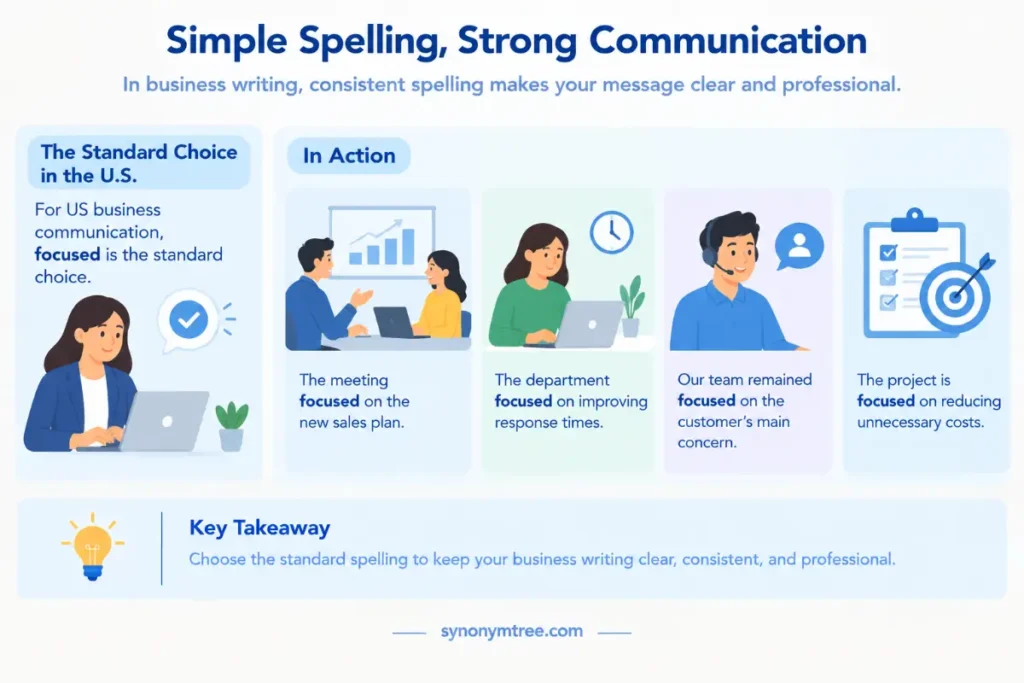
For US business communication, focused is the standard choice.
For example, the meeting focused on the new sales plan.
The department focused on improving response times.
Our team remained focused on the customer’s main concern.
The project is focused on reducing unnecessary costs.
These sentences are clear because focused describes a specific direction of attention or effort.
In professional writing, the word can also be useful when describing priorities.
For example, the company has a focused approach to product development.
The team took a focused approach to solving the problem.
The manager gave the group a focused plan for the next quarter.
The word works best when it is connected to something specific.
Common Mistakes With These Spellings
One common mistake is assuming that focussed is always wrong.
That is not accurate. The spelling is used in British English and some related varieties.
Another mistake is assuming that focused and focussed have different meanings.
They do not. They are spelling variants of the same word.
A third mistake is using focussed in US writing without realizing that focused is the standard American form.
This can make your writing look inconsistent if the rest of your spelling follows American conventions.
A fourth mistake is writing focussing when focusing is intended in standard American English.
The form focusing is normally used in American English.
Another mistake is confusing the verb with the noun.
Focus can be a noun or a verb.
For example, the focus of the meeting was customer service uses focus as a noun.
The team focused on customer service uses focused as a verb.
Understanding the role of the word helps you choose the correct form.
Focused And Focus
Focus has several common uses.
As a noun, it can mean the main point of attention.
For example, the focus of the meeting was customer service.
It can also describe the central subject of a discussion.
The focus of the book is family relationships.
As a verb, focus means to direct attention toward something.
For example, the team focused on the main problem.
The past form is focused in American English.
This distinction is useful because writers sometimes add an unnecessary ending.
You would not say the focused of the meeting.
You would say the team focused on the meeting topic.
Focused And Concentrated
Focused and concentrated are closely related words, but they are not always interchangeable.
For example, she stayed focused on her studies.
Concentrated often emphasizes mental effort or intense attention.
For example, she concentrated on the difficult math problem.
Both words can describe attention, but focused is often broader.
You can have a focused plan, a focused discussion, or a focused business strategy.
Concentrated is more commonly connected with mental effort or physical substances.
For example, concentrated juice describes a substance with less water.
That meaning has nothing to do with attention.
Focused And Dedicated
Focused describes where attention or effort is directed.
Dedicated describes strong commitment to a person, task, goal, or cause.
For example, he is focused on improving his writing.
That sentence tells us where his attention is directed.
He is dedicated to improving his writing tells us that he is strongly committed to the goal.
The two words can appear together.
She is a focused and dedicated employee.
Still, they should not be treated as exact synonyms.
Focused And Determined
Determined describes a strong decision to achieve something.
Focused describes attention directed toward a specific goal.
For example, she is determined to finish the project.
She is focused on finishing the project.
The first sentence emphasizes her decision and commitment.
The second emphasizes where her attention is directed.
A person can be both determined and focused, but the words describe different aspects of the situation.
How To Choose The Right Spelling
Choosing between the two spellings is simple if you know your audience.
For American English, choose focused.
For British English, check the style guide you are following. Focussed is accepted, but focused is also widely used.
For international websites, focused is often a practical choice because it is familiar to American readers and widely understood elsewhere.
If you are writing for a specific publication, use that publication’s preferred style.
The main goal is consistency.
Do not use focused in one paragraph and focussed in another unless you are intentionally discussing regional spelling.
Mixing forms can make your writing look careless even though both forms are recognized in some varieties of English.
A Simple Spelling Check
Ask yourself three questions.
First, who will read this?
If your audience is mainly American, use focused.
Second, what style of English does the publication use?
Follow its established spelling rules.
Third, have you used the same spelling throughout the document?
Consistency matters more than trying to force one form into every variety of English.
Why American English Uses Focused
American English has developed spelling conventions that often favor shorter or less doubled forms.
This pattern can be seen in words such as traveled and labeled.
British English often uses travelled and labelled.
Focused fits comfortably within the American preference for the single consonant spelling.
That does not mean the British form is a mistake. It reflects a different spelling convention.
English is spoken and written across many countries. Regional differences are a normal part of the language.
The goal is not to treat one regional form as universally correct. The goal is to choose the form that matches your audience and writing style.
What About Focussing
Focussing is another form you may encounter, especially in British English.
American English normally uses focusing.
For example, the company is focusing on customer service.
The student is focusing on the main idea.
The team is focusing on the problem.
British writing may use focussing in some contexts.
Again, the difference comes from regional spelling conventions.
If you are writing American English, focusing is the standard form to use.
This also gives you a useful set of forms to remember.
Focus is the base word.
Focuses is the third person singular present form.
Focused is the past tense and past participle in American English.
Focusing is the present participle in American English.
Keeping these forms together makes the spelling easier to remember.
Examples Of Correct American Usage
The following examples show common ways to use focused in US English.
The teacher focused on the main lesson.
She remained focused during the interview.
The company focused on improving customer support.
He focused his attention on the speaker.
The students stayed focused during the test.
The report focused on the causes of the problem.
The manager focused on the team’s most urgent task.
The athlete stayed focused before the competition.
I focused on one goal at a time.
The discussion focused on practical solutions.
The photographer focused the camera on the subject.
The article focused on the differences between the two words.
Each sentence uses the American spelling correctly.
Notice that the word can describe both mental attention and the act of directing something toward a subject.
Examples Of Incorrect Or Inconsistent Usage
The company focussed on customer service is not the preferred spelling for standard American English.
The company focused on customer service is the normal US form.
Another example is she is focussing on her homework.
For American English, she is focusing on her homework is preferred.
You should also avoid switching forms within the same document.
For example, using focused in one section and focussed in another can create unnecessary inconsistency.
If you are writing an American English article, choose focused and use it consistently.
A Memory Trick For Focused
A simple way to remember the American spelling is to connect it with other common US spellings that use one final consonant.
Think of focused as the standard American form.
Then connect it with focusing.
Focus.
Focused.
Focusing.
Focuses.
Seeing the four forms together helps prevent accidental spelling changes.
You can also remember the regional rule directly.
American English usually uses focused.
British English can use focussed.
That one sentence solves most spelling questions involving these two forms.
When To Use Focussed
Use focussed when it matches the English variety or style guide you are following.
For example, a British publication may prefer focussed.
A British school assignment may accept or prefer focussed depending on the school’s style.
A UK based company may use focussed in its internal documents.
In these situations, the spelling can be completely appropriate.
The key is not to treat focussed as an error simply because American English prefers focused.
English has several accepted regional spelling systems.
If you are writing for US readers, however, focused is the clearer choice.
When To Use Focused
Use focused for standard American English.
It is appropriate for US websites, resumes, school assignments, business documents, reports, emails, product descriptions, and general writing.
For example, a US company might say that its team is focused on customer service.
A student might write that the essay focused on the main character.
A resume might say that the candidate focused on improving sales.
An American news article might say that the discussion focused on the new policy.
This spelling is also widely understood outside the United States, so it is often a practical choice for international content.
Does The Extra S Change Pronunciation
No.
Focused and focussed are generally pronounced the same way.
The difference is written rather than spoken.
That can make the spelling confusing because you cannot usually hear which version a writer has chosen.
When you hear someone say focused, you cannot tell from the sound alone if they would write focused or focussed.
The surrounding writing style is what tells you which spelling convention the writer follows.
This is one reason regional spelling questions can cause trouble for learners of English.
The spoken form can remain the same while the written form changes.
Does The Difference Affect Meaning
No.
The two forms have the same basic meaning.
Both describe directing attention toward something or being concentrated on a particular goal or subject.
For example, focused on the task and focussed on the task communicate the same idea.
The main difference is spelling preference by region and style.
This is why a reader who understands one form will normally understand the other immediately.
The difference matters most when you are trying to maintain consistent spelling in formal writing.
How To Keep Your Writing Consistent
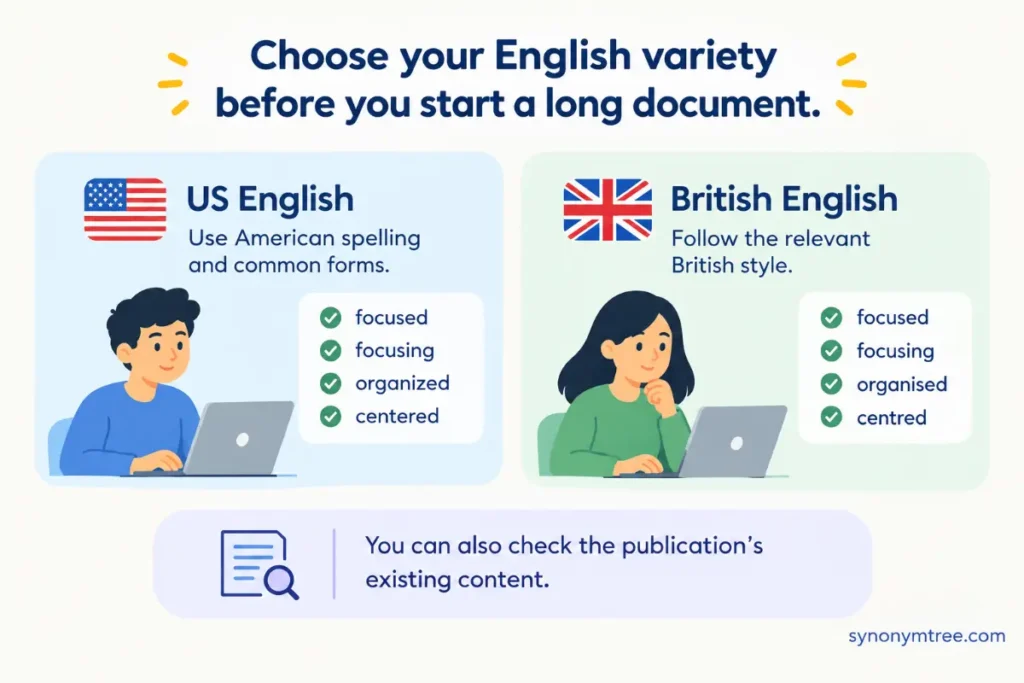
Choose your English variety before you start a long document.
If you are writing for a US audience, use American spelling.
That means focused, focusing, organized, centered, and other common US forms where appropriate.
If you are writing for a British audience, follow the relevant British style.
You can also check the publication’s existing content.
If its articles consistently use American spelling, match that style.
If the publication uses British spelling, follow it.
Consistency is especially useful for SEO content because readers may notice spelling differences across pages. Search engines can understand both forms, but your writing should still match the intended audience.
Conclusion
The answer to focussed or focused depends on the variety of English you are using. For American English, focused is the standard spelling. Focussed is also a recognized form, mainly in British English and some other varieties.
Both forms have the same meaning. They can describe directing attention toward something, concentrating on a task, or having a clear goal. The spelling difference does not create a different definition.
For US writing, the practical rule is simple. Use focused for resumes, school assignments, business documents, websites, reports, and everyday American English. If you are writing in British English, check the style guide because focussed may be accepted or preferred.
When in doubt, look at the audience and keep your spelling consistent. For American readers, choose focused. That single choice will keep your writing aligned with standard US spelling.
Frequently Asked Questions
Is focussed or focused correct in American English?
Focused is the standard spelling in American English. Focussed is recognized in British English and some other varieties, but it is not the usual choice for US writing. Use focused for American websites, resumes, schoolwork, and professional documents.
Is focussed wrong in British English?
No. Focussed is an accepted spelling in British English. Focused is also used in British English, so the choice can depend on the publication or style guide.
Why does British English spell focused as focussed?
British English has a spelling convention that can double the final consonant in some words before certain endings. Focussed developed under this convention. American English generally uses the simpler focused spelling.
Is focusing or focussing correct?
Both forms can be found in English, but focusing is the standard form in American English. Focussing is used mainly in British English. For US writing, choose focusing.
What is the past tense of focus?
The past tense is focused in American English. Focussed is also used in British English. Both forms have the same meaning.
Is focused an adjective or a verb?
Focused can be both a verb form and an adjective. As a verb, it can describe directing attention toward something. As an adjective, it can describe someone or something with clear attention or purpose.
Do focused and focussed mean the same thing?
Yes. They have the same basic meaning. The difference is mainly a regional spelling preference rather than a difference in definition.
Which spelling should I use on a US resume?
Use focused on a US resume. It matches standard American English and will look natural to American employers and readers. Keep the rest of your resume consistent with American spelling as well.
