
When two things appear in the same sentence, it can be hard to remember which one former and latter refers to. The pair looks simple, but many writers pause when they need to use it. If you’re searching for former vs latter, you likely want a quick answer before you put the wrong word in an email, essay, report, or message.
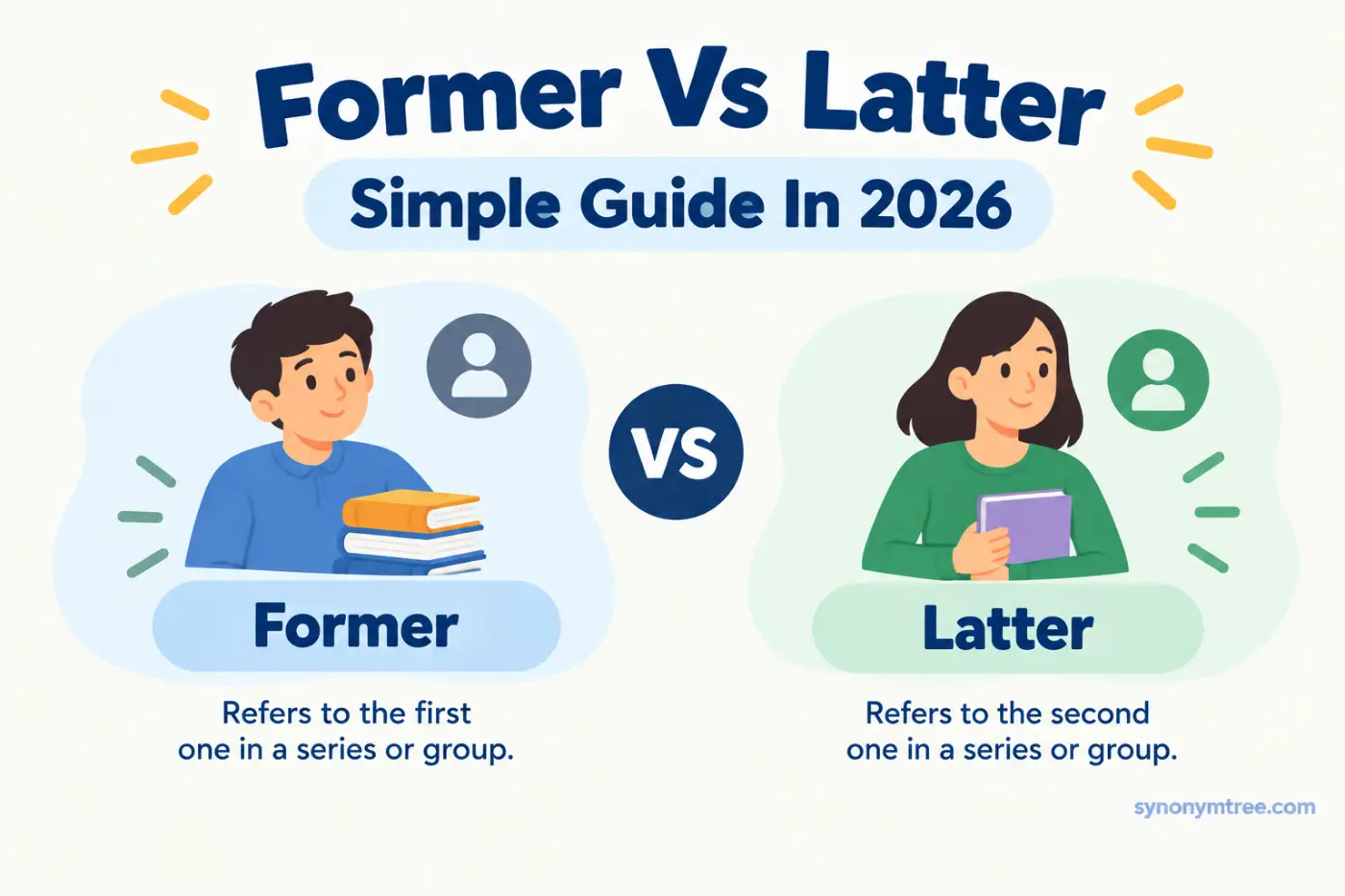
The basic rule is simple. Former refers to the first of two people or things mentioned. Latter refers to the second. Once you connect former with first and latter with last, the difference becomes much easier to remember.
For example, consider this sentence: I enjoy both hiking and swimming, but I prefer the former. The former means hiking because hiking came first. If the sentence says I prefer the latter, it means swimming because swimming came second.
This guide explains the difference between the two words, shows how they work in real sentences, covers common mistakes, and gives you easy ways to remember the rule. You’ll also see when these words sound natural and when a clearer phrase would work better.
Quick Definition
Former means the first of two people, things, or ideas that you have just mentioned. Latter means the second of two people, things, or ideas that you have just mentioned.
Think of the pair as a simple order system. Former equals first. Latter equals last.
Direct Answer
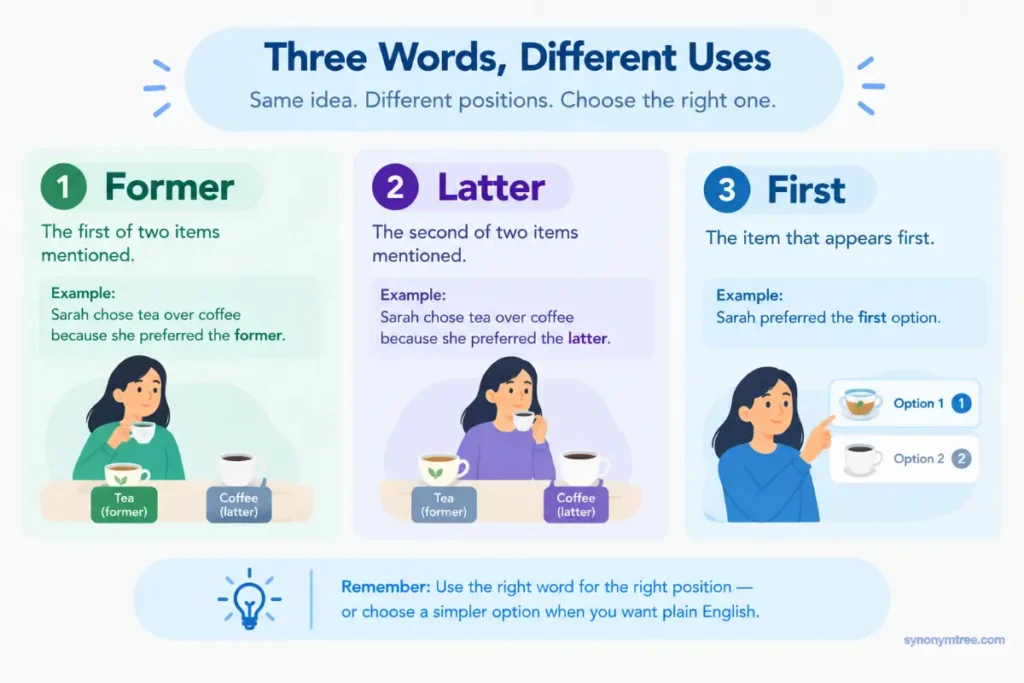
In former vs latter, former refers to the first item mentioned, while latter refers to the second item mentioned. For example, in tea and coffee, the former means tea and the latter means coffee.
Former Vs Latter Compared
| Word or Phrase | Meaning | Example Sentence | When to Use It |
|---|---|---|---|
| Former | The first of two items mentioned | Sarah chose tea over coffee because she preferred the former. | Use it for the first item. |
| Latter | The second of two items mentioned | Sarah chose tea over coffee because she preferred the latter. | Use it for the second item. |
| First | The item that appears first | Sarah preferred the first option. | Use it when you want plain English. |
| Second | The item that appears second | Sarah preferred the second option. | Use it when you want maximum clarity. |
| Earlier | Something mentioned before | The earlier idea was easier to explain. | Use it for time or order. |
| Later | Something mentioned after | The later suggestion worked better. | Use it for time or order. |
The key difference is position. Former points backward to the first item. Latter points backward to the second item.
For example, look at this sentence.
The company offers remote work and flexible hours. The former helps employees avoid long commutes.
The former refers to remote work because it appears first.
Now change the word.
The company offers remote work and flexible hours. The latter helps employees choose a schedule that fits their needs.
The latter refers to flexible hours because it appears second.
Nothing else changed. Only the reference changed.
What Does Former Mean
Former refers to the first of two people or things that you have mentioned.
Imagine that you write about apples and oranges. Apples come first. Oranges come second.
You could write:
I like apples and oranges, but I prefer the former.
The former means apples.
The word doesn’t mean that apples are old. It points to their position in the sentence.
Former can also describe a person who previously held a role or position. That use has a different meaning.
For example:
The former president spoke at the event.
Here, former means the person used to be president. It doesn’t mean the first person in a list.
That second meaning can cause confusion because the same word has two related but different uses.
In the former and latter pair, former means the first of two things mentioned. In phrases such as former employee or former teacher, it means someone who held that role in the past.
Context makes the meaning clear.
What Does Latter Mean
Latter refers to the second of two people or things mentioned.
Suppose you write:
The store sells laptops and tablets. The latter are easier to carry.
The latter refers to tablets because tablets came second.
Latter always points to something later in the order of the two items. It doesn’t mean newer or better. It simply identifies the second item.
This distinction matters because latter looks similar to later. The words share some history and meaning related to position, but they don’t always work in the same way.
For example:
I prefer the latter option.
Here, latter means the second option.
But:
We arrived later than expected.
Here, later refers to time.
A useful habit is to ask yourself what the word is doing. If you’re choosing between two things that were just mentioned, latter may be the right word. If you’re talking about time, later is usually the better choice.
Where Did Former And Latter Come From
Former and latter are old English words with roots connected to order and position.
Former developed from the idea of something that comes before another thing. Over time, it gained the meaning of the first of two items and also the meaning of something that was true in the past.
Latter developed from an older form related to later. Its main role in this pair is to identify the second of two things mentioned.
These words have stayed useful because they solve a specific problem. Instead of repeating a noun, a writer can use former or latter as a short reference.
Consider this example:
The manager discussed cost and quality. The former mattered to the budget team, while the latter mattered to the customer service team.
Without former and latter, the writer would need to repeat the nouns.
The manager discussed cost and quality. Cost mattered to the budget team, while quality mattered to the customer service team.
Both versions are correct. The second version is often clearer for a general audience.
That point becomes important in modern writing. Former and latter are useful, but plain English can sometimes make the sentence easier to understand.
Why Do Writers Confuse Former And Latter
The confusion usually comes from remembering the words without connecting them to their order.
Many people see former and think old. That meaning exists, but it isn’t the meaning used in the former and latter pair.
Others see latter and think later. That connection can help, but it can also cause mistakes if you use latter to describe time.
The easiest solution is to connect former with first.
Former means first.
Then connect latter with last.
Latter means last of the two.
For example:
Cats and dogs are common pets. I prefer the former.
Former means cats.
Cats and dogs are common pets. I prefer the latter.
Latter means dogs.
The words aren’t difficult once you stop trying to memorize long definitions. Think about their position instead.
How To Remember Former And Latter
The simplest memory trick is former starts with the idea of first.
Both former and first relate to the item that comes before the other.
For latter, think of later. The second item comes later in the list.
You can use this quick pattern:
Former = first.
Latter = second.
Another useful trick is to imagine two boxes.
The first box is former.
The second box is latter.
That mental picture works because the words normally refer to exactly two items.
You can also use a sentence pattern while practicing.
A and B. The former is A. The latter is B.
Try it with different examples.
Pizza and pasta. The former is pizza. The latter is pasta.
Summer and winter. The former is summer. The latter is winter.
Reading and writing. The former is reading. The latter is writing.
After a few examples, the pattern becomes automatic.
When Should You Use Former And Latter
Use former and latter when you have clearly mentioned two items and want to refer back to them without repeating their names.
For example:
The school offers online classes and evening classes. The former suits students who live far away.
The first option is online classes.
Now consider:
The school offers online classes and evening classes. The latter suits students who work during the day.
The second option is evening classes.
These words can make writing shorter. They can also create a formal tone.
You’ll often see them in essays, reports, academic writing, legal writing, and formal explanations.
Still, shorter doesn’t always mean clearer. If your sentence becomes difficult to follow, repeat the noun instead.
When Should You Avoid Former And Latter
Avoid these words when you mention more than two items.
For example, this sentence creates a problem:
The store sells apples, oranges, bananas, and pears. The latter are popular in winter.
Which item does latter refer to?
A reader may guess that it means pears because pears appear last. However, the traditional former and latter system works best with two clearly identified items.
A better sentence would be:
The store sells apples, oranges, bananas, and pears. Pears are popular in winter.
You can also say:
The store sells several fruits. Pears are especially popular in winter.
Clear writing doesn’t need to sound formal. If repeating the noun makes the meaning obvious, repetition can be the better choice.
Can Former And Latter Refer To People
Yes. Former and latter can refer to people as well as things.
For example:
Maria and James applied for the position. The former had more experience.
The former refers to Maria.
Maria and James applied for the position. The latter had more experience.
The latter refers to James.
The same rule applies. Look at the order in which the people appear.
Be careful with the other meaning of former when talking about people.
James is a former teacher.
This means James used to be a teacher.
It doesn’t mean James was the first person mentioned.
That difference is worth remembering because the same word can serve two different purposes.
Can Former And Latter Refer To Ideas
Yes. They can refer to ideas, choices, methods, arguments, plans, or other abstract concepts.
For example:
The writer discusses tradition and innovation. The former focuses on the past.
The former refers to tradition.
Another example is:
The manager considered hiring more staff or reducing the workload. The latter option was less expensive.
The latter refers to reducing the workload.
This use appears often in essays and reports because writers frequently compare two ideas.
Still, ask yourself if your reader can easily identify the reference. If the answer is no, repeat the idea instead.
Can You Use Former And Latter For More Than Two Things
Traditional usage limits the pair to two clearly identified items.
For example:
The teacher offered students a choice between an essay and a presentation. The former required more research.
This works perfectly.
The sentence gives the reader two choices. Former identifies the first one.
If you list three or more choices, avoid using latter as a shortcut for the final item.
Instead, name the item directly.
For example:
Students could choose an essay, a presentation, or a video project. The video project required the most editing.
That sentence leaves no doubt about the meaning.
Some writers use latter to mean the last item in a longer list. You may see this in modern writing, but it can make the sentence less precise.
For clear writing, two items is the safest rule.
Former And Latter In Academic Writing
Former and latter are common in academic writing because they let writers compare two concepts without repeating them.
For example:
The study compares individual learning and group learning. The former gives students more control over their pace. The latter creates more opportunities for discussion.
The meaning is easy to follow because only two concepts appear.
However, academic writing should still favor clarity.
If the paragraph contains several ideas, the reader may forget which noun former or latter refers to. Repeating the noun can solve the problem.
For example:
The study compares individual learning and group learning. Individual learning gives students more control over their pace. Group learning creates more opportunities for discussion.
The second version is longer, but it may be easier for readers who need to process complex information.
Former And Latter In Business Writing
Business writing often uses these terms in reports, emails, proposals, and presentations.
For example:
We can reduce costs by changing suppliers or reducing product packaging. The latter option would require less planning.
The latter option refers to reducing product packaging.
A more direct version would be:
We can reduce costs by changing suppliers or reducing product packaging. Reducing product packaging would require less planning.
Both sentences work.
The first sounds more formal. The second sounds more direct.
For emails, direct wording is often better. Readers usually want to understand the point quickly.
If you’re writing to a manager or client, don’t use former and latter just to sound sophisticated. Use them when they genuinely make the sentence smoother.
Former And Latter In Essays
These words can work well in essays when comparing two clear ideas.
For example:
Some students prefer studying alone, while others prefer studying in groups. The former approach offers more privacy, while the latter encourages discussion.
The former approach means studying alone.
The latter means studying in groups.
This structure works because the two choices appear together before the reference words.
An essay can become harder to read if you introduce too many former and latter references.
If a paragraph contains several comparisons, use the actual nouns again. Your reader shouldn’t have to scroll back mentally to solve a vocabulary puzzle.
Good academic writing should make the argument easier to follow, not harder.
Former And Latter In Emails
The pair can work in emails when you’ve just mentioned two clear options.
For example:
We can meet on Tuesday or Thursday. The latter works better for me.
The latter means Thursday.
That’s short and clear.
Still, if the email contains several dates or options, name the exact day.
For example:
We can meet on Tuesday, Wednesday, Thursday, or Friday. Thursday works best for me.
That version is much easier to scan.
Email readers often read quickly. Plain wording helps them find the important information without extra effort.
Former And Latter In Everyday Conversation
Former and latter are grammatically correct in speech, but they can sound formal.
A friend might say:
I like pizza and burgers, but I prefer the second one.
A more formal speaker might say:
I like pizza and burgers, but I prefer the latter.
Neither sentence is wrong.
The difference is tone.
In everyday conversation, people usually choose first, second, the first one, or the second one. Former and latter are more common in formal or written English.
If you want your conversation to sound relaxed, plain language usually wins.
Former Vs Latter In Real Examples
The best way to understand the difference is to see it in different settings.
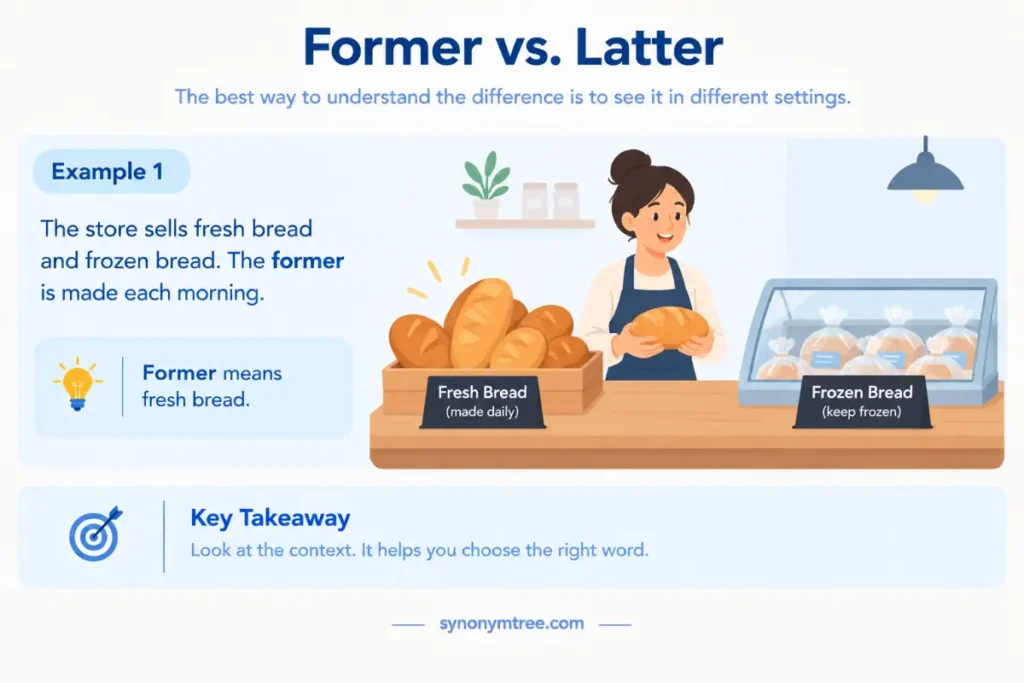
Example 1
The store sells fresh bread and frozen bread. The former is made each morning.
Former means fresh bread.
Example 2
The store sells fresh bread and frozen bread. The latter lasts longer.
Latter means frozen bread.
Example 3
John and David joined the meeting. The former spoke first.
Former means John.
Example 4
John and David joined the meeting. The latter spoke first.
Latter means David.
Example 5
The company can hire more staff or automate the process. The latter may reduce long term costs.
Latter means automate the process.
Example 6
The teacher compared online classes with classroom lessons. The former gives students more flexibility.
Former means online classes.
Example 7
The teacher compared online classes with classroom lessons. The latter offers more direct interaction.
Latter means classroom lessons.
Example 8
You can take the train or drive. The former is cheaper.
Former means taking the train.
Example 9
You can take the train or drive. The latter gives you more control over your schedule.
Latter means driving.
Example 10
The report discusses short term and long term goals. The latter require more planning.
Latter means long term goals.
Example 11
The company values speed and accuracy. The former matters during emergencies.
Former means speed.
Example 12
The company values speed and accuracy. The latter matters when checking financial records.
Latter means accuracy.
Former Vs Latter And First Vs Second
Former and latter have almost the same basic relationship as first and second.
The main difference is style.
Former and latter sound more formal.
First and second sound more direct.
Compare these sentences:
I prefer the former option.
I prefer the first option.
Both sentences point to the first choice.
Now compare:
I prefer the latter option.
I prefer the second option.
Again, both point to the second choice.
For everyday writing, first and second may be easier for most readers. Former and latter can be useful when you want a compact reference in a formal passage.
Former Vs Latter And Earlier Vs Later
These pairs look similar, but they don’t have exactly the same job.
Former and latter normally identify two items that you have mentioned.
Earlier and later often describe time.
For example:
The two options are online learning and classroom learning. I prefer the former.
Former identifies online learning.
Now consider:
I arrived earlier than my friend.
Earlier describes time.
The distinction becomes clearer with latter and later.
I prefer the latter option.
Latter identifies the second option.
I arrived later than expected.
Later describes time.
A simple test can help. If you’re pointing to one of two previously mentioned items, former or latter may fit. If you’re describing when something happened, earlier or later may fit.
Former Vs Latter And Previous Vs Next
Previous and next can also describe order, but they work differently.
Previous usually points to something that came before the current point.
Next points to something that follows.
For example:
Please review the previous page.
This means the page before the current page.
Please review the next page.
This means the page after the current page.
Former and latter work as a pair when two items have already been mentioned.
The report compares two plans. The former is cheaper, while the latter is faster.
The words previous and next wouldn’t express the same relationship as naturally.
Common Mistakes With Former And Latter
One common mistake is reversing the meanings.
Some writers think former means the second item because former sounds like something that came before. In this specific pair, former means the first item mentioned.
Another mistake is assuming latter means the last item in any list. The traditional rule works best with two items.
A third mistake is using latter when you mean later.
For example:
I will call you latter.
This is incorrect if you mean at a later time.
Write:
I will call you later.
Latter is used to identify the second of two things.
Another common mistake is using former when you mean previous.
For example:
I worked there former.
That sentence doesn’t work.
You could write:
I worked there previously.
Or:
I was a former employee there.
The right choice depends on the meaning you want.
Is Former More Formal Than First
Yes. Former usually sounds more formal than first in this type of reference.
Compare:
Of the two options, I prefer the former.
Of the two options, I prefer the first one.
The second version sounds more conversational.
That doesn’t mean former is always better in formal writing. Clarity still matters more than formality.
If your reader can understand first option immediately, there may be no reason to replace it with former.
Strong writing isn’t about choosing the fanciest word. It’s about choosing the clearest useful word.
Is Latter More Formal Than Second
Yes. Latter generally sounds more formal than second when the words identify the second of two options.
For example:
The latter choice requires less time.
sounds more formal than:
The second choice requires less time.
Both are correct.
If you’re writing a research paper, report, or formal explanation, latter may fit naturally. If you’re writing a quick message, second may sound more natural.
The audience and purpose should guide the choice.
Can Former And Latter Be Used In The Same Sentence
Yes. Using both together is common when comparing two things.
For example:
The company can improve speed or accuracy. The former saves time, while the latter reduces errors.
Former refers to speed.
Latter refers to accuracy.
This construction makes the relationship very clear because the two words appear in the same sentence and point back to the two choices.
Another example is:
The course teaches reading and writing. The former builds comprehension, while the latter develops communication skills.
Again, former means the first item and latter means the second.
Is It Better To Say The Former Or The Latter
The answer depends on your sentence and audience.
Use former when you want to refer to the first of two items.
Use latter when you want to refer to the second.
However, you don’t have to use either word. You can repeat the noun if that makes the sentence clearer.
For example:
The manager discussed hiring and training. The former requires more money.
This is correct.
But:
The manager discussed hiring and training. Hiring requires more money.
This may be even clearer.
Good writers choose clarity over unnecessary formality.
A Simple Test For Former And Latter
When you’re unsure, stop and identify the two items.
Write them mentally as A and B.
A = former.
B = latter.
For example:
Coffee and tea.
Coffee = former.
Tea = latter.
Now try:
The company discussed hiring and training.
Hiring = former.
Training = latter.
This simple test takes only a second.
If you have three or more items, name the item instead of relying on former or latter.
If you are talking about time, check if later or earlier would make more sense.
That quick check prevents most mistakes.
How Former And Latter Improve Writing
These words can prevent repeated nouns from appearing in the same paragraph.
Consider this example:
The report compares online shopping and in store shopping. Online shopping gives customers more convenience. In store shopping gives customers a chance to see products before buying them.
Now compare:
The report compares online shopping and in store shopping. The former gives customers more convenience, while the latter gives them a chance to see products before buying them.
The second version is shorter.
It also creates a clear comparison between the two ideas.
The tradeoff is that the reader must remember the order.
That’s why former and latter work best when the two items are close together and easy to identify.
When Repeating The Noun Is Better
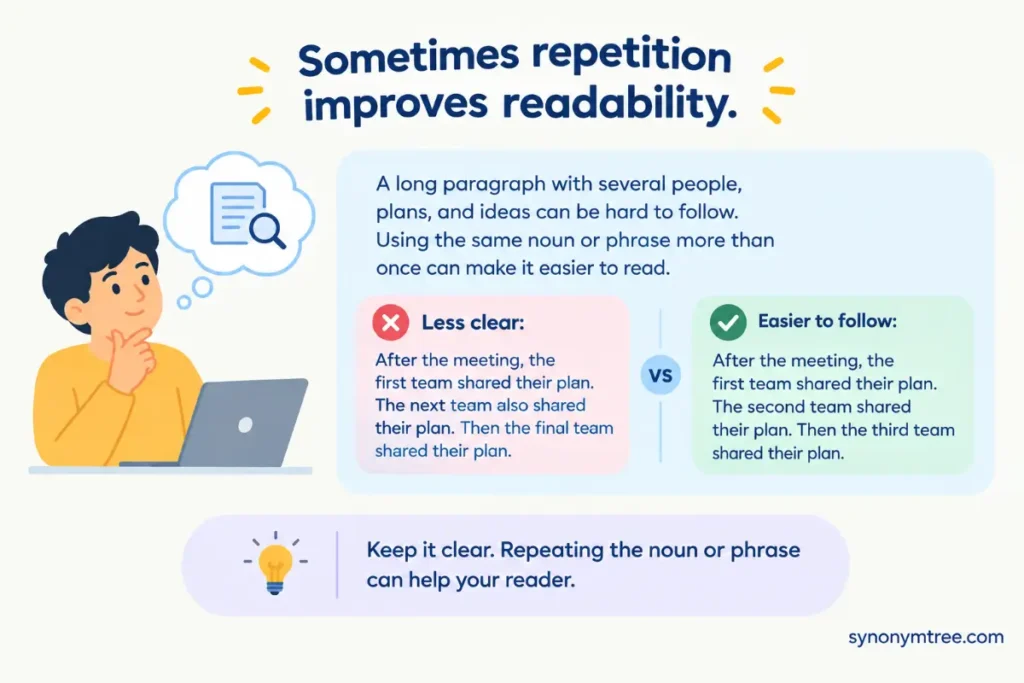
Sometimes repetition improves readability.
Imagine a long paragraph that mentions several people, plans, and ideas. A sentence using former or latter might force the reader to search backward.
For example:
The manager discussed the hiring plan with the sales director and then reviewed the training plan with the operations director. The latter had already approved the budget.
Who does latter refer to?
The operations director? The training plan? The last person? The sentence creates confusion.
A clearer version would be:
The manager discussed the hiring plan with the sales director and then reviewed the training plan with the operations director. The operations director had already approved the budget.
The noun is repeated, but the meaning is much clearer.
That is a good lesson for any writer. Shorter isn’t always better.
Quick Rules To Remember
Former refers to the first of two things mentioned.
Latter refers to the second of two things mentioned.
Former can also mean something that was true in the past.
Latter is not the same as later.
Use former and latter mainly when two items are clearly identified.
Avoid using them for long lists.
Repeat the noun when the reference might confuse the reader.
Use first and second when you want simpler everyday English.
Use former and latter when they make a formal sentence shorter without reducing clarity.
Conclusion
The easiest way to understand former vs latter is to focus on order. Former refers to the first of two people, things, or ideas you mention. Latter refers to the second. If you write about coffee and tea, coffee is the former and tea is the latter.
Former also has another meaning. It can describe someone or something that existed or held a position in the past. Latter does not normally carry that meaning.
When you use these words, keep the two items close together so your reader can identify them quickly. If the reference feels unclear, repeat the noun or use first and second instead. Clear writing matters more than sounding formal.
A quick memory trick can save you every time. Former means first. Latter means second. Keep that pair in mind and you’ll have little trouble choosing the right word.
Frequently Asked Questions
What is the difference between former and latter?
Former means the first of two things mentioned. Latter means the second of two things mentioned. For example, in apples and oranges, apples are the former and oranges are the latter.
Which comes first former or latter?
Former comes first. A simple way to remember the pair is former equals first and latter equals second.
Is former or latter the second one?
Latter is the second one. If you mention A and B, A is the former and B is the latter.
Can former and latter refer to more than two things?
They work best when you have exactly two things in mind. For three or more items, name the specific item instead of using former or latter.
Is latter the same as later?
No. Latter usually identifies the second of two things. Later usually refers to time or something that happens after another event.
Is former the same as first?
Former can mean the first of two things in this specific usage. First is more common in everyday English, while former often sounds more formal.
What is an easy way to remember former and latter?
Remember this simple pair: former means first and latter means second. If you mention two things as A and B, A is former and B is latter.
