
Accept vs except confuses even sharp writers, and it’s not because they’re careless. These two words sound almost the same when spoken fast, and that tiny sound gap is where the trouble starts.
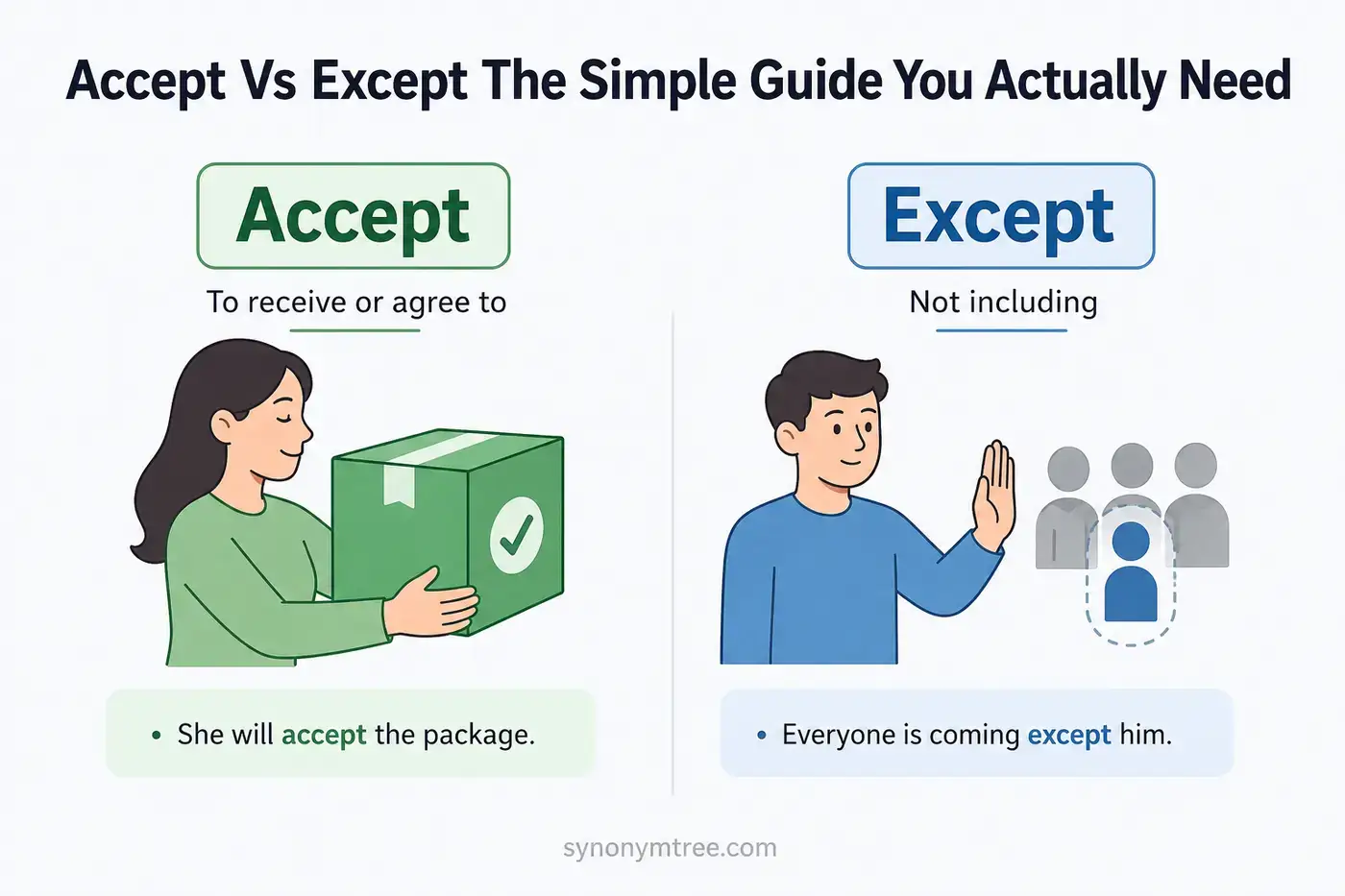
Here’s the plain truth. Accept means you’re saying yes to something or taking it in. Except means you’re leaving one thing out of a group. Once that idea sticks, the guessing stops for good.
This guide walks through it step by step, the way a patient teacher would in a real classroom. No heavy grammar talk. Just clear examples you can use in a text, an email, or a school paper today.
Simple Answer In One Look
Accept means you agree to something or you take it.
Except means one thing gets left out of the rest.
That’s the whole idea in two lines. Everything below just builds on it.
What This Means In Simple English
Picture accept as a hand reaching out and grabbing something offered to it. A friend hands you a gift, and you accept it. A teacher gives you advice, and you accept it. Your mind is saying yes.
Except works the opposite way. It points at the one thing that doesn’t belong with the rest. Think of a bowl full of apples with a single orange sitting inside. You’d say every piece of fruit in that bowl is an apple except the orange. That one item gets pulled out of the group and set apart.
So accept is about saying yes and pulling something in. Except is about pointing out and leaving something out. Two different jobs, even though the words sound like distant cousins.
Why People Mix These Words
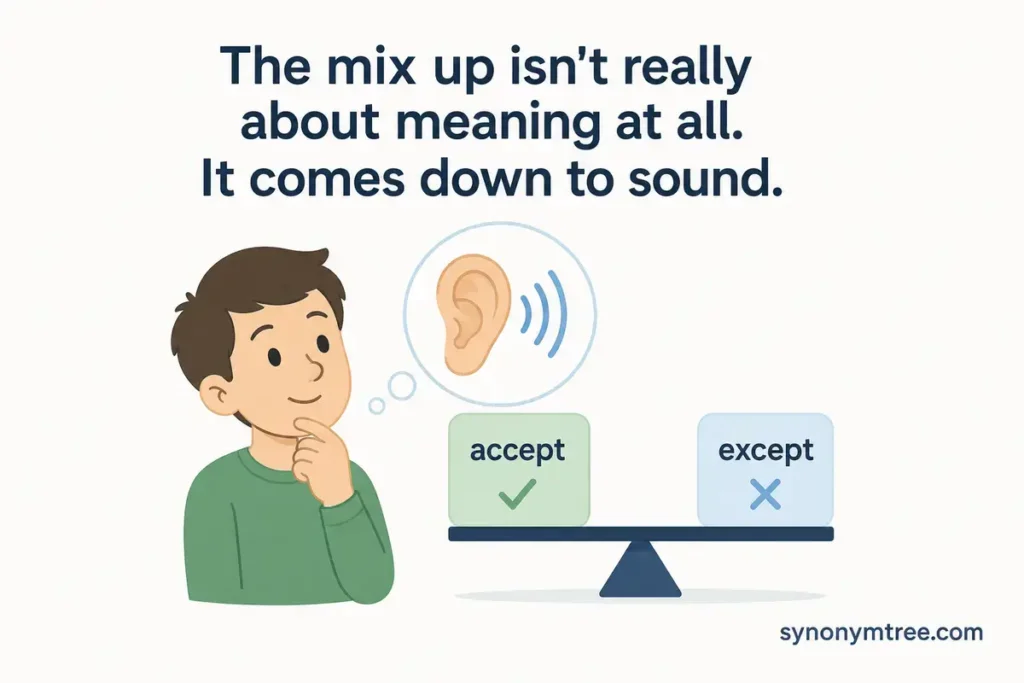
The mix up isn’t really about meaning at all. It comes down to sound. Say accept and except out loud right now, back to back. Notice how close they feel on your tongue. The opening sound barely changes, and your ear can miss it completely.
Autocorrect doesn’t help matters either. Phones swap one word for the other without asking first. Plenty of people also picked up these words by ear rather than by reading them slowly, so the spelling never fully locked in.
Here’s a real example people run into daily. Someone types I will except your offer instead of I will accept your offer. Read out loud, the sentence sounds fine. On paper, it’s flat out wrong. That’s the trap waiting in almost every inbox.
Clear Difference Explained Simply
Let’s line these two words up so the gap between them is easy to see.
- Accept is a verb, and it means to receive, agree to, or say yes to something.
- Except usually works to show exclusion, meaning it leaves something out.
- Accept pulls something toward you. Except pushes one thing away from a group.
- You accept a gift, an apology, or an invitation someone sends your way.
- You skip every day except Sunday, or you count every student except one.
Picture a teacher taking attendance. Every student answers except Maria, who’s home sick. Now picture that same teacher handing out a prize a moment later. The winning student happily accepts it. Same classroom, two completely different jobs for two very different words.
Which Form Should You Use?
Ask yourself one quick question before you type either word. Am I agreeing to something, or am I leaving something out?
If the answer points to agreeing, taking, or saying yes, reach for accept. If the answer points to leaving out or excluding, reach for except.
Try this small trick too. Swap the word for excluding right inside your sentence. If it still reads naturally, except is the right pick. She works every day excluding Friday makes sense, so except belongs there. She will excluding your offer makes no sense at all, so that sentence calls for accept instead.
This one small swap clears up almost every mix up within seconds, no grammar rulebook needed.
Easy Real Life Sentences You Can Use
- I accept your apology, and we’re good now.
- He’ll accept the job offer sometime this week.
- Everyone showed up to the party except John.
- She eats pretty much every vegetable except peas.
- Please accept my thanks for all your help.
- The store stays open every day except Sunday.
- They accepted the new rules without a single complaint.
- All of us passed the test except one student.
Read these sentences out loud a few times in a row. Your ear starts catching the pattern almost on its own after that.
Where This Word Comes From
Both words trace back to Latin roots, and that little bit of history actually clears up the confusion nicely. Accept comes from a Latin word meaning to take or receive. Except comes from a Latin word meaning to take out. So even centuries ago, one word meant bringing something in and the other meant pulling something out. English kept both words, and the spelling stayed close enough to keep tripping people up right through today.
You don’t need this history lesson to use the words correctly, but it does explain why they feel so linked even though their jobs sit at opposite ends of the spectrum.
Once the roots make sense, it gets easier to spot how these two words show up in bigger conversations, everyday stories, and old sayings people still use without thinking twice. Section two takes a closer look at how accept and except carry meaning in culture, daily speech, and the small habits of language most of us never question.
How This Word Is Understood In Culture And Stories
Accept and except both carry weight far beyond grammar class. You’ll hear accept in songs about self love, in speeches about forgiveness, and in stories where a character finally stops fighting their own past. It’s the word writers reach for when someone lets something in, whether that’s an apology, a new chapter, or a hard truth about themselves.
Except plays a smaller but sharper role in storytelling. It’s the word that sets one thing apart from the crowd. A whole village believes the myth except one old farmer who knows better. Everyone laughs at the joke except the person it’s actually about. That single exception often carries the real message of the story, tucked quietly behind one small word.
Put simply, accept tends to show up at moments of peace, and except tends to show up at moments of tension. Neither word is flashy, but both do heavy lifting in the way stories move and breathe.
Biblical And Mythological Meaning
Older texts and religious writings use accept in a way that still feels familiar today. People accept grace, accept forgiveness, or accept a path laid out for them. The meaning hasn’t drifted much across centuries. It still points to receiving something offered in good faith.
Except also appears often in these same texts, usually to carve out one exception inside a larger promise or rule. A passage might describe a blessing meant for everyone except a certain group, or a command that applies to all except a chosen few. This steady use across generations shows just how dependable these two small words have always been.
Symbolism Explained In Simple Words
What Accept Represents
Accept represents an open hand. It’s the word tied to letting something in, whether that’s a person, an idea, a mistake, or a whole new direction in life. Saying you accept something often means you’ve stopped resisting it and started living with it.
What Except Represents
Except represents a quiet boundary line. It marks off the one item, person, or moment that doesn’t sit with the rest of the group. There’s nothing harsh about it by nature. It just points a finger at a difference and leaves it there.
Side by side, the two words work like a pair of matching bookends. One welcomes something into the group. The other steps one thing outside of it.
Related Words You Should Know
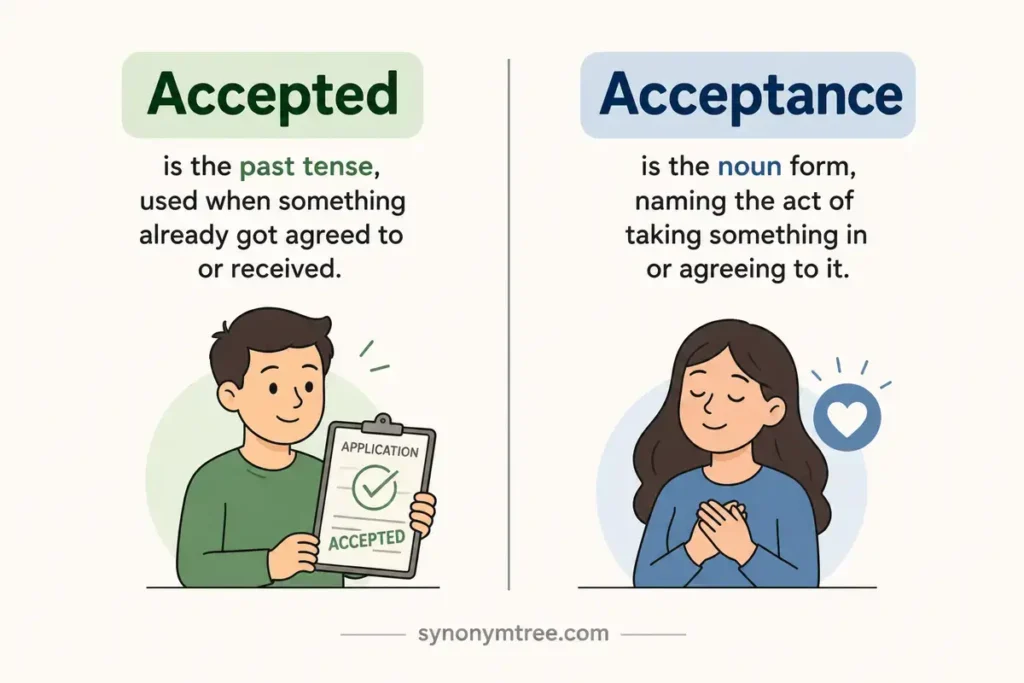
- Accepted is the past tense, used when something already got agreed to or received.
- Acceptance is the noun form, naming the act of taking something in or agreeing to it.
- Excepting shows up occasionally as another way to say leaving something out.
- Exception is the noun form, naming the one thing pulled out of a larger group.
- Exclude sits near except in meaning, since it also means leaving something out on purpose.
Knowing these forms keeps sentences clean, so you won’t confuse her quick acceptance of the offer with everyone left the room excepting two people who stayed behind.
How People Actually Use It In Daily English
- I’ve accepted that things won’t go back to how they were.
- Does this shop accept cash, or is it cards only.
- My cousin got accepted into nursing school this fall.
- Every store on this street closes early except the bakery.
- All staff need badges except visitors signed in at the desk.
- He accepts criticism without getting defensive, which I respect.
- I’ll eat almost anything except mushrooms, no matter how they’re cooked.
- We accepted their counteroffer after talking it over for a day.
- Everything on that shelf is on sale except the last row.
- The gym accepts new members on a rolling basis all year.
Notice how accept keeps circling back to agreement and receiving, while except keeps circling back to leaving something out. That split never really changes, sentence after sentence.
Accept Vs Except At A Glance
| Word | Part of Speech | Meaning | Example |
|---|---|---|---|
| Accept | Verb | To agree to or receive something | She accepted the award with a smile. |
| Except | Preposition | To leave one thing out of a group | Everyone came except Sam. |
| Accepted | Past tense of accept | Already agreed to or received | He accepted the offer yesterday. |
| Exception | Noun | The one thing left out | She was the only exception to the rule. |
This quick table sums up everything covered so far in one place, so you can glance back at it anytime you’re unsure.
Common Mistakes People Make
The most common slip is typing except when accept was actually intended, usually in a rushed message. I will except your terms is incorrect. The sentence needs to read I will accept your terms instead.
A second mistake happens when accept lands in a spot built for exclusion. All students accept Maria passed sounds like Maria got left off the list, but the writer almost certainly meant except in that spot.
The fastest fix is slowing down and asking one plain question before hitting send. Am I saying yes, or am I leaving something out. That single question catches almost every slip before it happens.
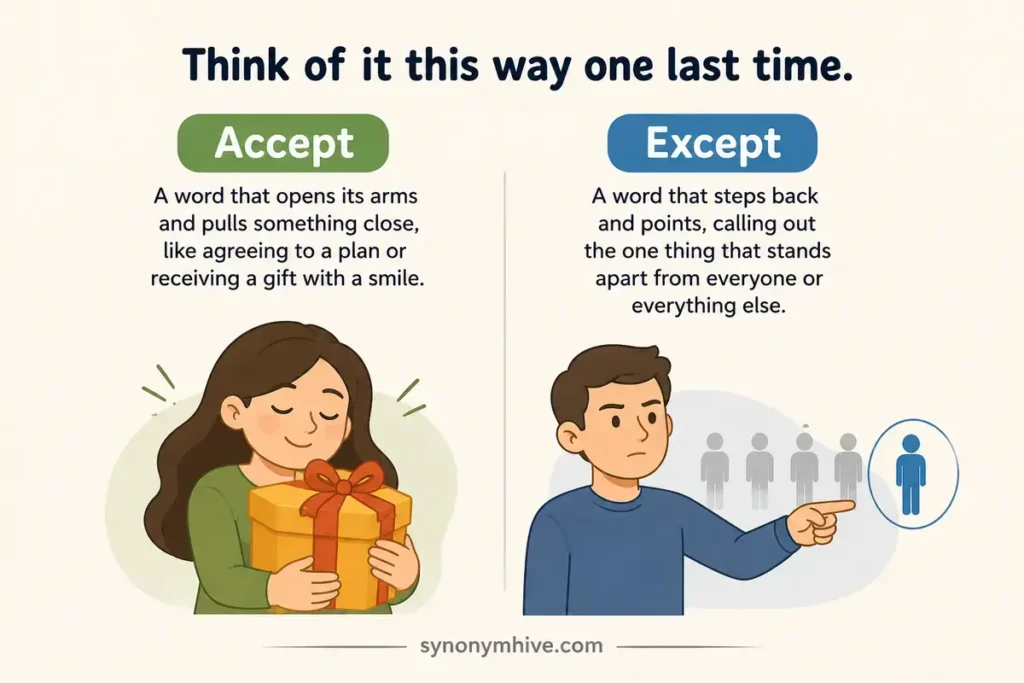
Final Teacher Explanation
Think of it this way one last time. Accept is a word that opens its arms and pulls something close, like agreeing to a plan or receiving a gift with a smile. Except is a word that steps back and points, calling out the one thing that stands apart from everyone or everything else.
When your sentence leans toward yes, agreement, or receiving, accept fits. When your sentence leans toward leaving something out or naming an exception, except fits. Reread your sentence and ask which job it needs done. That habit alone will keep you accurate for good.
Final Thoughts
Accept means you’re agreeing to or receiving something. Except means you’re setting one thing apart from a group. Yes and welcome point to accept. Leaving out and setting apart point to except.
Mastering accept vs except really comes down to noticing the sound and trusting the small test of swapping in excluding. Once that habit forms, the mix ups fade fast, and your writing starts sounding sharper without any extra effort.
Keep these examples nearby the next time doubt creeps in mid sentence. A short reread will settle the question in seconds, and soon this choice will feel completely automatic.
Frequently Asked Questions
What does accept mean in simple words.
Accept means agreeing to something or receiving it warmly. It’s the word you reach for when your answer is yes.
What does except mean in simple words.
Except means setting one thing apart from a group or a list. It points at the item that doesn’t belong with the rest.
Is it correct to say I except your offer.
No, that’s incorrect. The correct wording is I accept your offer, since you’re agreeing to receive something.
When should I use except instead of accept.
Reach for except when you’re calling out one thing that doesn’t belong with the rest of a group, like everyone except one person.
Why do people get confused between accept and except.
Both words sound nearly the same when spoken quickly, so the ear often can’t catch the small difference between them.
Can I use both words in the same sentence.
Yes, and it happens often. For example, the whole team accepted the new schedule except one person who had a conflict.
What’s the easiest trick to remember the difference.
Think of accept as a hand pulling something in, and except as a line drawn around a group to set one thing apart from it.
Is except always used to show exclusion.
Nearly always, yes. Except almost always signals that one thing is being left out of a bigger group or list.
