
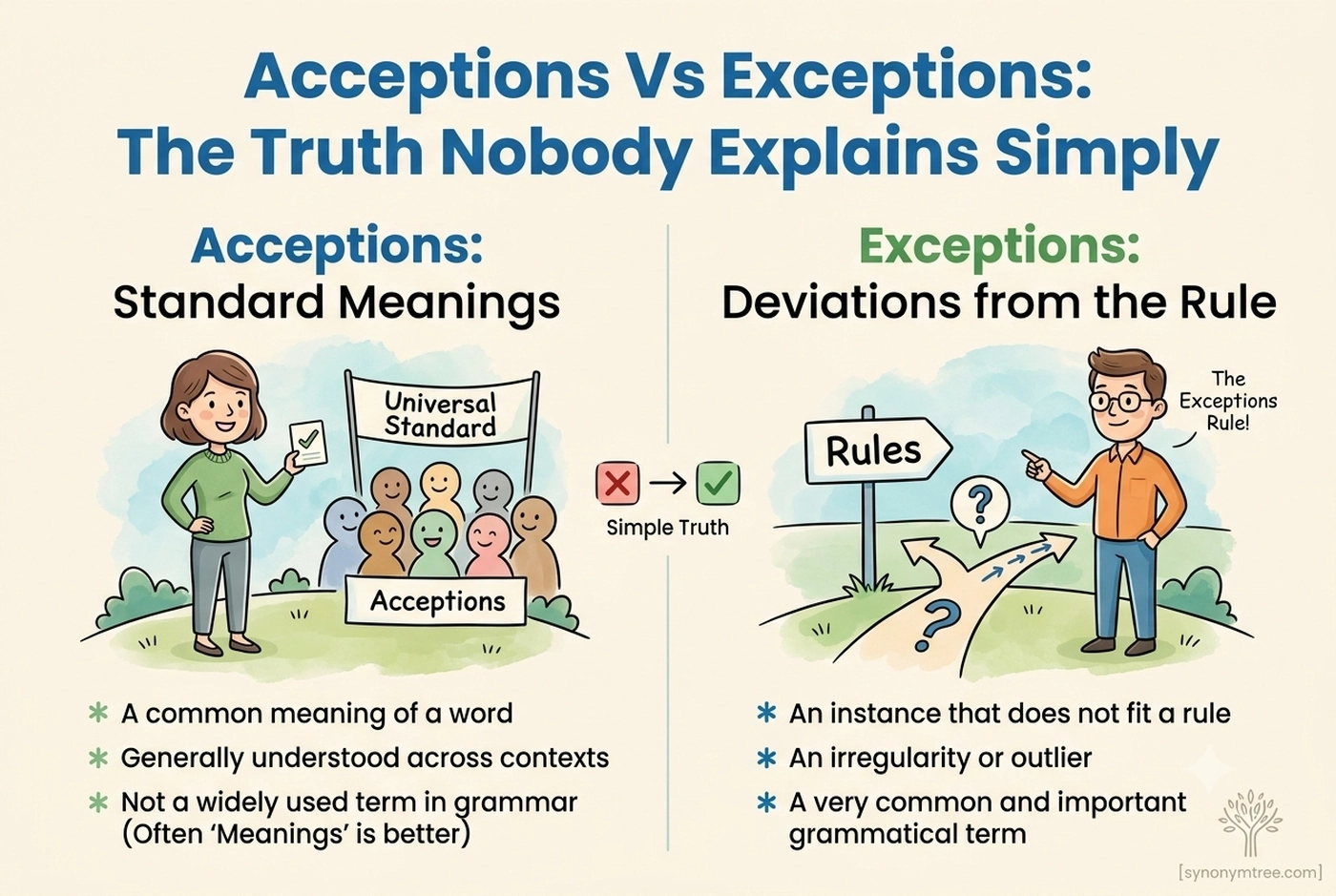
Acceptions vs exceptions is a mix up a lot of people run into without even knowing it. Here’s the short version. Acceptions isn’t actually a standard English word. The correct word almost every time is exceptions, and that one small fact clears up most of the confusion right away.
People hear exceptions spoken out loud and their brain quietly turns it into acceptions, especially when it’s mixed with the word accept in the same sentence. It’s an honest mistake, and it happens more often than you’d think.
This guide breaks it down step by step, the way a patient teacher would in a real classroom. No heavy grammar talk. Just clear examples you can use in a text, an email, or a school paper today.
Simple Answer In One Look
Exceptions is the correct word, and it means things left out of a general rule.
Acceptions isn’t a real word in standard English, even though it sounds like it could be one.
That’s the whole idea in two lines. Everything below just builds on it.
What This Means In Simple English
Exceptions are the items that don’t follow the usual rule. Picture a class rule that says every student must wear a uniform. One student has a medical note, so they’re allowed to skip it. That student is an exception to the rule.
Acceptions sounds like it should mean something similar, maybe things that get accepted. But standard English doesn’t use that word at all. The real word for that idea is acceptance, which is a totally different noun tied to the verb accept.
So when someone says acceptions, their brain is likely blending two real words together, exceptions and acceptance, into one word that doesn’t actually exist in dictionaries.
Why People Mix These Words
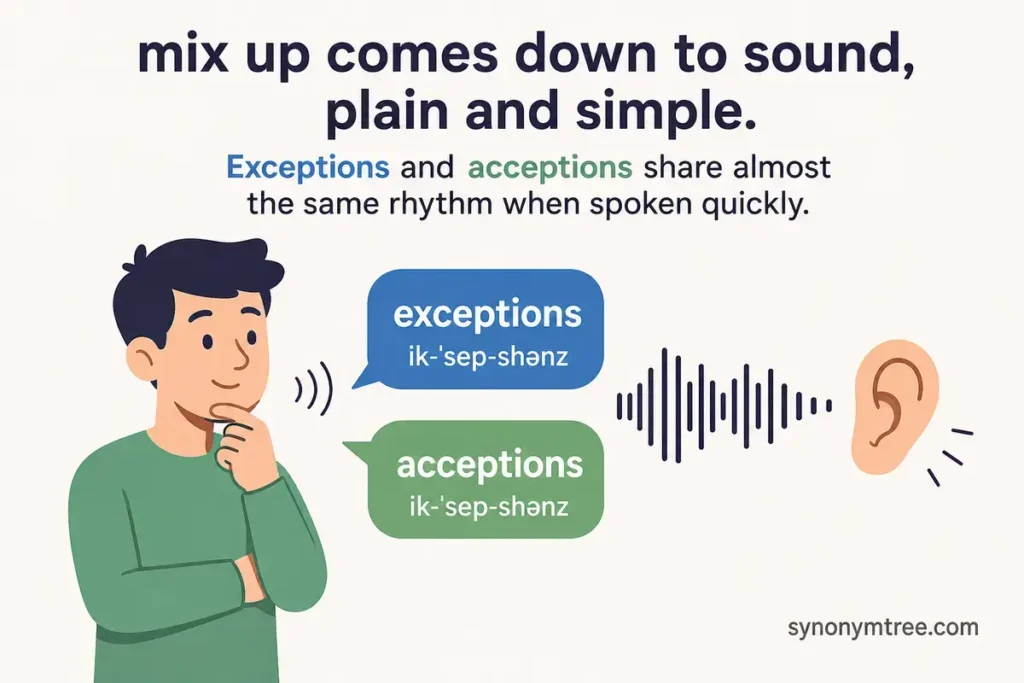
This mix up comes down to sound, plain and simple. Exceptions and acceptions share almost the same rhythm when spoken quickly. The middle part of both words sounds nearly identical, and the ear can’t always catch the small difference at the front.
Autocorrect makes things worse too. Some keyboards don’t flag acceptions as wrong, so it slips through unnoticed in texts and emails. Plenty of people also learned these words by ear rather than by reading them slowly, so the correct spelling never fully locked in.
Here’s a real example people run into daily. Someone types there are a few acceptions to this rule instead of there are a few exceptions to this rule. Read out loud, it sounds fine. On paper, it’s simply incorrect.
Clear Difference Explained Simply
Let’s line these up so the difference is easy to see at a glance.
- Exceptions is a real, standard English word that means things left out of a rule.
- Acceptions is not a standard word, even though it sounds like it belongs in the language.
- The correct noun tied to accept is acceptance, not acceptions.
- You’d say every rule has exceptions, never every rule has acceptions.
- You’d say her acceptance of the offer surprised us, never her acceptions of the offer surprised us.
Picture a sign at a store that reads all sales are final except for exceptions listed at checkout. That sign is using exceptions correctly. If it said except for acceptions listed at checkout, that sentence would confuse most native speakers instantly.
Which Form Should You Use?
Use exceptions any time you mean things left out of a general rule. That’s the only correct choice between the two, since acceptions doesn’t hold a place in standard English at all.
If you’re trying to talk about someone agreeing to or receiving something, the word you actually need is acceptance, not acceptions. Her quick acceptance of the job offer surprised everyone is correct. Her acceptions of the job offer is not.
A simple test works well here. Ask yourself if you mean things left out, or if you mean the act of agreeing to something. The first case always calls for exceptions. The second case always calls for acceptance.
Easy Real Life Sentences You Can Use
- Every rule has a few exceptions, and this one is no different.
- The teacher made an exception for students who were sick that day.
- Her acceptance of the award felt well earned after years of hard work.
- There are no exceptions to the dress code this week.
- His calm acceptance of the bad news surprised his coworkers.
- Most stores accept returns, but there are a few exceptions listed on the receipt.
- The club’s acceptance rate dropped after the new rules started.
- We made an exception this one time, but it won’t happen again.
Read these sentences out loud a few times in a row. Your ear starts locking onto the correct pattern fast once exceptions and acceptance get separated in your mind.
Where This Word Comes From
Exceptions comes from a Latin root that means to take out or leave out, which lines up perfectly with how the word works today. Acceptance comes from a different Latin root that means to take or receive, which also lines up with its modern meaning.
Acceptions likely formed by accident, as a blend created when speakers merged the sound of exceptions with the meaning of acceptance. It never became a real, accepted word in standard dictionaries, even though the blend feels natural to say out loud.
Knowing this small bit of history explains exactly why the mix up happens so often. Two real words with two real Latin roots quietly collided, and a third word that doesn’t officially exist slipped into casual speech.
Once you see how these words split apart at the root, it gets easier to notice how exceptions and acceptance show up in bigger conversations, everyday sayings, and even stories people tell without thinking twice about the words they’re choosing. Section two takes a closer look at how these two ideas carry meaning in culture, daily speech, and the small habits of language most of us never question.
How This Word Is Understood In Culture And Stories
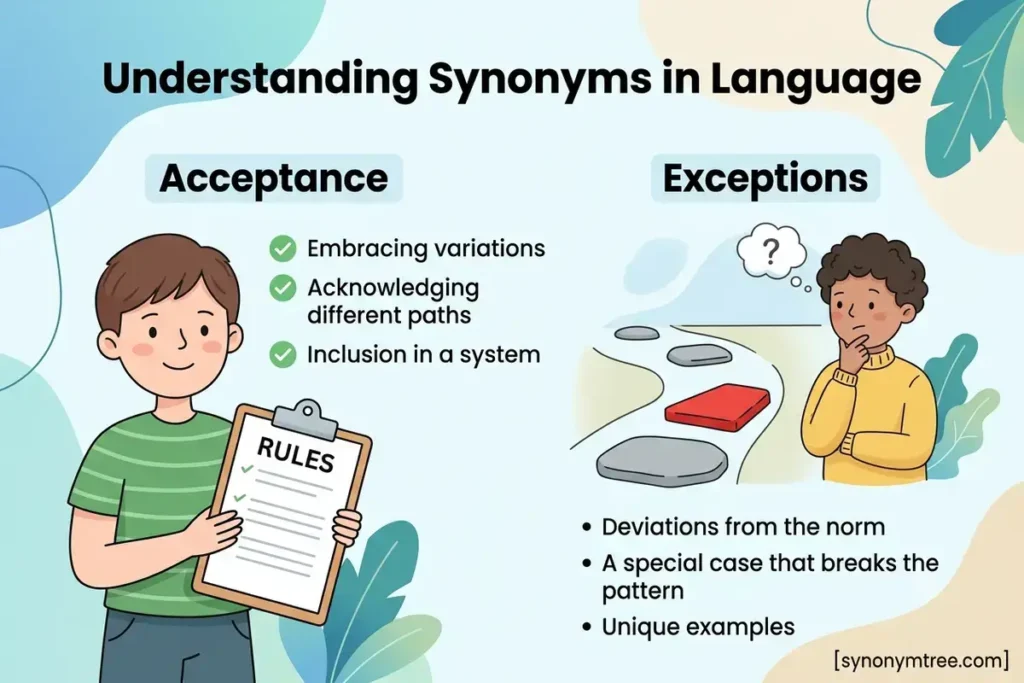
Exceptions show up everywhere in the way people talk about life. You’ll hear someone say every rule has its exceptions when they’re explaining why one situation doesn’t fit the usual pattern. It’s a phrase that pops up in family talks, workplace policies, and even casual arguments between friends.
Acceptance shows up just as often, but it carries a softer, more personal tone. People talk about accepting change, accepting a loss, or accepting who they’ve become over time. It’s tied closely to peace and moving forward, rather than to rules and lists.
Acceptions doesn’t really show up in culture at all, since it isn’t a real word. When people do type it or say it, they’re almost always reaching for exceptions or acceptance without realizing the two got tangled together in their head.
Biblical And Mythological Meaning
Older texts and religious writings lean heavily on both real words here. Exceptions often shows up when a rule gets described along with the rare case where it doesn’t apply, like a law given to everyone except one small group. Acceptance shows up in a warmer sense, tied to grace, forgiveness, and being welcomed in without judgment.
Both ideas have stayed remarkably steady across centuries of translation and retelling. A rule with its exceptions and a heart that shows acceptance are themes that show up again and again in old stories, long before modern grammar guides ever existed.
Symbolism Explained In Simple Words
What Exceptions Represents
Exceptions represents the idea that rules aren’t always perfect fits for every single case. It stands for flexibility, for the one situation that breaks the pattern and still gets acknowledged fairly. It’s less about breaking rules and more about recognizing when a rule needs a little room to bend.
What Acceptance Represents
Acceptance represents letting go of resistance. It stands for peace, for finally agreeing with a situation instead of fighting it. When someone reaches acceptance, they’ve usually stopped asking why and started figuring out what comes next.
Together, these two real words cover very human ground. One admits that rules have limits. The other admits that people need to make peace with things beyond their control.
Related Words You Should Know
- Exception is the singular form, describing one single case left out of a rule.
- Except is the word used to introduce that one case, as in everyone except her.
- Accept is the verb form, meaning to agree to or receive something.
- Accepted is the past tense, used when something already got agreed to.
- Acceptable is an adjective describing something that meets a standard well enough to be approved.
Knowing these five words keeps your writing accurate, since none of them ever get spelled as acceptions in correct, standard English.
How People Actually Use It In Daily English
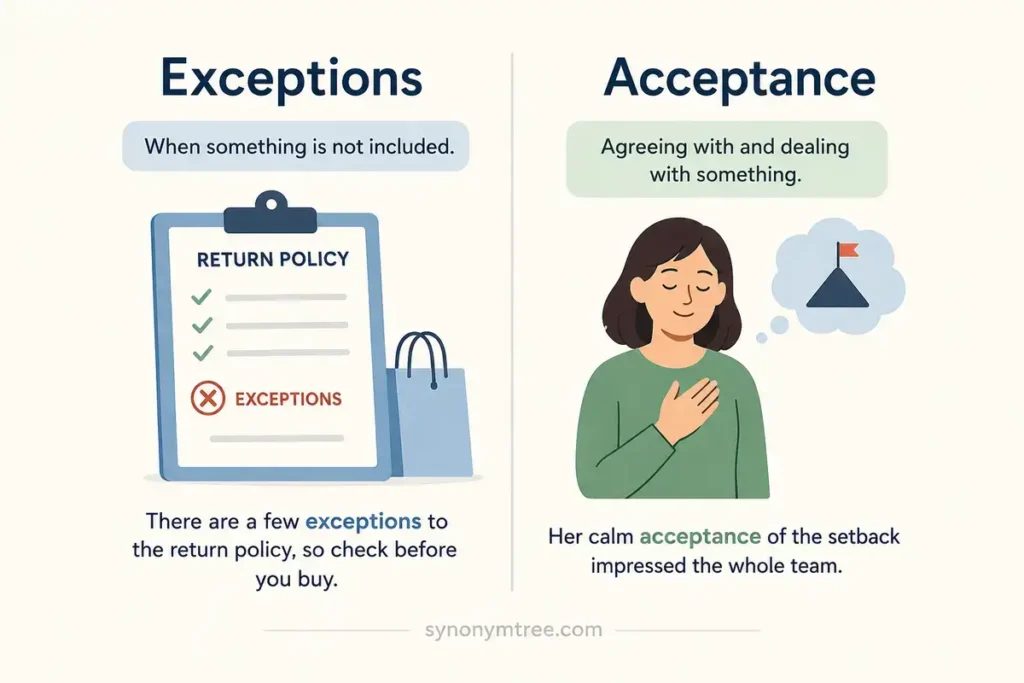
- There are a few exceptions to the return policy, so check before you buy.
- Her calm acceptance of the setback impressed the whole team.
- Every workplace has exceptions to its normal schedule during holidays.
- He finally reached a place of acceptance after a rough year.
- The rule applies to everyone, with no exceptions this time.
- Their quick acceptance of the plan saved everyone a lot of time.
- Most teachers make an exception if a student has a real emergency.
- Self acceptance takes practice, and it rarely happens overnight.
- The list of exceptions gets shorter every year as rules tighten up.
- His acceptance letter arrived earlier than anyone expected.
Notice how exceptions keeps circling back to rules and rare cases, while acceptance keeps circling back to agreement and peace. Neither one ever gets spelled acceptions in correct writing.
Common Mistakes People Make
The most common mistake is typing acceptions when exceptions was the actual word needed. There are a few acceptions to this rule is incorrect. It should read there are a few exceptions to this rule.
A second mistake happens when acceptions gets used in place of acceptance. Her acceptions of the offer felt genuine is incorrect. The correct sentence reads her acceptance of the offer felt genuine.
The easiest fix is pausing before you type and asking one plain question. Do I mean something left out of a rule, or do I mean the act of agreeing to something. The first case needs exceptions. The second case needs acceptance. Acceptions never fits either spot.
Final Teacher Explanation
Here’s the simplest way to remember this for good. Exceptions is the word for the rare case that doesn’t follow the usual rule, like the one kid excused from a class trip. Acceptance is the word for agreeing to or making peace with something, like finally saying yes to a new plan.
Acceptions tries to sit in the middle of both words, but it isn’t a real word at all. If you ever feel tempted to type it, stop and ask which of the two real words actually fits your sentence. That one habit will keep your writing sharp and correct every time.
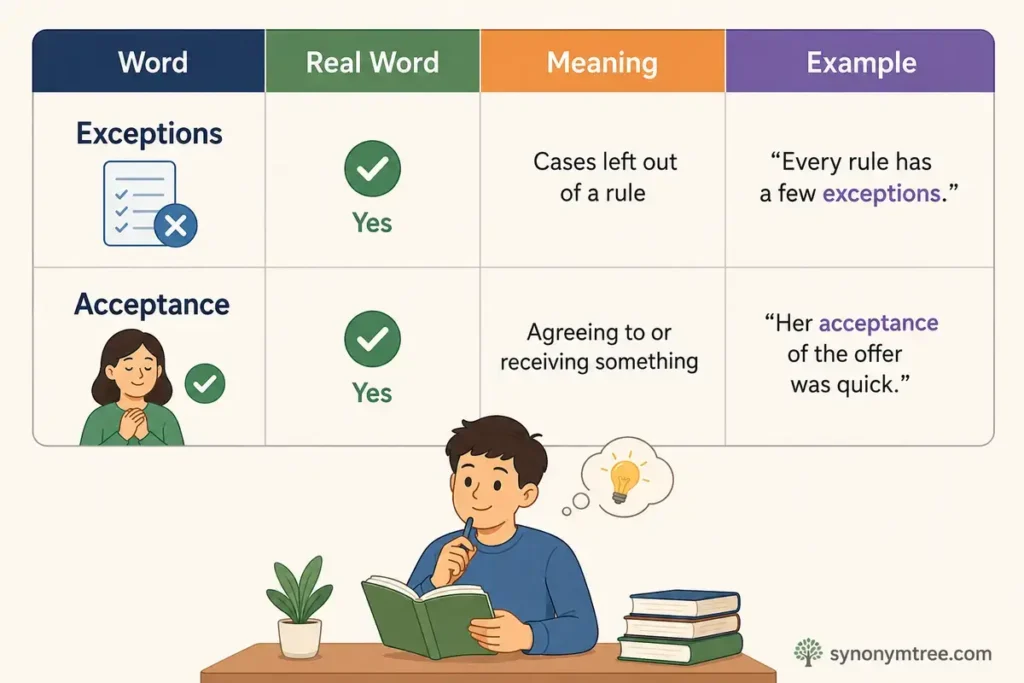
Acceptions Vs Exceptions At A Glance
| Word | Real Word | Meaning | Example |
|---|---|---|---|
| Exceptions | Yes | Cases left out of a rule | Every rule has a few exceptions. |
| Acceptance | Yes | Agreeing to or receiving something | Her acceptance of the offer was quick. |
| Acceptions | No | Not a standard English word | Should be replaced with exceptions or acceptance. |
Final Answer Quick Recap
Exceptions means the cases left out of a general rule. Acceptance means agreeing to or receiving something with peace. Acceptions is not a real word, and it should never replace either one in your writing.
Getting this right really just takes noticing the pattern once and sticking with it. Once you know exceptions handles rules and acceptance handles agreement, the mix up disappears fast, and your writing starts sounding cleaner without any extra effort.
Keep this guide close by the next time doubt creeps in mid sentence. A short reread will settle the question in seconds, and soon the correct choice will feel completely automatic.
Frequently Asked Questions
What does acceptions mean in simple words.
Acceptions isn’t a real word in standard English. People usually mean exceptions or acceptance when they type it.
Is it correct to use acceptions or exceptions.
Exceptions is correct. Acceptions doesn’t appear in standard dictionaries and should be avoided in formal writing.
When should I use the word exceptions.
Use exceptions when you’re talking about cases left out of a general rule, like every rule has exceptions.
Why do people get confused between acceptions and exceptions.
The two words sound alike when spoken quickly, and acceptions likely formed by blending exceptions with acceptance.
Can I use acceptions in writing.
No, it’s best avoided completely. Use exceptions for rule based cases and acceptance for agreement based cases instead.
What’s the difference between exceptions and acceptance.
Exceptions refers to cases left out of a rule. Acceptance refers to agreeing to or receiving something with peace.
Is acceptions used anywhere correctly.
Not in standard English. It shows up in casual speech and typos, but it isn’t recognized as a correct word.
What’s the easiest way to remember the correct word.
Think of exceptions for rules with rare cases, and acceptance for agreeing to something. Acceptions fits neither spot correctly.
