
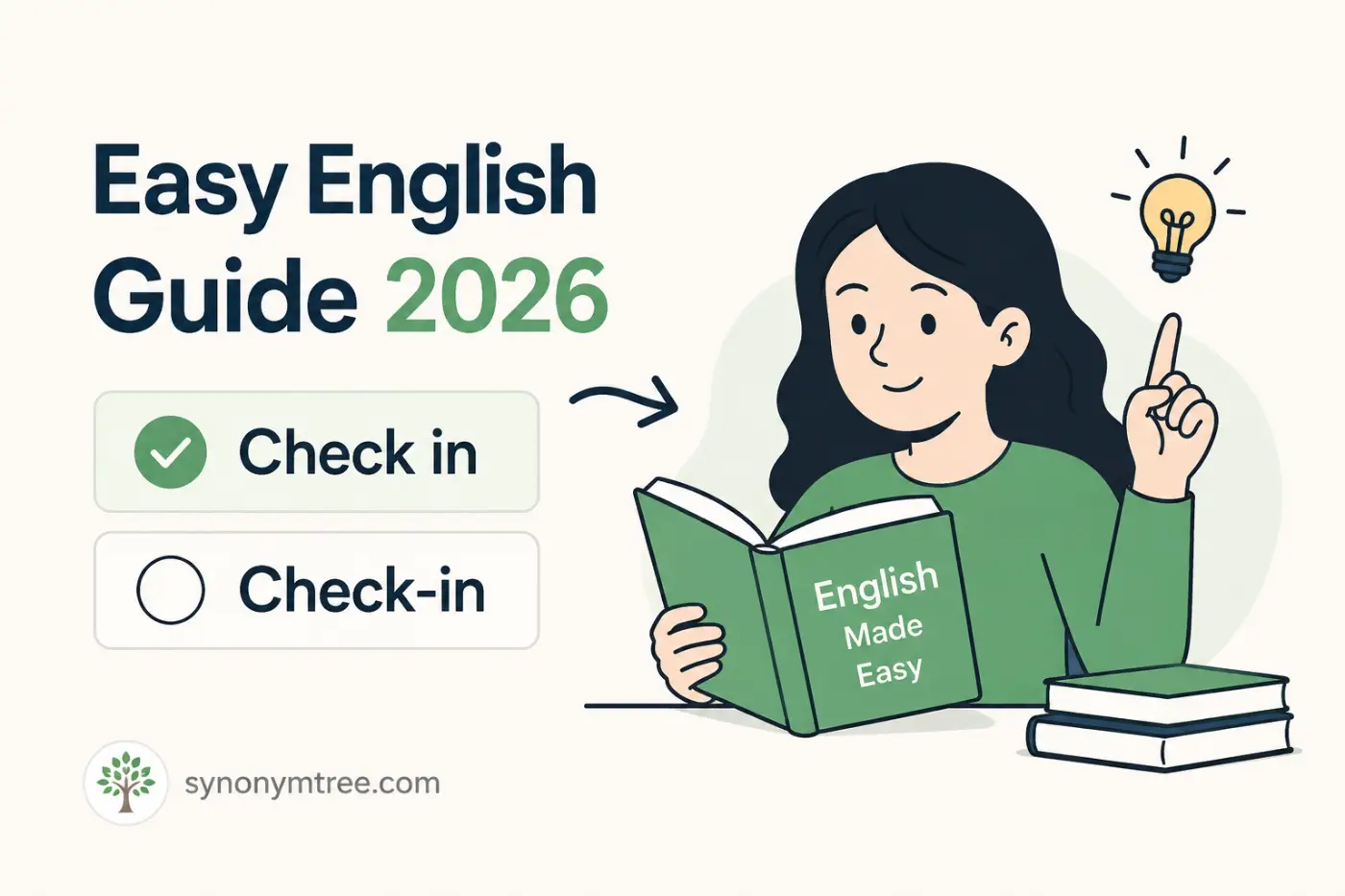
The difference between check in and check-in is simple once you know how each form works. Use check in when you mean the action of arriving and registering. Use check-in when you use the expression as a noun or as a word that describes another noun.
You may see both forms at hotels airports offices and events. That can make English learners wonder which form is correct. The answer depends on the job the words are doing in the sentence.
This guide explains check in or check-in in very simple English. You’ll learn the basic rule first. Then you’ll see real examples that show how people use these forms in daily American English.
Simple Answer in One Look
Use check in as a verb. Use check-in as a noun or as an adjective before another noun. For example you can say I need to check in at the hotel. You can also say The hotel has a fast check-in process.
What This Means in Simple English
Think of check in as an action. It tells someone what a person does. A traveler checks in at a hotel. A passenger checks in for a flight. A guest checks in at an event. The two words work together as a verb phrase. The word check tells us about the action. The word in completes the meaning. You usually keep the two words separate when they work as a verb.
Now think about check-in as a thing or a description. A check-in can be the process of registering. It can also describe something connected to that process. You might talk about hotel check-in or check-in time. The easiest trick is to look at what comes before and after the expression. If you are telling someone to do something then check in usually stays open as two words. If you are naming the process or describing something connected to it then check-in usually takes the hyphen. This small difference causes many mistakes because English often changes the form of a phrase when its job changes. The meaning stays close. The grammar changes.
Imagine a teacher telling a student what to do. The teacher might say Please check in at the front desk. That is an action. Now imagine the teacher talking about the process. The teacher might say The check-in takes only five minutes. That is a thing or process. The meaning is closely connected in both sentences. The spelling changes because the expression has a different job.This is why you should not think of one form as right and the other as wrong. Both forms can be correct. The sentence tells you which form you need.
Why People Mix These Words
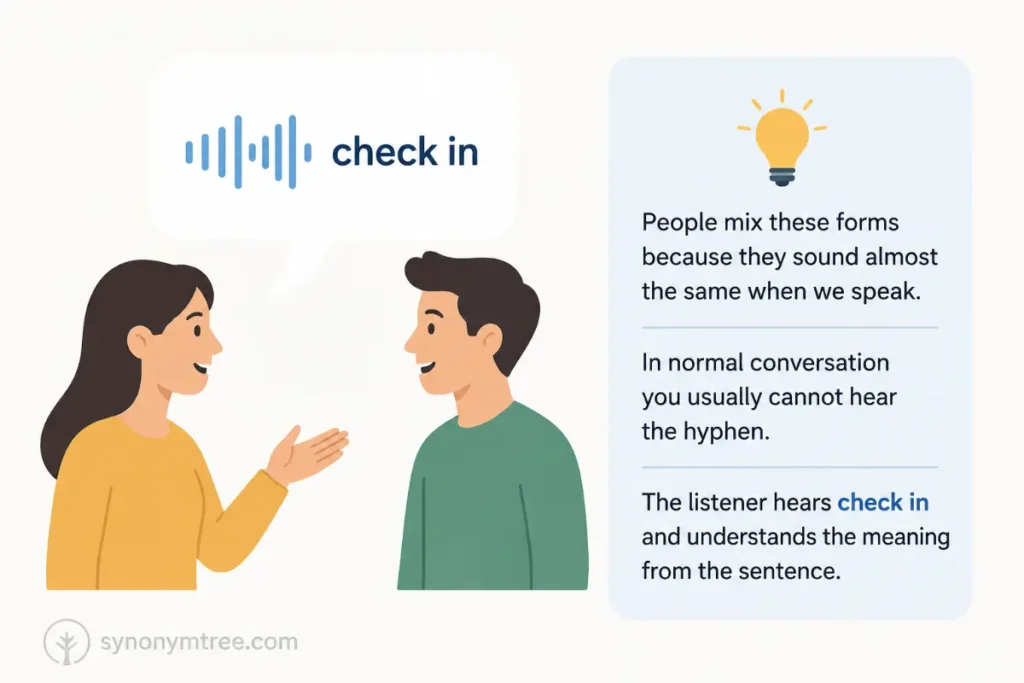
People mix these forms because they sound almost the same when we speak. In normal conversation you usually cannot hear the hyphen. The listener hears check in and understands the meaning from the sentence. Writing makes the difference easier to see. When you write the words down you need to choose the form that fits the sentence.
Another reason for the confusion is that many English phrases can change from an action into a thing. For example people can log in to an account. They can also talk about a login page. The same basic idea appears in check in and check-in.
Hotels create even more confusion. You may see signs that say Check In Here. You may also see signs that say Check In Time. Businesses sometimes use different styles in signs and branding. That does not always follow the cleanest grammar rule. Airports can create the same problem. You may hear Please check in online. Then you may read Online check-in is available now. The first sentence tells you what to do. The second sentence names the process.
Everyday speech also makes the difference harder to notice. People often use the phrase quickly. A person may say I need to check in before my flight. Another person may say The check-in starts at three.
Both sound natural because both forms are common in American English.The best way to learn this is to connect each form with its job. Do not try to memorize a long grammar rule. Just ask yourself one simple question. Am I talking about doing something or am I naming the process or describing something connected to it. If you are talking about doing something use check in. If you are naming or describing the process use check-in.
Clear Difference Explained Simply
The difference between check in or check-in becomes much easier when you look at simple sentence patterns. Use check in when someone performs the action. You can place a person before it. The person may be I you we they he she or a name. Use check-in when you talk about the process itself. You can also place it before another noun to describe that noun.
Here are some simple examples that show the pattern.
- I need to check in at the hotel.
- We should check in before the meeting.
- Please check in at the airport.
- She will check in online tonight.
- The hotel check-in starts at three.
- Our check-in was quick.
- The check-in desk is near the entrance.
- You can use the check-in area over there.
Notice how the first four examples describe an action. Someone needs to do something. That is why check in stays as two words. The last four examples name a process or describe a thing. That is why check-in uses a hyphen. The hyphen helps the reader see that the words work together as one unit. It is especially useful when check-in comes before another noun.
For example hotel check-in means the process of checking into a hotel. Check-in desk means a desk used for that process. Check-in time means the time when guests can begin checking in. You do not need to make this harder than it is. Look at the role of the phrase first. The role gives you the answer.
Which Form Should You Use for check in or check-in
Use check in when you can replace the phrase with an action such as arrive and register. You can say I need to check in. You can also say I need to arrive and register. The second sentence sounds less natural in daily English but the basic action is the same.
Use check-in when you can treat the phrase as a thing or a process. You can say The check-in was easy. You can also say The hotel check-in was fast. In both cases the phrase names a process. There is one useful test that can help you make the choice. Look for a person doing the action.If you can say I check in or you check in or they check in then you need the two word form. If you can say the check-in or a check-in or hotel check-in then you usually need the hyphenated form. This rule works in most normal situations. It gives English learners a simple way to make the right choice without memorizing complicated grammar terms. You may also see check in used after words such as please need want should can will and must. These words often introduce an action.
Here are a few examples.
- Please check in at the desk.
- You need to check in early.
- We should check in online.
- I can check in after lunch.
- They will check in at noon.
The pattern is clear. The expression describes something someone does.
Now look at these examples.
- The check-in was easy.
- Our check-in time is four.
- The hotel has a new check-in system.
- The check-in desk is upstairs.
- Online check-in saves time.
Here the expression names a process or describes something. That is why check-in is used.
Easy Real Life Sentences You Can Use
The best way to remember check in or check-in is to use the forms in situations you already know. Hotels airports offices clinics schools and events all use this expression. The following sentences sound natural in everyday American English. You can use them as models when you write or speak.
- I need to check in at the hotel.
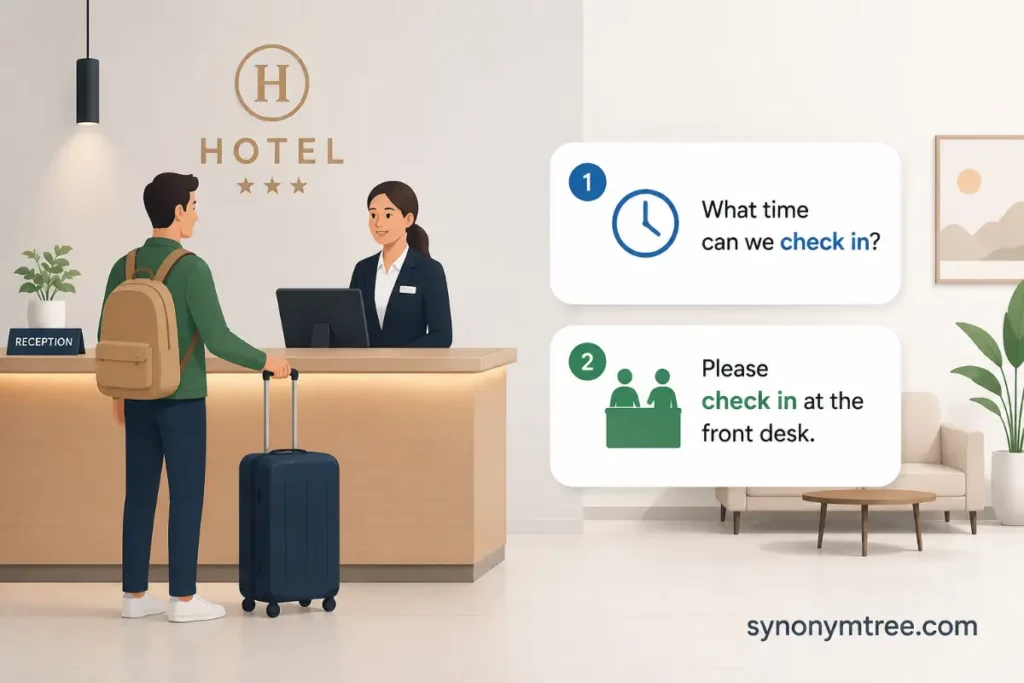
- What time can we check in.
- Please check in at the front desk.
- I checked in online this morning.
- Our check-in was very fast.
- The check-in desk is near the door.
- What is the hotel check-in time.
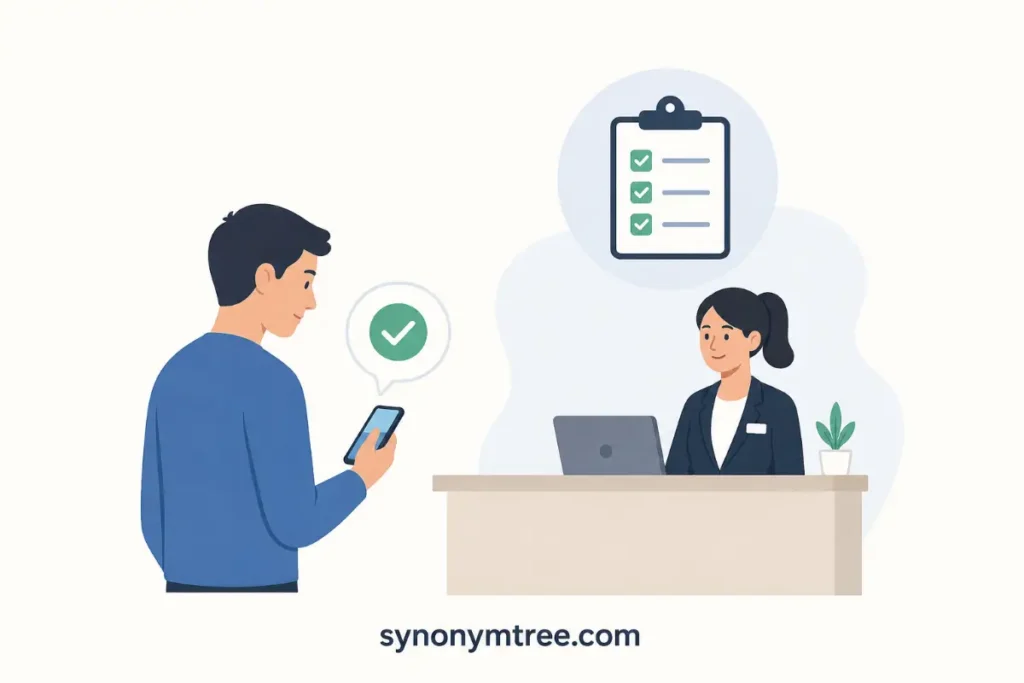
- Online check-in is available now.
These examples also show something useful about the phrase. Check in is not limited to travel. A person can check in at work. A student can check in for an event. A guest can check in at a conference.
The meaning can also change slightly based on context. In casual American English someone can check in with another person. That means the person contacts someone to see how things are going. For example you might say I’ll check in with you tomorrow. This does not mean you are arriving at a hotel. It means you plan to contact the person.
That use is common at work and in personal conversations. A manager might say I’ll check in with you later. A friend might say I just wanted to check in and see how you’re doing. The basic idea stays connected. Someone makes contact or confirms something. The exact meaning depends on the situation.
Where Check in or check-in Comes From
The expression check in developed from the idea of checking or confirming information. The word check has long been connected with examining or confirming something. Over time English speakers began using check in for the process of registering when arriving at places such as hotels and airports. The phrase became common in travel and business settings. The noun form check-in developed from the same expression. English often creates nouns from phrases that started as actions. That is why you can have check in as an action and check-in as the name of the process.
The history is not something you need to memorize for everyday writing. The useful lesson is that both forms grew from the same basic idea. You are checking information and confirming your arrival. In a hotel you confirm that you have arrived and provide the information the hotel needs. At an airport you confirm your trip details and receive what you need for the flight. That simple idea explains why the phrase appears in so many places today.
As English changed over time people began using the noun form in signs schedules forms and business language. That helped make check-in a familiar part of modern American English. The spelling rule stayed simple. The action usually appears as check in. The noun and describing form usually appears as check-in. This brings us to a deeper point. The expression is more than a spelling question. It is also a useful example of how English changes depending on how people use a phrase.
The Meaning Behind Check in or check-in
When you see check in or check-in in American English the core idea is usually confirmation. Someone confirms an arrival a booking an appointment or a connection. At a hotel the guest confirms the reservation and receives room information. At an airport the passenger confirms the trip and completes the required steps. At an event a guest confirms attendance.The phrase can also mean making contact. When someone says I’ll check in later they usually mean they will contact you and see how things are going.
This second meaning is especially common in spoken English. It can sound friendly and natural. A teacher may check in with a student. A parent may check in with a child. A coworker may check in with a teammate.
So the phrase has a practical idea at its center. You are making sure that something is known confirmed or okay. That idea helps you understand the phrase even when the setting changes. You have now learned the main spelling rule. You know that check in usually names an action. You know that check-in usually names the process or describes a related thing. The next part looks at culture daily speech common mistakes and the ways real people use this expression.
How Check in or check-in Is Understood in Culture and Stories
In American culture the phrase is strongly connected with travel. Most people hear it often at hotels airports and events. Because of that it has become a normal part of daily English. Travel stories often include a check-in scene. A person arrives at a hotel after a long trip. They go to the desk. They give their name. The worker confirms the reservation. Then the guest receives a room key.
A similar scene happens at an airport. A passenger checks in online or at the airport. The airline confirms the trip details. The passenger then moves to the next part of the journey. Movies and television shows use these scenes because viewers understand them quickly. A hotel check-in can show that a character has arrived in a new place. An airport check-in can show that a journey is about to begin.
The phrase also appears outside travel. In American workplaces people often use check in to describe communication. A manager may check in with an employee. A teacher may check in with a student. Friends may check in with one another.
This use has a friendly feeling. It often shows care or attention. When someone says I just wanted to check in they usually want to make contact without making the conversation sound formal. That makes the phrase useful in both professional and personal English.
Biblical and Mythological Meaning
Check in or check-in does not have a special biblical or mythological meaning. The expression is a modern English phrase connected mainly with registration confirmation and communication.
You may sometimes see the idea of checking or confirming used in religious stories. People may confirm information or report to another person. However that does not give the modern phrase a special biblical meaning.
The same applies to mythology. There is no well known mythological symbol built around the modern expression check in. So you do not need to search for a hidden religious or mythological meaning when you see this phrase. In normal English the meaning comes from the situation. At a hotel it means registering. At an airport it means completing the arrival or travel process. In a personal conversation it can mean contacting someone. Keeping the meaning connected to the context will help you understand the phrase quickly.
Symbolism Explained in Simple Words
The expression can still carry a simple idea in everyday communication. It can suggest confirmation connection and attention.
What One Version Represents
The action form check in represents something a person does. It suggests action and movement. When you say I need to check in you are talking about something that must happen. You are going to complete a task. The phrase can also suggest connection when you use it with a person. If you say I’ll check in with you tomorrow you are saying that you plan to make contact. So the two word form often feels active. Someone is doing something.
What the Other Version Represents
The noun form check-in represents a process event or thing. It can describe the moment or system connected with checking in. A hotel check-in is the process of registering at the hotel. An airport check-in is the process of confirming your flight details. The hyphenated form can also describe another noun. Check-in desk describes the desk used for checking in. Check-in time describes the time connected with the process. The simplest comparison is this. Check in tells you what someone does. Check-in tells you about the process or something connected to that process.
Related Words You Should Know
Several related words appear with check in or check-in. Learning them can make travel conversations and everyday English much easier.
- Check out means to leave a hotel and complete the departure process. You might say We need to check out by eleven.
- Check in time means the time when guests can begin the arrival process. You might ask What is the check-in time.
- Check out time means the time when guests are expected to leave the hotel. You might ask What time is check-out.
- Front desk means the main service desk at a hotel or similar place. You usually check in at the front desk.
- Registration means the process of giving information and officially entering a system or event. It has a more formal sound than check-in.
- Reservation means an arrangement made in advance. A hotel reservation gives the hotel your planned stay details.
- Arrival means the act of reaching a place. Check-in often happens after arrival.
- Departure means the act of leaving a place. Check-out often happens before departure.
- Online check-in means completing the process through a website or app. Airlines use this phrase very often.
- Check-in desk means the place where people complete the check-in process. You may see this phrase at airports hotels and events.
These related words help you see the larger language pattern. English speakers use several short expressions to describe travel and arrival.
How People Actually Use Check in or check-in in Daily English
Real English is often simpler than textbook examples. People use check in in short sentences when they need to explain an action. They use check-in when they talk about a process or describe a related thing. At a hotel you might say I need to check in. A worker might say Your check-in will take a few minutes. Both sentences sound natural because each form has a different job. At an airport you might hear Please check in online before your flight. You may also see a sign that says Online check-in is available. At work you might hear I’ll check in with Sarah tomorrow. This means the speaker plans to contact Sarah. At an event you might see a check-in table near the entrance. Guests go there to confirm their attendance.
Here are more examples from common situations.
- Can I check in early.
- We checked in around four.
- I’ll check in with you after lunch.
- Did you check in online.
- The check-in process was easy.
- Our check-in time is three o’clock.
- The check-in desk closes at ten.
- Please check in when you arrive.
- The online check-in saved us time.
- I’ll check in tomorrow to make sure everything is ready.
These examples show why the expression can feel confusing. The meaning stays close while the form changes. The key is to notice the role of the words. When the words describe an action use check in. When they name or describe the process use check-in.
Common Mistakes People Make
One common mistake is writing check-in when the phrase is used as a verb. For example you may see someone write I need to check-in at the hotel. In standard American English the better form is I need to check in at the hotel. Another common mistake is writing check in when the phrase is being used as a noun. For example The check in was quick is missing the usual hyphen. The clearer form is The check-in was quick. People also make mistakes when the phrase comes before another noun. The usual form is check-in desk rather than check in desk. The same pattern appears with check-in time and check-in process.
Here are some simple corrections.
- Incorrect. I need to check-in now.
Correct. I need to check in now.
- Incorrect. The check in was easy.
Correct. The check-in was easy.
- Incorrect. Where is the check in desk.
Correct. Where is the check-in desk.
- Incorrect. What is the check in time.
Correct. What is the check-in time.
- Incorrect. Please check-in online.
Correct. Please check in online.
There is another issue that can confuse writers. Some businesses use different styles in signs and names. You may see Check In written as a heading even when a standard sentence would use check in. You may also see Check In Time without a hyphen in informal signs. Do not copy every sign you see. For normal writing follow the basic rule. Use check in for the action. Use check-in for the noun and the describing form.
Final Teacher Explanation Very Important
If you remember only one lesson from this article remember this simple rule. Check in means do the action. Check-in means the process or something connected to the process. You can check in at a hotel. You can check in at an airport. You can check in online. These examples use the action form. You can talk about a check-in. You can talk about check-in time. You can talk about a check-in desk. These examples use the noun or describing form. The hyphen does not change the basic meaning. It helps show how the words work in the sentence.
Think of it like this. Check in is something you do. Check-in is something you can talk about. That one idea will solve most questions about the expression. The phrase can also mean contacting someone. If you say I’ll check in with you later you mean you will contact that person. If you say We had a quick check-in you are talking about the conversation or contact itself.
English learners often worry about tiny spelling differences. That is normal. Still you do not need to memorize every grammar rule. Look at the sentence and ask what the phrase is doing. If someone is doing the action use check in. If you are naming the process or describing a thing use check-in. This approach is simple reliable and useful in real writing.
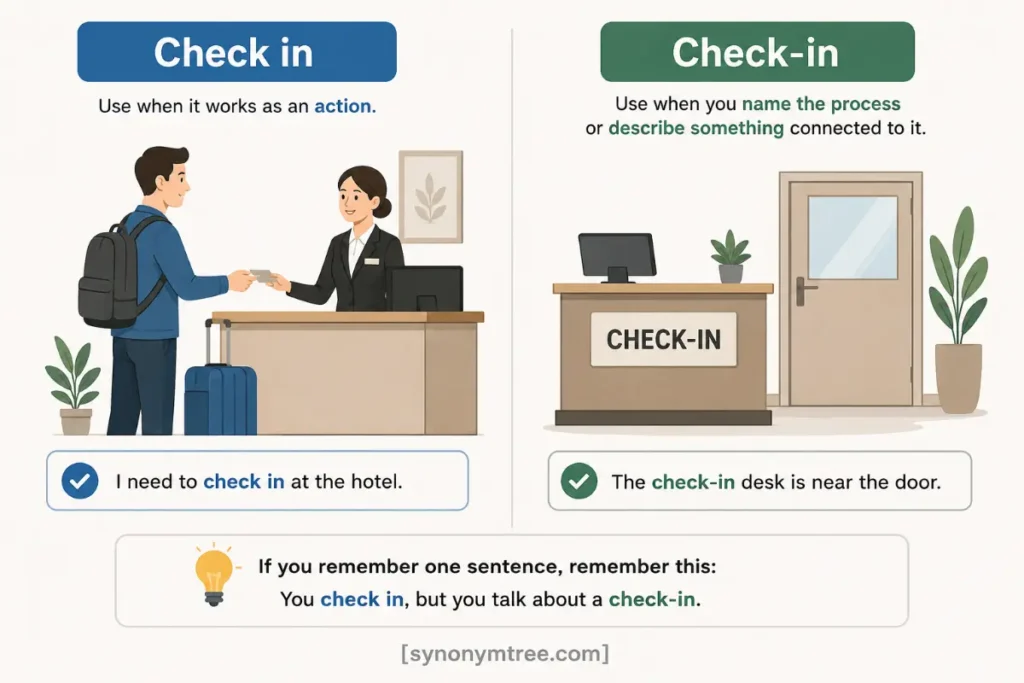
Final Answer Quick Recap
Use check in when it works as an action. Say I need to check in at the hotel. Use check-in when you name the process or describe something connected to it. Say The check-in desk is near the door. If you remember one sentence remember this. You check in but you talk about a check-in.
Conclusion
The difference between check in or check-in is easier than it first appears. The two forms share the same basic meaning but they have different jobs in a sentence. Use check in when you tell someone to perform the action. Use check-in when you name the process or describe something linked to it. This simple rule works across hotels airports events workplaces and everyday conversations.
You’ll also hear check in when people talk about contacting someone. A person can check in with a friend or coworker to see how things are going. That use is common and natural in American English. Once you see the pattern you’ll stop guessing. Check in describes an action. Check-in names the process or describes something related to it. That’s the key lesson.
Frequently Asked Questions About check in or check-in
What does check in mean in simple words?
Check in means to arrive and confirm your information. It can also mean to contact someone and see how things are going.
Is check in one word?
No. When it works as a verb the usual form is check in as two words.
Is check-in one word?
Check-in is normally written with a hyphen when it works as a noun or describes another noun.
Which is correct check in or check-in?
Both can be correct. Use check in for the action and check-in for the noun or describing form.
Can I say I need to check in?
Yes. This is the correct form because check in describes an action.
Can I say the check-in was easy?
Yes. This is correct because check-in names the process.
Why do people get confused between the two forms?
They sound the same when spoken. The difference becomes clear mainly when you see the words in writing.
Can I use check-in before another noun?
Yes. Common examples include check-in desk check-in time and check-in process.
