
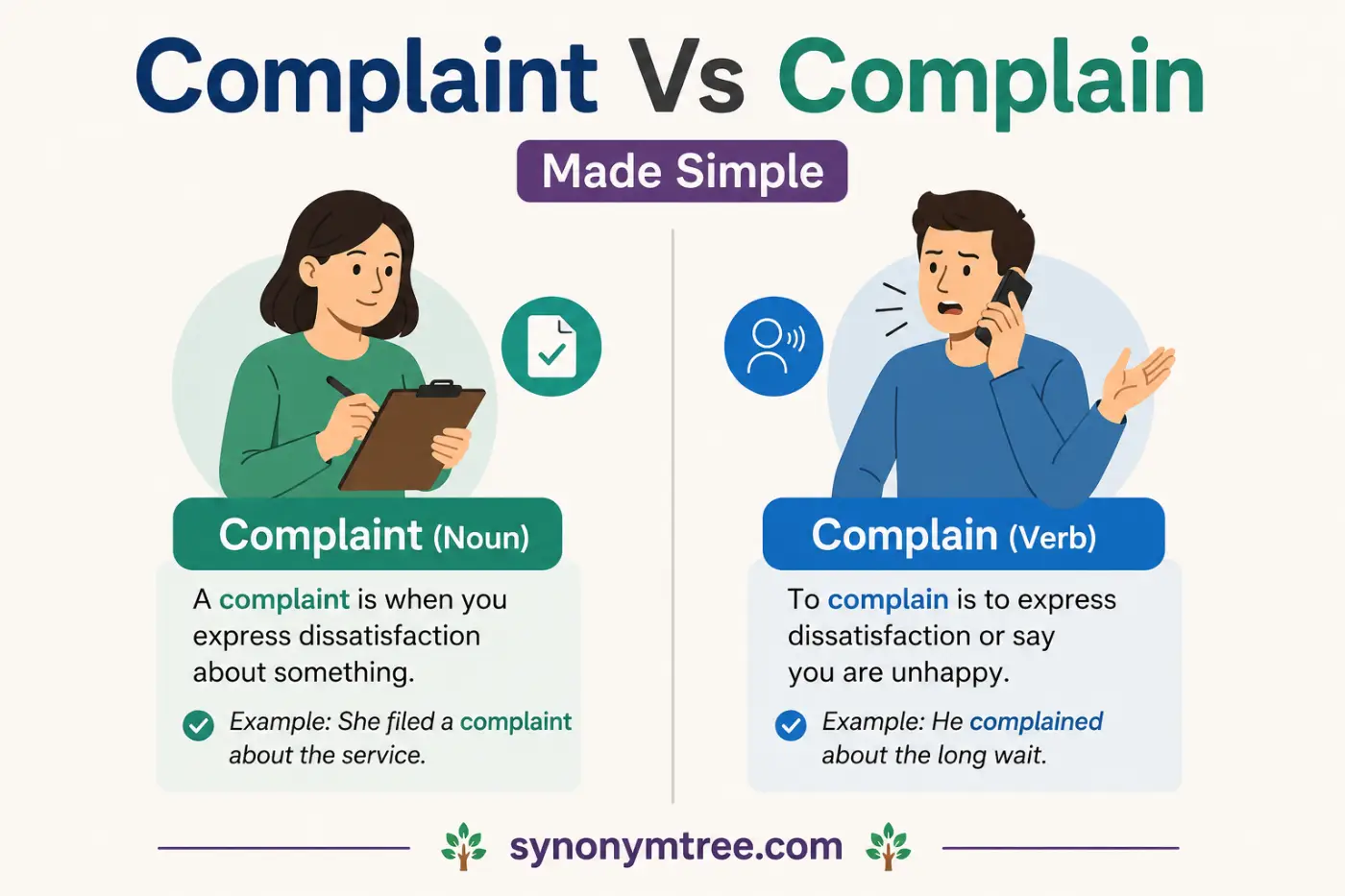
If you are confused about complaint vs complain you are not alone. These two words look almost the same and they have closely related meanings. The main difference is simple. Complain describes an action. Complaint names the problem concern or report. You complain about poor service. You make a complaint about poor service. Once you understand this pattern you can use both words with much more confidence.
Think about a customer who receives the wrong order. The customer may call the company and complain about the mistake. The customer may then send an email explaining the problem. That email can be called a complaint. The customer is doing the action when they complain. The concern itself becomes a complaint. This small difference is the key to understanding these words.
You will see this pattern in daily conversations at work in emails at school and in customer service. You do not need a difficult grammar rule to remember it. Just keep this simple idea in mind. You complain. You make a complaint.
Simple Answer In One Look
Complain means to say that something is wrong or that you are unhappy about something. Complaint means the problem concern or report that someone raises. Use complain for the action and complaint for the concern.
What This Means In Simple English
The easiest way to understand these words is to think about what a person does and what a person has. When someone says that they are unhappy about a problem they complain. When we name the problem or report that they have made we call it a complaint.
For example you might say I complained about the noisy room. This tells us what you did. You spoke about the noise because it bothered you. You could also say I made a complaint about the noisy room. This sentence focuses on the concern that you reported. Both sentences describe the same basic situation but the words work differently.
This is similar to other word pairs in English. You explain something but you give an explanation. You suggest something but you make a suggestion. In the same way you complain about something but you make a complaint about it. Learning the words as a pair makes the difference much easier to remember.
Imagine that your internet service stops working. You call the company and explain that the service has been down all morning. You are complaining about the service. If the company records your problem in its system it may record your complaint. The action is complain. The recorded concern is a complaint.
The same idea works in many normal situations. A student can complain about too much homework. A customer can complain about slow service. An employee can complain about a broken computer. A passenger can complain about a delayed flight. In each case the person is doing something. That is why complain is the right form.
Now change the focus. A student can have a complaint about too much homework. A customer can make a complaint about slow service. An employee can send a complaint about a broken computer. A passenger can file a complaint about a delayed flight. Here the word complaint names the concern. The difference is small but useful. Once you start looking at the role of the word in the sentence you will notice the pattern quickly.
Why People Mix These Words
People often confuse complaint vs complain because the words look and sound very similar. They also come from the same word family and describe closely related ideas. This makes the mistake understandable. The problem usually happens when someone knows the meaning but does not notice the form needed in the sentence.
A common mistake is saying I want to complaint about this problem. The correct sentence is I want to complain about this problem. The reason is simple. The sentence needs the action word.
Another common mistake is saying My complain is about the price. The correct sentence is My complaint is about the price. Here you are naming the concern so you need the noun form.
You can avoid both mistakes by asking one simple question. Am I describing an action or naming a concern. If you are describing the action use complain. If you are naming the concern use complaint.
The spelling can also give you a small reminder. Complain ends with ain. Complaint has an extra t at the end. Do not depend only on this spelling trick though. The sentence pattern is much more useful.
Clear Difference Explained Simply
The difference between complaint vs complain becomes clear when you look at common patterns. You complain about something. You can also send or file a complaint.
For example a customer complains about a late delivery. The same customer can make a complaint about the late delivery. An employee complains to a manager about a broken computer. The employee can also send a complaint to the manager. The situation stays the same but the sentence changes because the words have different jobs.
Complain focuses on the action. Complaint focuses on the concern. That is the most useful difference to remember. You may also notice that complaint appears often in customer service and workplace writing. A company may receive a complaint from a customer. A manager may review a complaint. A school may receive a complaint from a parent. These situations often involve a specific concern that needs attention.
Complain is very common in everyday speech. A friend may say I need to complain about this bill. Someone may tell you that they complained to the store. A parent may say that their child keeps complaining about school. These sentences sound natural because they describe what someone is doing. Both words can appear in casual or formal English. The difference is not mainly about formality. It is about the job the word has in the sentence.
Which Form Should You Use
Use complain when you are talking about the action of expressing unhappiness or pointing out a problem. Use complaint when you are naming the concern problem or report.
A useful pattern is I want to complain about something. For example I want to complain about the service. I want to complain about this charge. I want to complain to the manager.
Another useful pattern is I have a complaint about something. For example I have a complaint about the service. I have a complaint about this product. I have a complaint about the waiting time.
You can also remember the phrase make a complaint. Say I want to make a complaint about the service. Do not say I want to make a complain about the service. The easiest rule is still the best one. Complain is the action. Complaint is the concern.
Easy Real Life Sentences You Can Use
These examples show how the words sound in normal American English. Notice that complain usually tells us what someone does while complaint usually names the concern.
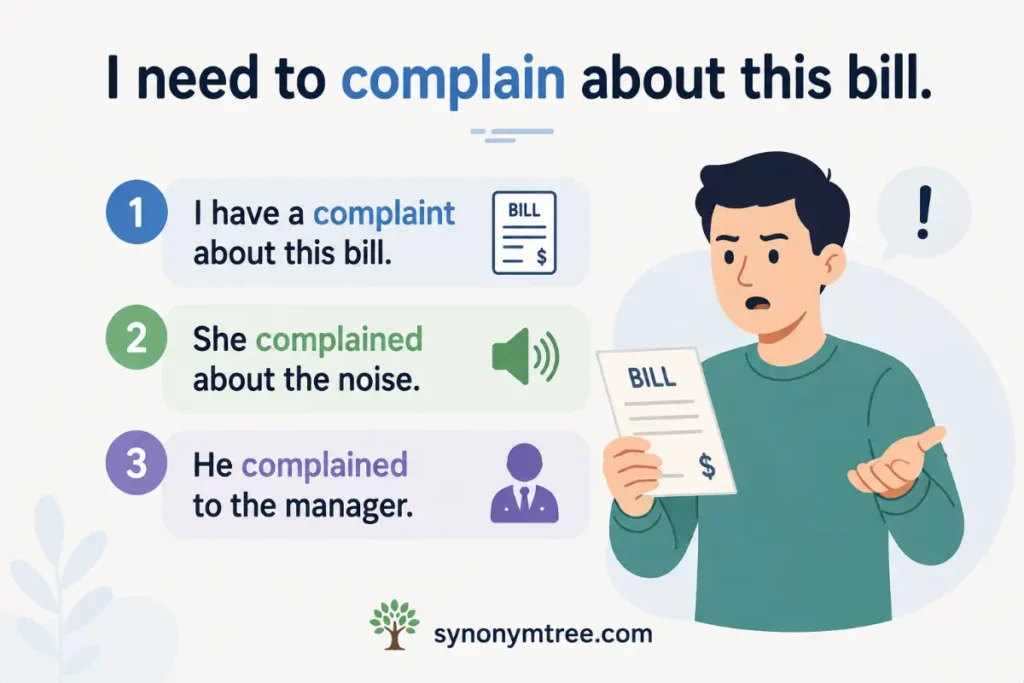
- I need to complain about this bill.
- I have a complaint about this bill.
- She complained about the noise.
- He complained to the manager.
- We made a complaint about the service.
- The customer complained about the late order.
- The company received a complaint from a customer.
- I do not like to complain but this food is cold.
These examples are useful because they show patterns you can reuse. You do not need to memorize every sentence. Learn the structure and change the details to match your situation.
Where These Words Come From
Complain and complaint come from the same word family. Complain entered English through French and can be traced back to Latin roots connected with expressing pain or sorrow. Over time the word developed the meaning we commonly use today when someone expresses dissatisfaction or points out a problem.
Complaint developed from the same family and became the noun used for a concern or expression of dissatisfaction. This shared history explains why the words look so similar. You do not need to remember their Latin history to use them correctly. It simply explains why the words are closely connected while still having different jobs.
A Simple Memory Trick
Think about a person and a problem. The person complains. The problem becomes a complaint. Imagine that you order a phone online and it arrives damaged. You call the company and complain about the damaged phone. You then send an email about the problem. The company receives your complaint.
You can use the same idea at school. A student complains about too much homework. The student can then make a complaint about the amount of homework. At work an employee complains about a broken computer and sends a complaint to the manager. The pattern stays the same. The person complains. The person has or makes a complaint.
How These Words Work In A Conversation
Imagine a customer walking into a store because a product stopped working. The customer says that they want to complain about the product. The store worker asks what the complaint is. The customer explains the problem and asks for a replacement.
Both words fit naturally into this short situation. The customer complains because the customer is taking an action. The worker asks about the complaint because the worker wants to know the concern.
The same thing can happen at school. A student may say that they want to complain about classroom noise. The teacher may ask what the complaint is. The student explains that other students are talking during a test.
This is a good way to remember the difference because you can see both words working together. You do not need to memorize a long definition. Just notice what each word does.
How These Words Are Understood In Culture And Stories
People have complained about problems for as long as people have shared their feelings. That is why complain and complaint appear often in stories conversations movies and everyday life. A character may complain about unfair treatment. Another character may have a complaint about a difficult situation. The words help show frustration disappointment or concern.
A complaint is not always a bad thing. Sometimes people complain because they want a problem fixed. A customer may complain about a damaged product because they want a replacement. An employee may complain about a broken machine because they want it repaired. A student may complain about a confusing lesson because they need more help.
The tone also matters. A person can complain politely. Saying that you are unhappy with a service does not automatically mean you are rude. A calm complaint can help someone understand a problem and find a solution.
Stories also use complaints to show personality. A character who complains about every small problem may seem negative. A character who makes one serious complaint may seem reasonable. The words themselves do not tell us who is right. The situation gives us that meaning.
Biblical And Mythological Meaning
There is no special biblical or mythological meaning for the difference between complain and complaint. These are normal English words used to describe dissatisfaction or a concern.
The general idea of people expressing frustration appears in many old religious texts and traditional stories. People ask questions about suffering. They express fear. They ask for help. Modern English translations may use words connected with complaining for some of these ideas.
The exact wording can change between translations because ancient religious texts were written in other languages. So it is better to focus on the normal English meaning of these words rather than giving them a special religious meaning. For everyday English the rule stays simple. Complain describes the action. Complaint names the concern.
Symbolism Explained In Simple Words
You can use a simple picture to remember the difference. Imagine someone facing a problem. The person speaks up about it. That person complains. The problem or concern they report is a complaint. This is not a fixed symbol or special cultural rule. It is simply a useful memory tool. It helps you connect the action with the thing being reported.
What Complain Represents
Complain represents the action of speaking up about something that bothers you. It can happen in a conversation a phone call an email or a formal report. A customer complains about a late delivery. A worker complains about a broken machine. A student complains about too much homework. The focus is on what the person does.
What Complaint Represents
Complaint represents the concern that someone has raised. It can be a small issue or a serious problem. It can also be casual or formal. A customer has a complaint about a late delivery. A worker makes a complaint about a broken machine. A student sends a complaint about a school problem. The focus is on the concern.
Related Words You Should Know
Several related words can help you understand this word family and the ideas around it.
- Complaining means expressing dissatisfaction about something. It describes the act of complaining.
- Complainer means someone who complains often. It can sometimes sound negative.
- Concern means something that worries or bothers someone. It can sound softer than complaint.
- Feedback means information about an experience product or service. Feedback can be positive or negative.
- Criticism means comments that point out problems or weaknesses. It does not always mean a formal complaint.
- Protest means a stronger expression of disagreement. It often involves public action.
These words are related but they do not mean exactly the same thing. Choosing the right one depends on the situation.
How People Actually Use These Words In Daily English
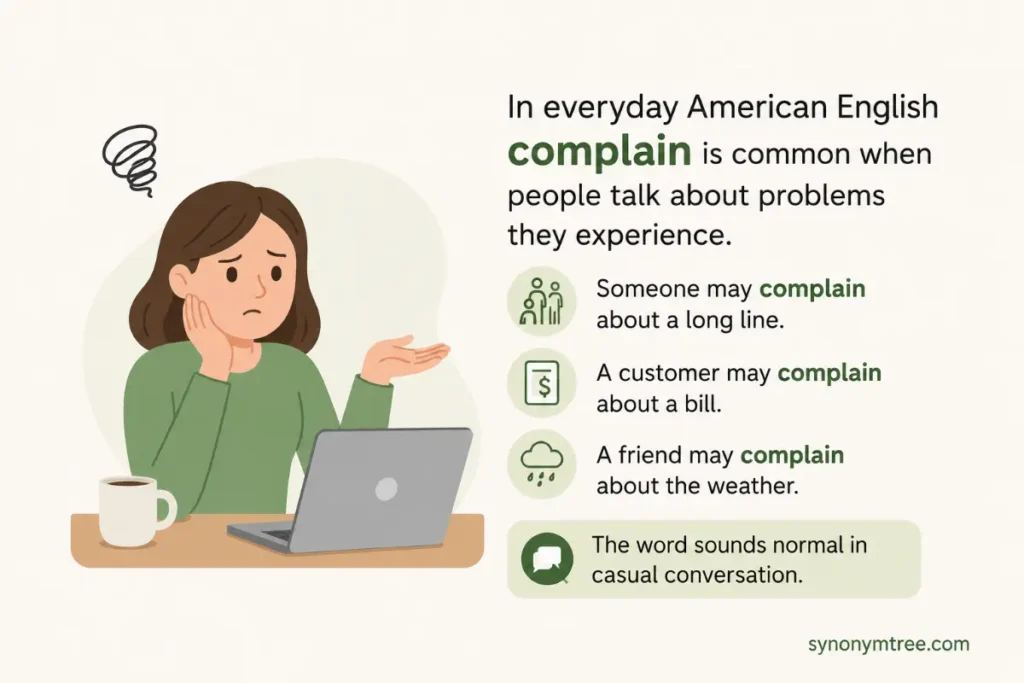
In everyday American English complain is common when people talk about problems they experience. Someone may complain about a long line. A customer may complain about a bill. A friend may complain about the weather. The word sounds normal in casual conversation.
Complaint often appears when people name a specific concern. A customer service worker may say that the company received a complaint. A manager may talk about a complaint from an employee. Someone may write an email to make a complaint about a service.
Here are some natural examples that show the difference.
- I complained about the long wait.
- My main complaint is the poor service.
- She complained to the manager.
- The manager received a complaint.
- We complained about the noisy room.
- They made a complaint about the hotel.
- He complained about the high price.
- Her complaint was about the damaged product.
- I do not like to complain but this food is cold.
- The company asked us to explain the complaint.
The examples show why the two words cannot simply replace each other. Complain describes what someone does. Complaint names what the person has reported.
Common Mistakes People Make
The first common mistake is using complaint as a verb. Do not say I want to complaint about the service. Say I want to complain about the service. The second common mistake is using complain as a noun. Do not say My complain is about the price. Say My complaint is about the price. Another common mistake is saying make a complain. The natural form is make a complaint. You can also say have a complaint or file a complaint.
People also sometimes forget the common patterns. Say complain about a problem. Say complain to a person.
You should also remember that complain does not always mean anger. Someone can complain calmly and politely. A complaint can also be small and simple. The word only tells us that someone has expressed dissatisfaction or raised a concern.
Final Teacher Explanation
If I were teaching this in a classroom I would give you one rule to remember. Complain is the action. Complaint is the concern. When someone complains they are doing something. When someone has a complaint they have a problem or concern that they want others to notice. This is why you say I complained about the service but I made a complaint about the service.
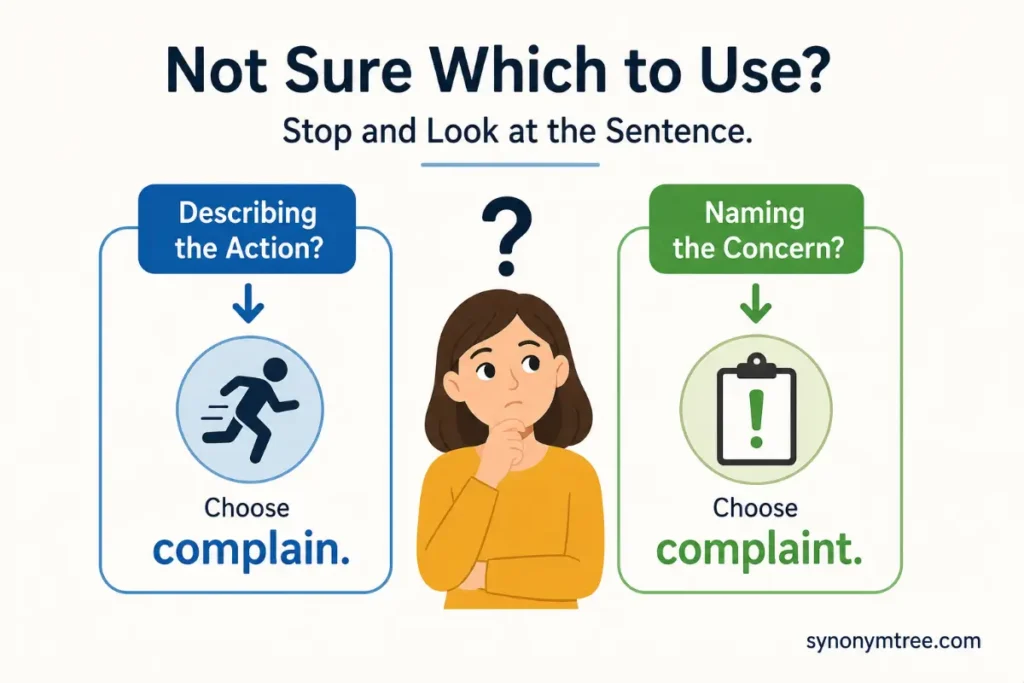
When you are unsure which form to use stop and look at the sentence. Ask yourself if you are describing an action or naming a concern. If you are describing the action choose complain. If you are naming the concern choose complaint.
You can also remember a few common patterns. Complain about something. Complain to someone. Make a complaint. Have a complaint. File a complaint. These patterns will help you use both words naturally without thinking too much about grammar.
The difference between complaint vs complain is simple once you see the pattern. You do not need a complicated rule. You only need to know what job the word is doing in your sentence.
Final Answer
Complain is the action of expressing dissatisfaction or pointing out a problem. Complaint is the concern or report that someone raises. Remember this simple rule. You complain about a problem. You make a complaint about a problem.
Conclusion
Understanding complaint vs complain can make your English clearer in everyday conversations emails school writing and workplace communication. The two words share the same basic idea but they work differently. Complain describes what a person does. Complaint names the concern or report.
Keep the rule simple and practice it in real sentences. If you are talking about the action use complain. If you are naming the concern use complaint. Once this pattern becomes familiar you will be able to choose the right word quickly and naturally.
Frequently Asked Questions
What Does Complain Mean In Simple Words?
Complain means to say that something is wrong or that you are unhappy about something.
What Does Complaint Mean In Simple Words?
Complaint means a concern problem or report about something that someone is unhappy with.
Is Complaint Or Complain Correct?
Both are correct. Complain is the action word. Complaint is the noun that names the concern.
Can I Say I Want To Complaint?
No. Say I want to complain about the problem.
Can I Say I Have A Complain?
No. Say I have a complaint about the problem.
Why Do People Confuse These Words?
They look very similar and they come from the same word family. Their meanings are also closely connected.
Can I Use Both Words Together?
Yes. You can say that someone complained about a problem and then made a complaint to the company.
Is Complaint More Formal?
Complaint is common in formal situations such as customer service and workplace reports but people also use it in everyday English.
