
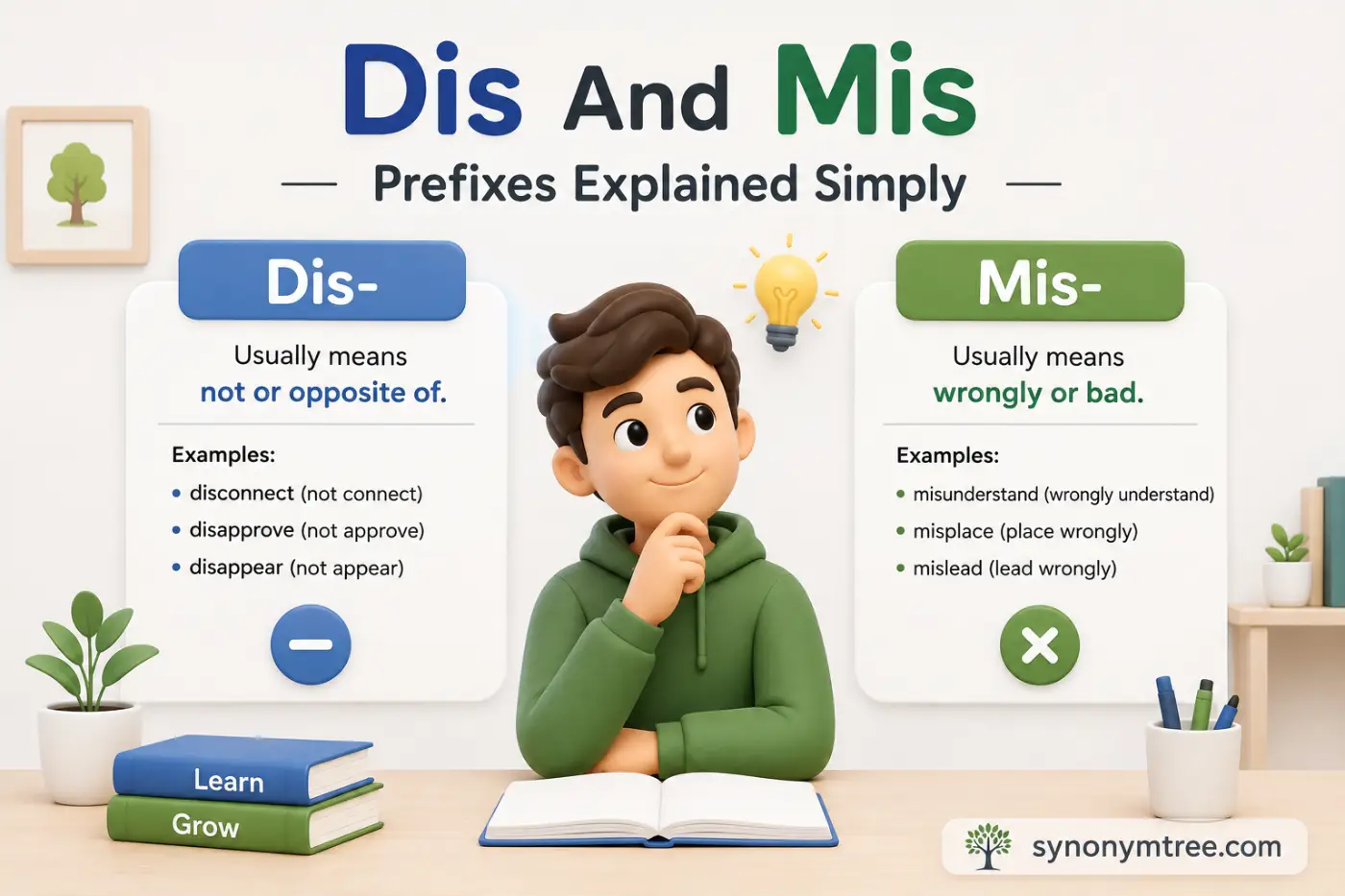
If you are learning English grammar you may have wondered how dis and mis prefixes change the meaning of a word. Both prefixes can create words with negative meanings. That makes them easy to mix up. Yet they do not mean exactly the same thing.
The prefix dis often shows an opposite idea. It can mean not doing something or doing the reverse of an action. The prefix mis usually shows that something was done badly incorrectly or wrongly.
For example disapprove means not approve. Misunderstand means understand something incorrectly. The two prefixes can look similar in meaning but they point to different ideas. This guide explains how each prefix works. You will learn the basic rules their meanings common examples spelling patterns and mistakes. By the end you should have a simple way to decide which prefix fits a word.
Quick Definition
A prefix is a group of letters added to the beginning of a word to change its meaning. The prefix dis often means not opposite or apart. The prefix mis usually means wrongly badly or incorrectly.
For example dis + agree gives disagree while mis + understand gives misunderstand. The first shows the opposite of agreement. The second shows an incorrect understanding.
Direct Answer
The prefix dis usually expresses an opposite or negative idea while mis usually means wrongly or incorrectly. Use dis for ideas such as disagree and disconnect and use mis for actions or results that happen incorrectly such as misunderstand and misread.
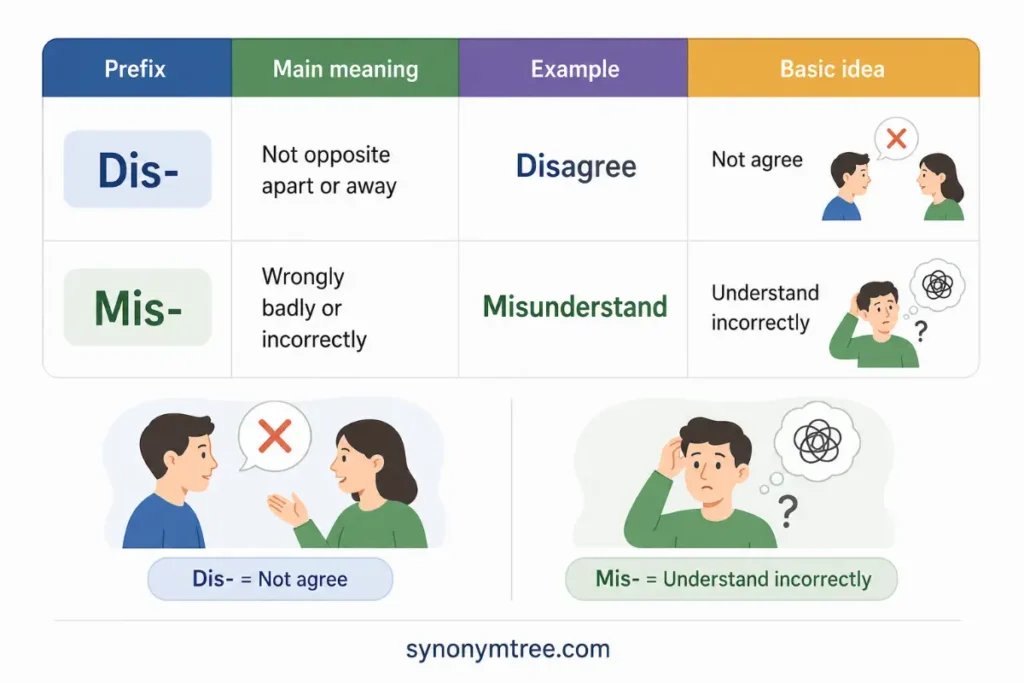
Comparison Table for dis and mis prefixes
| Prefix | Main meaning | Example | Basic idea |
|---|---|---|---|
| Dis | Not opposite apart or away | Disagree | Not agree |
| Mis | Wrongly badly or incorrectly | Misunderstand | Understand incorrectly |
| Dis | Reverse an action | Disconnect | Break a connection |
| Mis | Incorrect action | Misjudge | Judge incorrectly |
What A Prefix Does
Before looking closely at these two prefixes it helps to understand what a prefix does.
A prefix comes before a base word. It changes the meaning of that word without usually changing its basic word class.
Take the word agree.
Agree means to have the same opinion.
Add dis.
Disagree means to have a different opinion or not agree.
Now take understand.
Understand means to know the meaning of something.
Add mis.
Misunderstand means to understand something incorrectly.
The base word still gives you the main idea. The prefix adds another layer of meaning.
You can think of a prefix as a small sign placed in front of a word. That sign gives you a clue about how the meaning changes.
This is useful when you meet an unfamiliar word. If you know the meaning of the prefix and the base word you can often make a good guess about the full word.
That does not work perfectly every time. English has many words with meanings that have developed over hundreds of years. Still the method is very useful for common vocabulary.
What The Dis Prefix Means
The prefix dis has several related meanings.
It can show a negative idea.
It can show removal or reversal.
The exact meaning depends on the base word.
For example disagree means not agree.
Disconnect means break a connection.
Disobey means refuse to obey.
Dislike means not like.
Dishonest describes someone who is not honest.
These words all contain dis but the meaning changes slightly based on the word that follows it.
Dis Can Mean Not
One common use of dis is to create a negative meaning.
Consider like and dislike.
Like means to enjoy or have a positive feeling toward something.
Dislike means to have a negative feeling toward something.
The same pattern appears in other words.
- Honest becomes dishonest.
- Loyal becomes disloyal.
- Respect becomes disrespect.
- Trust becomes distrust.
- Agree becomes disagree.
In each case the prefix creates a negative or opposite meaning.
This is one reason learners often think dis simply means not.
That idea is useful but it is not the whole story.
Dis Can Show The Opposite
Dis can also show that an action is reversed or that something moves away from its original state.
For example connect means to join things.
Disconnect means to separate them.
For example you might connect your phone to a computer. If you disconnect it the connection ends.
Another example is appear and disappear.
Appear means to become visible.
Disappear means to become invisible or no longer be present.
The prefix changes the direction of the idea.
Dis Can Show Separation
Some words with dis involve separation.
For example disband means to break up a group.
Disperse means to spread out or move apart.
Disconnect means to break a connection.
These words do not simply mean not. They describe movement away from a connected or joined state.
That distinction becomes useful when you compare dis with mis.
Mis does not normally show separation. It points to an error or wrong action.
What The Mis Prefix Means
The prefix mis usually means wrongly badly or incorrectly.
It often describes an action that did not happen as intended.
Consider the word understand.
Understand means to correctly grasp an idea.
Misunderstand means to grasp the idea incorrectly.
The prefix tells you that something went wrong.
Other examples include misread mishear misjudge mislead and miscalculate.
Mis Can Mean Incorrectly
This is the most useful meaning to remember.
Misread means read something incorrectly.
Mishear means hear something incorrectly.
Miscalculate means calculate something incorrectly.
Misjudge means judge something incorrectly.
Misinterpret means interpret something incorrectly.
The base word tells you what action happened.
The prefix tells you that the action happened incorrectly.
For example misread combines the idea of read with the idea of doing it incorrectly.
Mis Can Describe A Mistake
Many words with mis describe mistakes.
If you misunderstand someone you make an incorrect interpretation of what they said.
If you misplace something you put it in the wrong place.
That connection makes it easier to remember.
Think of mis as a small warning sign that says something went wrong.
The Main Difference Between Dis and Mis
The easiest distinction is this.
Dis often means not opposite apart or away. Mis usually means wrongly or incorrectly.
Look at two examples.
Disagree means not agree.
Misunderstand means understand incorrectly.
These meanings are clearly different.
Now compare another pair.
Disconnect means break a connection.
Misconnect is a much less common word and can describe making an incorrect connection.
The first word focuses on separation. The second focuses on an incorrect action.
This distinction can help you when you meet new vocabulary.
Ask yourself what kind of meaning you need.
If the idea is opposite negative or separate then dis may be involved.
If the idea is an error or incorrect action then mis may be involved.
However you should not create new words simply by attaching dis or mis to any word you choose. Prefixes do not work like free building blocks in every situation. English accepts some combinations and does not commonly use others.
Common Words With The Dis Prefix
Learning common examples is one of the best ways to understand this prefix.
Disagree
Agree means to have the same opinion.
Disagree means to have a different opinion.
For example.
- I disagree with that idea.
- They disagreed about the best solution.
- She disagrees with her brother on that point.
The prefix creates an opposite idea.
Dislike
Like means to enjoy something or have a positive feeling about it.
Dislike means to have a negative feeling about it.
For example.
- I dislike very loud music.
- She dislikes waiting in long lines.
- He disliked the movie.
Disconnect
Connect means to join or link something.
Disconnect means to break that link.
For example.
- Please disconnect the cable.
- My phone disconnected from the network.
- The technician disconnected the machine.
Here dis expresses separation.
Disobey
Obey means to follow a rule or instruction.
Disobey means to refuse to follow it.
For example.
- The child disobeyed the teacher.
- Drivers should not disobey traffic laws.
- He was punished for disobeying the rules.
The prefix creates a negative or opposite action.
Dishonest
Honest means truthful.
Dishonest means not truthful.
For example.
- The report contained dishonest claims.
- He was dishonest about the money.
- A dishonest answer can create bigger problems later.
Disrespect
Respect means treating someone with proper care and regard.
Disrespect means showing a lack of respect.
For example.
- You should not disrespect your parents.
- His comment showed disrespect.
- She felt that the manager had disrespected her.
The prefix creates a negative meaning.
Common Words With The Mis Prefix
The mis prefix also appears in many everyday words.
Misunderstand
Understand means to correctly grasp the meaning of something.
Misunderstand means to understand it incorrectly.
For example.
- I misunderstood your question.
- She misunderstood what he meant.
- They misunderstood the instructions.
This is one of the clearest examples of the prefix.
Misread
Read means to look at written words and understand them.
Misread means to read something incorrectly.
For example.
- I misread the date.
- She misread the sign.
- He misread the instructions.
A small reading mistake can change the meaning of a sentence.
Mishear
Hear means to receive a sound through your ears.
Mishear means to hear something incorrectly.
For example.
- I misheard your name.
- She misheard the address.
- He misheard the question.
The problem is not that the person refused to hear. The problem is that the information was understood incorrectly.
Misjudge
Judge means to form an opinion or make an assessment.
Misjudge means to judge incorrectly.
For example.
- I misjudged the distance.
- She misjudged his intentions.
- The team misjudged the strength of its opponent.
Misplace
Place means to put something somewhere.
Misplace means to put something somewhere and then be unable to find it.
For example.
- I misplaced my keys.
- She misplaced the receipt.
- He often misplaces his glasses.
The prefix points to an incorrect placement.
Misspell
Spell means to write a word using the correct letters.
Misspell means to spell it incorrectly.
For example.
- I misspelled her name.
- Students often misspell difficult words.
- He misspelled the address on the form.
This word is especially useful for English learners.
How To Tell Which Prefix Fits
When you are unsure about a word think about the meaning first.
Do not choose a prefix just because it sounds right.
Ask yourself what you want the word to mean.
If you want to express an opposite idea then a dis word may fit.
For example.
Agree means share the same opinion.
Disagree means have a different opinion.
If you want to express an incorrect action then a mis word may fit.
For example.
Understand means correctly grasp an idea.
Misunderstand means grasp it incorrectly.
This simple meaning test can save you from many mistakes.
Ask If The Idea Is Opposite
Consider the sentence.
I do not agree with him.
The word disagree expresses that idea in one word.
I disagree with him.
The prefix gives the word an opposite meaning.
Ask If Something Went Wrong
Now consider this sentence.
I understood her message incorrectly.
The word misunderstand expresses that idea.
I misunderstood her message.
The prefix points to an error.
This is the key difference.
Dis often changes the direction or positive meaning of the base word.
Mis often shows that the action happened incorrectly.
Why The Two Prefixes Cause Confusion
The two prefixes can both create negative meanings.
That is the main reason learners mix them up.
Dislike means not like.
Misunderstand means understand incorrectly.
Both describe something negative but the type of negative meaning differs.
Imagine a simple traffic sign.
Dis can act like a sign saying stop or go in the opposite direction.
Mis can act like a sign saying wrong turn.
That is not a perfect rule for every English word but it gives you a useful mental picture.
The first idea is opposition or separation.
The second idea is error.
Once you learn common examples the difference becomes much more natural.
Common Mistakes With dis and mis prefixes
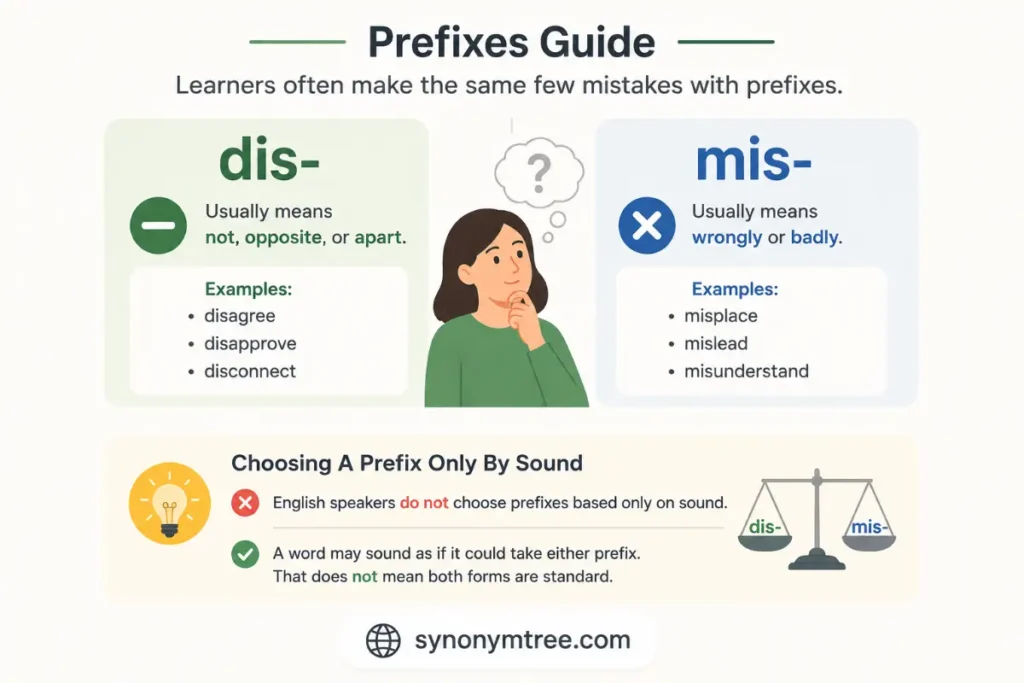
Learners often make the same few mistakes with prefixes.
Choosing A Prefix Only By Sound
English speakers do not choose prefixes based only on sound.
A word may sound as if it could take either prefix. That does not mean both forms are standard.
For example misunderstand is a standard word.
Disunderstand is not the normal word used for that meaning.
Likewise disagree is standard.
Misagree is not the normal word used to mean not agree.
The correct form depends on established English usage.
Assuming Dis Always Means Not
Dis often carries a negative meaning but it does not always mean simply not.
Disconnect means separate.
Disperse means spread apart.
Disband means break up a group.
So do not force the meaning not onto every dis word.
Assuming Mis Always Means Bad
Mis often points to an incorrect action. It does not always mean that something was morally bad.
If you misread a sentence you did not do something wrong on purpose.
You simply read it incorrectly.
If you mishear someone you are not being dishonest.
You heard the words incorrectly.
This distinction matters because bad can suggest poor quality or harmful behavior while mis often describes an error.
Dis And Mis In Everyday English
Both prefixes appear constantly in normal conversation.
You might say that you disagree with a friend.
You might explain that you misunderstood a text message.
These words do not sound formal or unusual. They are part of everyday English.
Here are some natural examples.
- Sorry. I misunderstood your message.
- I disagree with that plan.
- I think I misplaced my wallet.
- Please disconnect the charger.
- She misread the email.
- He disobeyed the instructions.
- I misheard the last part.
- They disagreed about the price.
These examples show how naturally the prefixes fit into ordinary speech.
Dis And Mis In Formal Writing
The same words also work well in formal writing.
For example a report might say that researchers misunderstood a result.
A business document might say that employees disagreed with a proposal.
A school paper might explain that a source was misinterpreted.
A technical guide might tell users to disconnect a device before cleaning it.
These words are useful because they are clear.
You do not need a longer phrase when a simple prefix word communicates the idea well.
For example misinterpret is often clearer than writing a long phrase about interpreting something incorrectly.
Clear writing depends on choosing the word that gives the reader the meaning quickly.
Prefixes And Base Words
A useful way to study vocabulary is to separate a word into its parts.
Take misunderstand.
The base word is understand.
The prefix is mis.
The full word means understand incorrectly.
Now take disagree.
The base word is agree.
The prefix is dis.
The full word means not agree or hold a different opinion.
This approach can help you learn several words at once.
If you know the base word you have already learned part of the meaning.
If you know the prefix you have another clue.
Together they give you a strong starting point.
Can Dis And Mis Be Added To Any Word
No.
This is an important point for English learners.
You cannot always take a word and add dis or mis to create a normal English word.
Some combinations are established words.
Agree and disagree.
Like and dislike.
Connect and disconnect.
Understand and misunderstand.
Read and misread.
Judge and misjudge.
Other combinations may sound possible but are not normally used.
English vocabulary developed over a long period. Some words became common through normal use while other combinations never became established.
So prefixes are helpful clues but they are not a complete word creation formula.
When you are unsure about a new combination check a reliable dictionary or trusted language source.
How Spelling Changes With Prefixes
Most words keep their main spelling when a prefix is added.
For example.
- Agree becomes disagree.
- Like becomes dislike.
- Connect becomes disconnect.
- Understand becomes misunderstand.
- Read becomes misread.
- Judge becomes misjudge.
The prefix simply goes before the base word.
Some words can create pronunciation changes or spelling details that learners need to notice. Still the main idea remains simple.
Learn the complete word rather than trying to build every word from scratch.
This is especially useful with common vocabulary.
The Pronunciation Difference
The prefixes dis and mis have different sounds.
In words such as disagree and dislike the dis part begins with a d sound.
In words such as misunderstand and misread the mis part begins with an m sound.
This difference can help you recognize the words when listening.
However pronunciation alone should not determine the spelling.
English contains many words where spelling cannot be guessed perfectly from sound.
It is better to connect pronunciation with meaning and spelling together.
For example when you hear misunderstood you should connect it with the base word understand and the idea of an incorrect understanding.
That gives you three useful pieces of information at once.
A Simple Memory Trick
Try these two short ideas.
Dis means opposite or apart.
Mis means wrong.
These are not perfect definitions for every word but they work well for many common examples.
You can also create two word groups.
The Dis Group
- Disagree means not agree.
- Dislike means not like.
- Disconnect means separate.
- Disobey means not obey.
- Dishonest means not honest.
The Mis Group
- Misunderstand means understand incorrectly.
- Misread means read incorrectly.
- Mishear means hear incorrectly.
- Misjudge means judge incorrectly.
- Misplace means place incorrectly.
Look at the pattern.
The dis group often moves away from the original meaning.
The mis group usually describes an error in the action.
That contrast makes the prefixes easier to remember.
A Practice Test
Choose the correct word for each sentence.
- I did not agree with his opinion so I ________ with him.
- I read the number incorrectly so I ________ the number.
- Please ________ the cable before moving the machine.
- She understood the instructions incorrectly so she ________ them.
- He did not obey the rule so he ________ the rule.
- I put my keys somewhere and now I cannot find them. I ________ them.
- They had different opinions so they ________ about the plan.
- I heard the name incorrectly so I ________ it.
The answers are below.
- I disagreed with him.
- I misread the number.
- Please disconnect the cable.
- She misunderstood the instructions.
- He disobeyed the rule.
- I misplaced them.
- They disagreed about the plan.
- I misheard it.
Notice how meaning guides the choice.
The disagreement is about an opposite opinion.
The misreading is about an incorrect action.
The disconnection is about separation.
The misunderstanding is about incorrect understanding.
Once you see those differences the choice becomes much easier.
Related Prefixes You Should Know
Learning dis and mis can also help you understand other common prefixes.
Un
The prefix un often means not or the opposite of a quality.
Examples include unhappy unfair and unclear.
For example unhappy means not happy.
Unfair means not fair.
Unclear means not clear.
This can look similar to dis because both can create negative meanings.
Still the words are not interchangeable.
You say disagree.
You do not normally replace it with unagree.
In
The prefix in can also create a negative meaning.
Examples include inactive incorrect and incomplete.
For example inactive means not active.
Incorrect means not correct.
Incomplete means not complete.
Again the meaning may look similar to dis but English chooses specific forms for specific words.
You cannot simply swap prefixes.
Re
The prefix re often means again.
Examples include rewrite reread and rebuild.
Rewrite means write again.
Reread means read again.
Rebuild means build again.
This gives you another useful contrast.
Misread means read incorrectly.
Reread means read again.
The base action stays connected to the meaning but the prefix changes what happened.
dis and mis prefixes In Opposite Situations
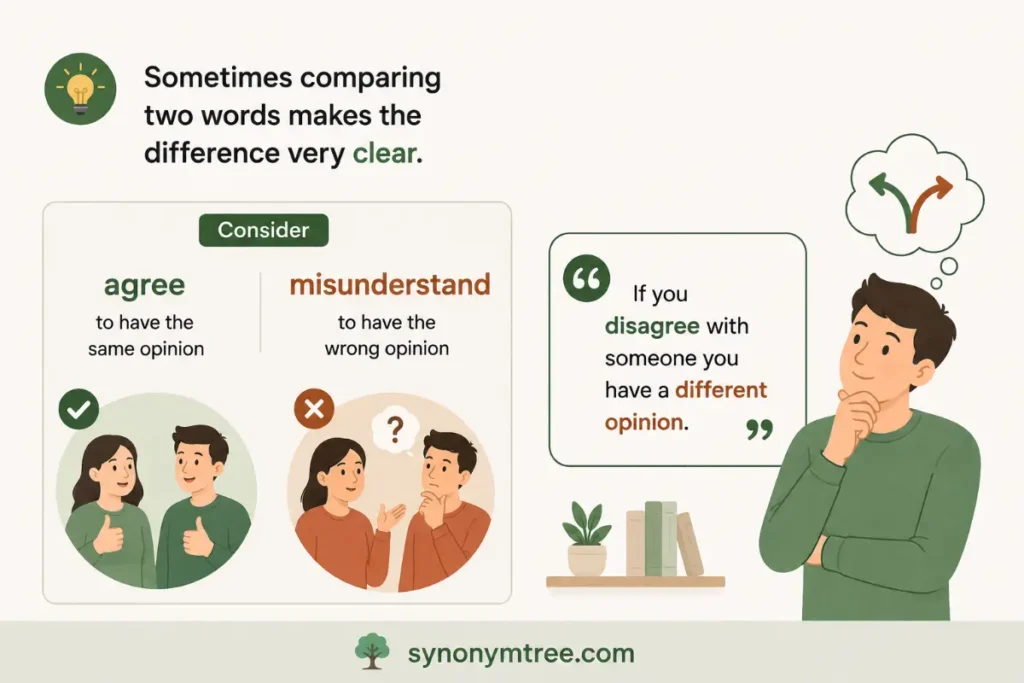
Sometimes comparing two words makes the difference very clear.
Consider agree and misunderstand.
If you disagree with someone you have a different opinion.
If you misunderstand someone you have interpreted their meaning incorrectly.
Those are two different situations.
Now compare connect and misconnect.
Disconnect is common and means break a connection.
Misconnect exists in some technical contexts but it is much less common in everyday English.
This shows why vocabulary learning needs context.
A prefix can suggest a meaning but common usage decides which complete word sounds natural.
When Dis Shows A Negative Relationship
Some dis words describe a lack of a positive quality.
Consider distrust.
Trust means confidence in someone or something.
Distrust means a lack of trust.
Disrespect works in a similar way.
Respect means treating someone with proper regard.
Disrespect means treating someone without proper regard.
Dishonesty also follows this pattern.
Honesty means truthfulness.
Dishonesty means a lack of honesty.
These words show how dis can turn a positive quality into its negative counterpart.
When Mis Shows A Wrong Result
Mis often focuses on the result of an action.
Suppose you count five objects but write down six.
You miscounted them.
Suppose you read a sentence but understand the wrong meaning.
You misread or misunderstood it.
Suppose you place your wallet somewhere and later cannot remember where you put it.
You misplaced it.
In each case the action happened but the result was wrong.
That is the central idea behind many mis words.
When The Prefix Changes The Meaning More Deeply
Some prefix words have meanings that cannot be understood by simply translating the prefix as one word.
For example mistake contains mis historically but modern speakers usually learn mistake as a complete word rather than thinking about its parts.
Misfortune means bad luck or an unfortunate event.
Mislead means cause someone to believe something incorrect.
Misconduct means improper behavior.
These words still connect to the general idea of something going wrong but the full meaning comes from normal English usage.
This is why a dictionary definition can be useful when a word feels unfamiliar.
Prefix knowledge helps you make a first guess. Context confirms the meaning.
How English Learners Can Study These Prefixes
You do not need to memorize a huge list.
Start with common words.
Learn five dis words.
Then learn five mis words.
Use each one in a sentence.
For example.
- I disagree with that point.
- I dislike very sweet drinks.
- Please disconnect the device.
- He disobeyed the rule.
- She showed disrespect.
Then practice the mis group.
- I misunderstood the question.
- I misread the date.
- I misheard the name.
- He misjudged the distance.
- I misplaced my keys.
Writing your own sentences makes the words easier to remember because you connect the vocabulary to a real situation.
Conclusion
The easiest way to understand dis and mis prefixes is to focus on the kind of meaning they add. Dis often creates an opposite or negative idea and can also show separation. Mis usually tells you that an action happened incorrectly or produced the wrong result.
Words such as disagree dislike disconnect and disobey show common uses of dis. Words such as misunderstand misread mishear and misjudge show common uses of mis.
Keep one simple memory rule in mind. Dis often means opposite or apart. Mis often means wrong. This will help you understand many common words without memorizing every definition from scratch.
When you meet a new word with one of these prefixes check the base word first. Then ask what the prefix adds to it. If the idea is opposition or separation think of dis. If the idea is an error think of mis. That quick check will make these words much easier to understand and use correctly.
Common Questions
What Do Dis And Mis Prefixes Mean?
Dis often means not opposite apart or away. Mis usually means wrongly badly or incorrectly. The exact meaning depends on the complete word.
What Is The Difference Between Dis And Mis Prefixes?
The main difference is the type of negative meaning. Dis often expresses opposition or separation while mis usually describes an incorrect action or result.
Is Mis Always Negative?
Mis usually gives a word a negative meaning because it often shows an error. However the meaning is more specific than simply bad because many mis words describe something done incorrectly rather than something harmful.
Does Dis Always Mean Not?
No. Dis can mean not or opposite but it can also express separation or reversal. Disconnect and disperse show this broader meaning.
Can I Add Dis Or Mis To Any Word?
No. Only certain combinations are established and commonly used in English. A word may look possible but still sound unnatural or incorrect to native speakers.
Is Disagree An Example Of A Dis Prefix?
Yes. Disagree combines dis with agree and expresses the idea of having a different opinion or not agreeing.
Is Misunderstand An Example Of A Mis Prefix?
Yes. Misunderstand combines mis with understand and means to understand something incorrectly.
How Can I Remember The Difference Between Dis And Mis Prefixes?
Remember a simple idea. Dis often points to an opposite or separation. Mis usually points to something going wrong or being done incorrectly.
