
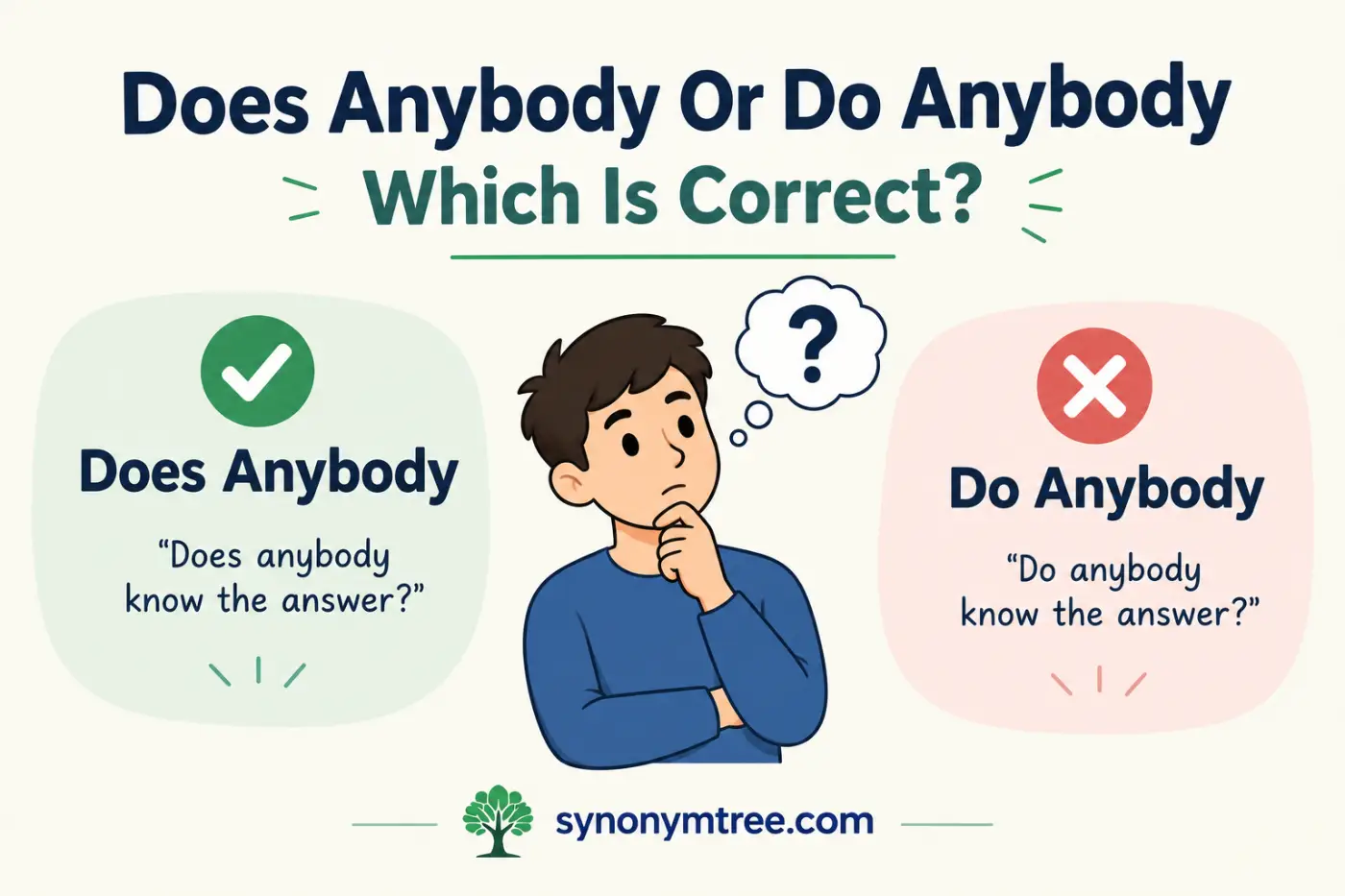
If you have ever wondered does anybody or do anybody belong in a sentence, the answer is usually simple. Use does anybody when anybody is the subject of the sentence. Anybody is treated as singular in standard English, so it takes the singular helping verb does.
This can feel confusing because anybody refers to people in general. You may think that a word referring to many possible people should take do. English does not work that way here. The word anybody is grammatically singular even when it refers to an unknown person from a larger group.
The difference becomes clear once you understand how indefinite pronouns work. Words such as anybody, anyone, somebody, someone, everybody, and everyone usually take singular verbs in standard English.
This guide explains the rule, shows many natural examples, explains why the mistake happens, and covers related questions about anyone and anybody. You will also see how these words work in questions, negative sentences, short answers, and everyday conversation.
Quick Definition
Anybody is a singular indefinite pronoun. Because it is grammatically singular, it normally takes does, has, is, and other singular verb forms.
For example, Does anybody know the answer? is correct. Do anybody know the answer? is not standard English when anybody is the subject.
Direct Answer
Use does anybody, not do anybody, when anybody is the subject of the sentence. The correct form is Does anybody know the answer?
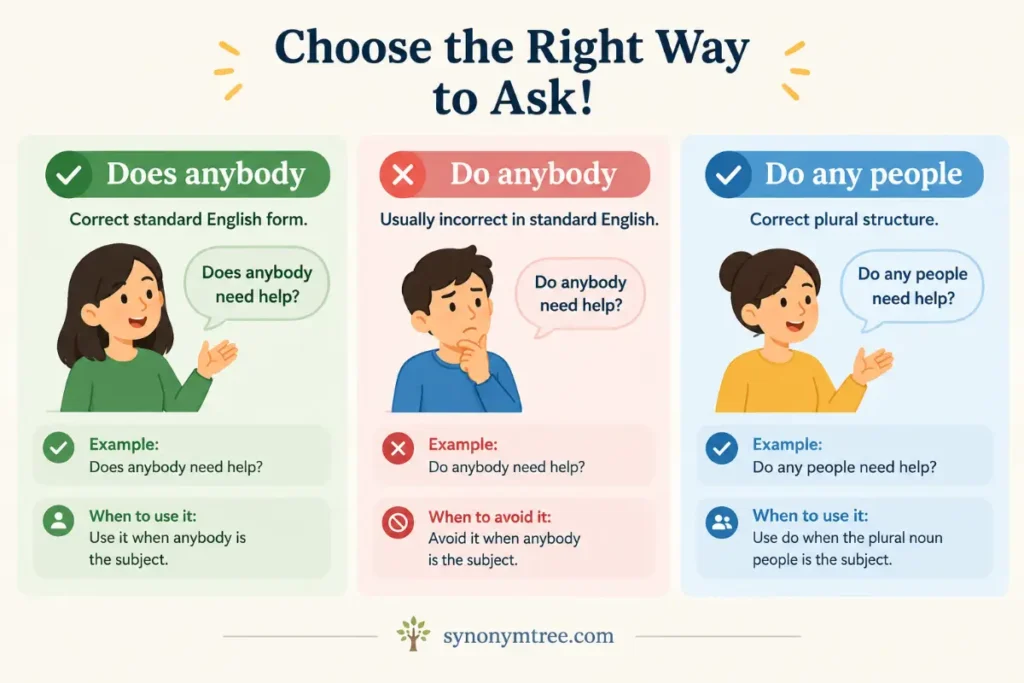
Does Anybody Or Do Anybody At A Glance
| Phrase | Meaning | Example Sentence | When To Use It |
|---|---|---|---|
| Does anybody | Correct standard English form | Does anybody need help? | Use it when anybody is the subject. |
| Do anybody | Usually incorrect in standard English | Do anybody need help? | Avoid it when anybody is the subject. |
| Do any people | Correct plural structure | Do any people need help? | Use do when the plural noun people is the subject. |
| Does anyone | Correct standard English form | Does anyone know her? | Use it when anyone is the subject. |
The key point is that anybody is grammatically singular. The word does not become plural simply because it can refer to many different people.
Why Anybody Takes A Singular Verb
The easiest way to understand this rule is to look at the structure of the word.
Anybody is an indefinite pronoun. It does not name a particular person. Instead, it refers to any person at all within the group being discussed.
Even though the word can refer to many possible people, English grammar treats anybody as singular.
That is why we say:
Does anybody know?
Anybody is here.
Anybody can join.
We do not normally say:
Do anybody know?
Anybody have the right to ask.
Anybody can join is different because can does not change between singular and plural subjects. The subject is still singular, but the modal verb can looks the same with all subjects.
This same pattern applies to many other indefinite pronouns.
Someone is ready.
Everyone is welcome.
Anyone has the right to ask.
Nobody knows the answer.
Each person gets a ticket.
The grammar is based on the pronoun itself, not on the number of people that the pronoun might represent.
The Basic Rule For Does Anybody
When anybody is the subject, use a singular verb.
The most common example is a question with does.
Who knows the answer?
Would anybody like coffee?
Can someone need a pen?
Who lives here?
Can anyone remember the meeting?
Has anyone got a question?
The same rule applies when anybody appears in other sentence structures.
Everyone is welcome.
Everyone knows that rule.
Anyone can make a mistake.
Everyone who works here receives an ID card.
The verb form depends on anybody because anybody is the subject.
Why Does Looks Strange At First
Some learners find this rule strange because anybody can mean any person among many people.
Imagine a teacher asking a room full of students, Does anybody know the answer?
The teacher is speaking to many students. Still, the grammar treats anybody as one person at a time.
The question means something like, Is there any person who knows the answer?
The implied structure is singular.
Is there any person who knows the answer?
That makes the singular verb easier to understand.
You are not asking several people as one plural subject. You are asking if at least one person has the answer.
Why Do Anybody Is Usually Wrong
The phrase do anybody sounds natural to some speakers because do often appears with plural subjects.
For example:
Do the students understand?
Do your friends live nearby?
In each sentence, the subject is plural.
Students is plural.
Workers is plural.
Friends is plural.
Anybody is not treated as plural in standard English.
So the correct question is:
Does anybody understand?
Not:
Do anybody understand?
This distinction is especially useful in formal writing, school assignments, professional communication, and edited content.
Some regional varieties of English may use patterns that differ from standard American English. If your goal is standard US English, use does anybody.
How Does Work In Questions
One of the most common places you will see this rule is in questions.
When a present tense question uses does, the main verb stays in its base form.
That means we say:
Does anybody know?
Not:
Does anybody knows?
This gives us two important rules at the same time.
Anybody takes does.
The main verb after does stays in its basic form.
So:
Could anybody know?
Would anybody want?
Does anybody need?
Can anybody understand?
Will anybody remember?
The same pattern works with many other singular subjects.
Can Sarah know?
Would your brother want coffee?
Could the teacher need help?
Can anyone understand?
Will somebody have a question?
The helping verb carries the tense and agreement. The main verb stays in its base form.
Does Anybody Know Or Does Anybody Knows
This is another common mistake.
The correct sentence is:
Does anybody know the answer?
The incorrect form is:
Does anybody knows the answer?
Why?
Because does already marks the present tense and singular agreement. The main verb returns to its base form.
Compare these two statements.
Anybody knows the answer.
Does anybody know the answer?
In the first sentence, knows carries the singular ending.
In the question, does carries that grammatical information. The main verb becomes know.
This rule applies to all regular verbs.
Anybody likes pizza.
Does anybody like pizza?
Anybody wants to leave.
Does anybody want to leave?
Anybody needs help.
Does anybody need help?
Anybody understands the problem.
Does anybody understand the problem?
Once you learn this pattern, many similar questions become easy.
Does Anybody Work In Negative Sentences
Anybody also appears often in negative sentences.
When you use does not or does not shortened to doesn’t, the main verb stays in its base form.
For example:
Anybody does not know the answer.
This sentence is grammatically possible, but it is not the most natural way to express the idea in ordinary English.
More commonly, English uses nobody or anyone with not.
Nobody knows the answer.
Anybody does not know the answer is possible in certain contexts, but it can sound awkward.
There is an important difference when anybody appears after not.
For example:
I do not think anybody knows the answer.
Here, anybody is inside the larger clause anybody knows the answer.
The word knows is singular because anybody is the subject of that smaller clause.
You can also say:
I don’t think anybody understands.
I don’t think anybody has the key.
These are natural forms.
Notice that the main clause uses I don’t think, while the clause containing anybody uses a singular verb.
Anybody With Has And Have
The same rule appears with has and have.
Because anybody is singular, use has when anybody is the subject.
For example:
Does anybody have a question?
Anybody has the right to speak.
Does anybody have a copy?
Does anybody have my phone?
At first glance, Does anybody have may look unusual because you might expect has after a singular subject.
But the same helping verb rule applies.
Compare:
Anybody has a question.
Does anybody have a question?
The statement uses has.
The question uses does plus the base form have.
You should not say:
Does anybody has a question?
The correct form is:
Does anybody have a question?
This is one of the most useful patterns to remember.
Anybody With Is And Are
Anybody also takes is rather than are when it is the subject of a sentence.
For example:
Anybody who is interested can apply.
Anybody is allowed to enter.
However, you will often see anybody in questions with does rather than is.
For example:
Does anybody know where the office is?
Does anybody need a ride?
The word is still singular. The helping verb does simply creates the question.
Compare these examples:
Anybody is available.
Is anybody available?
Anybody knows the answer.
Does anybody know the answer?
The subject stays the same. The sentence structure changes.
The Difference Between Anybody And Any People
One useful way to understand the rule is to compare anybody with any people.
Anybody is singular.
Any people is plural.
That means the verb changes.
For example:
Does anybody want to come?
Do any people want to come?
The first sentence uses does because anybody is singular.
The second sentence uses do because people is plural.
However, any people is less common in ordinary conversation. Native speakers usually choose other wording depending on the meaning.
For example:
Are there any people outside?
Do any people here know the answer?
The word people clearly takes plural grammar.
This shows why you cannot decide the verb by thinking about the possible number of people. You need to look at the actual subject.
Anyone And Anybody Follow The Same Rule
Anyone and anybody are very similar.
Both are singular indefinite pronouns.
Both normally take singular verbs.
So we say:
Does anyone know?
Does anybody know?
Anyone is welcome.
Anybody is welcome.
Has anyone seen my keys?
Has anybody seen my keys?
Does anyone have a question?
Does anybody have a question?
You can generally treat anyone and anybody the same way when thinking about subject and verb agreement.
The choice between them is usually about style and context rather than basic grammar.
Anyone can sound slightly more neutral in some sentences. Anybody can sound a little more conversational in some situations.
Both are standard English.
Someone And Somebody Follow The Same Rule
The same pattern applies to someone and somebody.
Someone is singular.
Somebody is singular.
Therefore:
Does someone know the answer?
Does somebody know the answer?
Someone has left a message.
Somebody has left a message.
Someone is waiting outside.
Somebody is waiting outside.
Again, the words can refer to an unknown person, but the grammar treats each one as singular.
This is an important pattern because it gives you a larger grammar rule instead of one isolated fact.
Everyone And Everybody Follow The Same Rule
Everyone and everybody also take singular verbs.
This surprises many learners because these words clearly refer to groups.
For example:
Everybody knows the rules.
Everyone wants to win.
Everybody is ready.
Everyone has a ticket.
We do not normally use plural verbs with these subjects in standard English.
You would not write:
Everybody know the rules.
Everyone want to win.
Everybody are ready.
Everyone have a ticket.
The reason is grammatical agreement. Everyone and everybody are singular indefinite pronouns.
This is one of those cases where meaning and grammar do not seem to match at first. The meaning can involve many people, but the grammatical form remains singular.
Nobody And No One Follow The Same Rule
Nobody and no one also use singular verbs.
For example:
Nobody knows the answer.
No one wants to leave.
Nobody has called yet.
No one is available.
These words refer to zero people, but they are still grammatically singular.
That gives us a useful family of words.
Anybody takes singular grammar.
Anyone takes singular grammar.
Somebody takes singular grammar.
Someone takes singular grammar.
Everybody takes singular grammar.
Everyone takes singular grammar.
Nobody takes singular grammar.
No one takes singular grammar.
Learning this group can save you from many agreement mistakes.
Real Examples With Does Anybody
Here are natural sentences you might hear or write.
- Does anybody know where the meeting is?
- Does anybody have a spare charger?
- Does anybody want another slice of pizza?
- Does anybody remember his name?
- Does anybody need help with the project?
- Does anybody live in that house?
- Does anybody know what time the store closes?
- Does anybody have an extra ticket?
- Does anybody understand this question?
- Does anybody want to go outside?
- Does anybody recognize this song?
- Does anybody know how this works?
- Does anybody have a better idea?
- Does anybody remember what happened?
- Does anybody need a ride home?
These examples show how common the structure is in real English.
Common Mistakes With Anybody
Many grammar mistakes happen because speakers focus on the meaning of a sentence instead of the grammatical form.
Mistake One Using Do With Anybody
The most common mistake is using do because anybody can refer to many people.
For standard English, use does when anybody is the subject.
Correct:
Does anybody know?
Incorrect:
Do anybody know?
The word anybody remains singular.
Mistake Two Adding S After Does
Another common mistake is putting the singular ending on the main verb.
Correct:
Does anybody know?
Incorrect:
Does anybody knows?
Correct:
Does anybody want coffee?
Incorrect:
Does anybody wants coffee?
Remember that does already carries the singular form.
Mistake Three Using Are With Anybody
You should normally use is rather than are when anybody is the subject.
Correct:
Is anybody available?
Incorrect:
Are anybody available?
The same idea applies to statements.
Anybody is welcome.
Not:
Anybody are welcome.
Mistake Four Using Have After A Simple Statement
The correct statement is:
Anybody has a chance.
The correct question is:
Does anybody have a chance?
Do not combine does with has in this structure.
Incorrect:
Does anybody has a chance?
Correct:
Does anybody have a chance?
Why Meaning Can Trick You
English learners often make agreement mistakes because they connect anybody with the idea of many people.
Imagine ten people sitting in a room.
You ask:
Does anybody want coffee?
You are speaking to ten people. Still, anybody means any single person from that group.
The question can be understood as:
Does any one person want coffee?
That is why does works.
This is similar to the difference between each and all.
Each student is ready.
All students are ready.
Each is singular.
All is plural.
Anybody behaves like the singular group in this kind of grammar pattern.
Anybody In Formal Writing
In formal writing, use the standard singular form.
For example:
Does anybody have information about the incident?
Does anybody have evidence to support this claim?
These sentences are clear and grammatically standard.
You may see informal speech written differently online. Social media, text messages, and casual conversation often contain nonstandard grammar.
That does not mean the nonstandard form is appropriate for an essay, article, application, report, or professional message.
If you are writing for a broad US audience, standard subject and verb agreement is the safest choice.
Anybody In Everyday Conversation
Anybody is extremely common in spoken English.
People often use it when they want to ask an open question.
Does anybody have a pen?
Does anybody want to watch a movie?
These questions sound natural and friendly.
You can use anybody when you do not know the specific person who might answer.
The speaker does not expect the word anybody to represent a specific individual. It simply opens the question to any person who qualifies.
Does Anybody Or Do Anybody In Questions
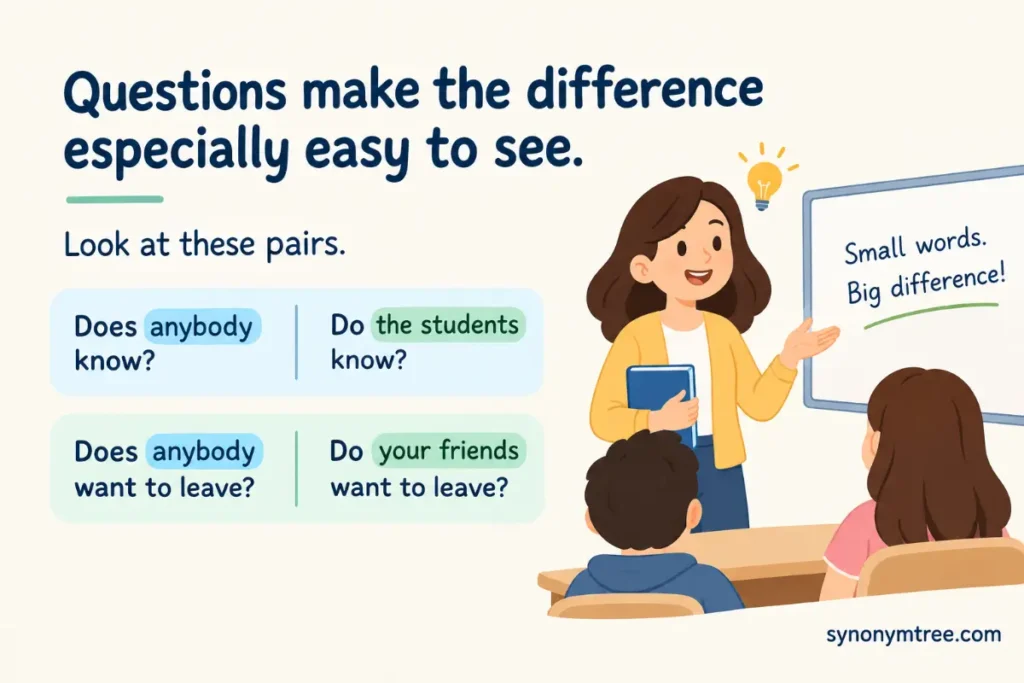
Questions make the difference especially easy to see.
Look at these pairs.
Does anybody know?
Do the students know?
Does anybody want to leave?
Do your friends want to leave?
Does anybody have a ticket?
Do the guests have tickets?
The first sentence in each pair has a singular indefinite pronoun.
The second has a plural noun.
That is why the helping verb changes.
Does agrees with the singular subject.
Do agrees with the plural subject.
This pattern works far beyond anybody.
Does Anyone Or Does Anybody
Anyone and anybody usually have the same grammar.
Both can introduce questions such as:
Can anyone know the answer?
Could anybody know the answer?
Would anyone want to join us?
Could anybody want to join us?
Can anyone have a question?
Would anybody have a question?
The meaning is nearly the same.
The choice is usually a matter of personal style and context.
Anybody often sounds slightly more conversational. Anyone can sound slightly more neutral. Neither choice is wrong.
The important grammar point is that both take singular agreement.
Anyone Versus Anybody In Negative Sentences
Both anyone and anybody often appear after negative words.
For example:
I don’t know anybody here.
I don’t know anyone here.
She didn’t tell anybody.
She didn’t tell anyone.
These sentences are natural.
Notice something important. The verb in the main clause may be do or did because the subject is I or she.
I don’t know anybody.
She didn’t tell anybody.
The presence of anybody does not determine the main verb when anybody is not the subject.
This is a very important point.
The rule applies when anybody is the subject.
Consider:
I don’t think anybody knows.
Here, anybody is the subject of the smaller clause, so knows is singular.
But in:
I don’t know anybody.
I is the subject of the main clause. The word anybody is the object.
This difference explains many sentences that seem confusing.
Subject Versus Object
Knowing the difference between a subject and an object will make this rule much easier.
The subject performs the action or controls the verb.
The object receives the action.
Consider:
Anybody knows the answer.
Anybody is the subject.
Now consider:
I know anybody who can help.
This sentence is unusual in meaning, but grammatically I is the subject. Anybody is not controlling the verb know.
A more natural example is:
I don’t know anybody here.
I is the subject.
Know is the verb.
Anybody is the object.
That is why you do not use does simply because the word anybody appears somewhere in the sentence.
The position and function of the word matter.
A Useful Grammar Test
If you are unsure which verb to use, find the subject first.
Ask who or what performs the action.
Consider:
Does anybody know the answer?
Who knows the answer?
Anybody.
That tells you the subject is anybody.
Because anybody is singular, use does.
Now look at:
Do the students know the answer?
Who knows the answer?
The students.
Students is plural, so use do.
This simple test works in many situations.
When Do Is Correct
Do is not wrong by itself.
It becomes wrong only when you use it with a singular subject such as anybody in the standard structure discussed here.
Do works with plural subjects.
For example:
Can the children understand?
Could the teachers agree?
Can your parents know?
Could these people live here?
Can my friends need help?
Can I need a ticket?
Could you understand?
Can we have enough time?
So the real rule is not simply use does with questions about people.
The rule is to match the helping verb with the subject.
Anybody is singular.
Plural nouns usually take do.
I and you also take do.
He, she, it, and singular nouns take does.
A Simple Verb Agreement Chart
| Subject | Correct Helping Verb | Example |
|---|---|---|
| I | Do | Do I need help? |
| You | Do | Do you know her? |
| We | Do | Do we have enough time? |
| They | Do | Do they live here? |
| Students | Do | Do students need books? |
| He | Does | Does he know? |
| She | Does | Does she understand? |
| It | Does | Does it work? |
| Anybody | Does | Does anybody know? |
| Anyone | Does | Does anyone agree? |
| Somebody | Does | Does somebody need help? |
| Everybody | Does | Does everybody understand? |
This chart shows that anybody belongs with the singular group.
How The Rule Works With Relative Clauses
Anybody often appears before a relative clause.
For example:
Anybody who knows the answer can speak.
Anybody who has a question can raise a hand.
The verb inside the relative clause also agrees with the word that acts as the subject.
In:
Anybody who knows the answer can speak.
Anybody is singular, so knows is singular.
In:
People who know the answer can speak.
People is plural, so know is plural.
Compare them carefully.
Anybody who knows.
People who know.
This is another clear example of why meaning alone does not control verb agreement.
Anybody Can Be Singular In Meaning And Broad In Reference
This is the heart of the issue.
Anybody has broad reference. It can point to any person in a large group.
But broad reference does not make a pronoun grammatically plural.
Think about the sentence:
Anybody can apply.
The sentence does not mean that many people must apply.
It means any person has permission or ability to apply.
That is why the singular grammatical form makes sense.
The same pattern appears with everyone.
Everyone is invited.
The sentence can refer to a room full of hundreds of people.
Still, everyone is grammatically singular.
Memory Tricks That Actually Help
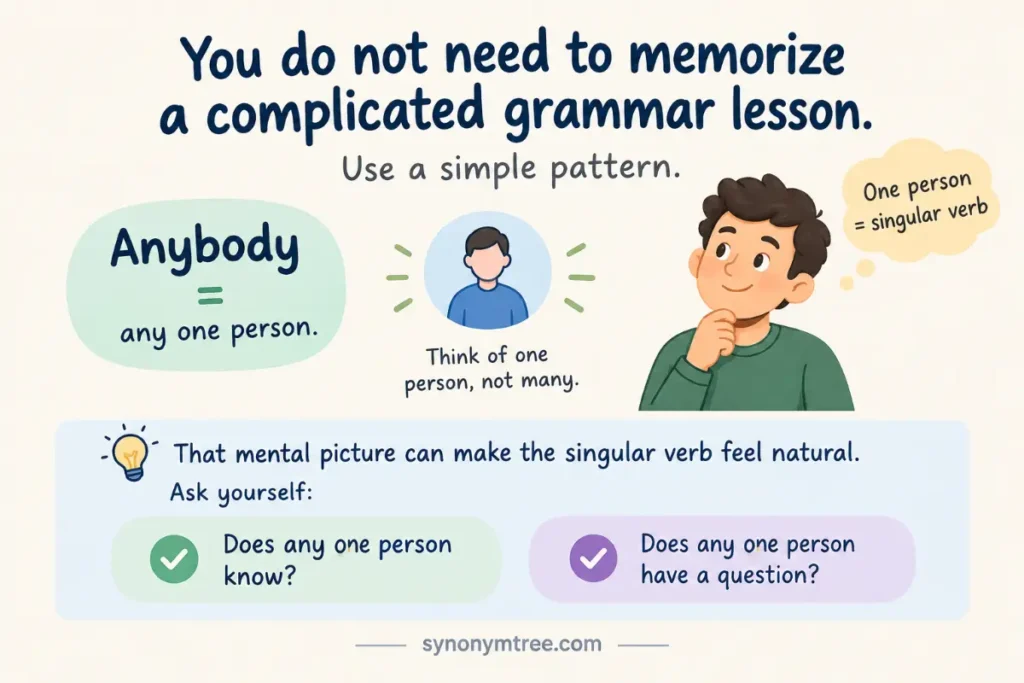
You do not need to memorize a complicated grammar lesson.
Use a simple pattern.
Anybody equals any one person.
That mental picture can make the singular verb feel natural.
Ask yourself:
Does any one person know?
Does any one person have a question?
The answer will naturally point you toward does.
Another useful trick is to group similar words together.
Anyone takes does.
Anybody takes does.
Someone takes does.
Somebody takes does.
Everyone takes does.
Everybody takes does.
Nobody takes does.
No one takes does.
If you remember this group, you will avoid many subject and verb agreement mistakes.
Practice Examples
Try choosing the correct form in each sentence.
- Does anybody know where she lives?
- Does anybody want some water?
- Does anybody have a question?
- Does anybody understand the instructions?
- Does anybody remember his name?
- Does anybody need a copy?
- Does anybody live nearby?
- Does anybody have an answer?
- Does anybody want to leave early?
- Does anybody know what happened?
Each sentence uses does because anybody is the subject.
Now compare them with plural subjects.
- Do the students know where she lives?
- Do the children want some water?
- Do the workers have a question?
- Do the teachers understand the instructions?
- Do your friends remember his name?
- Do the visitors need a copy?
- Do the neighbors live nearby?
- Do the managers have an answer?
- Do the guests want to leave early?
- Do the players know what happened?
The subject controls the verb.
That is the rule worth remembering.
How This Works With Other Tenses
The same basic idea appears in other verb forms.
In the present tense, anybody takes singular agreement.
Anybody knows.
Anybody is.
When you form a question with does, use the base form after does.
Does anybody know?
Does anybody understand?
Past tense works differently.
You normally use did for both singular and plural subjects in questions.
Did anybody call?
Did anybody leave early?
Notice that you do not say:
Did anybody called?
Did anybody left early?
After did, use the base form.
So you can think of the pattern this way.
Present question:
Does anybody know?
Past question:
Did anybody know?
Present statement:
Anybody knows.
Past statement:
Anybody knew.
This pattern is useful because it shows how the helping verb controls the verb form.
Conclusion
The answer to does anybody or do anybody is clear once you focus on grammar instead of the number of people involved. Anybody is a singular indefinite pronoun, so it normally takes does in present tense questions.
The correct sentence is Does anybody know the answer? The incorrect standard form is Do anybody know the answer? You should also remember that does is followed by the base form of the main verb, so Does anybody knows is incorrect.
The same rule applies to anyone, someone, somebody, everyone, everybody, nobody, and no one. These words can refer to groups or unknown people, but English still treats them as singular for verb agreement.
When you get stuck, replace anybody with any one person in your mind. If the sentence would use does for one person, use does with anybody. That quick check will help you choose the right form in everyday speech, school writing, emails, and professional communication.
Frequently Asked Questions
Does anybody or do anybody which one is correct?
Does anybody is the correct form in standard US English when anybody is the subject. For example, Does anybody know the answer? is correct.
Why does anybody take a singular verb?
Anybody is an indefinite pronoun that English grammar treats as singular. It can refer to any person in a group, but its grammatical form remains singular.
Can I say do anybody in casual English?
You may hear nonstandard forms in some varieties of English, but do anybody is not the standard form for edited US English. Use does anybody when anybody is the subject.
Is does anybody know grammatically correct?
Yes. Does anybody know the answer? is grammatically correct. After does, the main verb must use its base form, so know is correct rather than knows.
Should I use does anybody have or does anybody has?
Use does anybody have. The word does already marks the singular present tense, so the main verb stays in its base form.
Does anyone follow the same rule as anybody?
Yes. Anyone is also grammatically singular. You should say Does anyone know? rather than Do anyone know?
Is anybody singular or plural?
Anybody is grammatically singular. It can refer to any person in a larger group, but it still takes singular agreement.
What other words work like anybody?
Anyone, someone, somebody, everyone, everybody, nobody, and no one follow the same basic singular agreement pattern. For example, Everyone knows and Somebody has are standard forms.
