
If you are unsure about donar or donor, you are not alone. These two spellings look very similar, but only one is the standard English word for a person who gives something to help another person or group. The correct spelling is donor.
A donor can give money, blood, an organ, food, supplies, or another useful resource. You will see the word often in medical care, charities, fundraising, blood drives, and nonprofit work.
This guide explains the difference between the two spellings, shows how to use the correct word in real sentences, and explains why the mistake happens. You will also learn related words, common spelling problems, and simple ways to remember the correct form.
Quick Definition
A donor is a person or organization that gives something to another person or group. The gift can be money, blood, an organ, food, clothing, or another resource. Donar is not the standard English spelling for this meaning.
Direct Answer
Donor is the correct English spelling when you mean a person or organization that gives something. Donar is usually a spelling mistake.
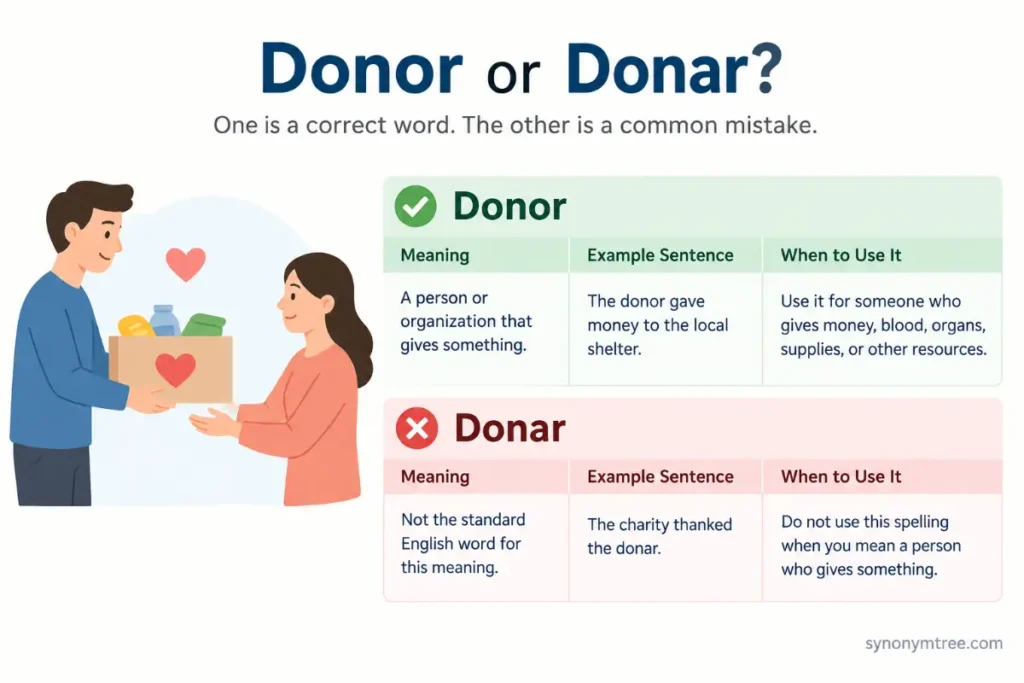
Comparison Table For Donar Or Donor
| Word | Meaning | Example Sentence | When to Use It |
|---|---|---|---|
| Donor | A person or organization that gives something | The donor gave money to the local shelter. | Use it for someone who gives money, blood, organs, supplies, or other resources. |
| Donar | Not the standard English word for this meaning | The charity thanked the donar. | Do not use this spelling when you mean a person who gives something. |
Why People Confuse These Words
The confusion comes from the way the word sounds and looks. When people hear donor spoken aloud, they may connect the sound to the spelling donar. The ending can feel natural because many English words have different spelling patterns that sound alike.
English spelling does not always match pronunciation in a simple way. A sound can sometimes be represented by several letters. That makes spelling mistakes easy, especially when you have heard a word many times but have not seen it written often.
The word donor also has a clear connection to the verb donate. That connection can help you remember the correct spelling. A person who donates is a donor.
For example, you might say that Maria donated blood. You can then describe Maria as a blood donor. The noun keeps the same basic idea of giving.
This pattern appears in many common English words. A person who acts can often have a noun form that describes that person. A person who creates can be called a creator.
The word donor follows a similar pattern.
The Link Between Donate And Donor
The verb donate means to give something for a helpful or charitable purpose. The noun donor describes the person or organization that gives it.
Consider these examples.
- James donated $100 to the food bank.
- James was a donor to the food bank.
- The hospital received donated blood.
- The blood donor completed a health form.
The relationship between donate and donor makes the spelling easier to remember. If you know the word donate, think of the person who donates as the donor.
Why The Final Letter Matters
The final spelling is or, not ar. This small difference changes the word from the accepted English spelling to a spelling error.
You might see the incorrect version in informal writing, online posts, messages, or user generated content. Seeing a misspelling many times does not make it standard English.
When you are writing something formal, use donor.
This matters in applications, charity materials, medical forms, school assignments, business documents, and professional communication. A simple spelling mistake can make otherwise good writing look less polished.
What Donor Means
A donor is someone who gives something without expecting the same thing back. The word is especially common when the gift supports a person, organization, medical treatment, or public cause.
The thing being given can vary widely.
A person can donate money to a charity. That person is a financial donor.
Someone can give blood at a blood center. That person is a blood donor.
A person can give an organ for medical treatment. That person can be called an organ donor.
A company can give supplies to a community organization. The company can be described as a corporate donor.
The word does not always refer to a single person. An organization, company, foundation, or other group can also act as a donor.
Donor In Charity Work
Charities use the word donor very often. A donor gives money or other resources to support a cause.
For example, a charity might write:
The organization thanked its donors for supporting the winter food program.
Here, donors are the people or groups that gave support.
A donor does not have to give a large amount. Someone who gives five dollars and someone who gives five thousand dollars can both be donors.
The word describes the act of giving, not the size of the gift.
You may also see terms such as new donor, regular donor, monthly donor, major donor, individual donor, and corporate donor. These phrases describe different types of supporters.
Donor In Medicine
The word has a special place in medical English.
A blood donor gives blood. An organ donor gives an organ for transplantation. A tissue donor provides tissue that may help another patient.
For example:
The hospital needs more blood donors this month.
She registered as an organ donor.
The medical team thanked the tissue donor family.
In these sentences, donor refers to someone who gives biological material for medical use.
The word can also appear in discussions about reproductive medicine. A person who provides sperm or eggs for another person’s treatment may be described as a donor.
The exact meaning depends on the medical context, but the central idea stays the same. A donor provides something that another person may use.
Donor As A Noun
Donor is mainly a noun. A noun names a person, place, thing, or idea.
The word identifies the person or organization that gives something.
For example:
The donor gave the school new computers.
The donor asked to remain anonymous.
The charity contacted each donor after the event.
The hospital thanked every blood donor.
In each sentence, donor names the giver.
The plural form is donors.
For example:
Many donors supported the project.
The hospital needs more blood donors.
The charity sent updates to its donors.
The plural simply adds s to the end.
Donor And Donate
These words are closely related, but they have different jobs in a sentence.
Donate is a verb. It describes the action of giving.
Donor is a noun. It describes the person or group that gives.
Compare these examples.
- Sarah donated clothes to the shelter.
- Sarah is a donor to the shelter.
- The company donated food.
- The company became a major donor.
The first sentence focuses on the action. The second focuses on the giver.
This distinction helps you choose the correct word when writing.
Donor And Donation
There is another useful word in this family. It is donation.
A donation is the thing that someone gives.
The three words have different roles.
- Donate means to give.
- Donor means the person or group that gives.
- Donation means the thing that is given.
Look at this example:
The donor donated a large donation to the charity.
This sentence is grammatically possible, but it sounds repetitive. A more natural version would be:
The donor gave a large donation to the charity.
You can also say:
The donor donated $500 to the charity.
Now the verb and noun roles are clear.
How To Use Donor In Real Sentences
The best way to learn a spelling is to see the word in natural sentences. Here are several common situations where donor fits.
- The donor gave money to help families affected by the storm.
- The hospital thanked every blood donor.
- A private donor funded the new school library.
- The charity received support from hundreds of donors.
- She became an organ donor after learning more about transplantation.
- The donor asked the organization not to publish their name.
- Each donor received a thank you letter.
- The foundation is one of the museum’s largest donors.
- The food bank depends on local donors.
- The company became a major donor to the community program.
These examples show that donor works across many areas. It can describe charitable giving, medical giving, educational support, community programs, and organizational funding.
Donor In Common Phrases
You will often find donor next to another word that explains what kind of giving is involved.
Blood Donor
A blood donor gives blood for medical use.
Example:
The blood center is looking for more blood donors.
Organ Donor
An organ donor gives an organ for transplantation or agrees to donate organs after death under applicable medical and legal rules.
Example:
He registered as an organ donor.
Charity Donor
A charity donor gives money or resources to support a charitable organization or cause.
Example:
The charity sent a newsletter to its donors.
Major Donor
A major donor provides a large amount of financial support compared with other donors.
Example:
A major donor helped the nonprofit expand its food program.
The exact amount that makes someone a major donor depends on the organization and its fundraising goals.
Anonymous Donor
An anonymous donor gives something without having their identity publicly shared.
Example:
An anonymous donor paid for the family’s medical treatment.
Monthly Donor
A monthly donor gives money on a regular monthly schedule.
Example:
Monthly donors help the shelter plan its budget.
These phrases all keep the same basic meaning. Donor refers to the giver.
Common Mistakes With Donor
Spelling mistakes often happen because people remember how a word sounds instead of how it looks. The incorrect form can also appear familiar after repeated exposure.
Here are some common problems to watch for.
Using Donar Instead Of Donor
The biggest mistake is simply writing donar when you mean donor.
Incorrect:
The donar gave $500 to the school.
Correct:
The donor gave $500 to the school.
The correct form ends in or.
Confusing Donor With Donation
A donor is the giver. A donation is the gift.
Incorrect:
The donation gave money to the charity.
Correct:
The donor gave money to the charity.
Or:
The donor made a donation to the charity.
The second sentence uses both words correctly.
Confusing Donor With Donate
Donate describes an action. Donor names the person or group doing the action.
Incorrect:
The charity thanked every donate.
Correct:
The charity thanked every donor.
You could also say:
The charity thanked everyone who donated.
That sentence uses the verb form instead.
Using Donor For Every Kind Of Giving
The word donor often suggests giving for a helpful, charitable, medical, or supportive purpose. It does not describe every person who gives anything in every situation.
For example, you would not normally call a person who gives you a birthday present a donor. You would usually call that person a friend, family member, or gift giver.
Context matters.
A donor typically gives something to support a person, organization, cause, or medical purpose.

A Simple Memory Trick to Remember Donar Or Donor
Here is an easy way to remember the spelling.
Think of donate and donor as a pair.
Donate means to give.
Donor means the one who gives.
Both words use the o sound and the or ending in the noun form.
You can make a short mental sentence:
I donate. I am a donor.
That connection can help you avoid the incorrect spelling.
Another useful trick is to remember that donor looks like other common words ending in or.
Actor.
Creator.
Director.
Donor.
These words name people who perform an action or role.
You do not need to memorize a complicated spelling rule. Just connect donor with donate.
Donor And Similar Words
English has several words that describe people who give or support others. They are related, but they do not always mean the same thing.
Donor And Giver
Giver is a broad and simple word. It can describe anyone who gives something.
Donor is more specific. It often refers to giving money, blood, organs, resources, or support to a cause or organization.
For example:
She is a generous giver of gifts.
She is a regular donor to the hospital.
The first sentence has a wider meaning. The second has a more specific context.
Donor And Contributor
A contributor is someone who contributes something to a project, organization, discussion, or cause.
A contributor can give money, ideas, work, writing, or other help.
For example:
He is a contributor to the magazine.
He is also a donor to the local charity.
A donor usually gives resources. A contributor can provide many different kinds of support.
Donor And Sponsor
A sponsor usually provides money or other support for an event, activity, person, team, or organization. Sponsorship often involves a public relationship or promotional benefit.
A donor generally gives support without that sponsorship relationship being the main focus.
For example:
A company sponsored the school sports event.
A company donated computers to the school.
Both involve giving support, but the purpose and relationship can differ.
Donor And Benefactor
Benefactor is a more formal word for someone who provides help or financial support.
For example:
The university honored a longtime benefactor.
Donor is much more common in everyday charity and fundraising language.
If you are writing for a general audience, donor is usually the simpler choice.
Donor In Formal Writing
The correct spelling matters most in writing that other people may review.
Think about a scholarship application, charity website, annual report, medical document, school paper, or fundraising email. A spelling error in an important word can distract the reader.
If you are writing about fundraising, check every use of the word before publishing.
For example:
The organization thanked its donors for their support.
This sounds natural and professional.
A sentence using the incorrect spelling can make the writer seem less careful:
The organization thanked its donars for their support.
The problem is easy to fix. Replace the incorrect form with donor.
Proofreading tools can also help, but you should still understand the word yourself. Spell checkers do not always catch every writing problem, especially when a misspelled word resembles another valid word.
Why Spell Check May Not Always Be Enough
Modern writing tools can catch many spelling errors. Still, human review matters.
Some mistakes happen because a writer chooses a real word that does not fit the sentence. A spelling checker may not understand the intended meaning.
With donor, the main problem is usually simple spelling. Still, it is useful to know the correct word family.
If you know donate, donation, and donor, you can often catch an error yourself.
Reading your writing slowly can also help. When you see a word you have typed many times, your brain may automatically accept it. Slowing down gives you a better chance to notice a wrong letter.
Is Donar Ever Correct
For standard English, use donor when you mean a person or organization that gives something.
Donar may appear as a name, a username, a brand name, or a word from another language. Those special uses do not change the standard English spelling.
If you are writing ordinary English about someone who gives money, blood, organs, or other resources, donor is the safe and correct choice.
This distinction is useful because people sometimes assume that every word they see online is standard English. Online writing contains names, informal spellings, typos, translations, and language from many countries.
Context can explain why you see donar somewhere. It does not make it the standard English spelling for this meaning.
Related Word Forms
Knowing the full word family makes English easier.
Donate
Donate is the verb.
Example:
Many people donate food to the shelter.
Donated
Donated is the past form and past participle of donate.
Example:
The company donated computers to the school.
Donating
Donating is the form used for an action in progress or as a gerund.
Example:
Donating blood can help patients in need.
Donation
Donation is the noun for something that is given.
Example:
Her donation helped pay for the supplies.
Donor
Donor is the person or organization that gives.
Example:
The donor supported the hospital for many years.
These forms are connected. Learning them together can make the spelling much easier.
When To Use Donor In A Sentence
Use donor when you need to identify the giver.
For example:
The donor gave the library several new books.
Here, donor tells us who gave the books.
Use donation when you need to identify the thing that was given.
The library received a large donation of books.
Use donate when you need to describe the act.
The family decided to donate the books.
These three sentences describe the same basic event from different angles.
The person is the donor.
The action is donate.
The gift is the donation.
That is one of the easiest ways to keep the words straight.
Donor In Everyday English
You may not use donor in casual conversation every day, but the word is very common in certain situations.
You will hear it at hospitals, blood centers, charities, schools, universities, religious organizations, museums, and nonprofit groups.
For example, a hospital may talk about blood donors. A museum may recognize donors who helped pay for an exhibit. A university may thank donors who provide scholarships.
The word can also appear in news reports and public announcements.
For example:
Local donors helped the shelter buy winter clothing.
The hospital needs more blood donors.
The university thanked its donors during the annual event.
These sentences sound natural because donor matches the context of giving support.
How Donor Changes In Different Contexts
The basic meaning stays the same, but the type of gift changes.
For charity work, a donor usually gives money or supplies.
In medicine, a donor may give blood, tissue, or an organ.
Within education, a donor may fund scholarships, buildings, books, or programs.
For the arts, a donor may support a museum, theater, or cultural project.
In community work, a donor may provide food, clothing, equipment, or money.
The word is flexible because it focuses on the giver rather than the exact item.
Tips For Better Spelling
Good spelling often comes from building connections rather than memorizing isolated words.
First, connect donor with donate.
Second, remember that donor ends with or.
Third, think about the person and the action separately.
The person is the donor.
The action is to donate.
The gift is a donation.
Finally, read the word often. Seeing the correct spelling in real sentences helps your brain remember its shape.
You can also create your own sentence:
The donor decided to donate a large donation.
That sentence is repetitive, but it can help you connect all three forms while studying. In normal writing, you would usually choose a smoother sentence.
For example:
The donor gave a large donation.
Or:
The donor donated a large amount to the charity.
A Quick Editing Test
If you are checking a sentence and are unsure about the spelling, ask yourself one simple question.
Am I talking about the person or group that gives something.
If the answer is yes, donor is probably the word you need.
If you are talking about the thing that was given, use donation.
For example:
The ___ gave money to the charity.
The answer is donor.
The family decided to ___ blood.
The answer is donate.
The charity received a large ___.
The answer is donation.
This three word test can solve most problems quickly.
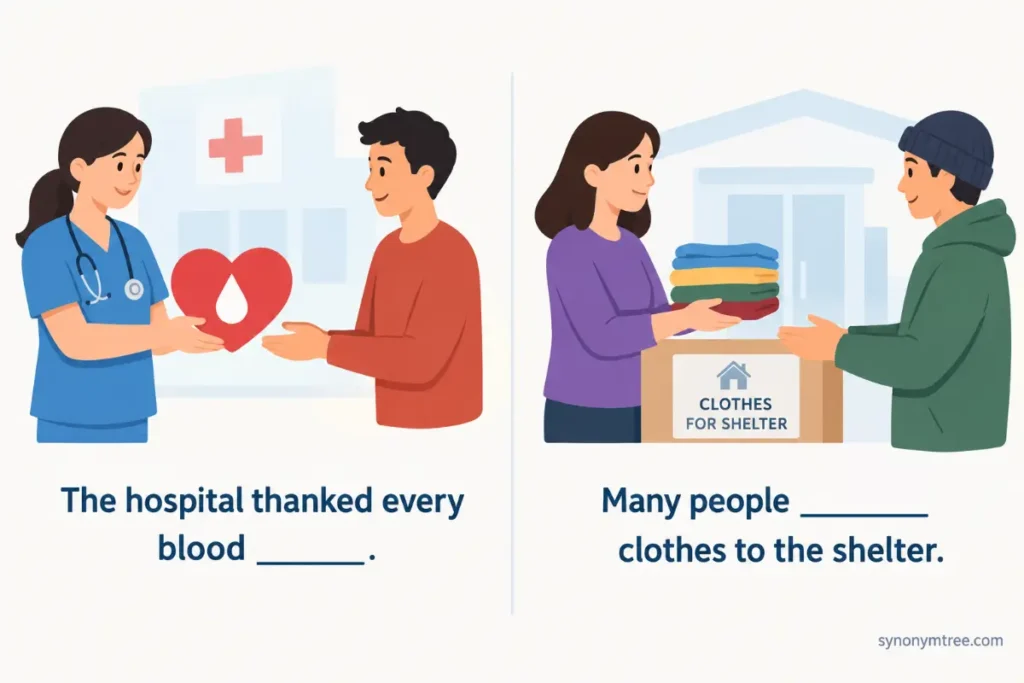
A Useful Practice Exercise For Donar Or Donor
Try filling in the blanks with donor, donate, or donation.
- The hospital thanked every blood ___.
- Many people ___ clothes to the shelter.
- The school received a generous ___.
- The anonymous ___ supported the project.
- We plan to ___ food next week.
The answers are donor, donate, donation, donor, and donate.
Practice like this can help you recognize the role each word plays in a sentence.
Conclusion
If you came here wondering about donar or donor, the answer is simple. Use donor when you mean a person or organization that gives something to support another person, group, cause, or medical purpose. The easiest way to remember it is to connect donor with donate and donation. A donor gives. To donate means to give. A donation is the thing that is given.
You will see donor in phrases such as blood donor, organ donor, charity donor, major donor, and anonymous donor. The exact type of gift can change, but the basic meaning stays the same.
When you are writing and get stuck, ask what you are describing. If you mean the person or organization that gives, write donor. That one small spelling check will help you avoid the most common mistake.
FAQs
Is Donar Or Donor The Correct Spelling?
Donor is the correct standard English spelling when you mean a person or organization that gives something. Donar is not the standard spelling for this meaning.
What Does Donor Mean?
A donor is someone who gives money, blood, organs, supplies, or another resource to another person or group. The word can also describe an organization that provides support.
Is Donar A Word In English?
Donar is not the standard English spelling for a person who gives something. You may see it as a name, a special term, or a spelling mistake, but standard English uses donor for this meaning.
What Is The Difference Between Donor And Donate?
Donor is a noun that names the person or group that gives something. Donate is a verb that describes the act of giving.
What Is The Difference Between Donor And Donation?
A donor is the giver. A donation is the thing that the donor gives.
Is A Blood Donor Correct English?
Yes. Blood donor is the standard term for a person who gives blood for medical use. For example, you can say that the hospital needs more blood donors.
What Is The Plural Of Donor?
The plural of donor is donors. For example, a charity can have hundreds of donors.
How Can I Remember The Spelling Of Donor?
Connect donor with donate. The person who donates is the donor, and the noun ends with or.
