
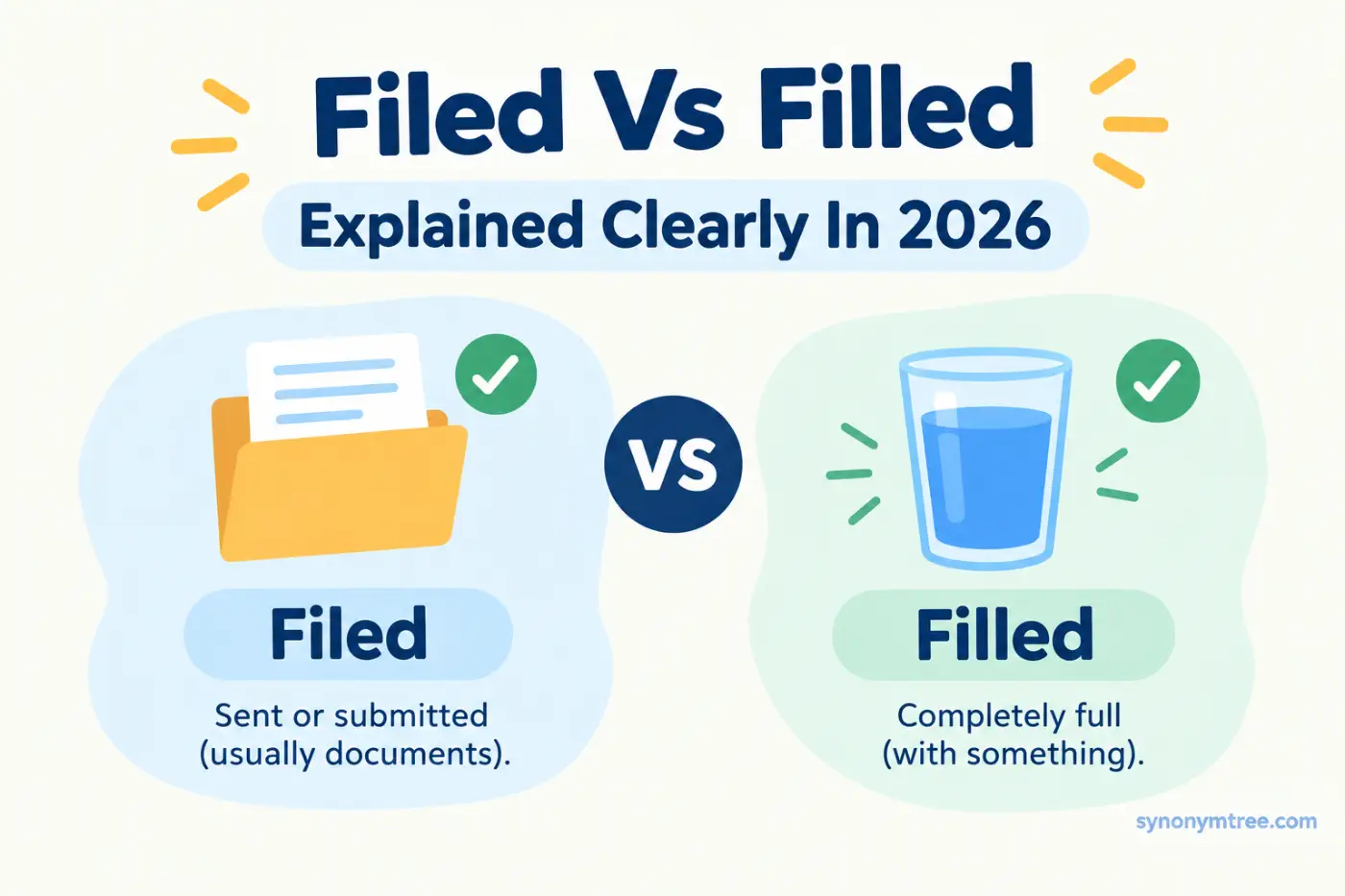
If you are confused about filed vs filled, you are dealing with two words that look and sound very similar but have different meanings. Filed comes from the verb file. Filled comes from the verb fill. The first usually relates to documents, records, or official submissions. The second usually means making something full or adding information to something.
The difference becomes much easier when you look at the base word. You file a report. You fill a bottle. Once you connect each past tense word to its original verb, the spelling starts to make sense.
This confusion often appears in office writing, schoolwork, legal documents, emails, applications, and everyday messages. A single letter can change the meaning of a sentence. That is why knowing the difference matters.
This guide explains the meanings, spelling, pronunciation, grammar, common expressions, mistakes, and practical examples. By the end, you will have a simple way to choose the right word without stopping to second guess yourself.
Quick Definition
Filed is the past tense of file. It usually means putting records into an organized system or officially submitting a document. Filled is the past tense of fill. It means making something full, putting something into an empty space, or completing something with information.
Direct Answer
Use filed when you mean stored, organized, recorded, or officially submitted. Use filled when you mean made full, supplied, completed, or given information.
The Main Difference
The easiest way to understand these words is to focus on the action.
When you file something, you usually place it into a record system or submit it to an organization. When you fill something, you put material or information into an empty space.
Think about these two sentences.
She filed the report.
She filled the bottle.
In the first sentence, the report was stored or officially submitted. In the second sentence, something was put into the bottle.
The words look almost alike, but they describe different actions. Filed connects to file. Filled connects to fill.
That connection is the key to the entire topic.
What Filed Means
Filed is the past tense and past participle of file. The word has several uses, but most common uses relate to documents, records, and formal submissions.
You can file papers in a folder. You can file records in a cabinet.
The basic idea is placing something into an official or organized record.
For example, you might say that the office worker filed the invoices. This means the invoices were organized and stored.
You might also say that a customer filed a complaint. This means the customer officially submitted the complaint.
The meaning depends on the situation, but the word always comes from file.
Filed Means Stored
One common use of filed describes putting documents into an organized place.
Imagine an office with several folders. A worker sorts papers by customer name. The worker puts each paper into the correct folder. The worker has filed the papers.
You could write, The assistant filed the invoices by date.
You could also write, Maria filed the records in the blue folder.
Another example is, The clerk filed the documents under the customer name.
In each case, the person is organizing information for storage or future use.
The filing system does not have to be physical. Modern offices often store records digitally. You can still use filed when someone places electronic documents into an organized record system.
For example, you might say, The employee filed the report in the company database.
The action remains the same. The information is being placed into an organized record.
Filed Means Officially Submitted
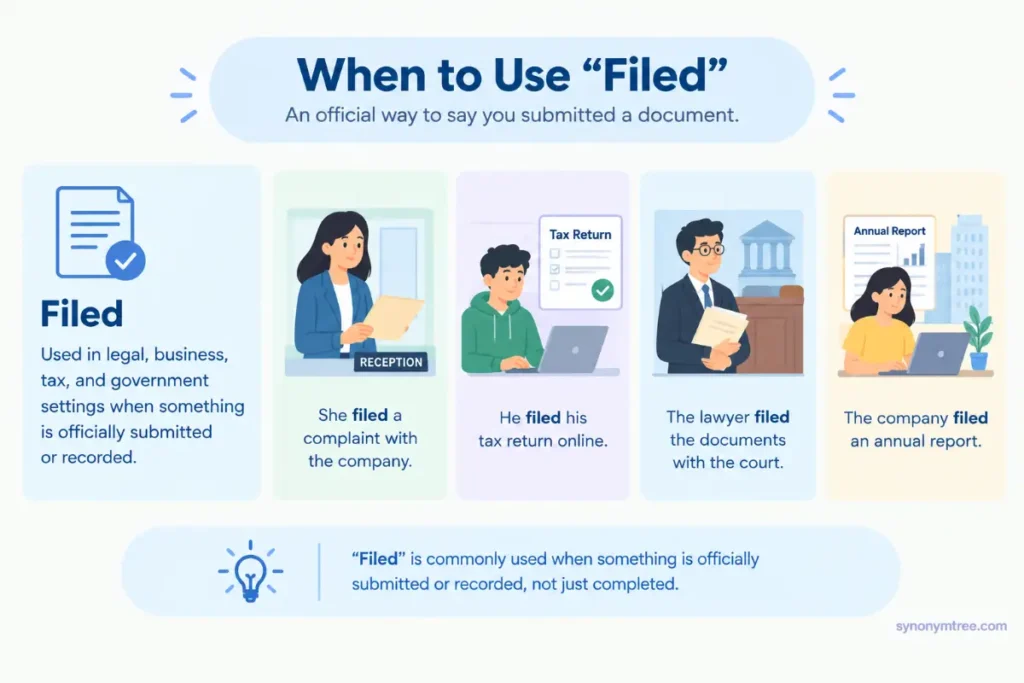
Filed also has a common meaning in legal, business, tax, and government settings.
When you officially submit a document, you can say that you filed it.
For example, She filed a complaint with the company.
You could also say, He filed his tax return online.
Another example is, The lawyer filed the documents with the court.
The company filed an annual report.
The applicant filed an appeal.
The customer filed a claim.
These examples all involve an official submission. The document is not simply sitting on a desk. It has been formally sent to an office, court, company, or other organization.
That is why filed appears so often in formal writing.
What Filled Means
Filled is the past tense and past participle of fill. The main idea is making something full or putting something into an empty space.
You can fill a glass with water. You can fill a box with books.
The meaning can be physical or more abstract.
For example, water can fill a bottle. People can fill a room. Information can fill a form. A person can fill an open position.
The common idea is that something empty or incomplete receives what it needs.
Filled Means Made Full
The most basic use of filled involves a container or space.
You might say, She filled the glass with water.
You could say, He filled the bucket with sand.
Another example is, We filled the tank before the trip.
You can also say, The children filled the room with laughter.
The word does not always mean that the object is completely full. It can simply describe putting something into an available space.
For example, She filled the bowl with soup.
The focus is on the action of putting soup into the bowl.
Filled Means Completed
Filled can also refer to forms and applications.
When you enter information into a form, you can say that you filled out the form.
For example, I filled out the application yesterday.
You can also say, She filled in the missing information.
The meaning here is not physical fullness. Instead, the form had empty spaces that needed information.
This is one reason people confuse filed and filled. Both words can appear when talking about documents.
The difference is the action.
You fill out a document by entering information.
You file a document by storing it or officially submitting it.
Filed And Filled With Forms
Forms make the difference especially clear.
Suppose a company sends you an application. You enter your name, address, phone number, education, and work history. You have filled out the application.
After completing it, you send the application to the company. You have filed the application if you are using file to mean officially submitting it.
You could write, I filled out the application and filed it with the office.
Both words are correct in that sentence because they describe two different actions.
The same pattern appears with many types of paperwork.
You can fill out a tax form and file it.
You can fill out a job application and file it.
This is a useful way to remember the difference. First you may fill something out. Later you may file it.
Why The Words Look So Similar
The spelling creates most of the confusion.
File contains one l before the final e.
Fill contains two l letters.
When file becomes filed, the result is filed.
When fill becomes filled, the two l letters remain and ed is added.
So the spelling comes directly from the base verb.
File becomes filed.
Fill becomes filled.
This gives you a simple spelling test. If you can identify the base verb, you can usually choose the correct past form.
Ask yourself which word you would use in the present tense.
If you would say file, write filed.
If you would say fill, write filled.
That approach is much safer than choosing the word based only on how it sounds.
How To Choose The Right Word
When you are unsure, ask what happened in the sentence.
Did someone store or organize a document?
Use filed.
Did someone officially submit a document?
Use filed.
Did someone make a container full?
Use filled.
Did someone enter information into a form?
Use filled.
Did someone supply an empty position?
Use filled.
For example, consider this sentence.
She ______ the records in the cabinet.
The action is organizing records. The base verb is file. The correct word is filed.
Now consider this sentence.
She ______ the cabinet with records.
The action is putting records into the cabinet. The base verb is fill. The correct word is filled.
The same words can appear in related situations. The meaning of the action determines the answer.
Filed In Everyday English
Filed is not limited to legal language. It appears in ordinary office and personal situations too.
You can file receipts after shopping. You can file bills after paying them.
For example, I filed the receipts in a folder.
You could also say, She filed the paperwork after the meeting.
Another natural example is, He filed the documents under the correct name.
In all of these sentences, the person is organizing information.
Filed can also describe official actions that happen outside a courtroom.
For example, She filed a complaint with the airline.
He filed a request with the city office.
The company filed a report with the agency.
These examples show how common the word is in practical writing.
Filled In Everyday English
Filled is even more common in everyday speech because people fill many kinds of spaces.
You can fill a glass, cup, bottle, box, bag, tank, room, seat, form, or schedule.
For example, She filled her cup with coffee.
He filled the bag with groceries.
The audience filled the theater.
We filled every seat before the show began.
The rain filled the bucket.
Her calendar was filled with appointments.
You can also fill something in a less physical sense.
The manager filled the open position.
The student filled in the missing answer.
She filled out the registration form.
Each example involves something that was empty or incomplete and then received what was needed.
Common Mistakes With Filed And Filled
These words lead to a few common errors. The good news is that each mistake has a simple fix.
Using Filed For A Container
A common mistake is writing, She filed the bottle with water.
If you mean that she put water into the bottle, the correct sentence is, She filled the bottle with water.
The base verb is fill. Therefore the past tense is filled.
Using Filled For An Official Complaint
Another mistake is writing, He filled a complaint with the company.
If you mean that he officially submitted a complaint, the correct sentence is, He filed a complaint with the company.
The base verb is file. Therefore the past tense is filed.
You could use filled in the same situation if you are talking about a form.
For example, He filled out the complaint form before filing the complaint.
Writing Filed Out
This is one of the most common errors.
Do not write, I filed out the form.
Write, I filled out the form.
The phrase fill out means to complete a form by entering information.
For example, Please fill out the application before Friday.
Another example is, She filled out the registration form online.
The word filed does not belong in this expression.
Confusing A Filed Folder With A Filled Folder
Consider these two sentences.
She filed the folder.
She filled the folder.
They can both be correct, but they mean different things.
She filed the folder means she placed the folder into an organized filing system.
She filled the folder means she put enough material into the folder to make it full.
The object is the same. The action is different.
This is a good example of why context matters.
Filed And Filled In Business Writing
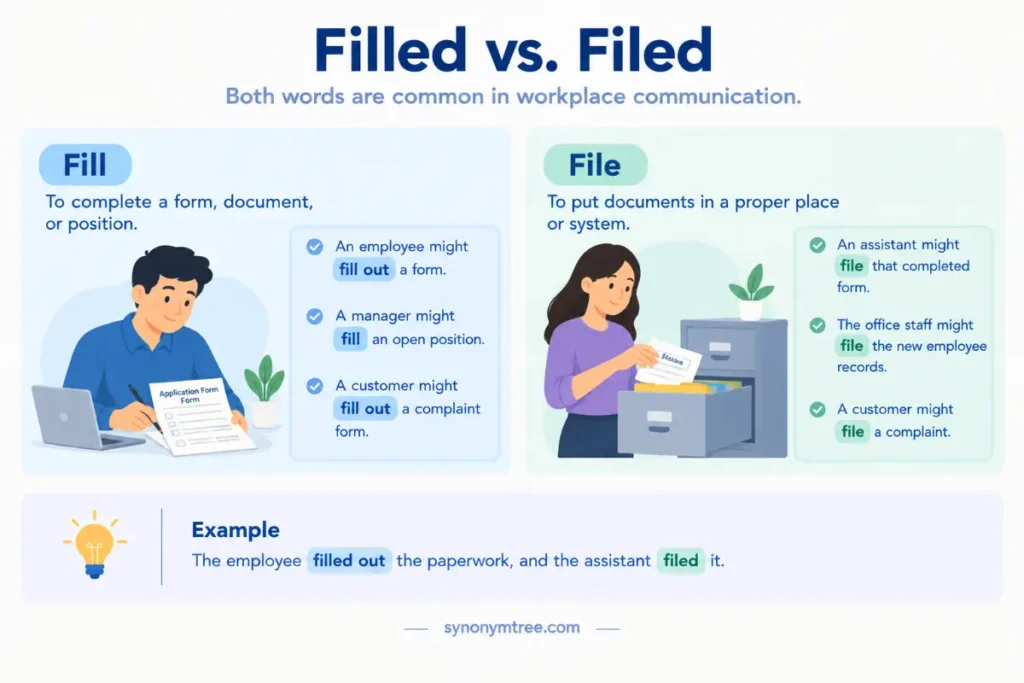
Both words are common in workplace communication.
An employee might fill out a form. An assistant might file that completed form.
A manager might fill an open position. The office staff might file the new employee records.
A customer might fill out a complaint form and then file a complaint.
For example, The employee filled out the paperwork, and the assistant filed it.
Another example is, The manager filled the open position, and the office filed the employee records.
These sentences sound natural because each word describes a different action.
In business writing, using the correct word helps readers understand exactly what happened. A report that was filed was not simply completed. It was stored or submitted. A form that was filled was not necessarily submitted. It received information.
That distinction can matter in emails, instructions, reports, and official records.
Filed And Filled In Legal English
Filed appears very often in legal writing.
You may hear that someone filed a lawsuit. A person can file a claim. A lawyer can file an appeal. An attorney can file a motion. A person can file a complaint.
These phrases describe formal legal submissions.
For example, The attorney filed an appeal yesterday.
Another example is, The company filed a claim against the insurer.
A third example is, She filed a complaint with the court.
Filled has a different role in legal settings.
An applicant may fill out a legal form.
A company may fill an open position.
A committee may fill an empty seat.
The setting does not decide the word. The action does.
Filed And Filled In American English
American English commonly uses the phrase fill out when talking about completing a form.
For example, Please fill out this form.
I filled out the application this morning.
She filled out all the required fields.
The phrase fill in is also used.
For example, Please fill in your name.
He filled in the missing answer.
She filled in the blank space.
The two phrases are related, but fill out is especially common in American English when someone completes an entire form.
Neither phrase should become filed out.
The correct expression is filled out.
Filed And Filled With Prepositions
The words that follow a verb can also help you identify the intended meaning.
Filed often appears with with when describing an official submission.
For example, She filed a complaint with the company.
He filed the documents with the court.
The company filed the report with the agency.
Filled often appears with with when describing something that contains another thing.
For example, The box was filled with books.
The room was filled with people.
The bottle was filled with water.
The schedule was filled with appointments.
The two expressions can look similar because both may use with. Their meanings remain different.
Filed with the court refers to official submission.
Filled with water refers to fullness.
Filed And Filled In Passive Sentences
Both words work in passive sentences.
For example, The documents were filed yesterday.
The form was filled out correctly.
The complaint was filed with the office.
The tank was filled with water.
The records were filed alphabetically.
The seats were filled before the show began.
The passive structure changes the focus of the sentence, but it does not change the meaning of the words.
If something was stored or submitted, use filed.
If something became full or received information, use filled.
Can Both Words Be Correct
Yes. Sometimes both words can describe the same situation from different angles.
Imagine a folder containing many documents.
You could say, She filed the documents in the folder.
This focuses on organizing the documents.
You could also say, She filled the folder with documents.
This focuses on the folder becoming full.
Both statements can describe true actions.
The same thing happens with forms.
You could say, She filled out the application.
This means she entered the information.
You could also say, She filed the application.
This means she officially submitted or stored it.
The words are not interchangeable. They simply describe different parts of the same process.
The Role Of Context
Context often gives you the answer before you even think about grammar.
Consider the sentence, He ______ the form yesterday.
The sentence could mean he completed the form. In that case, you would say he filled out the form.
It could also mean he officially submitted the form. In that case, you would say he filed the form.
The noun form does not automatically tell you which word to use.
You need to understand the action.
That is a useful lesson for many English word choices. Instead of asking which word sounds right, ask what the sentence is actually saying.
Pronunciation Of Filed And Filled
Filed and filled sound similar, which explains part of the confusion.
Filed is pronounced like fyld.
Filled is pronounced like fild.
The vowel sound is different, but the difference can be small in fast conversation.
Context usually helps listeners understand the intended meaning. Writing gives you a clearer distinction because the spelling shows the base verb.
When you’re unsure about the spelling, think about the sound of the base verb only as a secondary clue. Your first question should be about meaning.
Do you mean file?
Or do you mean fill?
Once you know the base verb, the past form is easy.
Why Filled Has Two Ls
The spelling of filled comes directly from fill.
The word fill already has two Ls.
When you add ed, you get filled.
The same pattern remains visible in related forms.
Fill.
Fills.
Filling.
Filled.
By contrast, file has one l and ends with e.
Its forms include file, files, filing, and filed.
The spelling difference is small, but the base words are different.
Remembering the original word is the easiest way to keep the two forms apart.
A Simple Memory Trick
Use this short idea.
Fill means full.
File means filing.
A glass becomes full, so it is filled.
A report goes into a record system, so it is filed.
A bottle gets water, so it is filled.
A complaint goes to an office, so it is filed.
A form receives information, so it is filled out.
A completed form gets submitted, so it is filed.
The trick works because it connects spelling with meaning. You are not simply memorizing two words. You are building a mental picture around each word.
Common Phrases With Filed
Submitting a complaint means officially filing it.
Making a claim means officially submitting it.
Starting a lawsuit means formally beginning a legal case through the required filing process.
Submitting an appeal means officially filing it.
Submitting a report means officially recording or filing it.
Organizing documents means placing them into an organized record system.
Storing records means keeping them in an organized way.
These phrases are common in legal, business, government, and office writing.
Common Phrases With Filled
Putting liquid into a glass means filling it.
Making a room full of people or things means filling it.
Adding liquid or fuel to a tank means filling it.
Completing a form with the requested information means filling it out.
Adding missing information means filling in a blank.
Giving an open role to a person means filling a position.
Occupying an empty seat means filling it.
Adding appointments or activities to available time means filling the schedule.
These phrases all connect to the idea of fullness or completion.
Filed And Filled In One Sentence
One sentence can help you remember the entire difference.
She filled out the complaint form and filed it with the office.
First, she entered the required information. That is the filling action.
Next, she officially submitted the document. That is the filing action.
Here is another example.
The assistant filled the folder with documents and filed the folder in the cabinet.
Filled describes the folder receiving documents.
Filed describes the folder being placed into an organized storage system.
These examples show that the words can work together without having the same meaning.
A Quick Practice Test
Try these sentences and choose the correct word mentally.
She ______ the glass with milk.
The answer is filled because milk was put into the glass.
He ______ the papers in the cabinet.
The answer is filed because the papers were organized and stored.
I ______ out the application.
The answer is filled because information was entered into the application.
The attorney ______ the complaint yesterday.
The answer is filed because the complaint was officially submitted.
We ______ the tank with water.
The answer is filled because water was put into the tank.
She ______ the receipts by date.
The answer is filed because the receipts were organized.
They ______ every seat in the theater.
The answer is filled because the seats became occupied.
He ______ in the missing information.
The answer is filled because information was added to an empty space.
The company ______ the open position.
The answer is filled because someone was chosen for an empty role.
The clerk ______ the records under the customer name.
The answer is filed because the records were organized.
The pattern becomes much easier when you focus on the action instead of the spelling alone.

A Useful Test For Fast Writing
When you are writing quickly and hesitate between the two words, remove the past tense ending in your mind.
Take this sentence.
She ______ the bottle with water.
Ask yourself which present tense verb works.
She file the bottle.
That doesn’t make sense.
She fill the bottle.
That gives you the correct base verb.
So the answer is filled.
Now try this sentence.
He ______ the report with the court.
Ask yourself which base verb makes sense.
He file the report with the court.
The grammar needs adjustment for the present tense, but the intended verb is clearly file.
Therefore the past form is filed.
This test is quick and reliable because it takes you back to the source word.
Related Word Confusions
English has many word pairs that cause problems because they look or sound alike.
Accept and except have different meanings.
Advice and advise have different grammar roles.
Than and then are used in different situations.
Affect and effect can be confusing because their meanings and grammar can vary by context.
The same basic strategy works with all of them. Look at the meaning first. Then identify the word that expresses that meaning.
With filed and filled, the distinction is especially useful because the base verbs are simple.
File relates to records and official submission.
Fill relates to fullness and completion.
When You Should Use Filed
Use filed when a person has organized a document into a record system.
For example, The assistant filed the invoices.
Use it when someone has officially submitted something.
For example, The company filed a report.
Use it for many legal submissions.
For example, The lawyer filed an appeal.
Use it for formal complaints and claims.
For example, She filed a complaint with the office.
Use it for records that are being placed into an organized system.
For example, The clerk filed the records by date.
In all these situations, file is the base verb.
When You Should Use Filled
Use filled when something becomes full.
For example, She filled the bottle with water.
Use it when someone puts material into a container.
For example, He filled the box with books.
Use it when people occupy available space.
For example, The audience filled the theater.
Use it when someone completes a form.
For example, I filled out the application.
Use it when someone supplies an empty position.
For example, The company filled the open position.
In all these situations, fill is the base verb.
The Easiest Rule To Remember
You don’t need a complicated grammar rule to remember these words.
Filed comes from file.
Filled comes from fill.
File has one l.
Fill has two l letters.
That gives you a simple mental check.
If you are talking about storing records or making an official submission, think filed.
If you are talking about making something full or adding information, think filled.
When a form is involved, remember the common sequence. You fill out the form. Then you may file the completed form.
That one example covers many situations where people confuse the two words.
Conclusion
The difference between filed vs filled comes down to the base verbs file and fill. Filed usually describes storing records, organizing documents, or officially submitting something. Filled describes making something full, adding information, or supplying something that was missing.
The spelling becomes easier when you remember the original verbs. File becomes filed. Fill becomes filled. The two L letters in filled come directly from fill, while filed keeps the spelling of file.
Forms provide one of the clearest examples. You fill out a form when you enter the requested information. You file the completed form when you store it or officially submit it. Both actions can happen to the same document.
When you are unsure, don’t guess from the sound. Ask yourself what happened and identify the base verb. If the action comes from file, use filed. If it comes from fill, use filled. That quick habit will help you choose the right word with confidence.
FAQs
What is the difference between filed and filled?
Filed comes from file and usually means stored, organized, recorded, or officially submitted. Filled comes from fill and usually means made full, supplied, or completed with information. The best way to choose between them is to identify the action in the sentence.
Is it filed or filled out a form?
The correct phrase is filled out a form. You fill out a form when you enter the information it asks for. You may later file the completed form if you store it or officially submit it.
Is it filed or filled a complaint?
Use filed when you mean officially submitted a complaint. You can say that someone filled out a complaint form before filing the complaint with an organization.
Can filed and filled appear in the same sentence?
Yes. A person can fill out an application and then file it. The first action involves adding information. The second action involves storing or officially submitting the document.
Why does filled have two L letters?
Filled comes from the base verb fill. Since fill already contains two L letters, the past form keeps those letters and adds ed. This gives you filled.
How can I remember filed and filled?
Connect filed with file and filled with fill. File relates to records and formal submissions. Fill relates to fullness, completion, and adding information.
Is filled out correct in American English?
Yes. Filled out is a standard expression in American English for completing a form. You can say, I filled out the application this morning.
Can something be both filled and filed?
Yes. A document can be filled out with information and then filed for storage or official submission. A folder can also be filled with documents and later filed in a cabinet.
