
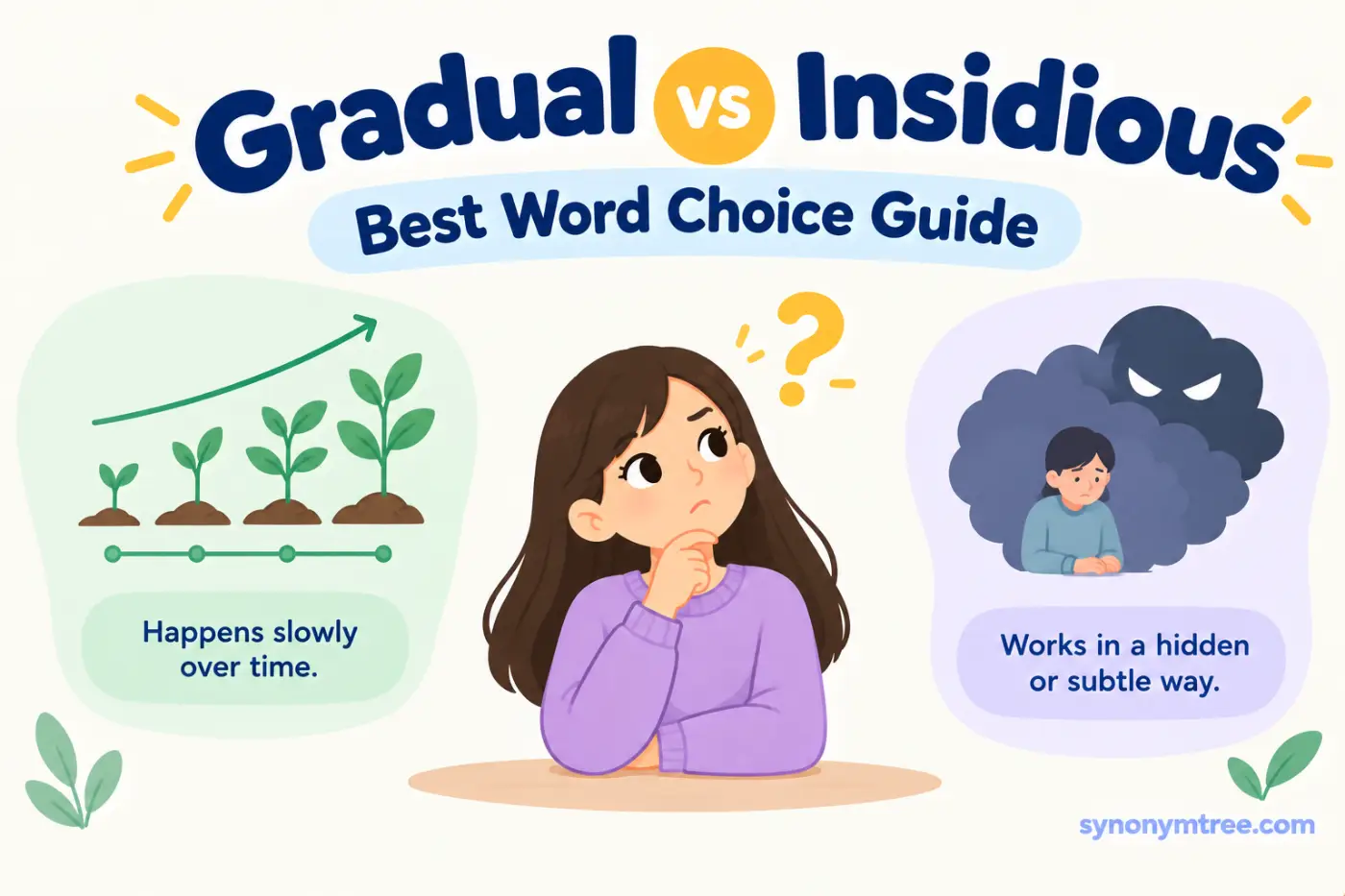
When you’re choosing between two words that describe slow change, the difference can be easy to miss. A sentence such as “The change was gradual” sounds clear, but “The change was insidious” gives the reader a very different idea. Knowing the difference between gradual vs insidious can help you choose a word that matches your exact meaning.
Both words can describe something that develops over time. That shared idea is what causes the confusion. However, they focus on different parts of the change. Gradual mainly tells us that something happens slowly or in stages. Insidious usually suggests that something harmful develops quietly and causes damage before people fully notice it.
The distinction matters in school writing, professional emails, reports, health discussions, news writing, and everyday speech. You can use gradual for neutral or positive changes, while insidious usually carries a negative meaning.
This guide explains the meanings, origins, grammar, tone, intensity, common uses, examples, and close word choices. It also shows how to decide which word fits a sentence without guessing.
Quick Definition
Gradual means happening slowly, step by step, or over a period of time. It is usually neutral and can describe positive, negative, or ordinary changes.
Insidious means developing slowly and quietly in a harmful or dangerous way. It often describes something that causes damage before its harmful effects become obvious.
Direct Answer
Gradual describes the speed or pace of a change, while insidious describes a change that is slow, hidden, and usually harmful. Use gradual when you simply mean slow or progressive, and use insidious when you want to stress a quiet danger or harmful effect.
Comparison Table
| Word or phrase | Meaning | Example sentence | When to use it |
|---|---|---|---|
| Gradual | Happening slowly over time | The town saw a gradual increase in population. | Use it for slow change without suggesting hidden danger. |
| Insidious | Slowly causing harm in a way that is hard to notice | The problem had an insidious effect on the company. | Use it for a quiet, harmful, or deceptive process. |
| Slow | Taking a long time | The recovery was slow. | Use it for simple descriptions of pace. |
| Progressive | Developing step by step | The disease caused progressive damage. | Use it for changes that continue or advance. |
| Steady | Continuing at a regular rate | The business made steady progress. | Use it when the change is consistent. |
| Subtle | Difficult to notice or recognize | There was a subtle change in his tone. | Use it when the change is slight or hard to detect. |
| Hidden | Not seen or known | A hidden problem affected the project. | Use it when something is concealed. |
| Harmful | Causing damage | The habit became harmful over time. | Use it when the focus is on damage rather than pace. |
What Does Gradual Mean
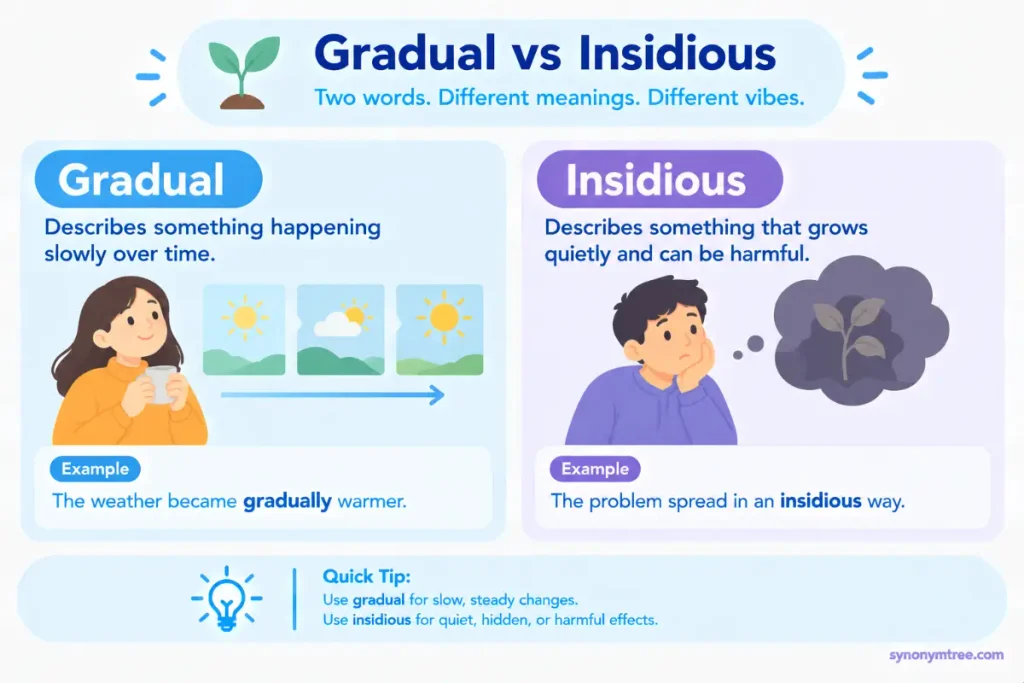
Gradual is an adjective that describes something happening slowly over time. A gradual change usually happens through a series of small steps instead of one sudden event.
For example, you might say:
“The weather became gradually warmer.”
The sentence tells us that the temperature did not rise all at once. It changed over a period of time.
The word does not automatically tell us that the change is good or bad. A gradual improvement can be positive. A gradual decline can be negative.
Consider these examples:
“She made gradual progress in reading.”
“The company experienced a gradual decline in sales.”
“The gradual change in color was easy to miss.”
“The child became gradually more confident.”
Each sentence describes a process that develops over time. None of them requires a hidden threat.
What Does Gradual Mean in Plain English
A simple way to understand gradual is “slow and step by step.”
It can describe:
- A slow increase.
- A slow decrease.
- A slow improvement.
- A slow decline.
- A slow physical change.
- A slow emotional change.
- A slow social change.
- A slow process of learning or growth.
The key idea is pace.
If you are mainly telling the reader how fast something changes, gradual is often the right choice.
What Does Insidious Mean
Insidious is also an adjective, but it carries much more meaning than simply “slow.”
Something insidious usually develops slowly, quietly, or in a way that is difficult to recognize. The word often suggests harm, danger, or a bad effect that grows before people fully understand what is happening.
For example:
“The company faced an insidious threat to its reputation.”
This sentence does more than say that the threat developed slowly. It suggests that the threat was difficult to recognize and could cause serious harm.
Another example is:
“Stress can have an insidious effect on sleep.”
The point is not simply that stress changes sleep slowly. The word suggests that the harmful effect may develop quietly and become clear only later.
What Does Insidious Mean in Plain English
A simple way to understand insidious is “slowly harmful and hard to notice.”
The word often has three ideas behind it:
- The process develops over time.
- The harmful effect is not immediately obvious.
- The result can become serious or damaging.
That is why insidious is stronger than gradual.
If a tree grows gradually, there is nothing negative about the statement.
If a harmful habit becomes insidious, the speaker is warning the reader about its effects.
Why Do People Confuse These Words
The confusion comes from one shared feature. Both words can describe something that develops over time.
Imagine a person slowly losing interest in a hobby. You could call the change gradual because it happened slowly.
Now imagine a harmful habit slowly affecting that person’s health while the person barely notices. You might call the effect insidious.
The time element appears in both cases. The meaning changes because insidious adds the idea of hidden or difficult to recognize harm.
This is one of the most useful distinctions to remember:
Gradual answers the question “How fast does it happen?”
Insidious often answers the question “How does the harm develop, and why is it dangerous?”
That difference can make a sentence much clearer.
What Is the Origin of Gradual
Gradual comes from the Latin word gradus, meaning “step.” The word entered English through French and has long been connected with the idea of moving from one level to another.
That origin gives you a useful memory clue. Think of gradual change as moving one step at a time.
A gradual improvement does not happen in one leap. It develops through stages.
For example:
“His writing improved gradually.”
You can imagine his writing moving from one level to the next.
The origin also explains why gradual works so well with words such as increase, decline, progress, change, improvement, development, growth, and transition.
What Is the Origin of Insidious
Insidious comes from Latin insidiae, which referred to an ambush or a hidden trap. That history connects the modern word to the idea of something harmful that is difficult to see coming.
This origin provides a strong memory clue.
Think of gradual as steps.
Think of insidious as a hidden trap that develops quietly.
Modern English does not limit insidious to literal traps. It can describe harmful influences, threats, diseases, habits, problems, and other forces that work quietly.
The historical meaning helps explain why the word usually has a negative tone.
What Is the Main Difference Between Gradual and Insidious
The main difference is the extra meaning carried by insidious.
Gradual focuses on slow development. Insidious focuses on slow development combined with hidden or harmful effects.
| Feature | Gradual | Insidious |
|---|---|---|
| Slow development | Yes | Usually |
| Step by step | Yes | Often |
| Neutral meaning | Yes | Rarely |
| Positive meaning | Yes | No, in normal use |
| Negative meaning | Sometimes | Usually |
| Hidden danger | No | Yes |
| Hard to notice | Not required | Often |
| Harmful effect | Not required | Usually implied |
| Useful for ordinary change | Yes | Usually no |
This table captures the key point. Gradual is about the pace of change. Insidious adds a warning.
When Should You Use Gradual
Use gradual when you want to describe a slow process without adding a strong judgment.
It works well in academic writing, business writing, school essays, reports, and everyday conversation.
For example:
“The patient showed gradual improvement.”
“The company made a gradual shift toward online sales.”
“The gradual increase in rent made it harder for families to stay in the area.”
“The team went through a gradual change in leadership.”
“The child made gradual progress in math.”
In each case, the word describes development over time. It does not claim that the change was secretly harmful.
Gradual also works with positive changes.
“Her confidence grew gradually.”
“His fitness improved gradually.”
“The garden gradually became greener.”
Those sentences would sound strange with insidious because there is no harmful hidden process.
When Should You Use Insidious
Use insidious when the slow process is harmful, dangerous, deceptive, or difficult to recognize.
For example:
“The insidious spread of misinformation damaged public trust.”
“The habit had an insidious effect on his finances.”
“The company failed to recognize the insidious threat to its data.”
“The disease can have an insidious onset.”
“The insidious problem became obvious only after several months.”
The word is especially useful when you want to warn the reader. It tells the reader that the problem deserves attention because it may be working quietly in the background.
You should not use it simply because something takes a long time.
A slow sunrise is gradual.
A harmful influence that quietly damages a person’s life can be insidious.
How Strong Is the Word Gradual
Gradual is a mild word. It usually does not create a strong emotional reaction.
Compare these sentences:
“The neighborhood experienced a dramatic change.”
“The neighborhood experienced an insidious change.”
The first sentence is neutral. The second suggests a large or noticeable change. The third suggests something harmful or troubling that developed quietly.
This makes gradual a safe choice when you want to avoid exaggeration.
It is especially useful in formal writing because it describes the process without adding emotional judgment.
How Strong Is the Word Insidious
Insidious is much stronger. It often signals danger.
Compare:
“The problem developed gradually.”
“The problem developed insidiously.”
The first sentence tells us about timing. The second suggests that the problem was harmful and difficult to detect.
Because of this, you should not use insidious just to make your writing sound more advanced. It can change the meaning of a sentence.
If you write:
“She made an insidious improvement in her skills.”
the sentence sounds wrong because improvement is normally positive. The reader may wonder what hidden harm you are describing.
A better choice is:
“She made a gradual improvement in her skills.”
What Words Are Similar to Gradual
Many words can replace gradual, but each has a slightly different meaning.
Slow
Slow is the simplest choice. It describes something that takes a long time.
“The recovery was slow.”
Steady
Steady suggests that something continues at a fairly regular rate.
“The company saw steady growth.”
Progressive
Progressive describes something that develops or advances in stages.
“The condition caused progressive damage.”
Incremental
Incremental describes change that happens through small additions or steps.
“The team made incremental improvements to the system.”
Gradual
Gradual is broader. It simply shows that something happens over time rather than suddenly.
“The town underwent gradual development.”
What Words Are Similar to Insidious
Insidious has several related words, but none is exactly the same.
Harmful
Harmful simply means causing damage.
“The chemicals are harmful.”
It does not necessarily suggest that the damage develops slowly or secretly.
Dangerous
Dangerous means capable of causing harm.
“The road is dangerous.”
Again, the word does not automatically suggest a hidden process.
Subtle
Subtle means difficult to notice or understand.
“There was a subtle change in her expression.”
Subtle does not have to be negative.
Deceptive
Deceptive means likely to mislead someone.
“The simple design was deceptive.”
This focuses more on misleading appearances than slow harm.
Creeping
Creeping can describe something that develops slowly and often creates a sense of concern.
“The creeping problem affected the entire team.”
It is more informal than insidious.
What Are the Best Words by Intensity
Choosing the right word often depends on how strong you want the description to sound.
Mild
Use these words when you want a calm description:
- Slow.
- Gradual.
- Steady.
- Subtle.
- Measured.
Example:
“The company saw gradual growth.”
Moderate
Use these words when you want to show stronger development:
- Progressive.
- Incremental.
- Developing.
- Expanding.
- Increasing.
Example:
“The problem became progressively harder to control.”
Strong
Use these words when the change has serious effects:
- Harmful.
- Dangerous.
- Damaging.
- Destructive.
- Insidious.
Example:
“The insidious influence of the rumor damaged the team’s trust.”
The best word depends on the meaning you want. Stronger vocabulary is not automatically better vocabulary.
Can Gradual and Insidious Be Used as Adjectives
Yes. Both words are adjectives.
An adjective describes a noun.
For example:
“gradual change”
“gradual decline”
“insidious threat”
“insidious influence”
Both words can appear before a noun.
They can also appear after linking verbs.
“The change was gradual.”
“The effect was insidious.”
This makes them flexible choices in both casual and formal writing.
Can You Use Gradually and Insidiously
Yes. Both words have adverb forms.
Gradually means slowly or step by step.
“Sales gradually increased.”
Insidiously means in a quietly harmful or deceptive way.
“The problem spread insidiously through the organization.”
The difference remains the same.
Gradually focuses on slow development. Insidiously adds the idea of hidden harm or danger.
Is Gradual More Common Than Insidious
Yes. Gradual is much more common in ordinary English because it describes many normal kinds of change.
People talk about gradual growth, gradual improvement, gradual decline, gradual movement, gradual change, and gradual progress.
Insidious is more specialized. It appears often in serious discussions about threats, disease, harmful habits, social problems, corruption, misinformation, and other negative forces.
Because it has a strong negative meaning, you should use it carefully.
Does American English Differ From British English Here
There is no major spelling difference between American and British English for these words.
American English uses gradual and insidious.
British English also uses gradual and insidious.
The main difference is not regional spelling. It is context and tone.
Both words have the same basic meanings in the two forms of English.
Which Word Works Best in a Resume
Gradual is usually the safer choice in resume writing.
A resume often describes growth, improvement, progress, learning, and development. These ideas are normally positive.
For example:
“My skills showed gradual improvement through regular training.”
However, a stronger sentence may be better:
“I steadily improved my project management skills through regular training.”
Insidious is rarely appropriate for describing your own achievements.
You would not normally write:
“I made an insidious improvement in customer service.”
That wording suggests hidden harm and creates the wrong impression.
Which Word Works Best in an Essay
The right word depends on your subject.
Use gradual when discussing ordinary development.
“The gradual growth of cities changed local transportation.”
Use insidious when discussing a harmful process.
“The insidious spread of false information made the problem harder to control.”
Academic writing benefits from precise vocabulary. Do not choose insidious simply because it sounds more sophisticated.
If your point is only that something happened slowly, gradual is more accurate.
Which Word Works Best in Texting
Gradual is more natural in casual texting, although many people would simply use slow.
For example:
“The change was gradual.”
“You can see the gradual shift.”
Insidious is less common in casual conversation. It may sound formal unless you’re talking about a serious problem.
You might text:
“That habit has an insidious effect.”
That can work if the conversation is serious, but it is much more formal than:
“That habit is slowly causing problems.”
Which Word Works Best in an Email
Use gradual for neutral workplace changes.
“The team has seen a gradual increase in requests.”
Use insidious only when you genuinely mean that a harmful problem has developed quietly.
“We failed to see the insidious effect of poor communication.”
The second sentence has a serious tone. It suggests that the problem was not obvious at first.
Which Word Works Best in Speaking
In everyday speech, gradual is much easier to use.
You can say:
“The change happened gradually.”
“Things got better gradually.”
“The weather became gradually warmer.”
Insidious is better saved for situations where the hidden danger matters.
For example:
“That kind of stress can have an insidious effect.”
The word can sound powerful in speech, but it should match the seriousness of the topic.
What Are Some Real Examples of Gradual
Here are natural examples that show how the word works in different situations.
- The gradual rise in prices forced the family to change its budget.
- Her confidence grew gradually after several successful presentations.
- The gradual change in the weather allowed farmers more time to prepare.
- The company made a gradual move toward remote work.
- His recovery was gradual, but he continued to make progress.
- The gradual decline in attendance became a concern for school leaders.
- We noticed a gradual improvement in the quality of the reports.
- The road became gradually narrower as we moved into the mountains.
- The team’s gradual progress was easy to see after several months.
- The gradual transition gave employees time to learn the new system.
These sentences show why gradual is useful. It can describe change that is positive, negative, physical, social, professional, or emotional.
What Are Some Real Examples of Insidious
These examples show the stronger meaning of insidious.
- The insidious spread of rumors damaged the team’s trust.
- The habit had an insidious effect on his financial decisions.
- The company underestimated the insidious threat posed by weak security.
- The disease can have an insidious onset, with signs appearing slowly.
- The insidious influence of fear kept people from speaking openly.
- The problem was insidious because no single event revealed it.
- The campaign used an insidious form of manipulation.
- The harmful practice had an insidious effect on workplace morale.
- The group failed to recognize the insidious nature of the threat.
- Small acts of dishonesty can have an insidious effect on trust.
These sentences all carry a warning. The problem is not simply slow. It is also harmful, hidden, difficult to recognize, or quietly damaging.
Gradual vs Insidious What Is the Difference
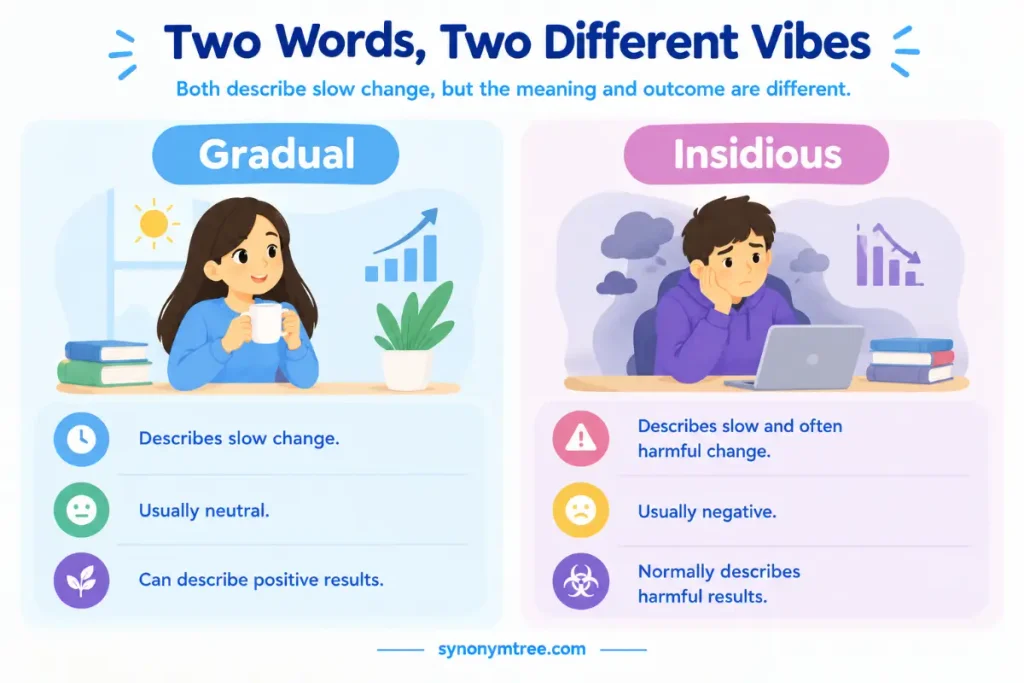
The easiest comparison is pace versus danger.
| Gradual | Insidious |
|---|---|
| Describes slow change | Describes slow and often harmful change |
| Usually neutral | Usually negative |
| Can describe positive results | Normally describes harmful results |
| Does not require secrecy | Often suggests something hidden or hard to notice |
| Focuses on time and pace | Focuses on the nature and effect of the process |
| Common in everyday English | More formal and serious |
Think of a plant growing.
“The plant grew gradually.”
That simply tells us that growth happened over time.
Now imagine a harmful fungus spreading through the plant.
“The fungus spread insidiously.”
The second sentence suggests a quiet process that may cause damage before it is noticed.
Gradual vs Slow What Is the Difference
Gradual and slow are close, but gradual often suggests a process of change.
Slow mainly describes speed.
“The train was slow.”
“The change was gradual.”
You can sometimes use both words, but they do not always fit the same nouns.
For example:
“slow traffic” sounds natural.
“gradual traffic” does not.
“gradual improvement” sounds natural.
“slow improvement” also works, but it emphasizes the pace more directly.
Gradual is especially useful when something moves from one state to another.
Gradual vs Progressive What Is the Difference
Progressive can suggest continuing development or worsening over time. It is often used in technical, medical, academic, and formal writing.
For example:
“The disease caused progressive damage.”
This means the damage continued to develop.
“Gradual” simply tells us that the change was slow.
“The disease caused gradual damage.”
This sentence is less specific about the direction or continued progression.
Progressive can therefore carry a stronger sense of ongoing development.
Insidious vs Subtle What Is the Difference
Insidious and subtle can both describe things that are difficult to notice, but they are not interchangeable.
Subtle means not obvious or easy to detect. It does not have to be harmful.
“She gave a subtle smile.”
That smile may be pleasant.
Insidious usually suggests hidden harm.
“The rumor had an insidious effect on the group.”
The difference is simple:
Subtle means hard to notice.
Insidious means quietly harmful or dangerous.
A subtle change can be positive, neutral, or negative. An insidious change is normally negative.
Insidious vs Deceptive What Is the Difference
Deceptive focuses on misleading someone.
Insidious focuses on harmful effects that develop quietly.
A deceptive advertisement may trick you with false information.
An insidious habit may slowly cause harm without you realizing it.
The two words can overlap.
For example:
“The deceptive campaign had an insidious effect on public trust.”
Here, deceptive describes the misleading method. Insidious describes the harmful result.
Common Mistakes With Gradual
One common mistake is using gradual as a synonym for every type of slow activity.
For example:
“The turtle was gradual.”
This sounds unnatural because gradual usually describes change or development, not an object moving at a slow speed.
A better sentence is:
“The turtle moved slowly.”
Another mistake is using gradual when you mean regular or constant.
“The company had gradual sales every month.”
That sentence is unclear.
You might mean:
“The company had steady sales every month.”
Use gradual when something changes over time.
Common Mistakes With Insidious
The biggest mistake is using insidious when you only mean slow.
For example:
“The plant had an insidious growth.”
That suggests the growth is harmful or threatening.
If you simply mean the plant grew slowly, say:
“The plant had gradual growth.”
Another mistake is using insidious for positive changes.
“She made an insidious improvement.”
This sounds wrong because improvement is normally positive.
Say:
“She made a gradual improvement.”
You should also avoid using insidious just to sound intelligent. Strong vocabulary only helps when it expresses the right idea.
When Should You Not Use Insidious
Do not use insidious for ordinary slow changes.
Avoid it when:
- The change is neutral.
- The change is positive.
- There is no hidden danger.
- You only want to describe speed.
- The reader does not need a warning.
- A simpler word gives the exact meaning.
For example:
“The gradual growth of the garden was beautiful.”
There is no need for a stronger word.
“The gradual improvement in her grades was encouraging.”
Again, the process is positive.
Using insidious here would change the meaning instead of improving the sentence.
What Are the Antonyms of Gradual
The most useful opposite of gradual is sudden.
Other possible opposites include:
- Abrupt.
- Immediate.
- Rapid.
- Instant.
- Sudden.
For example:
“The change was gradual.”
“The change was sudden.”
These sentences present opposite speeds.
What Are the Antonyms of Insidious
The opposite of insidious depends on which part of its meaning you want to contrast.
Possible choices include:
- Open.
- Obvious.
- Direct.
- Harmless.
- Safe.
- Transparent.
For example:
“An insidious threat” suggests a hidden danger.
“An obvious threat” suggests danger that can be seen clearly.
“A harmless influence” removes the idea of danger.
There is no single perfect antonym for insidious in every sentence because the word combines several ideas.
How Can You Remember the Difference
Use a simple two word memory trick.
Think of gradual as steps.
Think of insidious as a trap.
Gradual comes from a word connected with steps. The idea is movement from one stage to another.
Insidious has roots connected with an ambush or hidden trap. The idea is something harmful that may not be noticed at first.
You can also remember this sentence:
“Gradual tells you how fast. Insidious tells you how dangerous.”
That is not a complete dictionary definition, but it is a useful writing shortcut.
How Do You Choose the Right Word
Ask yourself a few simple questions before choosing the word.
Is the change simply slow
Use gradual.
“The company made a gradual transition.”
Is the change positive
Use gradual, steady, progressive, or another suitable neutral word.
“She made gradual progress.”
Is the process harmful
Consider insidious.
“The habit had an insidious effect.”
Is the problem hard to notice
Insidious may fit if the hidden nature is also harmful.
“The company faced an insidious threat.”
Do you only mean slow speed
Use slow rather than gradual.
“The internet connection was slow.”
Do you want a neutral tone
Gradual is usually safer.
Do you want to warn the reader
Insidious may be appropriate if the facts support that stronger meaning.
Which Word Sounds More Formal
Insidious sounds more formal and serious.
Gradual is common in both casual and formal English.
This does not mean insidious is always better for formal writing. A formal sentence still needs accurate word choice.
For example:
“The gradual increase in costs affected the budget.”
This is perfectly professional.
“The insidious increase in costs affected the budget.”
The second sentence suggests that the increase was harmful and difficult to recognize. If that is not your intended meaning, it is the wrong word.
Good formal writing is not about choosing the most unusual word. It is about choosing the clearest accurate word.
Which Word Is Better for a Negative Change
Both words can describe negative change, but they do different jobs.
Use gradual when the negative change is simply slow.
“The company suffered a gradual decline in sales.”
Use insidious when the negative change is quiet, harmful, and difficult to detect.
“The company suffered from an insidious decline in trust.”
The second sentence creates a stronger warning. It suggests that the damage developed beneath the surface.
Which Word Is Better for Positive Change
Gradual is the clear choice for positive change.
You can say:
“gradual improvement”
“gradual growth”
Insidious does not normally work with these positive ideas.
If you want to describe positive change more strongly, consider steady, consistent, meaningful, significant, or progressive.
Can Insidious Describe a Person
Yes, but this use is less common and carries a strong negative judgment.
If someone is described as insidious, the word may suggest that the person is secretly harmful, treacherous, or deceptive.
For example:
“An insidious figure worked behind the scenes.”
This is a serious description. It suggests that the person is not simply quiet or private.
Do not use insidious to mean shy, reserved, or calm.
A quiet person is not automatically insidious.
Can Gradual Describe a Person
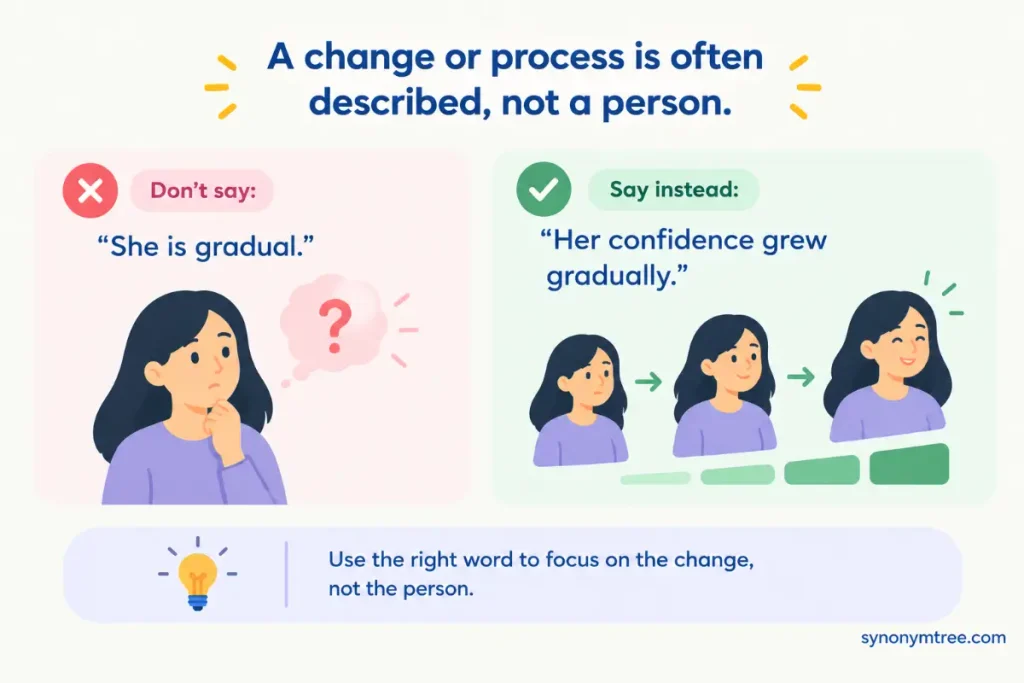
Gradual normally describes a change or process rather than a person.
You would not usually say:
“She is gradual.”
Instead, describe the change:
“Her confidence grew gradually.”
Or describe the person with a word such as patient, steady, calm, or deliberate, depending on your meaning.
This distinction helps avoid awkward sentences.
Why Context Matters So Much
Words do not work alone. The noun around the word can change how the reader understands it.
Consider the word change.
“The change was gradual.”
This sounds neutral.
“The change was insidious.”
This sounds troubling.
Now consider improvement.
“The improvement was gradual.”
This sounds natural.
“The improvement was insidious.”
This sounds contradictory because insidious normally suggests harm.
The grammar may be correct, but the meaning is not logical.
That is why vocabulary questions cannot always be solved by looking for two words with similar dictionary definitions. You also need to consider tone, context, and the noun being described.
A Practical Editing Test
When you are unsure, remove the adjective and read the sentence again.
Suppose you write:
“The company faced an insidious problem.”
Ask what you really mean.
Did the problem grow slowly?
Did it cause harm?
Was it hard to notice?
Did people fail to see its effects at first?
If the answer is yes to most of these questions, insidious may be a strong choice.
Now consider:
“The company faced a gradual problem.”
That sounds less natural because gradual usually needs a noun that represents a process or change.
You could write:
“The company experienced a gradual decline.”
This is much clearer.
The editing test is simple. Look at the whole sentence, not just the adjective.
Quick Tips for Choosing Between the Two
Keep these points in mind when editing.
- Choose gradual for slow change.
- Choose insidious for quietly harmful change.
- Use gradual for positive progress.
- Use gradual for neutral development.
- Use insidious when danger is part of the meaning.
- Use insidious when the harm is difficult to notice.
- Use slow when you are talking about speed alone.
- Use subtle when something is hard to notice but not necessarily harmful.
- Use deceptive when the main idea is misleading someone.
- Do not choose a stronger word just to sound more advanced.
- Read the complete sentence before making your choice.
- Ask what you want the reader to understand about the change.
The best word is the one that gives the reader the right picture with the least confusion.
Conclusion
The clearest way to understand gradual vs insidious is to focus on what each word adds to a sentence. Gradual describes something that develops slowly, often through a series of small changes. It can describe positive, negative, or neutral situations.
Insidious carries a stronger warning. It describes something that develops quietly and usually causes harm that may not be obvious at first. That makes it useful for hidden threats, harmful habits, damaging influences, and problems that grow beneath the surface.
When you’re editing a sentence, ask what you want the reader to notice. If the main point is slow progress or change, choose gradual. If the main point is quiet danger or hidden harm, choose insidious. That simple test will help you make the right choice without reaching for a stronger word than your sentence needs.
Frequently Asked Questions
What is the difference between gradual and insidious?
Gradual means something happens slowly over time. Insidious usually means something develops slowly while causing hidden or difficult to detect harm.
Is insidious always a negative word?
Yes, insidious normally carries a negative meaning. It usually describes something harmful, dangerous, deceptive, or quietly damaging.
Can I use gradual for positive changes?
Yes, gradual works very well for positive changes. You can describe gradual improvement, gradual growth, gradual progress, and gradual recovery.
What’s another way to say gradual?
Good alternatives include slow, steady, progressive, incremental, measured, and step by step. The best choice depends on the exact sentence.
Is gradual or insidious better for academic writing?
Both can work in academic writing, but they serve different purposes. Use gradual for slow development and insidious for a harmful process that develops quietly or is hard to recognize.
Can insidious mean slow?
Insidious can include the idea of slow development, but slow is not its full meaning. The word also suggests hidden harm, danger, or a damaging effect that is not immediately obvious.
How can I remember gradual vs insidious?
Remember gradual as steps and insidious as a hidden trap. Gradual focuses on slow development, while insidious adds the idea of quiet danger or harm.

1 thought on “Gradual vs Insidious Best Word Choice Guide In 2026”