
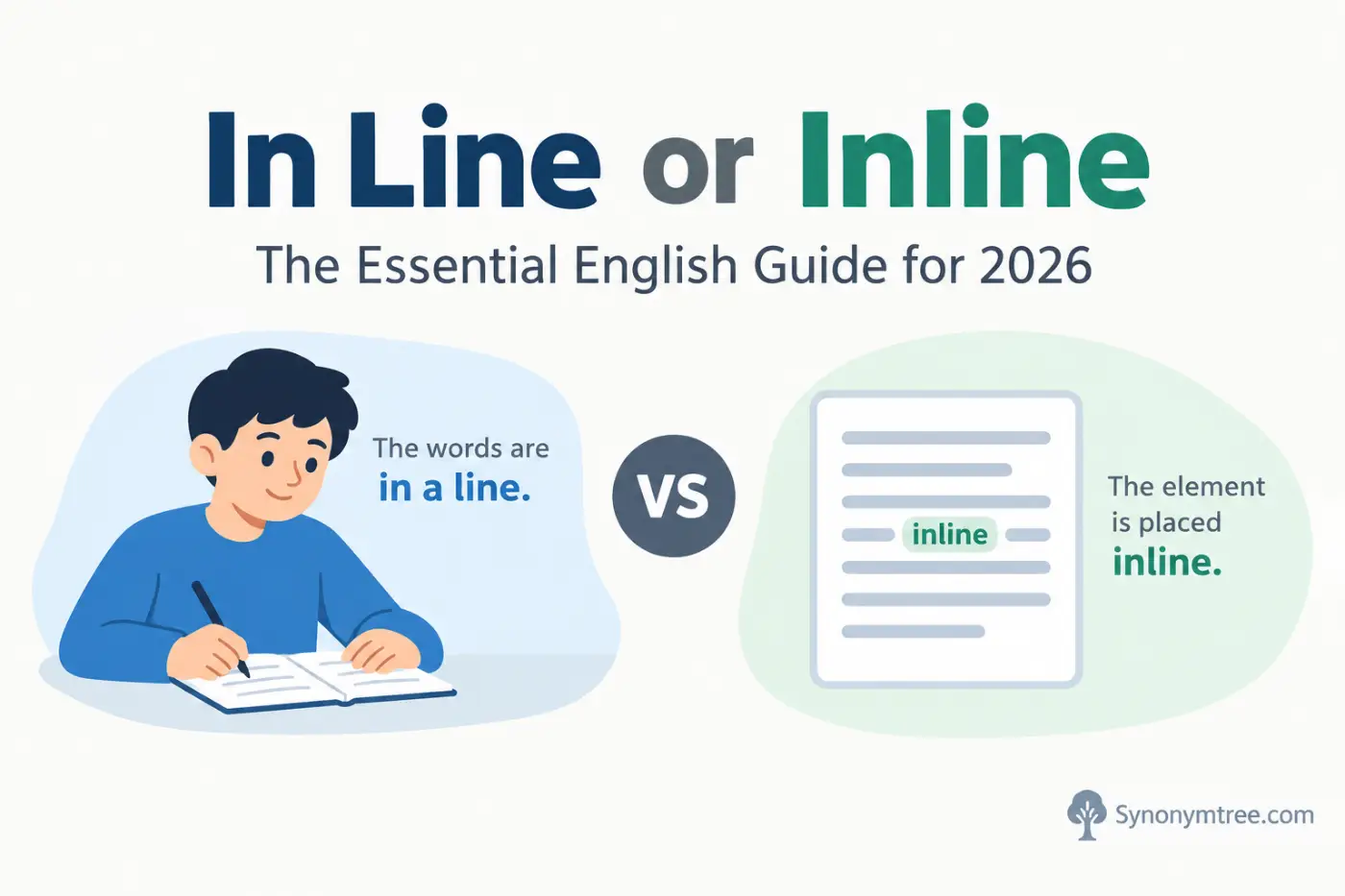
Have you ever stopped while writing an email or school assignment because you weren’t sure if you should write in line or inline? The difference between in line or inline can seem small, but the space between these words can change how you use them. Both forms are correct, but they don’t always mean the same thing.
In simple English, in line usually means standing in a queue, following a rule, or agreeing with something. Inline usually describes something arranged within a line, placed alongside other content, or built into something else. The right choice depends on what you want to say.
Let’s make this easy to remember. You might stand in line at a grocery store, keep your actions in line with your goals, or use inline images in a document. Once you understand these common situations, you’ll know which form to choose in everyday writing.
Simple Answer in One Look
In line is usually written as two words when it means waiting in a queue, agreeing with something, or following a rule. Inline is one word when it describes something placed within a line or included directly in another item, such as inline code or inline images.
Both forms are correct. The meaning of your sentence tells you which one to use.
What Does In Line or Inline Mean in Simple English?
Imagine you’re standing outside a movie theater. Several people are waiting to buy tickets. You stand behind the last person and wait for your turn. In this situation, you are standing in line.
Now imagine a teacher puts a picture inside a paragraph instead of placing it on a separate page. The picture appears inline with the text. Here, the word describes how the picture fits into the content.
These examples show the basic difference. In line often describes a position, agreement, or relationship. Inline often describes something that appears within a row, line, or larger piece of content.
What Does In Line Mean?
The phrase in line has several common meanings. The first is waiting in a queue. People stand in line at stores, banks, airports, and ticket counters. They wait for their turn instead of pushing ahead of others.
For example, you might say, “We stood in line for twenty minutes.” This means you waited behind other people before reaching the front.
The phrase can also mean that something agrees with a rule, plan, belief, or expectation. If your actions are in line with your goals, they match what you want to achieve. If a school rule is in line with a local law, the rule agrees with that law.
Here are some simple examples of how people use in line.
- I stood in line to buy lunch.
- She waited in line at the bank.
- His actions are in line with his promises.
- The new plan is in line with our goals.
- Your answer is in line with what the teacher explained.
Notice that the phrase often connects one thing to another. It can describe where someone is standing or how an action matches a plan, rule, or idea.
What Does Inline Mean?
The word inline is commonly used as an adjective in technology, design, writing, and other fields. It describes something placed within a line or included directly in another item.
For example, an inline image appears within a paragraph or text area. It does not sit in a separate section away from the words. An inline code example appears within a sentence rather than on its own block.
You may also see inline in discussions about web design, email formatting, and computer programming. In these settings, it often describes where something appears or how it fits into a larger structure.
Here are a few examples.
- The article contains an inline image.
- The developer added inline code to the page.
- The email displays an inline picture.
- The website uses inline styles to format some text.
- The editor placed the note inline with the paragraph.
In these examples, inline works as one word because it describes the type or placement of an item.
Why Do People Mix Up In Line and Inline?
People often confuse in line and inline because the words look almost the same. They contain the same letters, and both can relate to the idea of a line. However, English uses spaces to separate words when they serve different roles or express different meanings.
This can make the choice confusing, especially when you’re writing quickly. You might know what you want to say but still pause to think about the spelling.
Both Forms Relate to the Idea of a Line
The word line can mean a row of people, a row of text, or a path that connects points. Because both forms relate to this idea, their meanings sometimes seem close.
However, standing in a queue is different from placing something within a row of text. English uses in line for the first idea and often uses inline for the second.
Consider these examples.
- We waited in line outside the store.
- The editor placed an inline image in the article.
The first sentence describes people waiting for their turn. The second describes an image’s position in a piece of content.
The Space Between the Words Changes the Meaning
A space can matter in English. Compare every day with everyday. The first means each day, while the second describes something ordinary or common. The same kind of spelling difference can affect the meaning of in line and inline.
When you write in line, you’re using two separate words. When you write inline, you’re using one word to describe a feature or position.
That doesn’t mean one spelling is correct and the other is wrong. Both are accepted forms, but each fits different situations.
Technology Makes Inline More Common
People who work with websites, emails, and computer programs often see inline in technical instructions. For example, a developer may talk about inline code, inline styles, or inline elements.
Someone who doesn’t work with technology may use in line more often when talking about queues or following rules. This difference in daily experience can make the one word form seem unfamiliar.
The key is to look at the sentence rather than choose a spelling based only on how the words sound.
Clear Difference Between In Line and Inline
The easiest way to understand the difference is to compare the meaning and the situation in which each form appears. Both can be correct, but they usually do different jobs in a sentence.
- In line. Two words commonly used for waiting in a queue or matching a rule, plan, or expectation. Example: We stood in line for coffee.
- Inline. One word commonly used to describe something placed within a line or included directly in another item. Example: The page contains inline images.
- In line with. A common phrase meaning consistent with or in agreement with something. Example: Her choices are in line with her values.
- Inline code. Code that appears within a sentence or line of text. Example: The teacher showed us an inline code example.
- Inline image. An image displayed within the body of text or a message. Example: I added an inline image to the email.
These examples reveal a useful pattern. When you talk about waiting or agreement, use in line. When you describe a feature that sits within another item, inline is often the right choice.
How to Remember the Difference
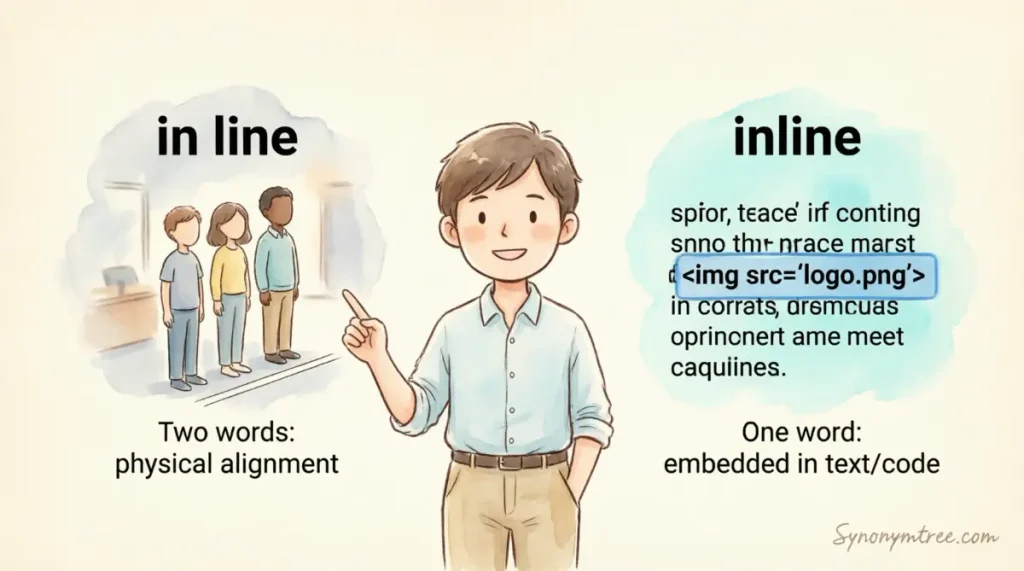
Think of a grocery store. You stand in line while waiting to pay. Now think of a picture inside a message. The picture appears inline with the message.
You can remember the rule with two short ideas. People wait in line. Content appears inline.
This is not a rule for every possible technical use, but it works well for common everyday examples.
Which Form Should You Use?
Choose the form that matches the meaning of your sentence. If you’re talking about a queue, a plan, a rule, or an action that agrees with something, write in line. If you’re describing content placed within another item, write inline.
Here are some simple rules to guide you.
- Use in line when people wait for their turn. Example: We waited in line to enter the museum.
- Use in line with when something matches a plan, rule, or belief. Example: The decision is in line with school policy.
- Use inline when describing content within a larger item. Example: The email includes an inline image.
- Use inline in common technical terms such as inline code or inline styles. Example: The developer added inline styles to the page.
- Check the context when a technical field uses the word in a special way. Follow the spelling used in the relevant style guide or documentation.
Is In Line or Inline Correct in an Email?
Both forms can be correct in an email, but the meaning decides which one to use.
If you’re telling a friend that you waited for coffee, you might write, “I stood in line for ten minutes.” If you’re describing a picture that appears inside the email message, you might write, “I included an inline image.”
The same rule applies to work emails. You can say a proposal is in line with company policy. You can also discuss inline formatting when talking about how the email looks.
Is In Line or Inline Correct in Writing?
Again, both forms are correct in the right setting. Use in line when you mean that something agrees with a rule or follows a plan. Use inline when you describe text, images, or other content placed within a line or larger structure.
For example, “The student’s work is in line with the instructions” means the work follows the instructions. “The document contains an inline image” means the image appears within the document’s text or content.
Don’t choose the spelling based only on the subject of the sentence. Focus on the meaning you want to express.
Easy Real Life Sentences You Can Use
Reading examples helps you see how each form works in natural English. The sentences below cover school, shopping, work, technology, and everyday conversation.
- I waited in line to buy a sandwich.
- We stood in line outside the movie theater.
- Her decision is in line with our family values.
- The school policy is in line with local rules.
- The article contains an inline image.
- Please add the explanation inline with the paragraph.
- The developer placed the code inline with the text.
- The email shows the photo as an inline image.
The first four examples use in line because they describe waiting or agreement. The last four use inline to describe how content appears within a larger item.
You can also make your own examples. Think about something you did yesterday. Did you wait in line at a store? Did you read a message with an inline picture? Creating sentences from real experiences can help the spelling stay in your memory.
Where These Expressions Come From
The word line has a long history in English. It can refer to a mark, a row, a direction, or a sequence of things. Over time, people began using it in many expressions.
The phrase in line developed common uses connected with being in a row and being in agreement with something. When people stand in a line, they form a row and wait in order. When a plan is in line with a rule, it follows the same direction or idea.
The word inline combines in and line into a single word. It is often used as a descriptive term for something placed within a line or included in a larger structure. Its use is especially familiar in technology and publishing.
You don’t need to memorize the history to use these forms correctly. Just remember that in line usually describes a position or agreement, while inline commonly describes how something is placed within content.
Moving From Basic Meaning to Practical Use
You now know the main difference between in line and inline. One is commonly used for waiting in a queue or matching a rule. The other often describes content placed within a line or included directly in a larger item.
But these expressions appear in more than one setting. You may find them in school assignments, business emails, website instructions, and conversations about plans or behavior. Learning how they work in real situations will help you avoid spelling mistakes and write with confidence.
In the next section, we’ll look at how these expressions appear in culture and daily life, explore related words, correct common mistakes, and answer the questions English learners ask most often.
How This Word Is Understood in Culture and Stories
The difference between in line or inline becomes easier to understand when you see how people use these expressions in everyday life. Both forms describe a connection between things, but they do not always mean the same thing. The correct choice depends on the message you want to share.
The phrase in line often appears in stories about waiting, fairness, rules, and order. For example, imagine a group of children waiting to enter a classroom. Each child stands behind another child. They are standing in line. This simple phrase can also describe people who follow the same rules or ideas.
In stories, standing in line can represent patience. A character may wait for food, a ticket, or a chance to speak. The line shows that everyone must wait for their turn. It can also represent fairness because each person gets a chance instead of one person taking everything first.
The phrase can also describe agreement. Imagine a teacher who says that a student’s answer is in line with the lesson. The teacher means that the answer matches the ideas taught in class. In this case, the phrase does not describe a physical line. It describes a match between two things.
The word inline has a different use. It often describes something placed inside a larger item or arranged as part of a larger structure. You may see it in stories about computers, websites, books, or design. For example, an inline image appears within the text of a page instead of sitting in a separate section.
Biblical and Mythological Meaning If Applicable
The expressions in line and inline do not have special meanings in the Bible or in traditional mythology. They are ordinary English expressions used in modern speech and writing. Still, some ideas connected with them can help us understand stories about rules, order, patience, and belonging.
In many biblical stories, people are asked to follow guidance, respect others, and act with patience. These ideas can remind us of the everyday meaning of being in line with a rule or teaching. For example, a person may try to keep their actions in line with their beliefs. This means that their actions match what they believe is right.
However, this is a modern English use of the phrase. It does not mean that the exact expression has a special biblical meaning. The important idea is the connection between a person’s actions and their values.
Mythological stories also include ideas about order and proper behavior. A character may need to follow a rule, respect a promise, or wait for the right moment to act. These situations can help readers understand the general idea of staying in line with a plan or expectation.
The word inline has no widely recognized biblical or mythological meaning of its own. Its common uses are mainly connected with modern writing, technology, and the placement of information. For instance, a writer may place an inline explanation inside a story to help readers understand a character’s actions.
The key lesson is simple. You can discuss patience, order, and agreement when explaining the phrase in line, but you should not present those ideas as special religious meanings of the expression. Likewise, inline usually describes placement and structure, not a spiritual belief or ancient symbol.

Symbolism Explained in Simple Words
Words can sometimes suggest ideas beyond their basic meanings. The expression in line may remind people of patience, fairness, agreement, or order. The word inline may suggest connection, closeness, and the way information fits into a larger piece.
These are possible associations, not fixed meanings. The words do not always carry an emotional message. Their meaning still depends on the sentence and situation.
What One Version Represents
The phrase in line can suggest order and fairness when it describes people waiting for their turn. It reminds us that everyone may need to follow the same process. A person who waits patiently in line allows others to have their turns, too.
Consider a school activity in which every student must wait before speaking. The students are in line to share their answers. This situation can suggest patience and respect because each person has a chance to take part.
The phrase can also suggest agreement when it appears in a sentence about rules, plans, or beliefs. If a person’s actions are in line with their promises, their behavior matches what they said they would do. This meaning can connect the phrase with trust and honesty.
Here are three examples that show these meanings.
1. The children stood in line for lunch. This describes an orderly group waiting for food.
2. Her actions are in line with the school rules. This means her actions follow the rules.
3. His plan is in line with our goals. This means his plan matches what the group wants to achieve.
In each example, the phrase describes waiting, following rules, or matching an idea. The exact meaning comes from the words around it.
What the Other Version Represents
The word inline can suggest that something belongs inside a larger item. In writing and design, this may mean that a picture, note, or piece of information appears directly within the main content.
For example, an inline picture appears inside an article rather than in a separate gallery. An inline note may appear within a paragraph instead of at the end of a page. The word describes where the item appears and how it fits into the larger work.
Inline can also suggest a close connection between parts of a system. In computer programming, an inline element or instruction may be placed directly within another part of the code. The exact meaning depends on the technology being discussed.
Here are three simple examples.
1. The article includes an inline picture. The picture appears within the article.
2. The editor added an inline note. The note appears directly inside the document.
3. The website uses inline styles. The styles are written directly in the relevant HTML elements.
Unlike the phrase in line, inline does not normally suggest waiting for a turn or following a rule. It mainly describes placement or structure.
The clearest comparison is this. In line often describes a queue or a match with something else. Inline usually describes something placed within a larger item. They may look similar, but their jobs are different.
Related Words You Should Know
Learning related words can help you understand the difference between in line and inline. Some words describe waiting or agreement. Others describe placement, arrangement, or the way information appears in writing.
1. Queue. A queue is a line of people or things waiting for their turn. In American English, people often say line instead of queue.
2. Aligned. Something is aligned when it matches or fits with another thing. For example, your actions may be aligned with your goals.
3. Consistent. Something is consistent when it stays the same or agrees with an earlier idea. A decision can be consistent with a rule.
4. Orderly. An orderly group follows a clear arrangement. Students standing in line quietly may form an orderly group.
9. In line with. This phrase means matching or agreeing with something. For example, the decision is in line with the rules.
10. Line up. This expression can mean arranging people or things in a line. It can also mean organizing or preparing things for a task.
11. Within. This word means inside something or inside a limit. An inline comment appears within a document.
12. Placement. Placement means the position of something. Inline often describes the placement of an item inside a larger piece of content.
These related words are useful because they help you explain your meaning more clearly. If you mean that people are waiting, words such as queue and line may fit. If you mean that something appears inside a document, words such as embedded, placement, and inline may be more useful.
How People Actually Use It in Daily English
People use in line and inline in different situations. In everyday conversation, in line often refers to waiting or agreement. Inline appears more often in writing, design, and technology. The following examples show how to choose the correct form.
1. Waiting at a store. We stood in line for twenty minutes. This means we waited behind other people to pay for our items.
2. Waiting at school. The students are in line outside the classroom. This describes the students waiting in an orderly row.
3. Following a rule. Your answer is in line with the teacher’s instructions. This means your answer matches the instructions.
4. Matching a plan. The new schedule is in line with our plans. This means the schedule agrees with what we planned.
5. Talking about behavior. His actions are not in line with his words. This means he does not act in the way he says he will.
6. Writing an article. The writer added an inline image to explain the topic. This means the image appears within the article’s content.
7. Editing a document. Please add your comments inline. This means the comments should appear directly within the text instead of in a separate list.
8. Building a webpage. The developer added an inline style to an HTML element. This describes a style written directly in the element’s code.
Common Mistakes People Make
Many people mix up in line and inline because the expressions look almost the same. The difference is small on the page, but it can change the meaning of a sentence. You can avoid most mistakes by checking how the expression works in context.
Mistake One Using Inline for a Queue
Incorrect: We waited inline at the bank.
Correct: We waited in line at the bank.
In standard American English, in line is the usual expression for people waiting for their turn. The word inline is not normally used for a group waiting in a queue.
Mistake Two Separating Inline in Technical Writing
Incorrect: The article includes an in line image.
Correct: The article includes an inline image.
When inline describes an image or other item placed within a document, it is usually written as one word. This spelling is common in writing about websites, documents, and design.
Mistake Three Using In Line Without Enough Context
Unclear: The plan is in line.
Clearer: The plan is in line with our goals.
The phrase in line with often needs an explanation of what something matches. If you say that a plan is in line, your reader may not know which rule, goal, or idea you mean.
The shorter phrase can still be correct in a suitable context. For example, someone might say that a plan is in line for approval, meaning it is expected to receive approval. The surrounding words help explain the intended meaning.
Mistake Four Assuming Inline Always Means Inside Text
Inline often describes something placed within text, but its meaning can change across fields. In programming and design, it may describe an element, instruction, style, or other part of a system.
For example, an inline element on a webpage is not always the same as an inline image in a word processing document. Both uses involve placement within a larger structure, but the technical details differ.
The safest approach is to read the whole sentence and consider the subject being discussed.
Mistake Five Treating the Two Forms as Interchangeable
Incorrect: Please stand inline with the other students.
Correct: Please stand in line with the other students.
The first sentence is not the usual way to describe students waiting together in American English. The second sentence clearly describes their position in a queue.
However, the words can look similar in sentences about agreement. For example, the phrase in line with the rules means that something follows or matches the rules. Inline does not normally carry that meaning.
Mistake Six Adding a Space in Technical Terms
Incorrect: Add an in line comment to the document.
Correct: Add an inline comment to the document.
When the intended meaning is a comment placed directly inside the document or content, inline is generally the expected spelling. Some software products may use their own terminology, so follow the style used by the tool or organization when it provides a clear rule.
The best way to avoid these mistakes is to focus on meaning before spelling. First decide what you want to say. Then choose the form that expresses that idea clearly.
Final Teacher Explanation
Let’s bring the lesson together in a simple way. In line or inline is a spelling choice that depends on the meaning of your sentence. The two forms look similar, but they have different common uses.
Use in line when you talk about people waiting for their turns. For example, you can stand in line at a store, wait in line for lunch, or join a line of students outside a classroom. In these examples, people are waiting in an orderly group.
You can also use in line when you mean that something agrees with a rule, plan, goal, or belief. For example, your answer may be in line with the teacher’s instructions. This means your answer matches what the teacher asked you to do.
Use inline when you describe something placed within a larger item or structure. An inline picture appears inside an article. An inline style may be written directly in an HTML element.
Remember that the phrase in line with is especially useful when you want to describe agreement. It tells readers that one thing matches another thing. The word inline usually describes placement or structure instead.
Final Answer and Quick Recap
Use in line when describing people waiting for their turns or something that agrees with a rule or plan.
Use inline when describing something placed directly within text, a document, or another structure.
The easiest rule to remember is this. In line often describes waiting or agreement. Inline usually describes placement.
Conclusion
Choosing between in line and inline is easier once you focus on meaning instead of appearance. The phrase in line commonly describes a queue or something that matches a rule, plan, or expectation. The word inline usually describes something placed within a larger item, such as an image inside an article or a comment inside a document.
These expressions appear in different settings, from daily conversations to schoolwork and computer programming. That is why learning their uses can improve both your reading and writing. When you understand the sentence, the spelling often becomes clear.
Before you finish writing, take a moment to check what you mean. Are you describing people waiting for their turns, something that matches an idea, or something placed inside another item? That quick question will help you choose the correct form and write with confidence.
Frequently Asked Questions FAQs
What Does In Line Mean in Simple Words?
In line usually means waiting in a row for your turn. It can also mean that something matches a rule, plan, or idea.
What Does Inline Mean in Simple Words?
Inline means placed directly within a larger item or structure. For example, an inline image appears within an article.
Is In Line or Inline Correct?
Both forms are correct, but they have different uses. Choose in line for a queue or agreement and inline for something placed within another item.
When Should I Use In Line?
Use in line when talking about people waiting for their turns or something that agrees with a rule or plan. For example, the decision is in line with our goals.
When Should I Use Inline?
Use inline when describing an item or feature placed directly within a larger piece of content. Common examples include inline images, inline comments, and inline styles.
Why Do People Get Confused Between In Line and Inline?
They look and sound similar, so it is easy to mix them up. The best way to choose is to look at the meaning of the full sentence.
Can I Use Both Forms in Writing?
Yes. Both forms are correct when used in the right context. Use the two word phrase for waiting or agreement and the one word form for placement within something else.
Is Inline One Word or Two Words?
Inline is one word when it describes something placed within a larger structure. In line is two words when it describes a queue or appears in phrases such as in line with the rules.
