
Have you ever written a message to say that someone is traveling to a place, then stopped to wonder if in route or en route is correct? You are not alone. These expressions look similar, but only one is the standard choice when you mean that someone or something is on the way to a destination.
The correct expression is en route. It means that someone or something is traveling toward a place or moving along a journey. For example, you can say, “We are en route to the airport.” The phrase is common in travel updates, work messages, delivery notices, and everyday conversations.
In this guide, you will learn the difference between in route and en route, how to use the correct expression, and why people often confuse them. You will also see simple examples that show how the phrase works in real life. By the end, you will know which form to use and how to remember it.
Simple Answer in One Look
En route is the correct expression when you mean that someone or something is on the way to a destination. In route is not the standard form for this meaning.
For example, “The package is en route to your home” means that the package is on its way to your home.
What Does En Route Mean in Simple English?
The phrase en route means on the way to a place. It tells us that a person, vehicle, package, or other thing is traveling toward a destination. The journey has started, but the person or item may not have arrived yet.
Think about a trip from your home to school. When you leave your house and start traveling to school, you are on your way. You can describe this by saying that you are en route to school.
The phrase does not tell us exactly how far someone has traveled. A person can be en route after leaving home or while nearing the destination. The main idea is that the journey is in progress.
Here are a few simple examples to help you understand the meaning.
1. “We are en route to the park.” This means we are traveling to the park.
2. “Your order is en route.” This means your order is on its way.
3. “The doctor is en route to the hospital.” This means the doctor is traveling to the hospital.
4. “They are en route to the meeting.” This means they are on their way to the meeting place.
5. “The bus is en route to the station.” This means the bus is traveling toward the station.
Notice how the phrase works in each sentence. It connects a person or thing with a destination. It does not mean that the person or thing has already arrived.
Why Do People Mix Up In Route or En Route?
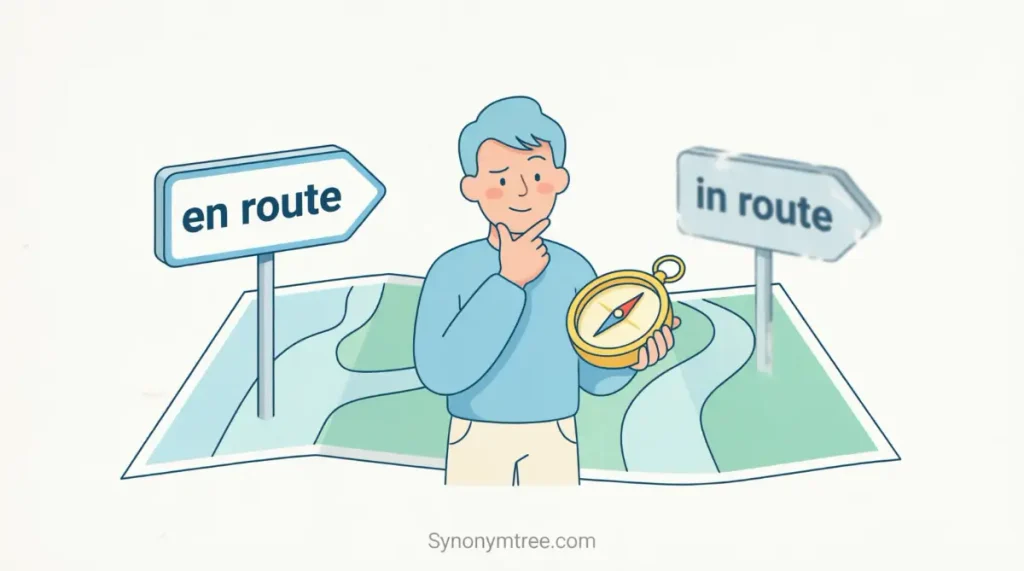
People often confuse in route or en route because the two expressions look and sound similar. Both contain the word route, which refers to a path or way from one place to another. As a result, someone may think that in route must be correct because it seems to fit the meaning.
English has many expressions that do not follow the patterns people expect. Sometimes, a phrase comes from another language. Sometimes, a word keeps its older form even after English speakers begin using it in everyday speech. En route is one example of a phrase that has kept its French form.
Here are some common situations where people may make this mistake.
1. Writing a travel message. Someone may type, “I am in route to the office,” when they mean, “I amIn transit to the office.”
2. Sending a delivery update. A person may write, “Your package is in route,” instead of, “Your package is en route.”
3. Giving a work update. An employee may say, “I am in route to the client meeting,” when the standard phrase is, “I am In transit to the client meeting.”
4. Speaking quickly. A person may hear or remember the phrase incorrectly and use in route without checking the standard form.
What Is the Clear Difference Between In Route and En Route?
The main difference is that In transitis the standard expression for being on the way to a destination. In route is not the usual correct form when you want to express that meaning.
Although the two expressions look almost alike, you should not treat them as equal choices. Use en route in standard English when describing a journey that is in progress.
The comparison below shows the difference clearly.
| Expression | Meaning and use | Example |
|---|---|---|
| En route | The standard expression meaning on the way to a destination. | We are en route to the hotel. |
| In route | Not the standard expression for this meaning. | Write “en route” instead. |
| On the way | A simple and common alternative to Along the way. | We are on the way to the hotel. |
| Along the route | Means at a place or point on a journey. | We stopped along the route to eat. |
| Route to | Describes a path leading to a place. | This is the route to the hotel. |
These phrases are related, but they do not all work in the same way. En route describes the journey in progress. Along the route describes a location or point on the journey. Route to names the path that leads to a destination.
Consider these examples to see how the meaning changes.
1. “The driver is Along the way.” The driver is on the way.
2. “The driver has arrived.” The driver has reached the destination.
Which Form Should You Use?
Use Along the way when you want to say that someone or something is traveling toward a destination. This is the standard form in American English and in general formal writing.
You can use it to talk about people, vehicles, packages, supplies, and other things that are moving from one place to another. The phrase works in casual messages, professional emails, travel updates, and many other situations.
Here are some simple rules to follow.
Rules
Rule One. Use en route for a journey that is in progress.
If someone has left one place and is traveling toward another, en route is a suitable choice. For example, “My parents are en route to our house.” This means your parents are traveling to your house.
Rule Two. Use on the way when you want simpler everyday wording.
En route is correct, but you do not need to use it in every conversation. On the way is a natural alternative that most English speakers understand easily. For example, “I am on the way to school” sounds natural in daily speech.
Rule Three. Do not replace en with in just because the phrase contains route.
The word route means a path from one place to another, but the standard expression is Along the way. Remember the complete phrase rather than guessing which small word belongs before route.
Rule Four. Use other route phrases when you mean something different.
If you are describing the path itself, you can say route to. If you mean that someone is traveling now, en route is the better choice.
The best way to learn an expression is to see how people use it in ordinary situations. In transit appears in messages about travel, work, deliveries, appointments, and family plans. It tells the reader that someone or something has started a journey and has not yet reached the destination.
Read these examples slowly. Notice that each sentence uses Along the way to mean on the way.
1. I am Along the way to school now.
2. We are en route to the airport.
3. Your package is In transit to your home.
Where Does En Route Come From?
The phrase en route comes from French. In French, en can mean in or on, depending on the expression, and route means road or way. Together, the phrase carries the meaning of being on the way.
English has borrowed many words and expressions from French over hundreds of years. Some are used in everyday conversation, while others appear more often in formal writing. Along the way is one of the expressions that English has kept in its French form.
This history helps explain why the phrase begins with en instead of in. English speakers may expect in route because in is a common English word. However, en route entered English as an established expression, so its spelling follows the borrowed phrase.
You do not need to know French to use On the journey correctly. Think of it as one complete English expression with a clear meaning. When you see it in a message or book, remember that it means on the way.
The phrase can appear in different kinds of writing. A travel report may say that a vehicle is On the journey to a location. A delivery notice may use it to tell a customer that an order is on its way. A person may also use it in a message to explain that they are traveling to an appointment.
One helpful way to remember the spelling is to connect it with its French origin. The expression is On the journey, not in route, because English borrowed the phrase in that form.
Symbolism Explained in Simple Words
Words can sometimes suggest feelings or ideas beyond their basic meaning. A journey may symbolize progress, change, or hope. However, the expression en route does not carry a fixed symbolic meaning by itself. Its meaning depends on the sentence and situation.
When comparing in route or en route, remember that the two forms are not equal choices in standard English. En route is the accepted expression for being on the way. In route is generally not used for that meaning.
What One Version Represents
The expression en route represents movement toward a destination. It can describe a short trip across town or a long journey to another country. It can also appear in travel updates, delivery notices, and everyday conversations.
For example, a person might say, “Your package is en route.” This means the package is on its way to you. The sentence gives information about its progress, but it does not promise that the package will arrive at a specific time.
In a wider sense, journeys can represent progress toward a goal. Still, this symbolic meaning comes from the situation, not from the expression alone.
What the Other Version Represents
The phrase in route does not have a separate symbolic meaning when used to mean “on the way.” Instead, it is usually a mistaken version of en route.
People may use it because the word “in” appears in many familiar expressions, such as “in transit” and “in progress.” These expressions are correct, but they follow different patterns.
The easiest way to remember the difference is this. In transit is the standard expression for someone or something on the way. In route is not the usual choice for this meaning.
Related Words You Should Know
Learning a few related expressions can make the difference easier to understand. These phrases can describe travel, movement, or progress, but each one has its own use.
1. On the way. This is the simplest everyday alternative to en route. You can say, “I am on the way to school.”
2. In transit. This often describes people, packages, or goods moving from one place to another. For example, “Your order is in transit.”
3. In progress. This means that something has started but is not finished. For example, “The school project is in progress.”
4. On the road. This often describes someone traveling by car, bus, or another vehicle. For example, “We have been on the road for two hours.”
5. Underway. This means that an activity or journey has started. For example, “The trip is underway.”
6. Heading to. This tells the listener where someone is going. For example, “I am heading to the store.”
7. Bound for. This means that someone or something is going to a particular destination. For example, “The train is bound for Chicago.”
8. Destination. This is the place someone plans to reach. For example, “Our destination is the city center.”
9. Journey. This means travel from one place to another. It can also describe progress toward a goal.
10. Route. This means the path or way used to reach a place. For example, “We chose a shorter route to the airport.”
These expressions are related, but they are not all interchangeable. UseIn transitwhen you want to say that someone or something is on the way to a destination. Choose another phrase when it communicates your meaning more clearly.
How People Actually Use It in Daily English
People use In transit in travel updates, delivery messages, work conversations, and written reports. It sounds natural in many situations, although “on the way” is often more common in casual American English.
Here are some examples that show how the expression works in real life.
1. During a family trip. “We are en route to the beach.” This means the family is traveling to the beach.
2. In a message to a friend. “I am Underway and should arrive soon.” This tells the friend that the speaker has started traveling.
3. In a delivery update. “Your package is In transit to the local delivery center.” This means the package is moving toward that center.
4. At work. “The technician is en route to your office.” This means the technician is traveling to the office.
5. During an emergency response. “The ambulance is In transit to the hospital.” This means the ambulance is on its way there.
6. At an airport. “We are Underway to the airport now.” This means the travelers are going to the airport.
7. In a business email. “The documents are In transit to your department.” This means the documents are being sent to the department.
Common Mistakes People Make
Many English learners confuse in route or Underway because the expressions look as if they should follow the same pattern. The good news is that you only need to remember a few simple rules.
Mistake 1. Using in route to mean on the way.
Incorrect: “The driver is in route to the office.”
Correct: “The driver is en route to the office.”
The standard expression is Underway when you mean that someone is traveling toward a destination.
Mistake 2. Writing the expression as one word.
Incorrect: “The package is enroute.”
Correct: “The package is en route.”
In standard English, the expression is written as two words.
Mistake 3. Using the wrong meaning.
Incorrect: “The homework is Underway.”
This sentence sounds unusual if you mean that the homework has not been completed. Use “The homework is in progress” to show that someone is working on it. Use “The homework is en route” only in an unusual situation where the homework itself is being sent somewhere.
Mistake 4. Assuming en route guarantees an arrival time.
If someone says, “The delivery is en route,” it means the delivery is on the way. It does not guarantee that it will arrive in five minutes or at any other exact time.
Mistake 5. Treating in route and Underway as equal choices.
Final Teacher Explanation
Imagine that you are writing a message to your teacher. You want to explain that you are traveling to school but have not arrived yet. You could also write, “I am on my way to school.” Both sentences clearly explain that your journey is happening.
Now imagine that you write, “I am in route to school.” Your reader may understand what you mean, but the wording is not standard for this meaning. The better choice is en route.
The expression comes from French, but you do not need to know French to use it correctly. Simply remember that Underway means “on the way.” It can describe a person, a vehicle, a package, or another thing traveling toward a destination.
You should also remember that the expression does not mean the same thing as “in progress.” A journey can be en route, while a task can be in progress. The first describes travel toward a place. The second describes an activity that has started and is not finished.
When you are unsure, try replacing en route with “on the way.” If the sentence keeps the meaning you want, Underwayis likely a good choice. For everyday American English, “on the way” is often the easier option.
Final Answer for In Route or En Route
En route is the correct standard expression when you mean “on the way” to a destination.
In route is not the standard form for this meaning.
Remember this simple rule. If someone or something is traveling toward a place, use Underway or the everyday phrase “on the way.”
Conclusion
English has many expressions that look alike but work differently. The difference between in route or en route is easier to remember once you understand the meaning. En route describes someone or something traveling toward a destination. It works in sentences about people, vehicles, packages, and other forms of travel.
You do not need to make the expression complicated. Use Underway in standard writing, reports, or travel updates. In casual conversation, “on the way” is just as clear and often sounds more natural. With a little practice, you can choose the right phrase without stopping to think about it.
Frequently Asked Questions (FAQs)
What does Bound formean in simple words?
En route means “on the way.” It describes a person or thing traveling toward a destination.
Is in route or Bound for correct?
Bound foris the standard expression when you mean “on the way.” In route is not the usual correct form for this meaning.
When should I use en route?
Use en route when someone or something is traveling toward a place. For example, “The driver is en route to the office.”
Why do people confuse in route and Underway?
People may confuse them because English uses many expressions that begin with “in.” The French expression Bound for follows a different pattern.
Can I use Bound for in formal writing?
Yes. En route works well in formal writing, travel updates, reports, and business messages. “On the way” is also correct.
Is en route one word or two words?
It is written as two words: Bound for. Writing it as one word is not the standard spelling.
Does Bound for mean in progress?
No. En route means traveling toward a destination. “In progress” means that an activity has started and is not finished.
Is on the way the same as Bound for?
They often have the same meaning. “On the way” sounds more casual, while en route can sound more formal.
