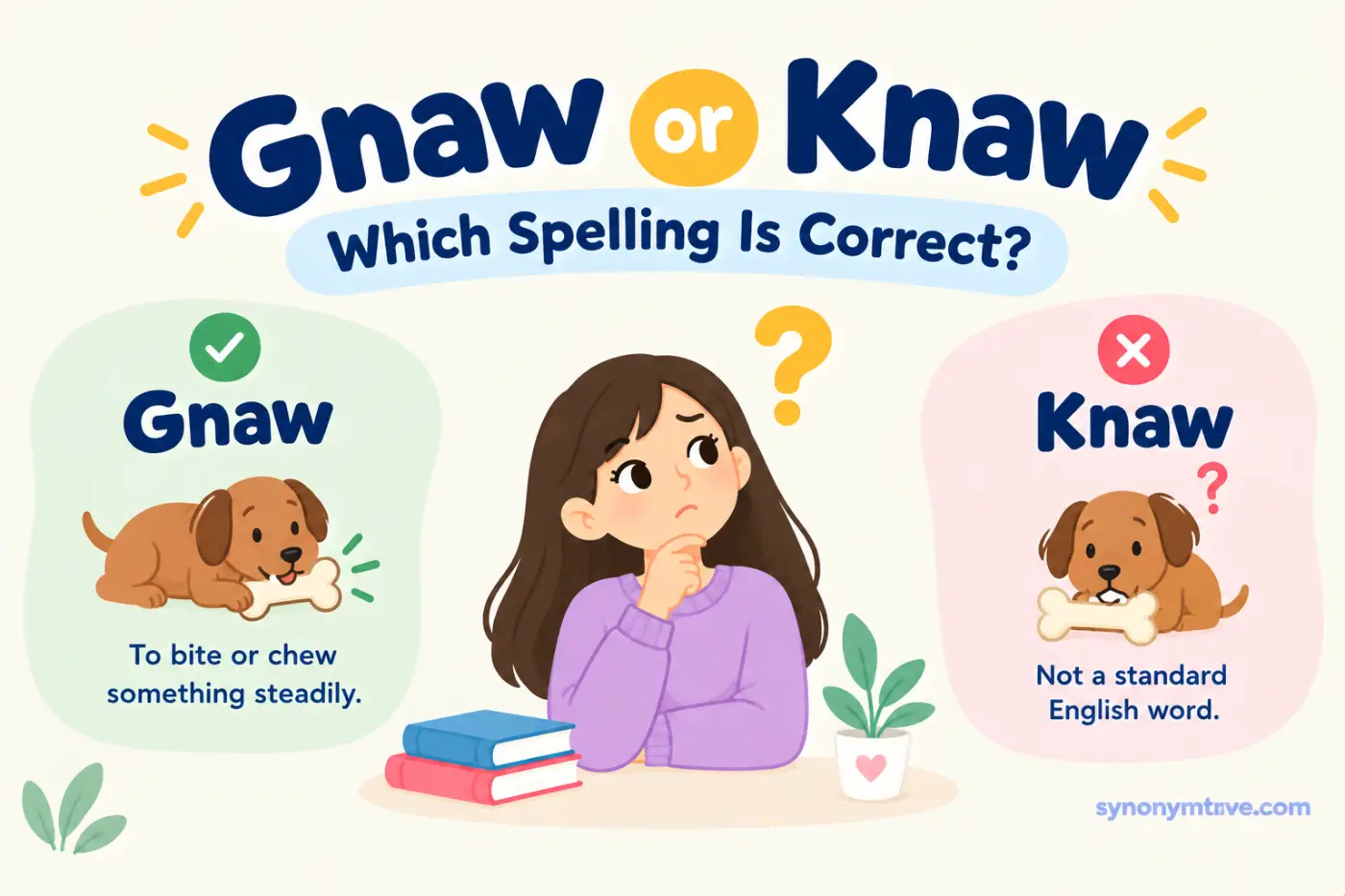
If you’re unsure about gnaw or knaw, you’re not alone. The two forms sound almost the same when spoken, but only one is the standard English spelling. This small spelling question can cause trouble in schoolwork, emails, essays, stories, and everyday writing.
The correct word is gnaw. It means to bite or chew something repeatedly, often with the teeth. It can describe an animal chewing on something, or it can describe a worry or feeling that keeps bothering someone.
Gnaw is pronounced with a silent g, so it sounds like “naw.” That silent letter is the main reason people sometimes write knaw instead. Once you understand where the word comes from and how it works in a sentence, the spelling becomes much easier to remember.
This guide explains the meaning, pronunciation, history, grammar, sentence patterns, common mistakes, memory tricks, related words, and several examples. You’ll also see how gnaw differs from words such as chew, nibble, bite, and worry.
Quick Definition
Gnaw is a verb that means to bite or chew something repeatedly, usually with the teeth. It can also mean to cause a steady feeling of worry, doubt, or discomfort.
Knaw is not the standard spelling of this word in modern English. If you mean to chew repeatedly or to bother someone over time, use gnaw.
Direct Answer
Gnaw is the correct spelling. Knaw is a misspelling when you mean to bite or chew something repeatedly, or to cause a persistent feeling of worry.
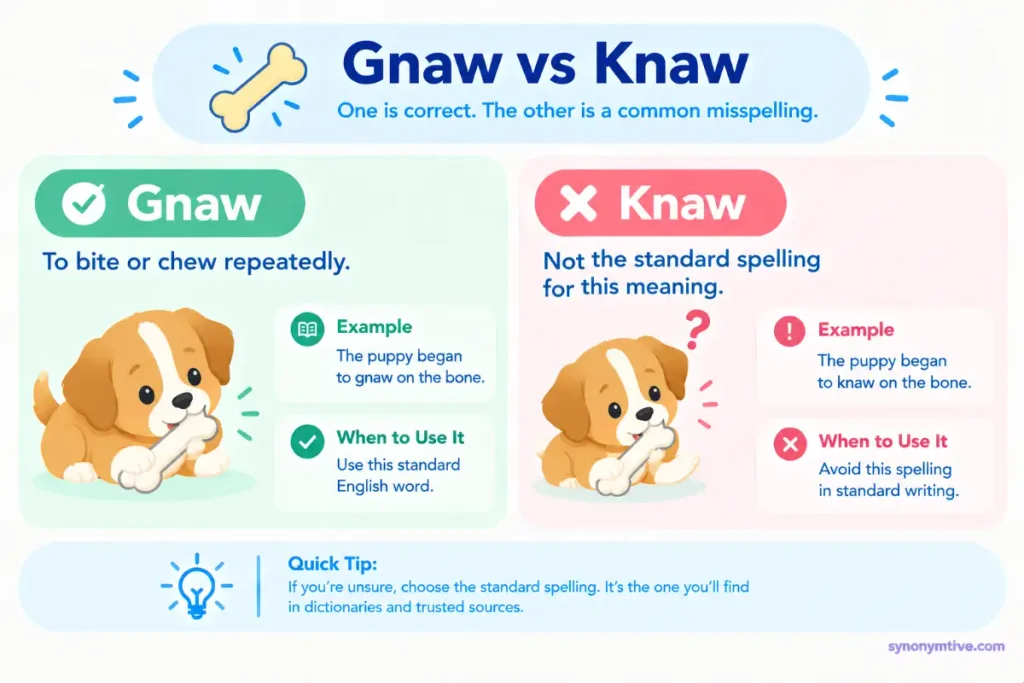
Gnaw or Knaw in a Simple Comparison
| Word | Meaning | Example Sentence | When to Use It |
|---|---|---|---|
| Gnaw | To bite or chew repeatedly | The puppy began to gnaw on the bone. | Use this standard English word. |
| Knaw | Not the standard spelling for this meaning | The puppy began to knaw on the bone. | Avoid this spelling in standard writing. |
The difference is simple. Gnaw is the word you want.
The tricky part is pronunciation. English has many words with silent letters, and gnaw is one of them. The g is written but not pronounced. That means the word sounds roughly like “naw,” which can make the spelling less obvious.
Why Do People Confuse Gnaw and Knaw?
The main source of confusion is sound.
When you hear gnaw, you do not hear the g. You hear something close to “naw.” If someone has only heard the word in conversation, they may try to spell it based on its sound.
The spelling knaw may seem reasonable at first because English has many words that begin with kn. Words such as know, knee, knife, knock, and knot all have a silent k. A person who knows those patterns may assume that knaw follows the same rule.
It does not.
The standard spelling is gnaw. In this word, the g is silent rather than the k.
That creates an interesting spelling pattern:
- gnaw has a silent g.
- know has a silent k.
- knee has a silent k.
- knife has a silent k.
- knock has a silent k.
- gnash has a silent g.
- gnarl has a silent g.
- gnat has a silent g.
English spelling does not always let you predict a word from its sound. Historical changes in pronunciation have left many silent letters behind.
So if you have heard “gnaw” but never seen it written, it is understandable that you might wonder how to spell it. The important thing is to remember that the accepted spelling begins with gn, not kn.
What Does Gnaw Mean?
Gnaw has a few closely related meanings.
The most basic meaning is to bite or chew something repeatedly. The action is usually slow or repeated rather than one quick bite.
For example:
The rabbit gnawed the carrot.
The dog gnawed on the old bone.
The mouse gnawed through the cardboard.
In these examples, an animal uses its teeth again and again.
Gnaw can also describe a person biting or chewing something. Someone might gnaw on a pencil while thinking, although chew is more common in everyday speech.
The word has another important meaning that is not physical. Gnaw can describe a worry, doubt, regret, or other unpleasant feeling that keeps bothering a person.
For example:
A small doubt began to gnaw at her.
The mistake continued to gnaw at him.
The thought of losing the job gnawed at his confidence.
Here, nobody is using teeth. The word describes a mental or emotional pressure that keeps working on someone.
This figurative meaning comes from the physical idea. Just as an animal can slowly wear away at something by chewing it, a worry can slowly wear away at a person’s peace of mind.
How Do You Pronounce Gnaw?
Gnaw is pronounced like “naw.”
The g is silent.
You do not say the g at the beginning. Saying something like “guh-naw” is not the standard pronunciation.
Here are a few examples of the sound pattern:
- gnaw sounds like “naw.”
- gnat sounds like “nat.”
- gnash sounds like “nash.”
- gnarl sounds like “narl.”
This is one reason spelling the word can be difficult. The first letter gives you no sound clue.
The same problem appears in many English words. For example, know and no sound alike, but their spellings and meanings are different. Knight and night also sound alike but have different meanings.
Gnaw is different because knaw is not a standard alternative spelling. The silent g is part of the correct spelling.
Where Did the Word Gnaw Come From?
Gnaw is an old English word with Germanic roots.
Its history helps explain the unusual spelling. The word has been part of English for a very long time. Earlier forms were pronounced differently from the way many English speakers say the word today.
Over the centuries, English pronunciation changed. In some words, sounds that were once pronounced clearly became silent. The spelling often stayed closer to the older form.
That is why the g remains in gnaw even though modern speakers do not pronounce it.
The same kind of historical change explains several other English words with silent letters. Spelling often preserves older forms even after speech has changed.
The word is related to similar forms found in other Germanic languages. Its basic idea has long been connected with biting, chewing, or wearing something away with the teeth.
That history also helps explain the figurative meaning. A physical action that slowly wears something down became a useful image for worries and problems that slowly wear down a person’s peace of mind.
For modern readers, though, you do not need to know the entire history to use the word correctly. The practical rule is simple: spell it gnaw.
How Is Gnaw Used in a Sentence?
Gnaw can work as a verb in several sentence patterns.
The most common pattern is:
Subject + gnaw + object.
For example:
The mouse gnawed the wooden box.
You can also use gnaw with on:
Subject + gnaw + on + object.
For example:
The dog gnawed on a rubber toy.
Both structures can be natural, though gnaw on is especially common when describing repeated chewing.
The word can also be used with at:
Subject + gnaw + at + object.
This pattern often appears in figurative expressions.
For example:
The doubt gnawed at her.
The memory gnawed at him.
The question continued to gnaw at my mind.
When gnaw describes an emotional or mental problem, at is especially useful.
Gnaw as a Physical Action
The physical meaning is the easiest place to start.
An animal might gnaw because it needs to eat, sharpen its teeth, reach food, or chew through something. Rodents are especially often described as gnawing because their front teeth continue to grow and they commonly chew hard materials.
Here are some natural examples:
The beaver gnawed through a branch.
The squirrel gnawed on a nut.
The rabbit gnawed at the wooden cage.
The puppy spent the afternoon gnawing on a toy.
A rat had gnawed a hole in the box.
The horse gnawed on the wooden fence.
These examples show that gnaw often suggests repeated pressure from the teeth.
It can also suggest damage. If a mouse gnaws through a box, the repeated chewing may create a hole. If a dog gnaws on a chair leg, the wood may become damaged.
The word does not always mean that something is completely destroyed. It simply focuses on the repeated biting or chewing action.
Gnaw as a Figurative Feeling
The figurative meaning is just as important.
When something gnaws at you, it keeps bothering you. The feeling may be worry, guilt, regret, doubt, fear, or another unresolved thought.
Consider this sentence:
A strange feeling gnawed at me all day.
No teeth are involved. The feeling is simply difficult to ignore.
This use often suggests persistence. A person may try to push the thought away, but it keeps returning.
For example:
The unanswered question gnawed at him.
Her regret about the argument continued to gnaw at her.
A sense of doubt began to gnaw at the team.
The fear of failure gnawed at his confidence.
The memory gnawed at her long after the event was over.
This meaning is useful in essays, stories, articles, and personal writing because it gives a strong image of a thought slowly wearing someone down.
What Is the Difference Between Gnaw and Chew?
Gnaw and chew are close in meaning, but they are not always interchangeable.
Chew is the more general word. It means to use your teeth to break food or another object into smaller pieces.
Gnaw usually suggests repeated, persistent biting. It often brings to mind an animal working at something with its teeth.
Compare these sentences:
The dog chewed its food.
The dog gnawed on the old bone.
The first sentence describes ordinary chewing. The second gives a stronger image of repeated biting at a hard object.
Chew is also much more common in everyday conversation.
You would normally say:
Chew your food slowly.
You would not normally say:
Gnaw your food slowly.
That sounds unusual because gnaw has a more specific feeling.
The reverse is also true. If a mouse is slowly damaging a wooden box with its teeth, gnaw is a strong choice:
The mouse gnawed through the box.
You could say the mouse chewed through the box, but gnawed gives the sentence a more exact image.
Gnaw vs Bite: What Is the Difference?
Bite usually refers to one act of closing the teeth around something. Gnaw suggests repeated biting or chewing.
A dog may bite a toy once.
A dog may gnaw on the toy for an hour.
That difference is useful.
Bite focuses on the action of the teeth.
Gnaw focuses on repeated chewing or biting over time.
For example:
The puppy bit my shoe.
This tells us about an act of biting.
The puppy gnawed on my shoe.
This suggests that the puppy kept chewing at it.
The words can also be used figuratively in different ways. Bite can describe a sharp or sudden effect, while gnaw often suggests a slow, continuing problem.
A harsh comment may bite, but a worry can gnaw at you.
Gnaw vs Nibble: What Is the Difference?
Nibble means to take small bites.
Gnaw usually suggests stronger, repeated chewing.
A rabbit may nibble on lettuce.
A mouse may gnaw through cardboard.
Nibble often sounds gentle or small. Gnaw can sound more forceful and persistent.
Compare:
The rabbit nibbled the leaves.
The rabbit gnawed on the wooden stick.
The first sentence suggests small bites of food. The second suggests repeated chewing of a harder object.
The choice depends on the image you want to create.
Gnaw vs Munch: What Is the Difference?
Munch is a casual word for eating or chewing food, often with a steady chewing action.
Gnaw is more specific.
You might say:
The child munched on popcorn.
You might say:
The dog gnawed on a bone.
Munch usually has a casual, everyday tone. Gnaw often sounds more descriptive and vivid.
Munch is strongly connected with eating food.
Gnaw vs Worry: What Is the Difference?
Gnaw and worry can overlap when talking about emotions, but they create different images.
Worry is the direct and common word. It simply means to think about a problem with fear or concern.
Gnaw suggests that the worry keeps working on you over time.
Compare:
I worry about the decision.
The decision gnaws at me.
The first sentence states the feeling plainly. The second suggests that the thought keeps bothering the speaker.
Gnaw is therefore useful when you want stronger imagery.
It can make writing more vivid without using complicated vocabulary.
What Are the Different Forms of Gnaw?
Gnaw is a regular verb.
Its main forms are:
| Form | Word |
|---|---|
| Base form | gnaw |
| Third person singular | gnaws |
| Present participle | gnawing |
| Past tense | gnawed |
| Past participle | gnawed |
Examples make the pattern easier to see.
Present:
The puppy gnaws on the bone.
Past:
The puppy gnawed on the bone.
Present participle:
The puppy is gnawing on the bone.
Past participle:
The bone has been gnawed by the puppy.
The spelling changes in the usual way for a regular verb.
Notice that gnawing keeps the g. The word does not become “nawing.”
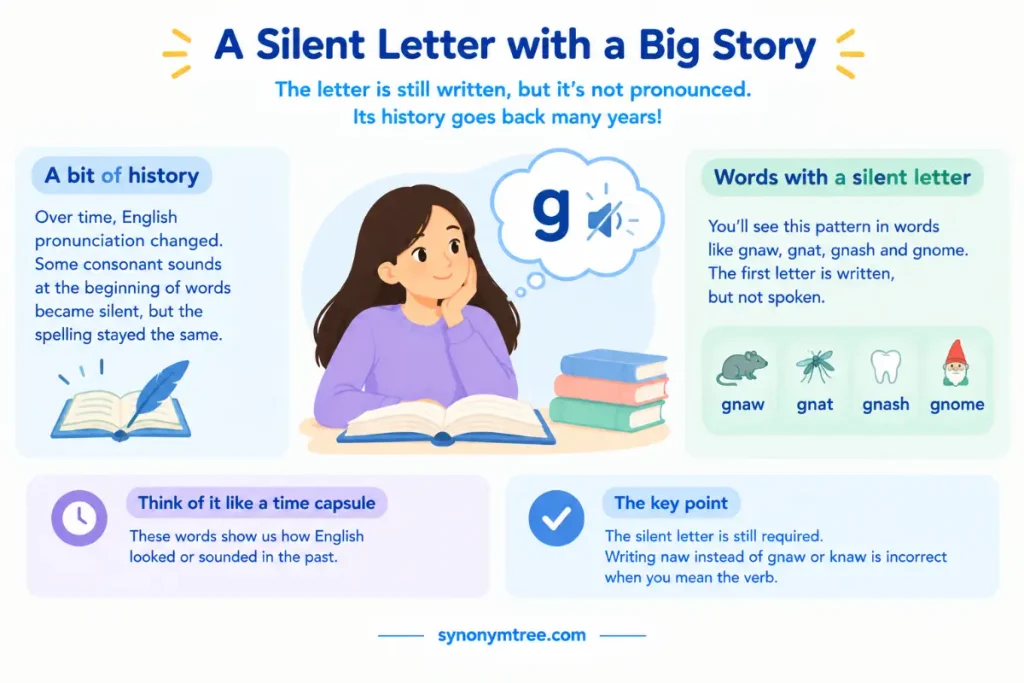
Why Is the G Silent in Gnaw?
The silent g comes from the word’s history.
English pronunciation has changed over hundreds of years. Some consonant sounds that were once pronounced at the beginning of words became silent.
The spelling remained.
That is why modern English has words such as gnaw, gnat, gnash, and gnome. The first letter is written but not spoken.
You can think of these words as spelling time capsules. Their letters show something about how English looked or sounded in the past.
The important point for modern writing is that the silent g is still required.
Writing naw instead of gnaw is also incorrect when you mean the verb. The same goes for knaw.
Is Knaw Ever Correct?
Knaw is not the standard spelling of the common English verb meaning to chew or bite repeatedly.
If your sentence means that someone or something is chewing, use gnaw.
For example:
Correct: The squirrel began to gnaw on the nut.
Incorrect: The squirrel began to knaw on the nut.
Correct: The worry continued to gnaw at him.
Incorrect: The worry continued to knaw at him.
You may occasionally encounter unusual spellings, names, usernames, or creative uses online. A nonstandard spelling can exist as a name or deliberate variation without becoming the standard English word.
For normal school, work, or professional writing, choose gnaw.
Common Mistakes With Gnaw
Several mistakes appear often because the pronunciation is not obvious.
Writing Knaw
This is the main spelling mistake.
Incorrect:
The dog began to knaw on the bone.
Correct:
The dog began to gnaw on the bone.
The k spelling is easy to understand as a sound-based guess, but it is not the standard form.
Writing Naw
Some writers may leave out the silent letter entirely.
Incorrect:
The mouse began to naw through the cardboard.
Correct:
The mouse began to gnaw through the cardboard.
English spelling often keeps letters that are not heard.
Pronouncing the G
The g is silent.
Avoid saying the word as if it begins with a hard g sound.
The correct pronunciation is close to “naw.”
Using Gnaw for Ordinary Eating
Gnaw is not the best choice for every kind of eating.
A person usually chews food. They do not normally gnaw their dinner.
The word works best when the action involves repeated biting or when you want a vivid image.
Forgetting the Figurative Meaning
Gnaw does not only describe animals and teeth.
A worry can gnaw at someone.
A doubt can gnaw at someone’s confidence.
A regret can gnaw at a person.
Knowing both meanings will help you understand the word in books and articles.
How Can You Remember the Spelling?
The easiest memory trick is to connect gnaw with other words that begin with gn.
Think of this group:
- gnaw
- gnat
- gnash
- gnarl
- gnome
In each word, the g is silent.
You can also connect the spelling with the word bite.
Think:
Gnaw means repeated biting.
Gnaw starts with gn.
Another trick is to remember that kn is already used in words such as knee, knife, knot, and know. Those words have a silent k, but gnaw belongs to the silent g group.
You do not need to memorize a complicated spelling rule. English has too many exceptions for that to work well.
Instead, remember gnaw as one member of the silent g family.
Examples of Gnaw in Real Sentences
Seeing the word in different settings is one of the best ways to understand it.
Animal Examples
The mouse gnawed through the cardboard box.
The puppy spent the morning gnawing on an old shoe.
A beaver gnawed at the tree trunk.
The rabbit gnawed on a piece of carrot.
The squirrel gnawed through the shell of the nut.
Everyday Examples
The dog kept gnawing on its favorite toy.
The child was caught gnawing on the end of a pencil.
The old chair had marks where the puppy had gnawed it.
The horse began to gnaw on the wooden fence.
The rabbit gnawed at the bars of its cage.
Figurative Examples
The unanswered question began to gnaw at me.
Regret continued to gnaw at her after the argument.
A quiet doubt gnawed at his confidence.
The fear of failure gnawed at him before the interview.
The memory of the mistake still gnawed at her.
The thought of leaving his family behind gnawed at him.
Writing Examples
The author uses the image of a rat gnawing through the wall to create tension.
A growing sense of guilt gnawed at the character.
The narrator could not escape the question that gnawed at his mind.
These examples show how flexible the word can be.
When Should You Use Gnaw in Formal Writing?
Gnaw is perfectly acceptable in formal English when the meaning fits.
It can be useful in essays, reports, stories, and other writing because it is a precise word.
For example:
The unresolved conflict continued to gnaw at the community.
The mistake began to gnaw at the student’s confidence.
The uncertainty gnawed at the committee as the deadline approached.
These sentences use the figurative meaning in a clear way.
Still, do not choose gnaw simply to sound sophisticated. If you mean worry, and there is no reason to create a stronger image, worry may be clearer.
Good writing is not about choosing the fanciest word. It is about choosing the word that gives the reader the meaning you want.
When Should You Use Chew Instead?
Use chew when you are talking about ordinary eating or normal chewing.
For example:
Chew your food carefully.
The baby is learning to chew.
He chewed the sandwich slowly.
The horse was chewing grass.
These sentences sound natural because chew is the normal word for ordinary eating.
Use gnaw when the action is repeated, forceful, persistent, or directed at something hard.
For example:
The puppy gnawed on the bone.
The rat gnawed through the wood.
The beaver gnawed at the branch.
The distinction is not absolute, but it helps you choose the more natural word.
When Should You Use Bite Instead?
Bite is the better choice when you want to describe a single action or a sharp action.
For example:
The dog bit the mail carrier.
She bit into the apple.
The mosquito bit my arm.
Gnaw works better when the action continues.
The dog gnawed on the bone.
The mouse gnawed through the box.
A useful shortcut is this:
One quick action often suggests bite.
Repeated chewing often suggests gnaw.
What Are the Antonyms of Gnaw?
There is no single perfect opposite for every meaning of gnaw.
For the physical meaning, possible opposites include:
- leave alone
- protect
- preserve
- stop chewing
- release
For the figurative meaning, possible opposites include:
- reassure
- comfort
- calm
- satisfy
- resolve
- reassure
The right opposite depends on the sentence.
For example:
The doubt gnawed at him.
A natural opposite idea might be:
The answer reassured him.
Or:
The explanation put his mind at ease.
For physical chewing, an exact antonym is less common.
How Does Gnaw Work With Prepositions?
Several prepositions can follow gnaw, and the choice can affect the meaning.
Gnaw on usually describes chewing something.
The dog gnawed on the bone.
Gnaw at can describe biting something repeatedly.
The mouse gnawed at the wood.
Gnaw at is also common in figurative expressions.
The doubt gnawed at her.
The memory gnawed at him.
Gnaw through describes chewing until something is passed through or damaged.
The mouse gnawed through the cardboard.
The rat gnawed through the wooden wall.
These patterns are useful because they show how the verb behaves naturally in real sentences.
Is Gnaw Transitive or Intransitive?
Gnaw can be used both with and without a direct object.
A transitive use has an object:
The rabbit gnawed the carrot.
Here, carrot receives the action.
It can also appear with a preposition:
The rabbit gnawed on the carrot.
In some contexts, the object may be understood:
The puppy sat quietly and gnawed.
That sentence is grammatically possible, although writers often say what the animal is gnawing.
The figurative form commonly appears with at:
The problem gnawed at him.
The uncertainty gnawed at her.
Learning these patterns makes the word easier to use naturally.
What Is the Past Tense of Gnaw?
The past tense is gnawed.
Examples include:
The dog gnawed on the bone.
The mouse gnawed through the box.
The worry gnawed at him for weeks.
The word is regular, so you add ed.
Do not write “gnawed” with an extra spelling change. The standard form is simply gnawed.
The pronunciation of the past form may vary slightly depending on the speaker and sentence, but the spelling stays the same.
What Is the Present Participle of Gnaw?
The present participle is gnawing.
Examples:
The dog is gnawing on a bone.
The mouse was gnawing through the cardboard.
The thought is gnawing at her.
Notice that the word keeps the g:
gnawing
Not:
nawing
Not:
knawing
The same spelling pattern applies to the verb’s other forms.
Is Gnaw a Common Word?
Gnaw is a familiar English word, but it is less common in everyday conversation than chew or bite.
You are more likely to hear chew when people talk about food.
You may see gnaw more often in books, stories, nature writing, and descriptive passages. It is also common in phrases about worry, doubt, guilt, and regret.
That makes gnaw especially useful for descriptive writing.
For example:
A worry gnawed at him.
This sentence is more vivid than:
He worried about it.
The second version is simple and direct. The first creates a picture of something slowly wearing away at the person.
Both can be correct. The best choice depends on the effect you want.
How Writers Use Gnaw to Create Strong Images
Writers often choose gnaw because it creates a physical image.
Imagine a mouse slowly chewing through a wooden wall. The action is quiet, repeated, and persistent.
Now apply that same image to a thought.
A doubt gnawed at her.
The reader can picture the doubt as something that keeps working away at her mind.
That is why the figurative meaning is powerful. It connects an emotional experience with a physical action.
You can use this idea in creative writing:
The fear gnawed at him during the long night.
The secret gnawed at her until she finally confessed.
A sense of guilt gnawed at the character after the accident.
The unanswered question gnawed at the detective.
These examples do not simply say that someone was worried. They show the pressure of the worry.
Is Gnaw Used in Idioms or Common Expressions?
Gnaw appears in several common patterns.
One of the most familiar is “gnaw at.”
For example:
The problem is gnawing at me.
The doubt began to gnaw at her.
The memory continued to gnaw at him.
Another common phrase is “gnaw at one’s conscience.”
For example:
The decision began to gnaw at his conscience.
This means that the person feels troubled by a moral concern or regret.
You may also see “gnawing hunger.” This is a figurative phrase for strong or persistent hunger.
For example:
By late afternoon, I had a gnawing hunger.
Here, gnawing describes hunger that keeps bothering the person.
The word therefore appears in both physical and figurative descriptions.
Can Gnaw Describe Hunger?
Yes.
Gnawing can describe hunger that feels persistent or uncomfortable.
For example:
A gnawing hunger made it hard to concentrate.
He felt a gnawing hunger after the long hike.
This use connects hunger with the physical image of something slowly biting or wearing away.
The phrase “gnawing hunger” is common enough that many readers recognize it immediately.
The hunger is not literally chewing someone. The word creates an image of a strong, persistent sensation.
Can Gnaw Describe Pain?
Yes, but this use is more descriptive than literal.
A writer may describe a dull or persistent pain as gnawing.
For example:
She felt a gnawing pain in her stomach.
He had a gnawing ache in his back.
This suggests pain that continues and bothers the person over time.
The word does not necessarily describe a sharp pain. Instead, it often suggests something persistent and hard to ignore.
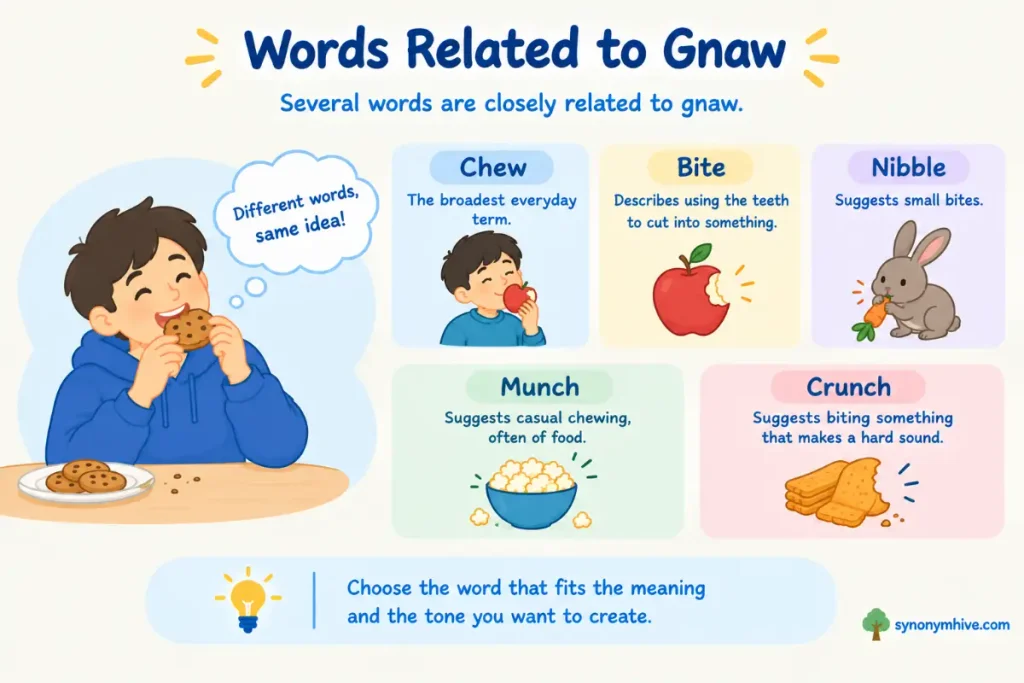
What Are Some Related Words?
Several words are closely related to gnaw.
Chew is the broadest everyday term.
Bite describes using the teeth to cut into something.
Nibble suggests small bites.
Munch suggests casual chewing, often of food.
Crunch suggests biting something that makes a hard sound.
Nip suggests a small or quick bite.
Devour means to eat eagerly or quickly.
Gnash means to grind or strike the teeth together, often from anger or frustration.
These words overlap, but each creates a different image.
Choosing the right one can make your writing more exact.
How Do You Know Which Word to Choose?
Ask yourself what kind of action you want to describe.
If someone is eating normally, use chew.
If someone takes one bite, use bite.
That simple test will cover most everyday cases.
Common Search Questions About the Spelling
People often search for this word because they have heard it but are unsure how to spell it.
The most common confusion involves the silent g.
A speaker says the word aloud, and the listener hears “naw.” From there, several possible spellings may come to mind.
The correct written form is gnaw.
Once you connect the spelling to the meaning, it becomes easier to remember.
Conclusion
The correct spelling is gnaw, not knaw, when you mean to bite or chew something repeatedly. The word is pronounced like “naw,” which explains why its spelling can be confusing.
Gnaw can describe a physical action, such as a dog chewing a bone or a mouse chewing through cardboard. It can also describe a mental or emotional problem that keeps bothering someone. A doubt can gnaw at you, and so can regret, guilt, or an unanswered question.
If you are deciding between gnaw or knaw, choose gnaw every time in standard English. Remember the silent g, just as you see in gnat and gnash. Once you connect that spelling with the idea of repeated biting, the word becomes much easier to remember and use correctly.
Frequently Asked Questions
Is gnaw or knaw the correct spelling?
Gnaw is the correct spelling for the verb meaning to bite or chew repeatedly. Knaw is not the standard spelling of this word.
How do you pronounce gnaw?
Gnaw is pronounced like “naw,” with the g silent. The pronunciation does not include a hard g sound.
What does gnaw mean?
Gnaw means to bite or chew something repeatedly with the teeth. It can also mean that a worry, doubt, regret, or other feeling keeps bothering someone.
Is knaw a real English word?
Knaw is not the standard spelling of the common verb gnaw. In normal English writing, use gnaw when you mean repeated biting or chewing.
What is the past tense of gnaw?
The past tense of gnaw is gnawed. For example, you can say, “The dog gnawed on the old bone.”
What is the difference between gnaw and chew?
Chew is a general word for using the teeth to break down food or another object. Gnaw suggests repeated biting or chewing, often on something hard or over a longer period.
Can you use gnaw for worry?
Yes. Gnaw can describe a worry or doubt that keeps bothering someone, as in, “The unanswered question began to gnaw at her.”
What’s an easy way to remember the spelling?
Remember that gnaw belongs with words such as gnat, gnash, and gnome, which have a silent g. Think of gnaw as the word for repeated biting or chewing.

2 thoughts on “Gnaw or Knaw Which Spelling Is Correct?”