
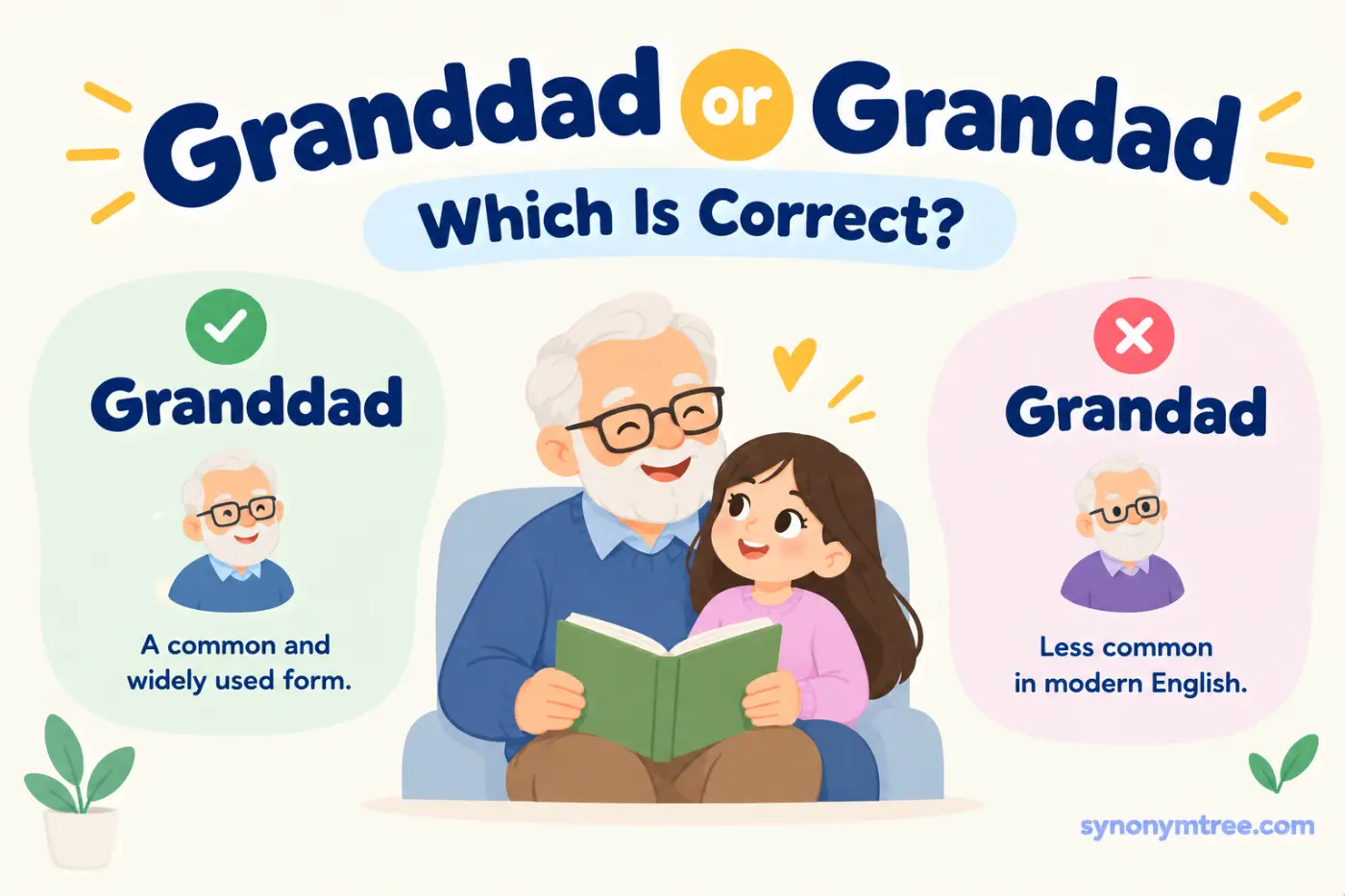
If you’re writing a family story, a birthday card, a school essay, or a message about your grandfather, you may stop at one small spelling question: granddad or grandad? Both forms are common, but they are not used equally in every variety of English.
The main difference comes down to regional usage. Granddad is the more common spelling in American English, while grandad is especially common in British English. Both words mean the same thing: a person’s grandfather.
The choice can also depend on family preference. Some families use granddad, while others use grandad, grandpa, or another family name. In informal writing, the spelling often reflects the word people actually say at home.
This guide explains the difference, the history behind both forms, how each one sounds, and which spelling works best in different types of writing. You’ll also see examples, related terms, common mistakes, and answers to questions people often ask.
Quick Definition
Granddad and grandad are informal words for grandfather. They have the same basic meaning and usually refer to your mother’s or father’s father.
Granddad is especially common in American English, while grandad is strongly associated with British English. Neither spelling is automatically wrong.
Direct Answer
Both granddad and grandad are correct spellings. Granddad is more common in American English, while grandad is widely used in British English.
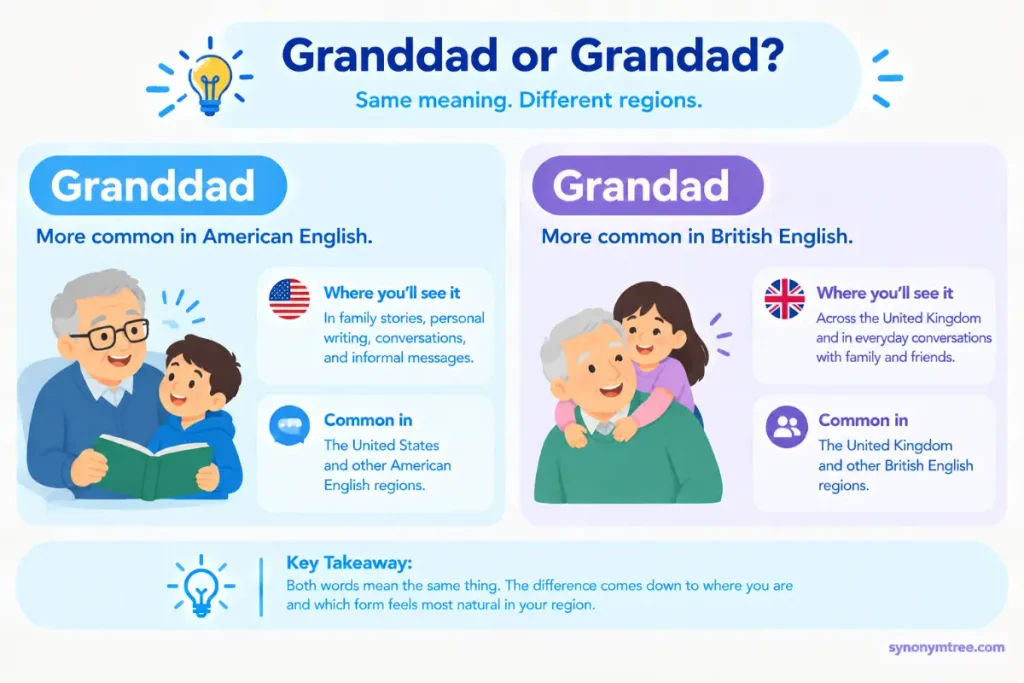
Granddad or Grandad in American and British English
The easiest way to understand the difference is to look at regional usage.
American English tends to favor granddad. You may see it in family stories, personal writing, conversations, and informal messages.
British English commonly uses grandad. The word is familiar across the United Kingdom and is often used by children and adults when talking about their grandfather.
There is no major difference in meaning. The two forms describe the same family relationship.
| Word | Meaning | Common Usage | Example |
|---|---|---|---|
| Granddad | Grandfather | Common in American English | My granddad taught me how to fish. |
| Grandad | Grandfather | Common in British English | My grandad lives near the coast. |
| Grandpa | Grandfather | Very common in American English and elsewhere | Grandpa told us a funny story. |
| Grandfather | Father of your parent | Formal or neutral | My grandfather was a teacher. |
| Gramps | Grandfather | Very informal | Gramps always makes us laugh. |
| Grandpappy | Grandfather | Informal and regional | Grandpappy loved telling old stories. |
The spelling you choose should match your audience and the style of the writing.
If you’re writing for a US audience, granddad will usually look natural. If your audience is mainly British, grandad may fit better.
Still, family names are personal. If someone’s family calls their grandfather Grandad, changing it to Granddad just to follow a regional pattern would not make sense.
Why Are There Two Spellings?
The two spellings developed from the same basic idea. Both combine grand with a familiar form related to dad.
Grand means something that is one generation above the parent in this family term. Dad is the familiar word for father. Put together, the form refers to a father’s father or a mother’s father.
English often creates family terms by combining words or changing familiar words into shorter forms. Granddad and grandad fit that pattern.
The difference in spelling is partly linked to how people pronounce the word. In many accents, the final sound can be heard as a clear d, but the spelling may vary from one region to another.
Informal family words are especially likely to develop several accepted forms. English has many examples of this kind of variation.
Consider these related terms:
- Grandfather.
- Granddad.
- Grandad.
- Grandpa.
- Gramps.
- Granny.
- Grandma.
- Gran.
- Grandmother.
Some forms are more formal. Others sound more personal or regional.
That does not mean one form has a better meaning. It simply means English speakers have developed different ways to name family members.
What Does Granddad Mean?
Granddad is an informal word for grandfather.
A grandfather is the father of one of your parents. If your mother’s father is named Robert, you can call him your grandfather or your granddad. The same applies to your father’s father.
Granddad often sounds warm and familiar. It is common in personal conversations and family writing.
For example:
“My granddad taught me how to ride a bike.”
The sentence tells us that the speaker learned to ride a bike from their grandfather.
You can also use granddad when talking about someone else’s grandfather.
“Her granddad owns a small farm.”
The word does not have to appear only in speech. It works in texts, emails, stories, cards, captions, and other informal writing.
What Does Grandad Mean?
Grandad also means grandfather.
It is especially common in British English and other varieties influenced by British usage.
For example:
“My grandad used to walk to school every morning.”
Here, grandad refers to the speaker’s grandfather.
The word has the same family meaning as granddad. The main difference is regional preference and personal choice.
A British writer might naturally write:
“My grandad gave me this watch.”
An American writer might be more likely to write:
“My granddad gave me this watch.”
Both sentences are clear. The difference is mainly spelling and regional style.
Granddad and Grandad Which One Should You Use?
If you’re unsure, think about your audience first.
For US English, granddad is a safe choice. For UK English, grandad is a natural choice.
If you are writing about a real person, family preference can matter more than regional preference. If your grandfather has always been called Grandad, keep that form.
Here is a simple guide.
| Situation | Recommended Form |
|---|---|
| US family conversation | Granddad |
| US informal writing | Granddad |
| UK family conversation | Grandad |
| UK informal writing | Grandad |
| Formal writing | Grandfather |
| Personal family name | Use the family’s preferred form |
| Academic writing | Grandfather |
| Professional writing | Grandfather |
There is no need to force one spelling into every situation.
Which Spelling Is More Common in the US?
Granddad is the more familiar choice for many American readers.
American English also uses grandpa very often. In some families, grandpa is much more common than either granddad or grandad.
You might hear:
“Ask Grandpa.”
You might also hear:
“Ask Granddad.”
Both sound natural in the right family.
Grandfather is more neutral and formal. It works well when you are describing a family relationship without using a nickname.
For example:
“My grandfather was born in 1942.”
That sentence sounds more formal than:
“My granddad was born in 1942.”
The choice depends on the tone you want.
Which Spelling Is More Common in the UK?
Grandad is a very familiar British English spelling.
You may see it in children’s books, newspapers, personal writing, conversations, and family messages. It is a normal informal term for a grandfather.
For example:
“Grandad is coming over for dinner.”
A British reader would have no trouble understanding the sentence.
Granddad also exists in British English. It is not an impossible or incorrect form. It is simply less strongly associated with British usage than grandad.
This is a useful point because regional vocabulary does not always follow strict borders. People move, families mix, and writers read material from different countries.
Is Granddad More Correct Than Grandad?
No. Neither spelling is universally more correct.
The two words have the same meaning. The main difference is regional preference.
If someone tells you that only one spelling is correct in every form of English, that is too simple. English has several accepted family terms, and usage varies by country and family.
For standard US English, granddad is generally the better choice. For standard UK English, grandad is generally the better choice.
Your own family tradition can also override the regional pattern.
How Do You Use Granddad in a Sentence?
Granddad usually acts as a noun.
Here are some natural examples:
- My granddad taught me how to swim.
- We visited my granddad last weekend.
- My granddad makes the best pancakes.
- I called my granddad after work.
- Her granddad gave her an old camera.
- My granddad tells great stories.
- We’re having lunch with Granddad today.
- Granddad helped me fix my bike.
- I found a photo of my granddad in an old box.
- My granddad loves watching baseball.
Notice that the word works in several sentence patterns.
It can be the subject:
“My granddad loves gardening.”
It can be the object:
“I called my granddad.”
It can appear after a possessive:
“That is my granddad’s jacket.”
The apostrophe in granddad’s shows possession.
How Do You Use Grandad in a Sentence?
Grandad follows the same basic grammar rules.
Here are examples:
- My grandad lives in Manchester.
- I visited my grandad during the summer.
- Grandad gave me an old book.
- My grandad loves gardening.
- We had dinner with Grandad last night.
- Her grandad taught her how to bake.
- I remember spending Sundays with my grandad.
- My grandad always carried a pocket watch.
- Grandad told us about his childhood.
- I bought a card for my grandad.
The only major change from the previous examples is the spelling.
When Should You Capitalize Granddad vs Grandad?
Capitalization depends on how you use the word.
If you use it as a personal name or direct form of address, capitalize it.
For example:
“Good morning, Granddad.”
“Grandad, can you help me?”
“I’ll call Granddad tonight.”
Here, Granddad functions much like a name.
If you use the word as a general description, lowercase it.
For example:
“My granddad lives nearby.”
“Her grandad is a retired engineer.”
This same rule applies to many family terms.
Compare:
“I asked Mom.”
“I asked my mom.”
“Thanks, Dad.”
“My dad is at work.”
The capital letter can show that the family term is being used like a name.
Granddad vs Grandfather
Granddad and grandfather have the same basic family meaning, but they do not have the same tone.
Grandfather is neutral and formal. Granddad is informal and personal.
| Word | Tone | Best Use |
|---|---|---|
| Grandfather | Formal or neutral | Essays, reports, formal writing |
| Granddad | Informal and warm | Conversation, family writing |
| Grandad | Informal and warm | Conversation, especially UK English |
| Grandpa | Informal and familiar | Family conversation |
| Gramps | Very informal | Casual family speech |
Consider these examples.
“My grandfather served in the navy.”
This sounds neutral and suitable for an essay.
“My granddad served in the navy.”
This sounds more personal.
“My grandpa served in the navy.”
This sounds familiar and conversational.
None of these sentences changes the family relationship.
Granddad vs Grandpa
Granddad and grandpa both refer to a grandfather, but grandpa is often more common in American family speech.
The choice can depend on what a child hears at home.
One family may say:
“Go ask Grandpa.”
Another may say:
“Go ask Granddad.”
Both are natural.
Grandpa can sound especially familiar and affectionate. Granddad has a similar friendly quality, but it may have a slightly different regional feel.
There is no grammar rule that requires one over the other.
Grandad vs Grandpa
In British English, grandad is a common choice, while grandpa is also widely understood and used.
A British family might say:
“Grandad is coming tomorrow.”
Another family might say:
“Grandpa is coming tomorrow.”
The difference often comes from family habit.
Children may start using a particular family name at a young age, and that name can remain in use for decades.
Granddad vs Gramps
Gramps is more informal than granddad.
It can sound playful or affectionate.
For example:
“Gramps took us fishing.”
The word is common in casual American English. It is less suitable for formal writing.
If you are writing a school essay, grandfather is usually safer.
If you are writing a personal story about your family, Gramps can sound natural if that is how the person is actually known.
Is Grandad British or American?
Grandad is strongly associated with British English, although Americans can understand and use it too.
British English has several family terms that may differ from the forms preferred by American speakers.
For example, British speakers may commonly use:
- Grandad.
- Mum.
- Gran.
- Holiday.
- Flat.
American speakers may more often use:
- Grandpa or granddad.
- Mom.
- Grandma.
- Vacation.
- Apartment.
These differences do not make one form better. They show how English changes across regions.
Is Granddad British or American?
Granddad is widely understood in both British and American English, but it has a strong place in American English.
It can still appear in British writing and speech. A British family may use granddad because that is their preferred family term.
Regional patterns are useful guides, not absolute rules.
Is Grandad One Word?
Yes. Grandad is written as one word.
Granddad is also written as one word.
Neither form should normally be written as “grand dad” in standard English.
The same applies to other common family terms such as grandfather and grandmother.
For example:
“My grandad lives nearby.”
“My granddad lives nearby.”
Not:
“My grand dad lives nearby.”
The two standard forms are closed compounds, meaning the parts are joined into one word.
Why Do People Write Grand Dad?
People sometimes write grand dad because they can hear the two parts separately.
The word contains grand and dad, so the mistake is easy to understand. However, standard English normally writes the term as one word.
This is similar to other compound family terms.
We write:
- Grandfather.
- Grandmother.
- Grandchild.
- Granddaughter.
- Grandson.
We do not normally split these words into separate parts.
The same pattern applies to granddad and grandad.
Is Grandad Informal?
Yes. Grandad is an informal term for grandfather.
It is commonly used in everyday speech and personal writing.
For formal documents, grandfather is usually the better choice.
For example, a family history can say:
“My grandfather was born in Leeds.”
A personal story might say:
“My grandad was born in Leeds.”
Both are clear, but the second one sounds more conversational.
Is Granddad Informal?
Yes. Granddad is also informal.
It is suitable for conversations, texts, family letters, cards, personal stories, and many other casual settings.
For example:
“I’m taking my granddad to the doctor.”
The word sounds natural because the sentence describes an everyday family situation.
In a formal report, you might instead write:
“The participant’s grandfather attended the meeting.”
The more formal term keeps the tone neutral.
Which Word Works Best in an Essay?
For a formal school or college essay, grandfather is usually the safest choice.
If the essay is personal, granddad and grandad may be appropriate.
Suppose you are writing a personal narrative about growing up with a family member. You might write:
“My granddad taught me how to repair old bicycles.”
That sounds personal and natural.
If you are writing a formal report about family relationships, use:
“My grandfather played an important role in my childhood.”
The best word depends on the purpose of the writing.
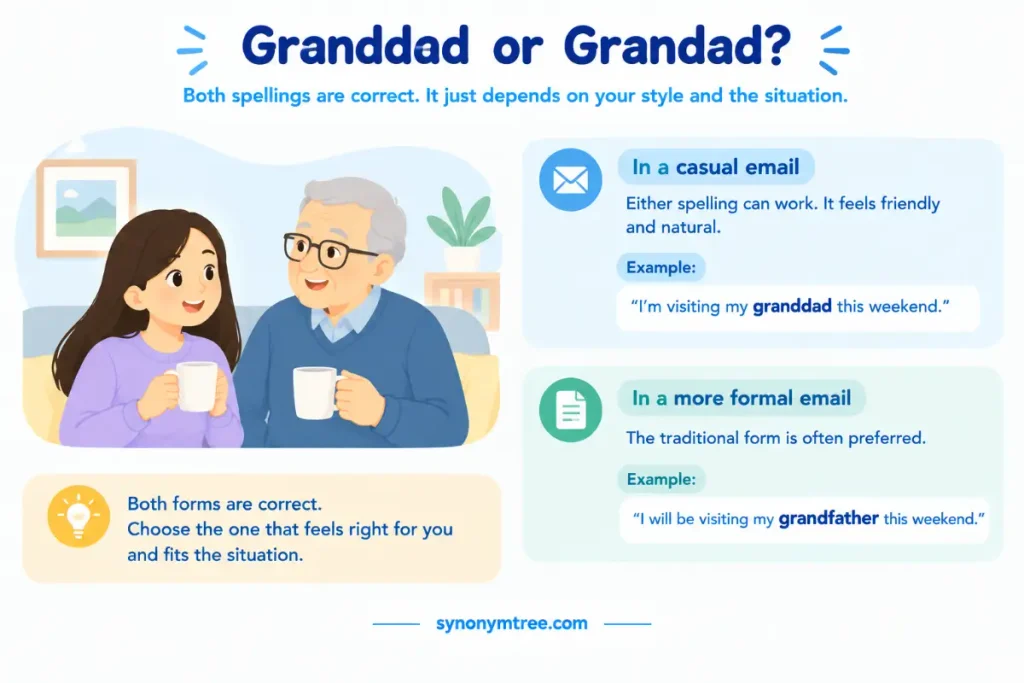
Which Word Works Best in an Email?
For a casual email, either granddad or grandad can work.
For example:
“I’m visiting my granddad this weekend.”
This fits a personal email.
A more formal sentence could be:
“I will be visiting my grandfather this weekend.”
The difference is tone rather than meaning.
Which Word Works Best in a Text Message?
Use the form you normally use with your family.
Text messages are informal, so granddad, grandad, grandpa, and gramps can all work.
For example:
“I’m going to Granddad’s after work.”
Or:
“I’m going to Grandad’s after work.”
If your family uses a particular spelling, keep it consistent.
Which Word Works Best in a Birthday Card?
Family preference matters most in a birthday card.
You might write:
“Happy Birthday, Granddad!”
Or:
“Happy Birthday, Grandad!”
You could also write:
“Happy Birthday, Grandpa!”
The best version is the one that matches what the person is actually called.
A birthday card is personal, so natural family language usually sounds better than formal wording.
Which Word Works Best in a Resume?
A resume rarely needs either term.
If you mention a grandfather in a personal statement or job related story, grandfather may sound more professional.
For example:
“Growing up, my grandfather taught me the value of careful craftsmanship.”
That sentence fits a professional personal statement better than a very casual family term.
Still, the right choice depends on the sentence and the story.
How Do You Know Which Form to Choose?
Use three simple checks.
First, identify your audience. US readers will usually recognize granddad immediately. UK readers will also recognize grandad immediately.
Second, consider the tone. Grandfather sounds more formal. Granddad and grandad sound more personal.
Third, think about the person involved. If your family uses Grandad, use Grandad. A personal family name does not need to be changed just to match a general regional trend.
Common Mistakes With Granddad and Grandad
Several mistakes appear often when people write these words.
Writing Grand Dad
The standard forms are granddad and grandad.
Do not normally split the word into grand dad.
Treating One Form as Always Wrong
Both forms are accepted.
The difference is mostly regional and personal.
Using a Lowercase Family Name
If you use the word like a name, capitalize it.
“Good morning, Granddad.”
If you use it as a general noun, lowercase it.
“My granddad lives nearby.”
Using Grandfather in a Very Casual Message
Grandfather is correct, but it can sound formal in a relaxed family text.
For example:
“Grandfather is coming over later.”
There is nothing grammatically wrong with this. It simply sounds more formal than:
“Granddad is coming over later.”
Changing a Person’s Family Name
If someone is known as Grandad, do not change the spelling to granddad just because you prefer that form.
Family names are personal.
When Should You Use Grandfather Instead?
Grandfather is the best choice when you need a neutral or formal word.
Use it in situations such as:
- Academic essays.
- Research writing.
- Legal documents.
- Official records.
- Formal biographies.
- Medical or professional documents.
- News reports.
- Formal family histories.
For example:
“My grandfather was born in 1935.”
This sentence is clear and neutral.
If the writing is personal, you have more freedom.
“My grandad was the person who taught me to love books.”
The informal term gives the sentence a warmer voice.
Can Granddad Refer to Either Grandfather?
Yes. Granddad can refer to either your mother’s father or your father’s father.
The same is true for grandad, grandpa, and grandfather.
For example:
“My mother’s granddad lives in Texas.”
This means the grandfather on the speaker’s mother’s side.
“My father’s granddad loved gardening.”
This refers to the grandfather on the father’s side.
In everyday speech, you may need another word to make the family connection clear.
How Do You Make Granddad Possessive?
The possessive form is granddad’s.
For example:
“I borrowed my granddad’s car.”
The apostrophe and s show that the car belongs to Granddad.
The same pattern works with grandad.
“I borrowed my grandad’s car.”
If you are talking about something that belongs to a grandfather, use the possessive form.
Examples include:
- My granddad’s house.
- My grandad’s watch.
- Granddad’s garden.
- Grandad’s recipe.
- My granddad’s old truck.
How Do You Make Granddad Plural?
A plural form is rarely needed because people normally talk about individual family members.
If you do need the plural, you can write granddads.
For example:
“Several granddads attended the school event.”
The same pattern applies to grandads.
“Several grandads were waiting outside.”
However, in most family writing, you will probably use the singular form.
What Are the Best Memory Tips?
A simple way to remember the difference is to connect the spelling with the audience.
For American English, think:
Granddad with dad.
For British English, think:
Grandad with one d at the end.
This is only a memory aid. It is not a strict grammar rule.
Another useful trick is to remember that both forms have the same meaning. If you see granddad and grandad in a sentence, you should read them as the same family relationship.
You can also remember the formal alternative:
Grandfather = neutral and formal.
Granddad vs grandad = informal and personal.
Grandpa = informal and familiar.
Gramps = very informal and playful.
Granddad or Grandad in Formal Writing
In formal writing, neither informal form is usually the first choice.
Grandfather is more suitable because it clearly names the relationship without sounding like a nickname.
For example:
“My grandfather was a respected community leader.”
That works in a biography or report.
Compare it with:
“My granddad was a respected community leader.”
The second sentence is still correct. It simply has a more personal tone.
Formal writing often favors neutral family terms. Personal writing can use the family term that sounds most natural.
Granddad and Grandad in Personal Writing
Personal writing gives you much more freedom.
A memoir, diary entry, family story, social media post, or personal essay can use granddad vs grandad naturally.
For example:
“My granddad kept an old radio in the garage.”
This sounds like someone remembering a real person.
You could also write:
“My grandad always made tea before anyone else woke up.”
The informal term helps the reader hear the writer’s personal voice.
Ten More Natural Examples
Here are more examples showing how the word can work in real situations.
- My granddad gave me his old baseball glove.
- I used to spend every Saturday with my grandad.
- Granddad called me after he heard the news.
- Grandad’s garden was full of roses.
- My granddad taught me how to change a tire.
- We’re taking Grandad out for lunch tomorrow.
- Her granddad kept hundreds of old photographs.
- My grandad always had a story ready.
- I wrote about my grandfather in my school essay.
- Granddad smiled when he saw the birthday cake.
- My granddad lives a few hours away.
- She learned to bake from her grandad.
- I found my granddad’s old toolbox in the shed.
- Grandad used to tell us stories about his childhood.
- My grandfather gave me advice that I still remember.
These examples show that the choice can change with tone.
The relationship stays the same.
Granddad vs Grandad What Is the Difference?
The main difference is regional spelling.
| Feature | Granddad | Grandad |
|---|---|---|
| Meaning | Grandfather | Grandfather |
| Tone | Informal | Informal |
| US usage | Common | Less common |
| UK usage | Used | Very common |
| Formality | Informal | Informal |
| Family use | Common | Common |
| Formal alternative | Grandfather | Grandfather |
The two forms should not be treated as different family relationships.
If you replace one with the other, the meaning normally stays exactly the same.
Granddad vs Grandpa What Is the Difference?
Granddad and grandpa both mean grandfather, but they have different regional and family patterns.
Grandpa is especially common in American English. Granddad is also common, but some families strongly prefer one term.
For example:
“My granddad lives in Chicago.”
“My grandpa lives in Chicago.”
Both are natural.
The choice often depends on what the family has always said.
Grandad vs Gran What Is the Difference?
Grandad refers to a grandfather.
Gran usually refers to a grandmother, especially in British English.
So these words describe different family members.
For example:
“My grandad lives in Bristol.”
“My gran lives in Bristol.”
Grandad is male. Gran usually refers to a female grandparent.
American English often uses grandma instead of gran.
What Should You Use for a Family Tree?
For a family tree, grandfather is usually the clearest label.
A family tree is designed to show relationships, so formal terms can make the information easier to understand.
You might label someone:
Grandfather
rather than:
Granddad
However, if a family tree includes personal names or family nicknames, you can include the preferred term too.
For example:
“John Smith, known as Grandad.”
This gives both the formal identity and the family name.
What Should You Use in a School Assignment?
Use grandfather for a formal assignment unless the teacher asks for personal or informal writing.
For example:
“My grandfather inspired me to become interested in history.”
That sentence fits a school essay.
If the assignment is a personal narrative, granddad or grandad may sound more natural.
For instance:
“When I was young, my granddad took me to the library every Saturday.”
The key is matching the word to the writing style.
How Does Pronunciation Affect the Spelling?
Pronunciation can help explain why both spellings exist.
In many accents, grandad and granddad sound very similar. The difference can be hard to hear in normal conversation.
When a word sounds the same or nearly the same, speakers may choose different spellings based on regional habits.
That is one reason spelling questions like this can be confusing.
The spoken form does not always tell you exactly which letters to write.
This is also common with other English words. Different regions can use different spellings or vocabulary while still communicating the same meaning.
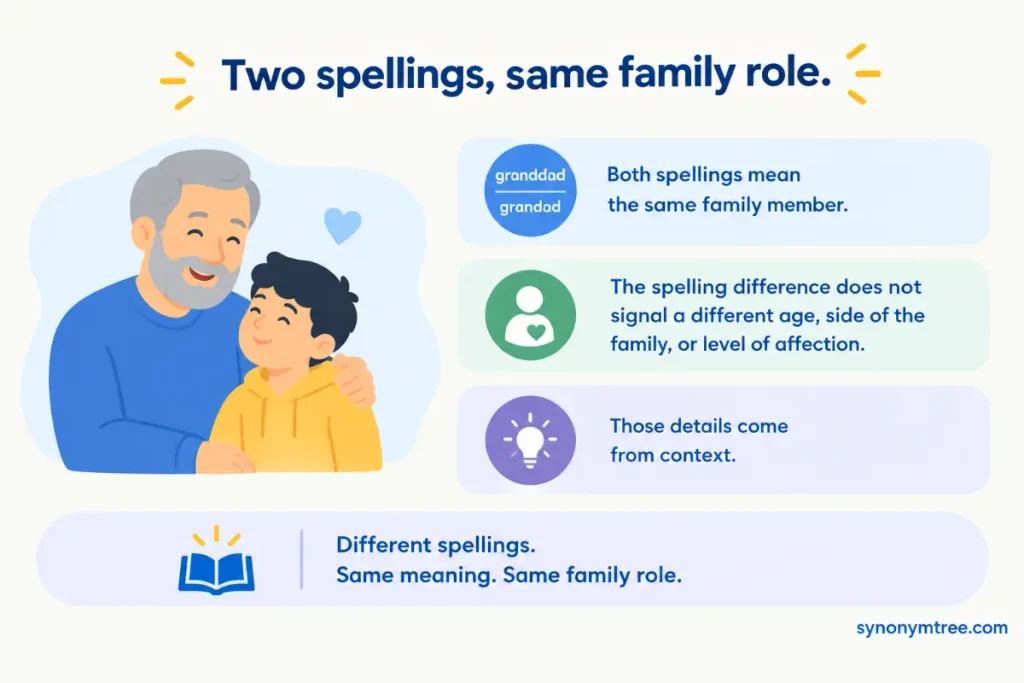
Does the Extra D Change the Meaning?
No. The extra d in granddad does not create a different family relationship.
Granddad and grandad both mean grandfather.
The spelling difference does not signal a different age, side of the family, or level of affection.
Those details come from context.
For example:
“My granddad lives nearby.”
“My grandad lives nearby.”
The meaning is the same.
What Is the Most Formal Word for Granddad?
Grandfather is the most formal and neutral choice.
It is useful when the reader needs a clear description of the family relationship.
For example:
“My grandfather attended the ceremony.”
This is more formal than:
“My granddad attended the ceremony.”
You can use grandfather in almost any setting, but it may sound more distant in a casual family conversation.
What Are the Main Related Words?
Several English words can describe grandparents and family relationships.
Grandfather
The standard formal term for your parent’s father.
Grandmother
The standard formal term for your parent’s mother.
Grandpa
An informal term for grandfather.
Grandma
An informal term for grandmother.
Granddad
An informal term for grandfather, especially common in American English.
Grandad
An informal term for grandfather, especially common in British English.
Gramps
A very informal term for grandfather.
Gran
An informal term for grandmother, especially common in British English.
These words overlap in meaning, but their tone and regional use can differ.
Conclusion
Granddad or grandad are both correct ways to refer to a grandfather. The biggest difference is regional usage, with granddad more common in American English and grandad strongly associated with British English.
The choice can also come down to family preference. If your family calls someone Grandad, there is no reason to change the spelling just because another version is more common in a different country.
For formal writing, grandfather is usually the safest option. For personal writing, use the form that matches your audience and the way your family speaks.
The simplest rule is easy to remember. Use granddad for a common US style, grandad for a common UK style, and grandfather when you want a neutral formal term. If you keep those three choices in mind, you can pick the natural form quickly and write with confidence.
Common Questions
Is granddad or grandad correct?
Both spellings are correct. Granddad is especially common in American English, while grandad is especially common in British English.
Is grandad only used in the UK?
No. Grandad can be understood and used outside the UK, but it has a strong British English association.
Is granddad an American word?
Granddad is widely used in American English, although grandpa is also very common. British speakers can use granddad too.
What’s another word for granddad?
Grandfather is the formal alternative, while grandpa and gramps are common informal alternatives.
Should I capitalize granddad?
Capitalize Granddad when you use it like a name or direct form of address. Use lowercase granddad when you are simply describing a family relationship.
Is grand dad two words?
No. The standard forms are granddad and grandad, both written as one word.
Which spelling should I use in a formal essay?
Use grandfather in a formal essay unless the context calls for a personal family term. It is neutral and works across US and UK English.

2 thoughts on “Granddad or Grandad: Which Is Correct?”