
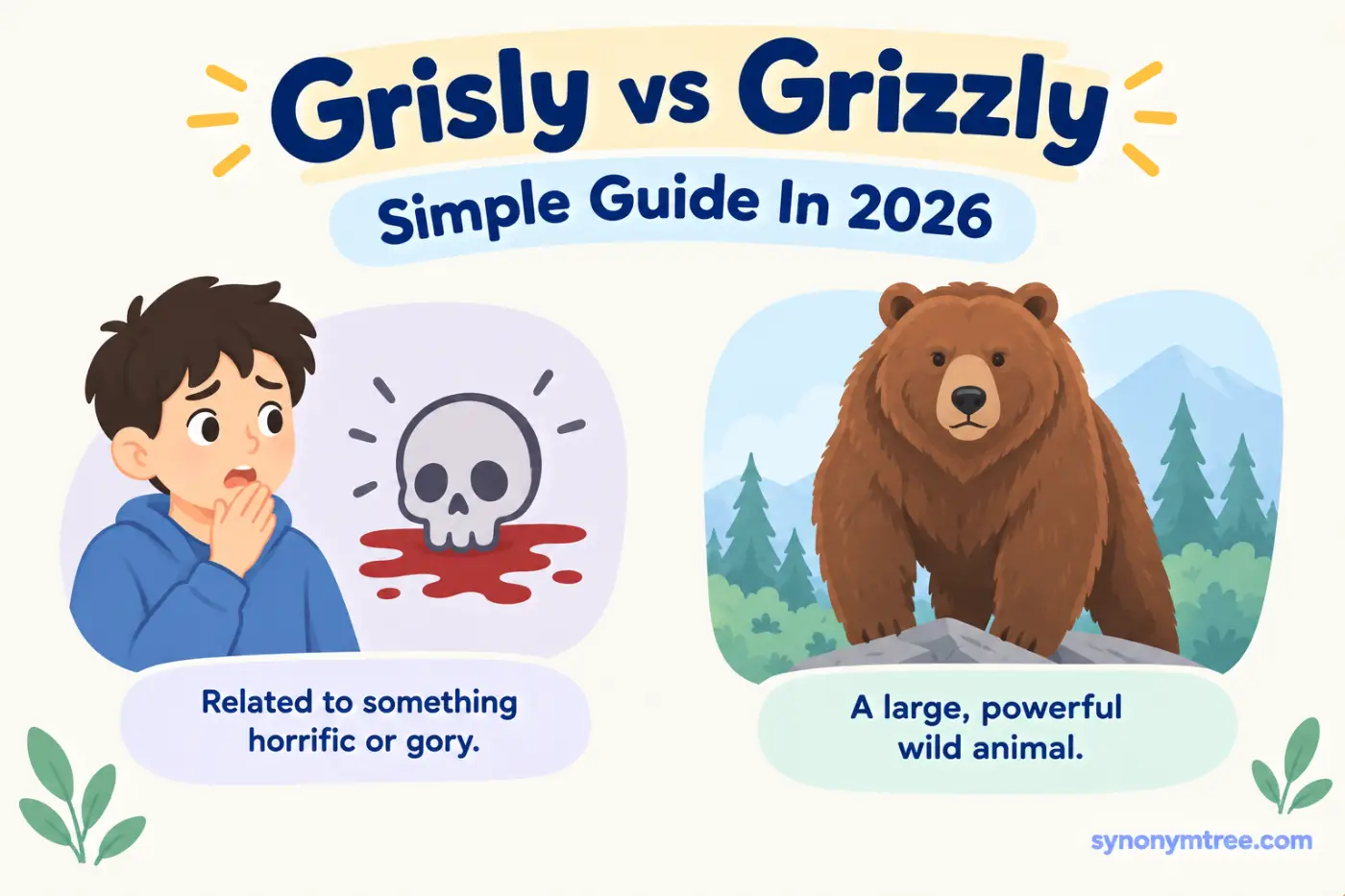
If you are unsure about grisly vs grizzly, you are not alone. These two words look and sound similar, but they have very different meanings. One describes something horrifying or bloody. The other usually refers to a large North American bear.
The confusion is easy to understand. Both words begin with the same four letters, and their pronunciation can sound close in some accents. Yet using the wrong one can change the meaning of a sentence completely. A grisly scene has nothing to do with a bear, while a grizzly bear has nothing to do with something being gruesome.
The good news is that the difference is simple once you connect each word with its main meaning. This guide explains what each word means, where the words came from, how to use them in real sentences, and how to remember the spelling. You will also see common mistakes and examples that make the difference easier to spot.
Quick Definition
Grisly is an adjective that means horrifying, gruesome, or involving blood, death, or serious injury. Grizzly is mainly a noun or adjective connected with the grizzly bear, a large brown bear found in parts of North America.
Direct Answer
Use grisly when you mean horrifying, gruesome, or bloody. Use grizzly when you mean the bear or something related to a grizzly bear.
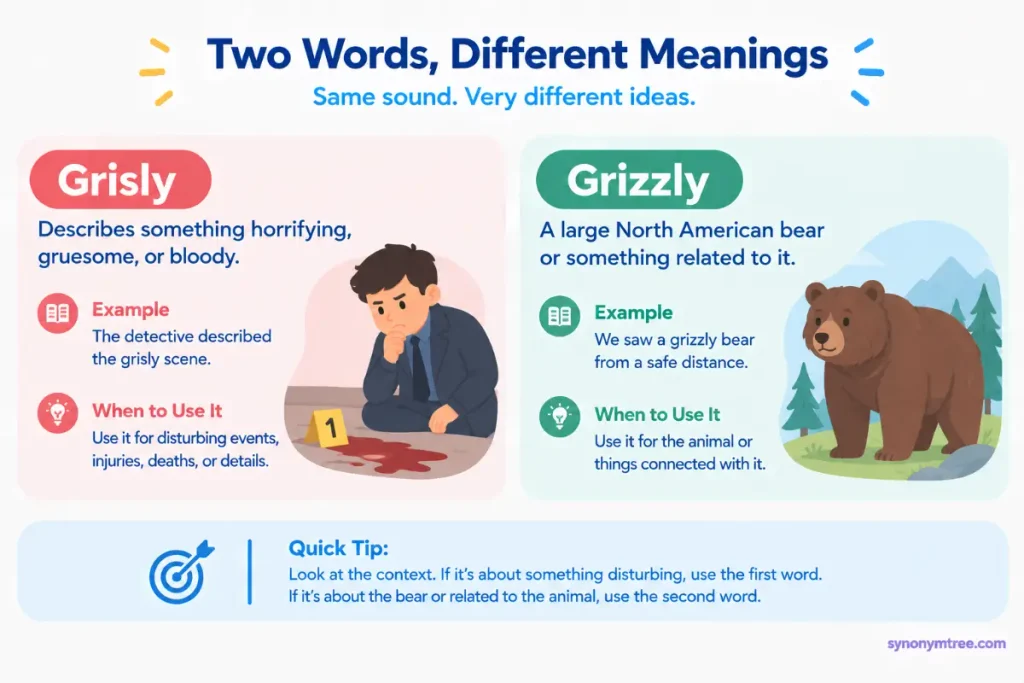
Grisly vs Grizzly at a Glance
| Word | Meaning | Example Sentence | When to Use It |
|---|---|---|---|
| Grisly | Horrifying, gruesome, or bloody | The detective described the grisly scene. | Use it for disturbing events, injuries, deaths, or details. |
| Grizzly | A large North American bear or something related to it | We saw a grizzly bear from a safe distance. | Use it for the animal or things connected with it. |
The easiest way to remember the difference is to focus on meaning instead of spelling.
If you are describing something frightening or bloody, choose grisly. If you are talking about a bear, choose grizzly.
What Does Grisly Mean?
Grisly describes something that causes horror or disgust because it involves death, blood, severe injury, or disturbing details. It is often used when talking about crime scenes, accidents, battles, murders, or other violent events.
For example:
The police discovered a grisly scene inside the building.
Here, grisly tells the reader that the scene was horrifying. It does not simply mean bad or unpleasant. The word often suggests something graphic or disturbing.
You can also use it in a less literal way. A person might describe a story as grisly if it contains a lot of violence or frightening details.
The novel contains a grisly account of the war.
The adjective can therefore describe both real events and fictional material.
What Does Grisly Mean in Simple English?
In simple English, grisly means very disturbing, bloody, or horrifying.
Think of words such as:
- Gruesome.
- Horrifying.
- Bloody.
- Disturbing.
- Terrible.
- Shocking.
- Macabre.
The exact meaning depends on the sentence, but the idea of horror is central.
When Do People Use Grisly?
You may see grisly in news reports, crime writing, fiction, history, and discussions of violent events.
For example:
The reporter described the grisly discovery.
The book tells the grisly story of a famous battle.
Investigators found evidence of a grisly crime.
The film includes several grisly scenes.
In each example, the word points to something disturbing.
What Does Grizzly Mean?
Grizzly is most commonly used when talking about the grizzly bear. A grizzly is a large type of brown bear found in North America.
The word can work as a noun.
We saw a grizzly near the river.
It can also work as part of a noun phrase.
The hikers spotted a grizzly bear.
As an adjective, grizzly can describe something connected with this animal.
The park is home to a large grizzly population.
The word is especially common in discussions about wildlife, national parks, forests, conservation, and outdoor safety.
What Is a Grizzly Bear?
A grizzly bear is a North American population or form of the brown bear. Grizzlies are known for their large size, powerful bodies, long claws, and a distinctive shoulder hump.
They live in parts of western North America. Their habitat includes forests, mountains, meadows, and other wild areas.
The word grizzly does not mean gruesome. A grizzly bear can certainly be dangerous, but the word itself names the animal.
That distinction matters.
Consider this sentence:
We watched a grizzly from a safe distance.
The sentence is about an animal.
Now compare it with:
We watched a grisly scene unfold.
That sentence is about something horrifying.
The spelling changes by only one letter, but the meaning changes completely.
Why Are These Two Words Confused?
The main reason is their similar spelling and pronunciation. Grisly and grizzly both contain the letters gris or griz near the beginning, and both have two syllables in common pronunciation.
English has many word pairs that look alike but have different meanings. This pair is especially easy to mix up because both words can appear in serious or dramatic writing.
A writer may know that grizzly is connected with a bear but still accidentally use it when trying to describe something gruesome. The mistake often happens when writing quickly or relying on sound instead of meaning.
For example, someone might write:
The detective found a grizzly scene.
That is usually not what the writer means.
If the writer means that the scene was horrifying or bloody, the correct word is grisly:
The detective found a grisly scene.
The reverse mistake can happen too:
The hikers saw a grisly bear.
If the hikers saw the animal, the correct word is:
The hikers saw a grizzly bear.
Learning the meaning of each word is much more useful than trying to memorize the spelling alone.
Where Did Grisly Come From?
The history of grisly helps explain why it has such a dark meaning.
Grisly is related to an old English word connected with fear and horror. Over time, the word developed into its modern meaning of something that causes terror, especially something involving blood, death, or disturbing details.
The word is now strongly linked with gruesome scenes and violent events.
You can see this connection in phrases such as:
A grisly tale.
A grisly scene.
These phrases all carry a sense of horror.
The word does not normally describe an ordinary problem. You would not usually say that a difficult math test was grisly. The word is much stronger and is generally connected with frightening or disturbing subjects.
Where Did Grizzly Come From?
Grizzly has a different history. The word is connected with the appearance of the animal.
The name is often linked to the bear’s grizzled or gray tipped fur. Grizzled describes hair or fur that contains gray or white strands. Early descriptions of the animal helped give rise to the name grizzly.
This makes the spelling easier to connect with the animal.
A grizzly bear has fur that can appear lighter or grayish at the tips. That visual feature is part of the history behind the name.
The word later became strongly associated with the North American bear.
So the two words have separate histories and separate meanings.
Grisly developed around fear and horror.
Grizzly became associated with a type of bear and its appearance.
How Is Grisly Used in Real Sentences?
The best way to understand grisly is to see it in different settings.
Crime
The detectives arrived at a grisly crime scene.
The article described the grisly details of the murder.
The case became known for its grisly evidence.
In crime writing, grisly often signals that the details involve blood, death, or serious violence.
Accidents
The newspaper reported a grisly accident on the highway.
The rescue team faced a grisly scene after the crash.
Here, grisly does not mean that the accident was simply serious. It suggests disturbing physical details.
History
The museum displayed records from a grisly period of the war.
The historian described the grisly conditions faced by the soldiers.
Historical writing often uses the word when discussing battles, executions, massacres, or other violent events.
Fiction
The horror novel contains several grisly scenes.
The author is known for writing grisly stories.
In fiction, grisly can describe violent or graphic content.
News
The reporter avoided describing the most grisly details.
That sentence means the reporter chose not to give the most disturbing information.
How Is Grizzly Used in Real Sentences?
Grizzly is most often used when talking about bears or places where bears live.
Wildlife
We saw a grizzly walking across the valley.
The guide taught us how to behave around a grizzly bear.
Grizzly bears can cover large areas while searching for food.
National Parks
The park protects important grizzly habitat.
Visitors were warned not to approach a grizzly.
The ranger explained what to do if a grizzly came near the campsite.
Nature Writing
A grizzly stood beside the stream.
The photographer captured a picture of a grizzly in the wild.
The word fits naturally into outdoor and wildlife writing.
Conservation
Scientists are studying grizzly populations.
Conservation groups work to protect grizzly habitat.
Here, grizzly functions as a clear reference to the animal.
Grisly vs Grizzly in Common Phrases
Some common word combinations can help you recognize the correct spelling.
Common Phrases With Grisly
Grisly details.
Grisly evidence.
These expressions usually involve death, violence, blood, injury, or something deeply disturbing.
Common Phrases With Grizzly
Grizzly bear.
Grizzly population.
These expressions usually relate to the animal, its habitat, behavior, or conservation.
One phrase deserves special attention: grizzly attack.
The word grizzly refers to the bear. The word attack tells you what happened.
It does not mean that the attack itself was gruesome. If you want to describe the attack as horrifying, you could say:
The attack left a grisly scene.
That sentence uses both words correctly because each one has a different job.
Grisly vs Grizzly in Everyday Writing
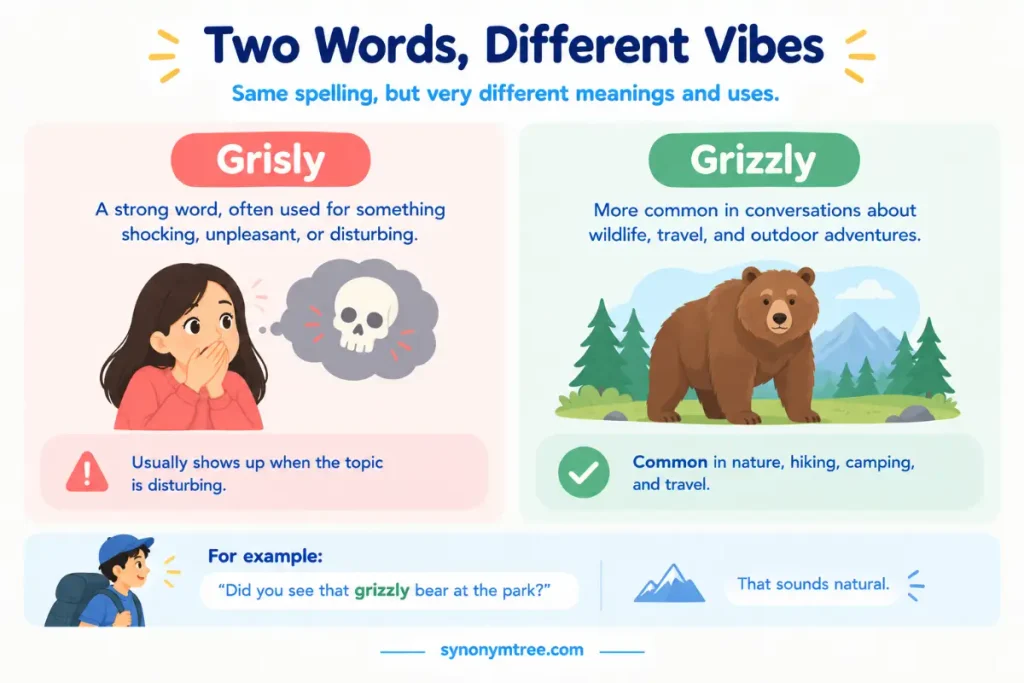
Most people will rarely need grisly in everyday conversation. It is a strong word and usually appears when the subject itself is disturbing.
Grizzly is more common in conversations about wildlife, travel, hiking, camping, and nature.
For example:
Did you see that grizzly bear at the park?
That sounds natural.
Now consider:
Did you see that grisly bear at the park?
The second sentence sounds as if the bear itself is gruesome or horrifying. It could make sense in a special context, but it does not mean simply grizzly bear.
The difference becomes clear when you ask what you are trying to describe.
Are you describing the animal?
Use grizzly.
Are you describing something horrifying?
Use grisly.
How Do You Remember the Difference?
A simple memory trick can make this pair much easier.
Grisly Has An S For Scary
Think:
Grisly = scary.
The letter S can remind you of scary, scene, or slaughter.
You do not need this trick to understand the word, but it can help when you are typing quickly.
Try this:
A grisly scene is scary.
The S in grisly can remind you that the word is about something disturbing.
Grizzly Has A Z For The Zoo
Think:
Grizzly = zoo or wildlife.
The letter Z can remind you of animals.
A grizzly is an animal.
This is not the origin of the word. It is simply a spelling trick.
Another easy memory line is:
Grisly is gruesome.
Grizzly is a bear.
The first letters of gruesome and grisly can help you connect the words.
When Should You Use Grisly?
Use grisly when you want to describe something horrifying, gruesome, bloody, or disturbing.
It often works with nouns related to:
Crime.
Death.
Murder.
Accidents.
War.
Injuries.
Bodies.
Violence.
Horror stories.
Graphic scenes.
For example:
The novel opens with a grisly murder.
The report included grisly details.
The investigators faced a grisly discovery.
The documentary showed the grisly effects of the battle.
These uses are direct and natural.
When Should You Use Grizzly?
Use grizzly when you are referring to the grizzly bear or something connected with it.
For example:
The ranger spotted a grizzly.
We learned about grizzly behavior.
The area is known for its grizzly population.
The hikers carried safety equipment because they were in grizzly country.
The last example uses grizzly as a modifier for an area known for grizzly bears.
The key idea stays the same. The word points back to the animal.
Can Grisly Describe a Person?
Yes, but the use is usually tied to a disturbing appearance, event, or role.
For example:
The story described the grisly killer’s actions.
Here, grisly modifies the nature of the person’s actions or the crime. It does not simply mean that the person looked unpleasant.
You should be careful with this word because it is strong. Calling something grisly suggests horror or gruesome detail.
If you only mean unpleasant, rough, or frightening, another adjective may be more accurate.
Can Grizzly Describe Something Other Than a Bear?
Yes. Grizzly can appear in phrases that refer to things connected with grizzly bears.
For example:
The region has strict grizzly protection rules.
The group studied grizzly habitat.
The park has a long history of grizzly sightings.
You may also encounter grizzly as part of a name or title. In those cases, the meaning depends on the proper name.
The central meaning still connects to the bear.
Is Grizzly Always a Noun?
No. Grizzly can be used as a noun and as an adjective.
As a noun:
A grizzly crossed the road.
Here, grizzly means a grizzly bear.
As an adjective:
The park has a large grizzly population.
Here, grizzly describes the type of population.
You can also say:
The researchers studied grizzly behavior.
Again, the word modifies behavior connected with grizzly bears.
Is Grisly Always an Adjective?
In modern standard English, grisly is mainly used as an adjective.
It describes something that is horrifying or gruesome.
Examples include:
A grisly scene.
A grisly discovery.
It does not name an object in the way that grizzly can name a bear.
This difference is another useful clue.
If you need a word that names an animal, grizzly may be the answer.
If you need an adjective that describes something horrifying, grisly is usually the better choice.
What Is the Difference Between Grisly and Gruesome?
Grisly and gruesome are close in meaning, but they are not interchangeable in every sentence.
Both can describe something disturbing, violent, or graphic.
For example:
The police found a grisly scene.
The police found a gruesome scene.
Both sentences work.
Grisly often has a strong connection with blood, death, or physical horror. Gruesome is broader and can describe anything deeply unpleasant or horrifying.
You might say:
The movie contains gruesome images.
You could also say:
The movie contains grisly images.
Both work, but the second often suggests more graphic violence or death.
What Is the Difference Between Grizzly and Brown Bear?
A grizzly is a type or population of brown bear found in North America.
The term brown bear is broader. Brown bears are found across parts of North America, Europe, and Asia. The word grizzly is commonly used for certain North American brown bears.
So these terms are related, but they are not exact synonyms in every context.
A sentence such as this is natural:
The grizzly is a well known North American bear.
You would not replace grizzly with grisly. That would turn the animal reference into an adjective about horror.
What Is the Difference Between Grisly and Grizzly in Meaning?
The central distinction is very simple.
Grisly describes horror.
Grizzly identifies a bear.
This is the main rule to remember.
A grisly story is a horrifying story.
A grizzly story would usually mean a story connected with a grizzly bear, though context could make other meanings possible.
A grizzly bear is an animal.
A grisly bear would describe a bear in a disturbing or gruesome way.
Compare these sentences:
The documentary showed a grisly accident.
The documentary showed a grizzly bear.
The first sentence describes a disturbing event.
The second sentence identifies an animal.
Common Mistakes With These Words
The most common mistake is using grizzly when the writer means grisly.
For example:
Wrong for the intended meaning: The article described the grizzly details of the murder.
Better: The article described the grisly details of the murder.
The second common mistake is using grisly when the writer means the animal.
For example:
Wrong for the intended meaning: We saw a grisly in the forest.
Better: We saw a grizzly in the forest.
Another common problem is assuming that grizzly means frightening because grizzly bears can be dangerous.
That connection is understandable, but the word itself does not mean dangerous or scary. It identifies the bear.
Likewise, grisly does not mean bear.
When Not to Use Grisly
Do not use grisly just because something is unpleasant.
For example, these sentences sound too strong:
The grisly weather ruined our picnic.
The grisly homework took two hours.
These examples do not involve horror, blood, death, or disturbing details.
Better choices might be:
The terrible weather ruined our picnic.
The awful traffic made me late.
The difficult homework took two hours.
Choosing a word that matches the level of meaning makes your writing more precise.
When Not to Use Grizzly
Do not use grizzly simply because something is rough, wild, or dangerous.
For example:
The grizzly storm damaged the town.
This does not normally make sense if you only mean that the storm was powerful.
You could say:
The violent storm damaged the town.
The severe storm damaged the town.
The dangerous storm damaged the town.
Grizzly should normally connect to the bear or something specifically related to the animal.
How the Words Work in Formal Writing
Both words can appear in formal writing, but their uses are different.
Grisly can appear in journalism, history, criminal justice writing, literature, and academic discussions of violence.
For example:
The report documented the grisly effects of the conflict.
Grizzly appears in wildlife research, environmental writing, conservation reports, and geography.
For example:
Researchers tracked grizzly populations across the region.
The best word depends on the subject, not on how formal the sentence is.
How the Words Work in Creative Writing
Creative writers often use grisly to create a strong reaction.
For example:
He opened the door and froze at the grisly sight before him.
The word gives the reader a clear signal that something disturbing is about to be described.
Grizzly can also be useful in creative writing when a bear is part of the scene.
For example:
A grizzly stepped quietly from the trees.
The two words can create very different images.
One suggests horror.
The other suggests a powerful wild animal.
Examples You Can Copy and Adapt
Here are more examples showing the difference in natural contexts.
- The detective described the grisly evidence found at the scene.
- The hikers saw a grizzly near the edge of the forest.
- The documentary explored the grisly history of the battlefield.
- A ranger warned visitors about a nearby grizzly.
- The newspaper avoided printing the most grisly details.
- The photographer captured a grizzly fishing in the river.
- The novel contains a grisly description of the crime.
- Scientists are monitoring the local grizzly population.
- The accident left behind a grisly scene.
- The campers learned how to respond to a grizzly encounter.
- The historian described the grisly conditions during the battle.
- The park has signs warning visitors about grizzly activity.
- The author is known for writing grisly horror stories.
- The researchers studied how grizzly bears find food.
- The reporter gave a brief account of the grisly discovery.
Notice how the context tells you which spelling belongs.
Crime, death, blood, and horror point toward grisly.
Bears, wildlife, parks, and animal behavior point toward grizzly.
A Simple Test for Choosing the Right Word
When you are unsure, stop and ask one question.
What am I describing?
If you are describing something horrifying, use grisly.
If you are describing a grizzly bear or something connected to one, use grizzly.
You can make the test even shorter.
Think:
Horror = grisly.
Bear = grizzly.
That two word rule handles most everyday cases.
A Quick Comparison Table for Tricky Sentences
| If you mean | Use | Example |
|---|---|---|
| A horrifying crime | Grisly | The police investigated a grisly crime. |
| A disturbing discovery | Grisly | They made a grisly discovery. |
| A bloody scene | Grisly | The room contained a grisly scene. |
| A grizzly bear | Grizzly | We saw a grizzly bear. |
| Bear habitat | Grizzly | The park protects grizzly habitat. |
| Bear behavior | Grizzly | Scientists studied grizzly behavior. |
| A bear sighting | Grizzly | The park reported a grizzly sighting. |
| A horrifying story | Grisly | The book tells a grisly story. |
This table gives you a fast way to check your spelling before you publish or submit your writing.
Does Pronunciation Help?
Pronunciation can help a little, but it is not the best way to remember the difference.
In many forms of American English, the words sound very similar. That means relying on sound can lead to mistakes.
Instead, connect each spelling with its meaning.
Grisly belongs with horror.
Grizzly belongs with the bear.
When writing, meaning is a safer guide than pronunciation.
Why Context Matters So Much
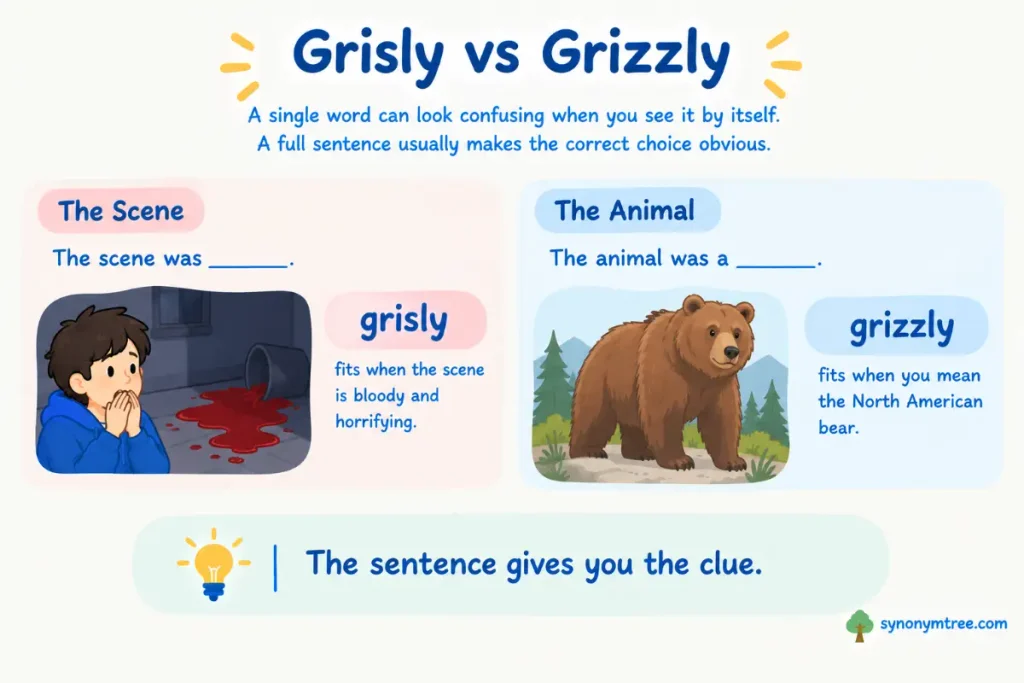
A single word can look confusing when you see it by itself. A full sentence usually makes the correct choice obvious.
Consider:
The scene was ___.
If the scene was bloody and horrifying, grisly fits.
Now consider:
The animal was a ___.
If you mean the North American bear, grizzly fits.
The sentence gives you the clue.
This is a useful general writing habit. When two words look alike, ask what idea you need the word to express. Meaning should come before spelling.
Quick Tips to Remember Grisly and Grizzly
Keep these points in mind.
- Grisly means horrifying or gruesome.
- Grizzly refers to a bear or something connected with that bear.
- A grisly murder is a horrifying murder.
- A grizzly bear is an animal.
- Grisly is mainly an adjective.
- Grizzly can be a noun or an adjective.
- The S in grisly can remind you of scary.
- The Z in grizzly can remind you of a zoo or animal.
- Do not choose the spelling based only on pronunciation.
- Ask yourself what you are actually describing.
Conclusion
The difference between grisly and grizzly becomes easy once you connect each word with its meaning. Grisly describes something horrifying, gruesome, bloody, or deeply disturbing. Grizzly refers mainly to the North American bear or something connected with that animal.
The key point is simple. If you are writing about a murder, accident, battlefield, injury, or disturbing scene, grisly is usually the right choice. If you are writing about bears, wildlife, forests, parks, or animal behavior, grizzly is the word you need.
When you face the choice grisly vs grizzly, do not rely on how the words sound. Ask what you mean first. Horror points to grisly. The bear points to grizzly. That quick check will help you choose the right spelling every time.
FAQs
Is grisly or grizzly correct?
Both are correct words, but they have different meanings. Grisly means horrifying or gruesome, while grizzly usually refers to a North American bear or something related to that bear.
Is a grisly bear the same as a grizzly bear?
No. A grizzly bear is the name of the animal. A grisly bear would mean a bear that is gruesome or disturbing in some way.
What does grisly mean in a sentence?
Grisly means horrifying, gruesome, or disturbing, often because something involves death, blood, injury, or violence. For example, The reporter described the grisly scene.
What does grizzly mean besides a bear?
Grizzly can describe things connected with grizzly bears, such as grizzly habitat, grizzly behavior, or grizzly conservation. As a noun, it can also simply mean a grizzly bear.
Why are grisly and grizzly so easy to confuse?
They have very similar spellings and can sound alike in speech. Their meanings are different, so learning the meaning behind each spelling is the easiest way to avoid the mistake.
What’s an easy way to remember grisly and grizzly?
Think of grisly as gruesome and grizzly as a bear. You can also remember the S in grisly as a reminder of scary.
Can I use grisly and grizzly interchangeably?
No. They are not interchangeable when you want to express their usual meanings. Use grisly for horror or gruesome details and grizzly for the bear or something related to it.

1 thought on “Grisly vs Grizzly: Simple Guide In 2026”