
If you are unsure about half-day and half day, the correct form depends on how you use the phrase in a sentence. Both forms can be correct, but they serve different grammatical roles.
Use half-day when the phrase works as a compound adjective before a noun, such as “a half-day workshop.” Use half day when the phrase functions as a noun, such as “I took a half day off.”
Quick Definition
Half-day is a hyphenated compound adjective that describes something lasting half a day. Half day is usually a noun phrase referring to a period of about half a day.
Direct Answer
Both half-day and half day are correct. Use half-day before a noun as an adjective, and use half day when you are talking about the period itself.
Comparison Table
| Form | Meaning | Example Sentence | When to Use It |
|---|---|---|---|
| half-day | Lasting half a day | We attended a half-day seminar. | Before a noun |
| half day | A period of half a day | I took a half day off. | As a noun phrase |
| half a day | One half of a full day | The repair took half a day. | When using a full phrase with “a” |
The easiest way to remember the difference is to look at the word that follows the phrase. If it is directly describing a noun, the hyphen usually helps show that the words work together as one adjective.
For example, in “a half-day course,” the phrase describes the course. In “I attended for half a day,” the phrase tells you how long something lasted.
Why Is Half-Day Hyphenated?
The hyphen in half-day connects two words that work together as one adjective. This makes the sentence easier to read.
Consider this sentence:
We signed up for a half-day class.
Here, “half-day” describes “class.” The two words act as one unit.
Without the hyphen, a reader can still understand the sentence:
We signed up for a half day class.
However, the hyphenated version is clearer in standard edited English because it shows that “half-day” belongs together as a modifier.
This follows a common English pattern. Compound adjectives often take a hyphen when they appear directly before a noun.
For example:
- a full-time job
- a five-day trip
- a two-hour meeting
- a part-time position
- a half-day workshop
The hyphen helps prevent confusion and makes the relationship between the words clear.
When Should You Use Half-Day?
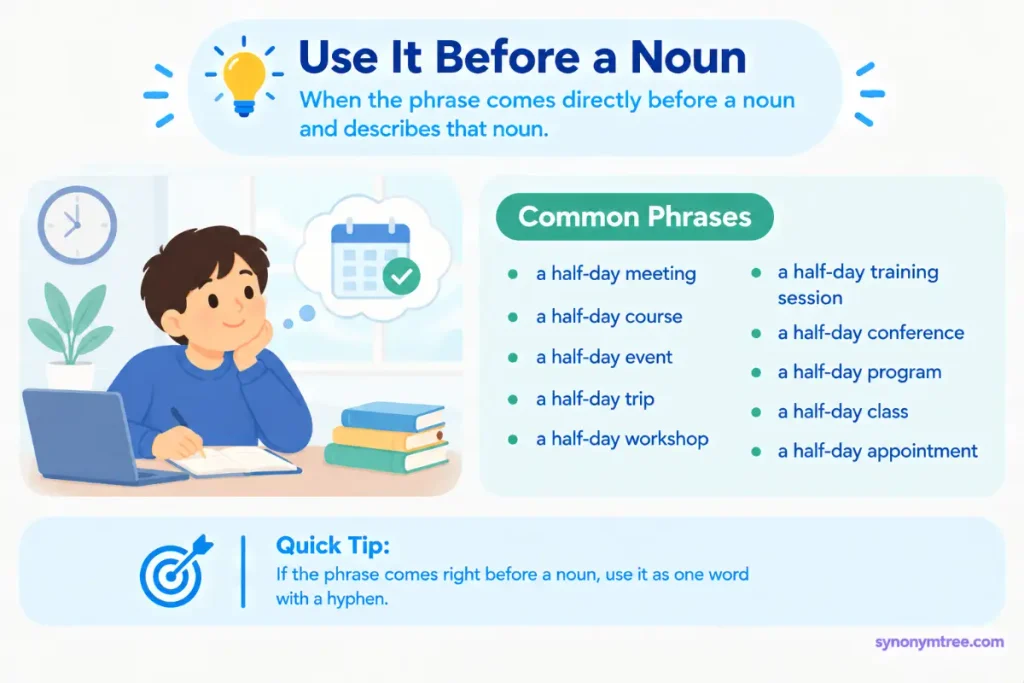
Use half-day when the phrase comes directly before a noun and describes that noun.
Here are some common examples:
- a half-day meeting
- a half-day course
- a half-day event
- a half-day trip
- a half-day workshop
- a half-day training session
- a half-day conference
- a half-day program
- a half-day class
- a half-day appointment
In each example, the phrase tells the reader what kind of meeting, course, event, trip, workshop, or program it is.
Half-Day as an Adjective
The key point is grammatical. Half-day works as a compound adjective.
An adjective gives information about a noun. In “half-day workshop,” the phrase tells us the length of the workshop.
Compare these sentences:
We joined a half-day workshop.
We joined a workshop that lasted half a day.
The meaning is almost the same. The first sentence uses half-day as a compact adjective. The second explains the duration in a longer phrase.
This is why the hyphen is useful. It signals that “half” and “day” belong together as a description of “workshop.”
When Should You Use Half Day?
Use half day when you are using the phrase as a noun rather than directly modifying another noun.
For example:
I took a half day off work.
Here, “half day” refers to the amount of time you took off. It is not directly describing another noun.
You might also write:
She worked a half day on Friday.
We only need a half day to finish the project.
He spent a half day at the office.
The students had a half day of classes.
In these examples, half day refers to a period of time.
There is one detail worth knowing. Different style guides and organizations can vary in how they handle phrases like “half day.” You may sometimes see “half-day” used more broadly, especially in workplace writing. The safest general rule is still to use the hyphen when the phrase directly modifies a noun.
Half-Day vs Half Day in Real Sentences
The difference becomes much easier when you see the forms in context.
Example 1
We attended a half-day training session.
Here, “half-day” describes the training session.
Example 2
We attended the training session for half a day.
Here, “half a day” expresses duration.
Example 3
I requested a half day off work.
Here, “half day” refers to the amount of time away from work.
Example 4
The company offered a half-day orientation.
Here, “half-day” describes the orientation.
Example 5
The orientation lasted half a day.
Here, “half a day” tells us the length of the orientation.
The meaning is closely related in all five examples. The grammar is what changes.
What Does Half-Day Mean?
Half-day means something lasts for approximately half of a normal day.
A full day has 24 hours, so half of a full calendar day is 12 hours. However, in ordinary speech, half-day usually does not mean exactly 12 hours.
For work, school, classes, events, and appointments, the phrase often refers to roughly half of the normal period.
For example, a half-day school program might last three or four hours. A half-day work shift might last four hours. A half-day conference could run from 9 a.m. to noon or from 1 p.m. to 5 p.m.
The exact length depends on the setting.
That is why you should not assume that every “half-day” event lasts exactly 12 hours.
What Does Half Day Mean?
Half day usually refers to a period that covers part of a normal day, often about half of the expected working or school day.
For example:
I took a half day off.
This usually means the person worked for part of the day and was away for the rest.
In a workplace, a half day might mean four hours in an eight-hour workday. In a school, it could mean a shortened schedule.
The exact meaning comes from context.
Half Day at Work
The phrase is especially common when talking about work schedules.
You might say:
I need to take a half day tomorrow.
She took a half day for her appointment.
Can I use a half day of vacation?
He worked a half day before leaving.
These sentences treat the phrase as a noun.
If you are describing a meeting or event instead, the hyphenated adjective is often better:
We have a half-day meeting tomorrow.
The meeting itself is being described as lasting half a day.
Half-Day in Workplace Writing
Workplace writing is one of the places where this distinction matters most.
Imagine an email to your manager:
I would like to take a half day off on Friday.
Here, “half day” refers to time away from work.
Now compare it with:
I will attend a half-day training session on Friday.
In this sentence, “half-day” describes the training session.
Both forms appear in professional writing, but they do different jobs.
Common Workplace Examples
Here are some natural examples:
I have a half-day training session tomorrow.
I need to take a half day off on Friday.
The team will attend a half-day workshop.
I am requesting a half day of leave.
The company scheduled a half-day orientation.
She worked a half day before going home.
Notice how the form changes based on the role of the phrase.
Half-Day in School Writing
The same rule applies to school and education.
Use half-day when the phrase describes a class, program, session, or event.
The school held a half-day workshop.
We attended a half-day science program.
The students completed a half-day training course.
Use half day when you refer to the period itself.
The students had a half day of classes.
We spent half a day at the museum.
You can also use half a day when talking about duration.
The field trip lasted half a day.
That form is often the most natural choice when you are simply describing how long something took.
Half-Day and Half Day in a Sentence
A useful test is to ask what the phrase is doing.
If it directly describes a noun, use half-day.
If you are expressing duration, half a day is often the natural choice.
Here is the test in a simple table:
| Sentence | Correct Form | Reason |
|---|---|---|
| We attended a half-day workshop. | half-day | Describes “workshop” |
| I took a half day off. | half day | Refers to time taken off |
| The trip lasted half a day. | half a day | Expresses duration |
| She joined a half-day course. | half-day | Describes “course” |
| He worked a half day. | half day | Refers to a work period |
| The event lasted half a day. | half a day | Expresses duration |
Is Half-Day Always Hyphenated?
No. The hyphen depends on the grammatical role of the phrase.
When two words combine to modify a noun before that noun, a hyphen is often appropriate.
For example:
a half-day seminar
The phrase “half-day” works as one modifier.
But when the words are used as a normal noun phrase, the hyphen is usually not needed:
I took a half day off.
There are also cases where half a day is more natural:
The job took half a day.
This is not a question of one spelling being correct and the other being wrong. The sentence structure determines the best form.
Why Do People Confuse Half-Day and Half Day?
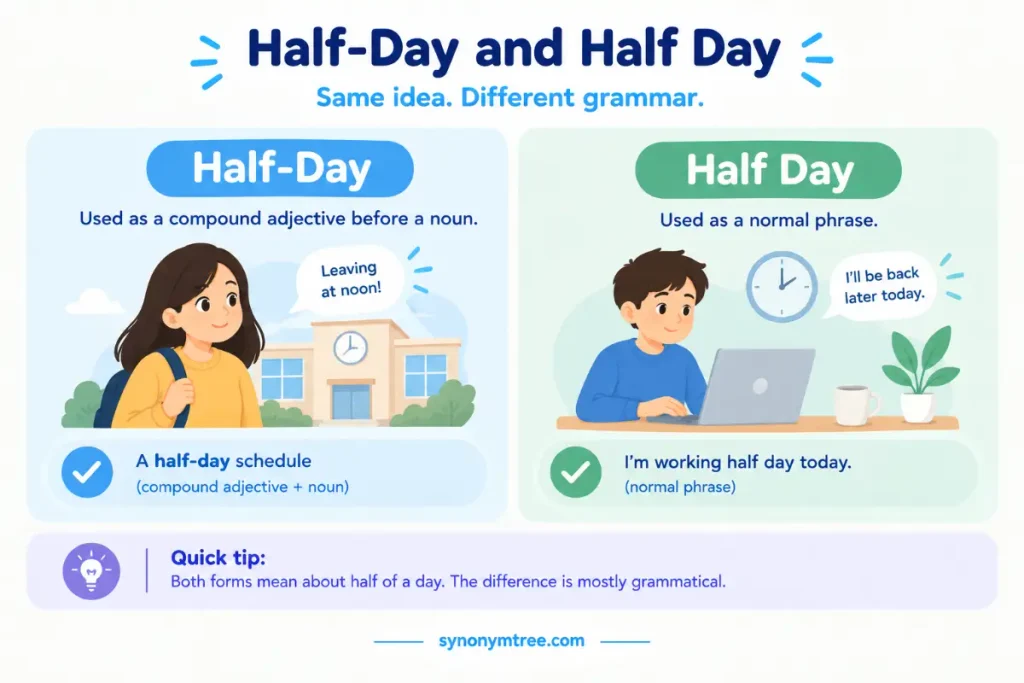
The confusion comes from the fact that the two forms have almost the same meaning.
Both refer to about half of a day. The difference is mostly grammatical.
English has many similar pairs.
Consider:
- a full-time employee
- I work full time
Or:
- a five-day course
- The course lasts five days
The first example uses a compound adjective. The second uses a normal phrase.
The same pattern appears with half-day and half day.
Once you recognize the grammar, the spelling becomes easier.
Half-Day vs Half a Day
These forms are closely related but not interchangeable in every sentence.
Half-Day
Use half-day before a noun when describing its length.
We booked a half-day tour.
The phrase describes the tour.
Half a Day
Use half a day when you are talking about duration.
We spent half a day on the tour.
The phrase tells us how long the activity lasted.
Compare these:
We booked a half-day tour.
The tour lasted half a day.
The first one names the type of tour. The second tells us its duration.
Half Day vs Half a Day
These two forms can also have slightly different uses.
Half day often appears when talking about a work or school period.
I took a half day off.
Half a day is very common when talking about how long something takes.
It took half a day to paint the room.
That does not mean “half day” can never describe duration. English usage is flexible, and workplace phrases can vary. The key is to pay attention to the sentence structure and the intended meaning.
Common Phrases With Half-Day
You will often see the hyphenated form in event and service descriptions.
Common examples include:
- half-day workshop
- half-day course
- half-day seminar
- half-day tour
- half-day trip
- half-day conference
- half-day training
- half-day class
- half-day program
- half-day session
- half-day event
- half-day appointment
These phrases are especially common in schedules, advertisements, calendars, travel listings, and business documents.
For example:
The hotel offers a half-day city tour.
We registered for a half-day writing course.
The company arranged a half-day leadership seminar.
The museum offers a half-day educational program.
In each case, the phrase comes before a noun and describes it.
Common Phrases With Half Day
The unhyphenated form often appears in workplace and time-off expressions.
Examples include:
- take a half day
- work a half day
- a half day off
- a half day of work
- a half day of school
- use a half day of leave
- request a half day
- spend a half day
For example:
I need to request a half day off.
She worked a half day on Monday.
We only had a half day of school.
He used a half day of vacation.
These expressions treat the phrase as a noun.
Common Mistakes
One common mistake is using half-day in every situation.
For example:
I took a half-day off work.
Many editors would prefer:
I took a half day off work.
The reason is that “half day” refers to the amount of time taken off.
Another common mistake is removing the hyphen when the phrase directly modifies a noun:
We attended a half day workshop.
A clearer standard form is:
We attended a half-day workshop.
The hyphen shows that “half-day” works as one adjective.
Mistake 1
We have a half day meeting.
Better:
We have a half-day meeting.
Mistake 2
I need a half-day off.
Better:
I need a half day off.
Mistake 3
The project took a half-day.
Better:
The project took half a day.
The third sentence sounds more natural because the phrase expresses duration.
When Not to Use Half-Day
Do not add a hyphen simply because the words appear next to each other.
The hyphen should have a grammatical reason.
If you are saying that something took half of a day, use:
It took half a day.
If you are talking about taking part of a workday off, use:
I took a half day off.
The best choice comes from the structure, not from the meaning alone.
Is Half-Day Used in American English?
Yes. Half-day is common in American English when it works as a compound adjective.
You might see it in:
- school schedules
- business programs
- training materials
- event descriptions
- travel packages
- appointment information
- workplace documents
American English also commonly uses half day in phrases involving work or leave.
For example:
I took a half day off.
You may also see half-day used in some workplace systems and internal documents even when another style guide might prefer “half day.” Company style can affect these details.
Is Half-Day Used in British English?
Yes. British English also uses half-day as a compound modifier.
The basic grammatical distinction remains useful in both major varieties of English.
However, British English may use some related terms differently from American English. For example, “half-day” can appear in school and work contexts where local customs affect the exact meaning.
The spelling of half-day itself does not create a major US versus UK difference.
Half-Day in Formal Writing
For formal writing, consistency matters more than trying to force one form into every sentence.
Use the compound adjective when it clearly modifies a noun:
The department scheduled a half-day review session.
Use the noun phrase when referring to time:
Employees may request a half day of leave.
These choices make your writing clear and natural.
Half-Day in Emails
In an email, choose the form based on what you want to say.
Asking for Time Off
Hi Mark,
I would like to request a half day off next Friday for a personal appointment.
Here, “half day” is a noun phrase.
Describing a Meeting
The team will attend a half-day planning session next Friday.
Here, “half-day” describes “planning session.”
Describing Duration
The training should take half a day.
Here, “half a day” expresses the length of the training.
These are all professional and natural.
Half-Day on a Resume
The phrase can also appear on resumes, especially when describing training, courses, or professional events.
For example:
Completed a half-day workplace safety training session.
Participated in a half-day leadership workshop.
The hyphen is useful because the phrase directly describes the training session or workshop.
However, you usually do not need to use the phrase at all if a simpler wording works better.
For example:
Completed four hours of workplace safety training.
That sentence gives the reader a more exact amount of time.
Half-Day in Event Titles
Event titles often use the hyphenated form:
Half-Day Leadership Workshop
Half-Day Photography Course
Half-Day Business Seminar
Half-Day Writing Workshop
This is because the phrase describes the event or program.
If you are writing a title for a website, flyer, schedule, or calendar, half-day is a clear choice when the phrase modifies the event name.
Half-Day in Travel Writing
Travel websites often use the term to describe tours.
Examples include:
half-day city tour
half-day hiking trip
half-day museum visit
half-day boat tour
A sentence might say:
We booked a half-day tour of the city.
Here, the phrase tells the reader what kind of tour they are booking.
You could also write:
The tour lasted half a day.
The meaning is similar, but the grammatical structure is different.
Half-Day and Other Hyphenated Time Expressions
The rule becomes easier when you compare half-day with other time expressions.
Consider:
- a two-day trip
- a three-hour meeting
- a five-week course
- a full-time job
- a part-time position
- a half-day workshop
These phrases use hyphens because they act as compound adjectives before nouns.
But look at the same ideas after the noun:
The trip lasted two days.
The meeting lasted three hours.
The course lasted five weeks.
She works full time.
He works part time.
The workshop lasted half a day.
The hyphens are not needed in these structures.
A Simple Grammar Test
There is a quick test you can use whenever you are unsure.
Look at the words immediately after the phrase.
If a noun follows and the phrase describes that noun, use the hyphenated compound:
a half-day course
If the phrase refers to the time itself, use the noun form:
I took a half day off.
This three-part test solves most cases.
Test One
Ask: “Is it describing a noun?”
If yes:
a half-day class
Test Two
Ask: “Am I talking about a period of time?”
If yes:
I took a half day.
Test Three
Ask: “Am I saying how long something took?”
If yes:
It took half a day.
Memory Trick
Think of the hyphen as a connector.
When half and day join together to describe another noun, connect them:
half-day workshop
When they are simply talking about time, keep them separate:
half day off
A simple pattern is:
Before a noun: half-day.
As a time period: half day.
For duration: half a day.
This is not a perfect rule for every style guide, but it works well for most everyday writing.
More Example Sentences
Here are more examples to make the difference clear.
- We attended a half-day marketing seminar.
- The marketing seminar lasted half a day.
- I took a half day off work.
- The company arranged a half-day training course.
- She spent half a day preparing the presentation.
- We have a half-day school schedule on Friday.
- He only worked a half day.
- The tour is a half-day experience.
- The repair should take half a day.
- She requested a half day of leave.
- The manager scheduled a half-day team meeting.
- The students completed a half-day science project.
- We spent half a day at the museum.
- The clinic offers half-day appointments.
- I will be away for a half day.
Notice how the hyphen appears when the phrase acts as an adjective before a noun.
Quick Comparison
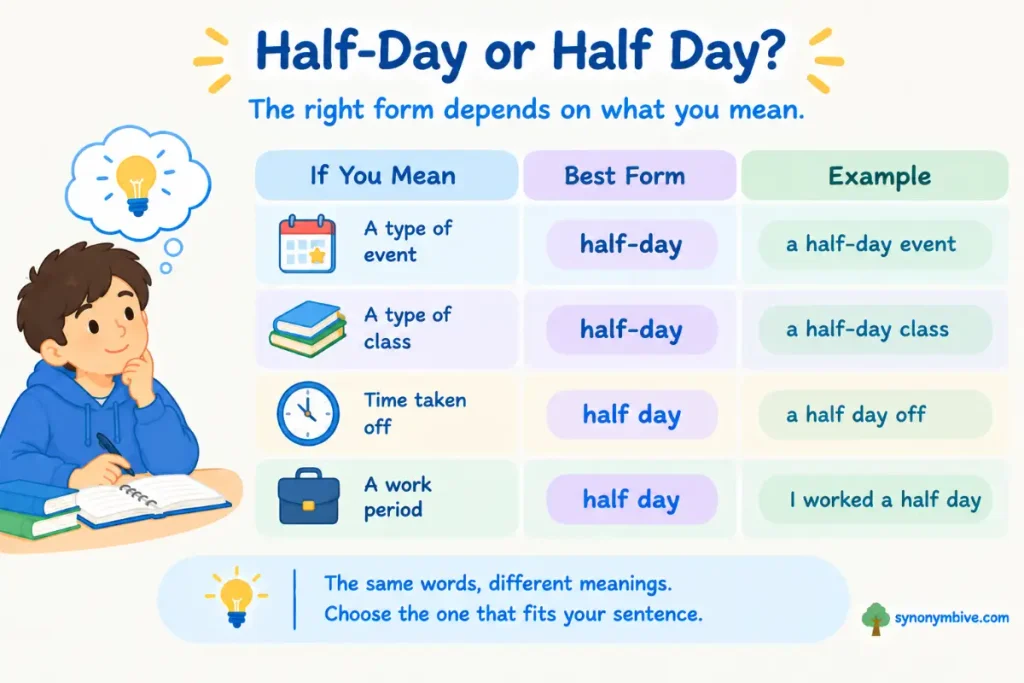
| If You Mean | Best Form | Example |
|---|---|---|
| A type of event | half-day | a half-day event |
| A type of class | half-day | a half-day class |
| Time taken off | half day | a half day off |
| A work period | half day | I worked a half day |
| Duration | half a day | It took half a day |
| A tour length | half-day | a half-day tour |
| How long a tour lasted | half a day | The tour lasted half a day |
Conclusion
The difference between half-day and half day is mainly about grammar. The hyphenated form works best when the phrase acts as an adjective before a noun, as in “a half-day workshop.” The unhyphenated form usually works as a noun phrase, as in “I took a half day off.”
When you are describing duration, half a day is often the clearest choice. For example, “The project took half a day” tells the reader exactly what you mean without forcing a compound adjective into the sentence.
The easiest rule to remember is simple. Use half-day to describe something, half day to name a period of time, and half a day to explain duration. That small distinction will help your writing sound polished and natural.
FAQs
Is half-day and half day correct?
Both can be correct, depending on the sentence. Use half-day when it directly modifies a noun, such as “a half-day course.” Use half day when it refers to a period of time, such as “I took a half day off.”
Is it half-day workshop or half day workshop?
The standard choice is half-day workshop. The hyphen connects the two words because they work together to describe the workshop.
Is it half day off or half-day off?
Use half day off in the common phrase “I took a half day off.” Here, “half day” refers to the amount of time you took away from work.
Should I write half a day or half-day?
Use half a day when you are describing duration. For example, “The project took half a day” is natural and clear.
Is half-day hyphenated in American English?
Yes. American English commonly hyphenates the phrase when it acts as a compound adjective before a noun. For example, “a half-day seminar” is standard and easy to read.
Can half-day describe a school schedule?
Yes. You can write “a half-day school schedule” when the phrase describes the schedule. You can also say “The students have a half day of school” when referring to the shortened period itself.
What is the easiest way to remember the difference?
Think about the job the phrase does. Use half-day before a noun, half day when referring to the time period, and half a day when explaining how long something takes.

2 thoughts on “Half-Day And Half Day Which Is Correct In 2026”