
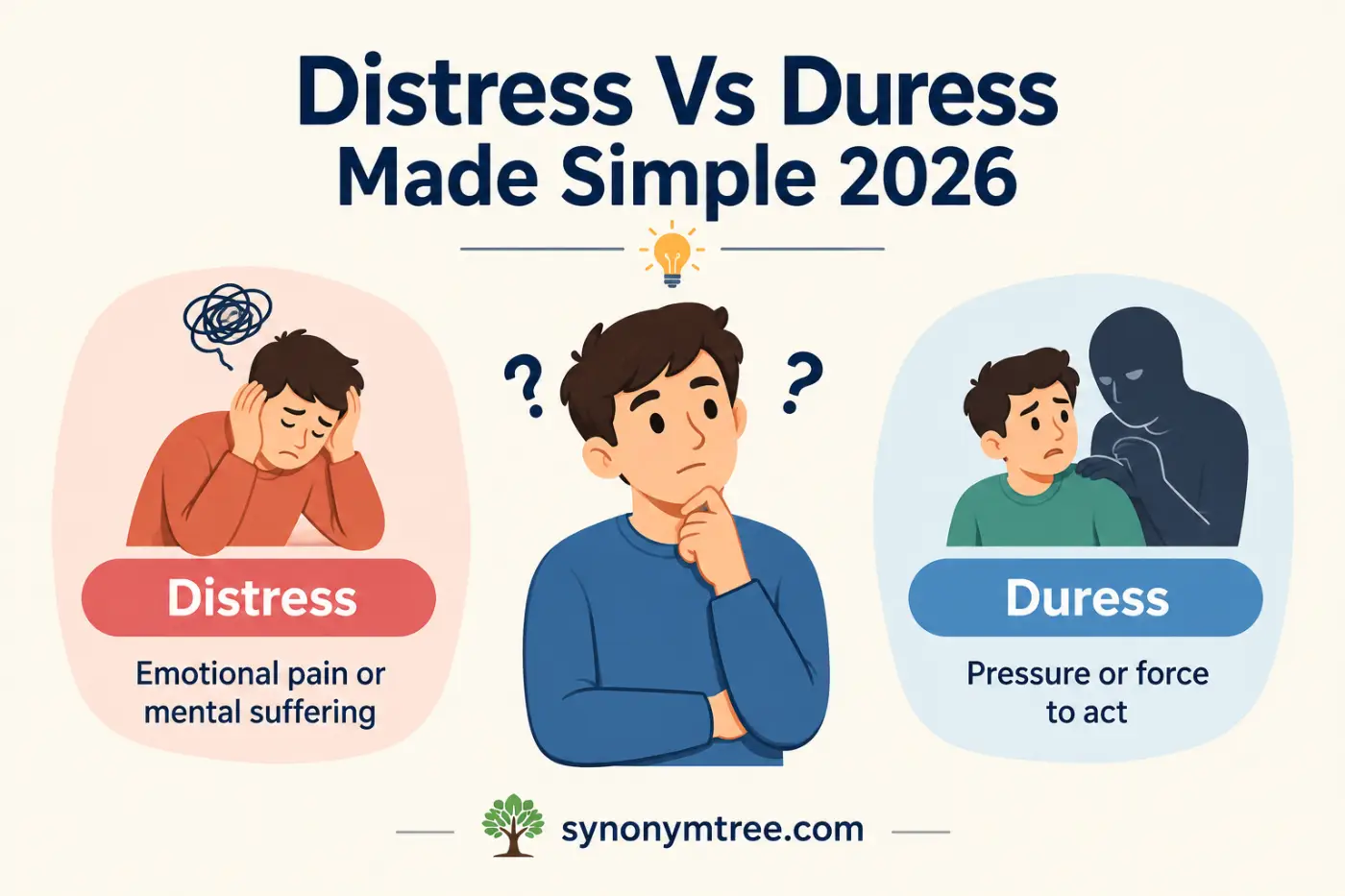
If you have ever wondered about distress vs duress, you are not alone. These two words look and sound similar, but they describe very different situations. One usually describes a state of emotional or physical suffering. The other describes pressure or force that makes someone do something they would not normally choose to do.
The difference matters because these words often appear in serious writing. You may see them in news reports, medical writing, legal documents, books, or everyday conversations. Using the wrong word can change the meaning of a sentence. The easiest way to remember the difference is simple. Distress describes suffering or extreme worry. Duress describes pressure, threats, or force used to make someone act.
This guide explains the meanings of both words, shows how they work in real sentences, explains their legal uses, and covers the mistakes people often make. By the end, you should be able to choose the right word without stopping to think twice.
Quick Definition
Distress means a state of great physical pain, emotional suffering, fear, worry, or sadness. A person can feel distress after a frightening event, a serious loss, or a painful experience.
Duress means pressure, force, or threats that cause someone to do something against their free choice. The word appears often in legal contexts, especially when someone claims they agreed to something because another person threatened or pressured them.
Direct Answer
Use distress when you mean suffering, pain, fear, or serious emotional upset. Use duress when you mean pressure, threats, or force that makes someone act against their wishes.
Distress Vs Duress At A Glance
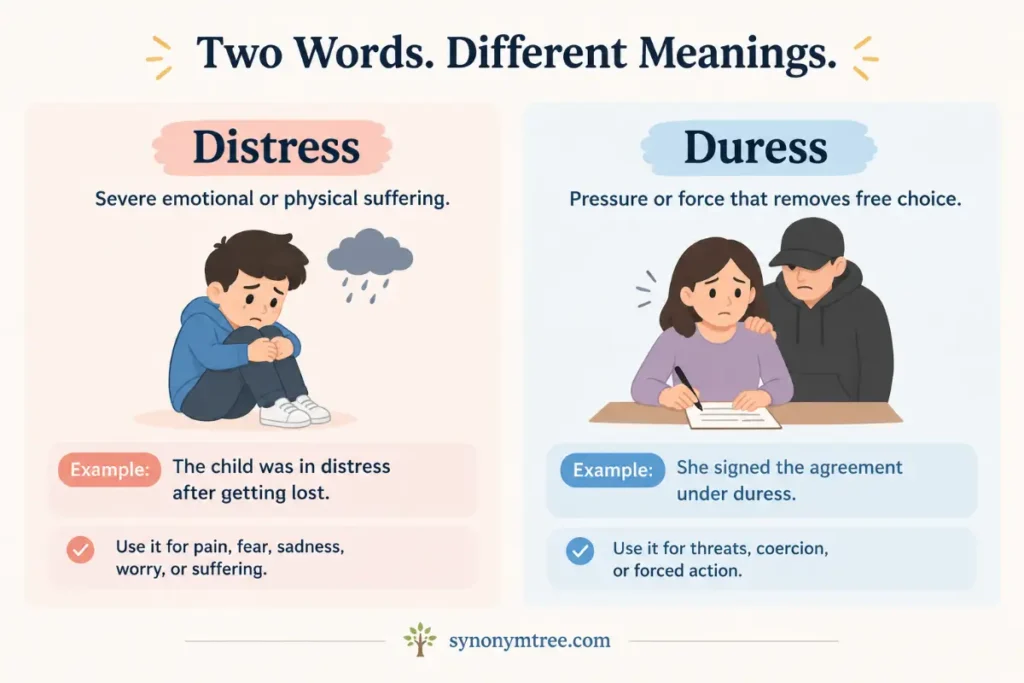
| Word or Phrase | Meaning | Example Sentence | When to Use It |
|---|---|---|---|
| Distress | Severe emotional or physical suffering | The child was in distress after getting lost. | Use it for pain, fear, sadness, worry, or suffering. |
| Duress | Pressure or force that removes free choice | She signed the agreement under duress. | Use it for threats, coercion, or forced action. |
The table gives you the basic difference, but there is more to each word. The words can appear in several forms, and their meanings can shift slightly depending on the situation.
What Distress Means
Distress describes suffering. That suffering can be emotional, mental, or physical.
Someone may experience distress after receiving bad news. A person may feel distress after losing a loved one. A child may become distressed after being separated from a parent. Someone trapped in a dangerous place may also be described as being in distress.
The word can describe a temporary reaction or a serious condition. The surrounding sentence usually tells you how severe the situation is.
For example, consider these sentences.
- The loud noise caused the baby great distress.
- She felt deep distress after hearing about the accident.
- The injured hiker was clearly in distress.
- The family watched in distress as the storm grew stronger.
- The dog showed signs of distress during the fireworks.
In each example, the central idea is suffering or serious discomfort. No one is necessarily forcing another person to act.
Distress As An Emotional State
One common use of distress relates to strong emotions.
A person may feel distressed because they are frightened, shocked, sad, confused, or deeply worried. The word is stronger than ordinary concern.
For example, saying that someone is worried gives a fairly mild picture. Saying that someone is in distress suggests that the situation has caused much greater emotional suffering.
Compare these sentences.
She was worried about her exam.
She was in distress after learning that she had failed the exam.
The first sentence describes normal concern. The second suggests a much stronger emotional reaction.
Distress can also describe suffering that other people can see. Someone crying, shaking, panicking, or struggling to cope may appear distressed.
Distress As Physical Suffering
Distress does not only describe emotions. It can also describe physical suffering or danger.
You may hear phrases such as a person in physical distress or a patient showing signs of distress. In these cases, the word points to a serious physical problem.
For example, a patient who is having trouble breathing may be described as being in respiratory distress. A person who has been injured may show signs of physical distress.
The general idea remains the same. Something is causing serious suffering or difficulty.
Distress As A Signal For Help
There is another useful meaning to understand.
When someone is in distress, they may need help. This is why the phrase in distress appears often in emergency situations.
For example, a person stranded at sea may send a distress signal. The signal tells others that the person is in serious trouble and needs assistance.
A boat in serious trouble can also send a distress call. An emergency worker might say that the person was found in distress.
Here, distress does not mean that someone is being forced to do something. It means that someone or something is in serious trouble.
What Duress Means
Duress is about pressure.
More specifically, it usually describes a situation in which someone uses threats, force, intimidation, or severe pressure to make another person act.
Imagine that someone tells you to sign a document and threatens to hurt you if you refuse. You sign because you fear the threat. You did not make the decision freely.
That situation may be described as acting under duress.
The word has a strong connection to free choice. The person facing duress is under pressure that affects their ability to make a voluntary decision.
Consider these examples.
- He claimed that he signed the contract under duress.
- She said the threat forced her to make the payment under duress.
- The witness said he gave the statement under duress.
- The agreement was challenged because one party claimed to have acted under duress.
- The employee said he resigned after facing extreme pressure from his employer.
The exact legal meaning of duress can depend on the law and the facts of a particular case. In everyday English, however, the central idea is pressure that takes away or seriously limits free choice.
Duress And Threats
Threats are one of the clearest examples of duress.
A threat can involve physical harm, damage to property, exposure of private information, or another serious consequence. The person making the threat wants to control another person’s actions.
For example, imagine someone says, Give me your money or I will hurt you.
If the victim hands over the money because of that threat, the action happened under coercive pressure.
The important point is not simply that the person felt upset. The important point is that another person created the pressure to control the person’s decision.
Duress And Coercion
Coercion is a useful related word.
Coercion means using force, threats, or pressure to make someone do something. Duress describes the condition created by that pressure.
These concepts overlap closely.
For example, if a person threatens someone until that person signs a contract, the threat may be described as coercion. The person who signs the contract may say they acted under duress.
This distinction can help you understand why the two words often appear together in legal writing.
The Main Difference Between Distress And Duress
The simplest difference is the source and nature of the problem.
Distress focuses on suffering.
Duress focuses on forced choice.
If a person is crying after receiving terrible news, that person may be in distress.
If someone threatens that person and forces them to sign a document, that person may be acting under duress.
The emotional reaction and the pressure can happen at the same time. A person under duress may certainly feel distress. However, the words still describe different parts of the situation.
Consider this example.
Maria received a frightening phone call and became distressed.
Later, someone threatened Maria and forced her to sign a document.
Maria was distressed because she was suffering emotionally. She signed the document under duress because someone pressured her into doing it.
That distinction is the key to understanding the pair.
Why These Words Get Confused
The confusion is easy to understand.
Both words describe difficult situations. Both can appear in serious writing.
Their spellings are similar too. Distress begins with dis, while duress begins with du. Their endings also look somewhat alike.
That similarity can make them seem interchangeable when they are not.
Another reason for confusion is that distress can result from duress.
Imagine someone threatens an employee. The employee becomes frightened and anxious. The employee is now in distress because of the threat. At the same time, the employee may be under duress because the threat is being used to influence their actions.
One situation can involve both words.
The words still answer different questions.
Ask yourself this.
Is the sentence mainly about suffering?
If yes, distress is probably the right word.
Is the sentence mainly about pressure that forces a person to act?
If yes, duress is probably the right word.
How To Use Distress In A Sentence
Distress works as both a noun and a verb.
As a noun, distress refers to a state of suffering or serious trouble.
For example, The patient was in distress.
Here, distress names the condition.
As a verb, distress means to cause someone to feel very upset or troubled.
For example, The news distressed her.
The meaning changes slightly because the word is now describing an action.
You can also use the adjective distressed.
For example, The distressed child called for her mother.
Distressed means suffering, upset, worried, or troubled.
There is also the adjective distressing. It describes something that causes distress.
For example, The family received some distressing news.
These forms are related, but they do different jobs in a sentence.
Common Forms Of Distress
Here are several useful forms.
- Distress is the noun.
- Distressed is the adjective describing a person or thing experiencing distress.
- Distressing is the adjective describing something that causes distress.
- Distress is also a verb meaning to cause serious emotional suffering.
Knowing these forms makes the word much easier to use naturally.
How To Use Duress In A Sentence
Duress is mainly used as a noun.
The most common expression is under duress.
For example, He signed the document under duress.
You can think of under duress as meaning under serious pressure or because of threats.
Another example is, She said that she acted under duress.
This means she claimed that pressure or threats affected her decision.
Duress is less common in casual conversation than distress. It often appears in legal, political, financial, or formal contexts.
That does not mean you cannot use it in everyday English. You can. The situation simply needs to involve serious pressure or forced action.
For example, someone might jokingly say, I agreed under duress.
In casual conversation, this can be humorous. It may mean that the person felt strongly pressured even though no real threat existed.
Still, the serious meaning of the word involves coercion or force.
Real Life Examples Of Distress
The best way to understand a word is to see it in natural sentences.
- The mother was in distress when she could not find her child.
- The storm caused severe distress among the residents.
- The dog showed signs of distress during the medical examination.
- He experienced emotional distress after losing his job.
- The emergency team helped a swimmer who was in distress.
- The news caused considerable distress for the family.
- The child became distressed when the lights suddenly went out.
- The doctor asked if the patient was experiencing any physical distress.
- The passengers noticed that the crew member was in distress.
- She tried to hide her distress during the meeting.
Notice the common thread. Each sentence involves suffering, worry, pain, fear, or trouble.
None requires another person to force someone into making a decision.
Real Life Examples Of Duress
Now look at examples involving pressure or forced action.
- He said he signed the contract under duress.
- She claimed that the payment was made under duress.
- The witness argued that his statement was given under duress.
- The company denied that the employee acted under duress.
- The court examined the claim that the agreement was made under duress.
- He refused to accept the document because he believed he was being placed under duress.
- She said the threat left her with no real choice and caused her to act under duress.
- The defendant claimed that the confession was made under duress.
- The victim said she gave the money under duress.
- The lawyer argued that the signature was obtained through pressure and duress.
Again, the main idea is pressure that affects free choice.
Distress In Legal English
Distress has a special history in legal English, and that can create extra confusion.
In modern writing, legal professionals may use distress to describe emotional suffering. For example, a person may claim emotional distress after a harmful event.
Emotional distress generally refers to significant mental or emotional suffering. Depending on the legal claim, the person may need to show specific facts to support that claim.
The exact rules differ from one legal system to another. A legal term should never be interpreted only from its everyday meaning when a court case is involved.
There is also an older legal meaning of distress connected with taking property to enforce a claim. This meaning is less common in ordinary modern English.
For most readers, the most useful meaning is suffering or serious emotional upset.
Duress In Legal English
Duress is especially important in contract law and criminal law.
In contract situations, a person may claim that an agreement should not be enforced because they entered into it under duress. The argument is usually that threats or improper pressure affected the person’s free decision.
For example, imagine a person is threatened with serious harm unless they sign a contract. The person signs because they fear the threat.
The person may later argue that the agreement was made under duress. Courts do not treat every uncomfortable negotiation as duress. Strong bargaining, deadlines, financial pressure, or an unpleasant conversation may not meet the legal standard.
The facts matter.
The legal definition also varies by jurisdiction. A real legal dispute requires advice from a qualified lawyer who knows the applicable law. For everyday English, you can remember the basic idea without learning every legal rule. Duress involves serious pressure that affects someone’s freedom to choose.
Distress Does Not Mean Duress
This is one of the most useful points to remember.
A person can be distressed without being under duress.
For example, someone may become distressed after hearing that their house has been damaged by a storm. No one forced them to feel that way.
Likewise, a person can experience duress and distress at the same time.
Imagine someone threatens another person and demands a signature. The victim may feel frightened and emotionally distressed. The victim may also be under duress because the threat is being used to force an action.
So you should not treat the words as synonyms.
Distress describes the suffering.
Duress describes the coercive pressure.
Common Mistakes People Make
These words cause several predictable mistakes.
Using Duress For Ordinary Stress
Duress is stronger than ordinary stress.
A busy workday can cause stress. A difficult exam can cause stress. A family argument can cause emotional distress.
None of these situations automatically involves duress.
For duress, look for pressure that affects a person’s freedom to act. Threats or coercion are common signs.
Using Distress For Forced Action
A person can be distressed during a forced situation, but distress does not explain the forced action.
Consider this sentence.
He signed the agreement in distress.
This sentence tells us that he was suffering emotionally. It does not clearly tell us that someone forced him to sign.
If the intended meaning is that threats or coercion caused him to sign, under duress is more precise.
Treating The Words As Synonyms
This is the biggest mistake.
Distress and duress overlap in some situations, but they do not have the same meaning.
Using one in place of the other can make your sentence vague or incorrect.
Assuming Every Strong Pressure Is Duress
Another mistake is using duress for any pressure.
A manager may pressure an employee to finish a project. A salesperson may push a customer to buy something. A parent may strongly encourage a child to study.
Those situations may involve pressure, but they do not automatically qualify as duress.
The word usually suggests a much more serious form of coercion.
A Simple Memory Trick
You can remember the difference with two short ideas.
Distress means suffering.
Duress means pressure.
Think of the first part of distress as connected with being disturbed or troubled. The word describes the condition you feel.
For duress, think about a decision being pushed out of your hands. Someone else is applying pressure and trying to control what you do.
Another useful trick is to remember the phrase under duress.
People commonly say that someone acted under duress.
They do not normally say that someone acted under distress when they mean that another person forced the action.
You can also ask yourself one question.
Am I describing how someone feels or why someone was forced to act?
If you are describing how someone feels, distress is likely the better choice.
If you are describing why someone was forced to act, duress is likely the better choice.
Related Words You Should Know
Understanding related words makes this distinction even easier.
Stress
Stress describes pressure or strain. It can come from work, school, money, family problems, health concerns, or many other sources.
Stress does not always mean severe suffering.
For example, I have a lot of stress at work sounds natural.
Anxiety
Anxiety describes worry, fear, or nervousness. It can range from mild concern to serious emotional difficulty.
A person can experience anxiety and distress at the same time.
Suffering
Suffering is a broad word for pain or hardship. It can describe physical pain, emotional pain, or difficult life experiences.
Distress is more specific in many contexts because it often suggests a strong reaction to trouble.
Pressure
Pressure can mean many things. A deadline creates pressure. Social expectations can create pressure. A threat can also create pressure.
Duress is a more serious and specific concept. It usually involves pressure that interferes with free choice.
Coercion
Coercion means using force or threats to make someone do something.
This is closely related to duress.
The words are not always interchangeable, but they often appear in the same discussions.
Intimidation
Intimidation means making someone feel afraid or less willing to resist.
Compulsion
Compulsion refers to a strong force or pressure that makes someone act.
The word can describe internal urges as well as external pressure, so context matters.
When Distress And Duress Can Appear Together
The two words can appear in the same story because one situation can create both.
Imagine a person receives a serious threat.
The threat causes emotional distress.
The same threat also creates duress if it forces the person to take an action they would not freely choose.
For example, a person may be extremely distressed after being threatened. If that threat causes the person to sign a document, the person may later say they signed under duress.
This is why the words can seem interchangeable when you read them in a news report or legal case.
They are describing different parts of the same event.
The distress is the suffering.
The duress is the pressure.
How Writers Can Choose The Right Word
When editing your own writing, start with the main idea.
If your sentence focuses on a person’s feelings, consider distress.
If the sentence includes both ideas, you may need both words.
For example, The victim was in distress after being threatened describes the emotional effect.
The victim signed the document under duress describes the forced action.
The victim experienced severe distress after signing the document under duress describes both parts of the event.
This method works well because it makes you focus on meaning instead of spelling.
Formal And Informal Use
Distress is common in both formal and everyday English.
You might say, The child was distressed.
You might also read, The patient showed signs of respiratory distress.
The word fits many settings.
Duress is more formal. It is strongly associated with legal and serious situations.
You may hear it in a conversation, especially when someone is making a humorous complaint.
For example, I agreed to watch the movie under duress.
In that casual sentence, the speaker probably does not mean a serious legal situation. They are using the word playfully to suggest that they felt strongly pressured.
The formal meaning remains much stronger.
Pronunciation And Spelling
The words are spelled differently and pronounced differently.
Distress is pronounced with the stress on the second syllable. It sounds like dih STRESS.
Duress is commonly pronounced with the stress on the second syllable as well. It sounds like dih RESS.
The similar rhythm can make the words harder to separate when you first hear them.
The spelling can also create confusion because both words begin with d and end with ss.
Still, pronunciation alone is not a reliable way to choose the correct word. Focus on meaning.
Distress Vs Duress In Writing
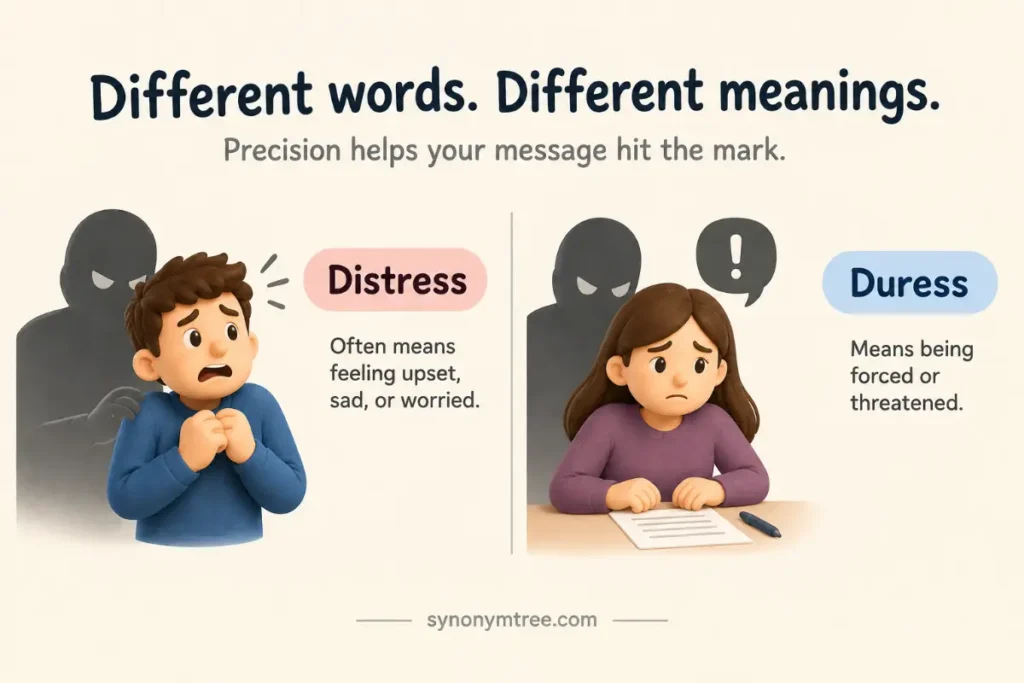
When you write an essay, report, email, or formal explanation, precision matters.
Suppose you write that a person acted in distress when the real meaning is that someone threatened them.
The reader may understand that the person was upset, but they may not understand that the person’s choice was forced.
Now suppose you write that someone acted under duress when they simply felt sad or worried.
You have made the situation sound much more serious than the facts support.
Good word choice helps readers understand exactly what happened.
This is especially important in legal, medical, workplace, and news writing. Small differences in meaning can change how a reader understands an event.
A Side By Side Example
Here is a simple situation.
James loses his job. He feels frightened and deeply worried about paying his bills. He is in distress.
Later, a person threatens James and tells him to sign a document. James signs because he fears what will happen if he refuses. He acts under duress.
The first situation describes emotional suffering.
The second describes coercive pressure.
Now imagine both events happen together.
James is distressed because of the threat. He also signs the document under duress.
The two words work together because they describe different parts of the experience.
Questions To Ask Before Choosing The Word
If you still hesitate, ask these questions.
- Is someone suffering?
If yes, distress may fit.
This quick test can help you choose the right word in seconds.
Why Context Matters
Words do not exist in isolation.
The same event can produce several different descriptions.
A person may be frightened. That is an emotional state.
A person may be distressed. That describes the seriousness of the suffering.
A person may be under duress. That tells us that pressure or threats are affecting their choice.
A person may also experience stress or anxiety.
All these words can describe parts of the same situation, but each one carries a different meaning.
Strong writing does not simply choose a word that sounds close. It chooses the word that gives the reader the exact idea.
A Few More Natural Examples
Here are additional examples that show the difference in everyday and formal contexts.
- The rescue team found the climber in distress.
This means the climber was in serious trouble and needed help.
- The child became distressed after the sudden noise.
This means the child became very upset.
Conclusion
The difference between distress vs duress becomes much easier once you focus on the central idea behind each word. Distress describes suffering, fear, worry, pain, or serious emotional upset. Duress describes pressure, threats, or force that affects a person’s free choice.
Think of distress as the condition someone experiences. Think of duress as the pressure that pushes someone into an action. A person can feel distressed without anyone forcing them to do anything. A person under duress may also become distressed because of the pressure they face.
The most useful phrase to remember is under duress. If someone signs a document because of threats or serious coercion, you can say they signed it under duress. If someone is suffering emotionally or physically, distress is usually the better word.
When you are unsure, ask one simple question. Am I describing suffering or forced choice? Suffering points to distress. Forced choice points to duress. That quick test will help you make the right choice in emails, essays, reports, and everyday writing.
Frequently Asked Questions
What is the difference between distress and duress?
Distress means serious suffering, worry, fear, or pain. Duress means serious pressure, threats, or force that affects someone’s ability to choose freely.
Is distress a synonym for duress?
No. The words can appear in the same situation, but they do not have the same meaning. Distress focuses on suffering, while duress focuses on coercive pressure or forced action.
What does acting under duress mean?
Acting under duress means doing something because of serious pressure, threats, or force. The pressure is strong enough to affect the person’s free choice.
Can someone be in distress and under duress at the same time?
Yes. A person who is threatened may feel emotional distress while also being under duress. The first word describes the suffering, while the second describes the pressure causing or influencing the action.
Is distress a legal term?
Distress can have legal meanings, including emotional distress. It can also have older legal uses involving property. The exact meaning depends on the legal context and the law that applies.
Is duress always a legal term?
No. Duress is often used in legal writing, but people can also use it in general conversation. In casual speech, it may sometimes be used humorously to describe strong pressure.
What is a simple synonym for distress?
Depending on the context, useful alternatives include suffering, anguish, sadness, worry, pain, trouble, fear, and upset. The best synonym depends on the exact situation.
What is a simple synonym for duress?
Useful related words include coercion, force, pressure, intimidation, and compulsion. These words are not perfect substitutes in every sentence, especially in legal writing.
