
If you’re writing a text, caption, social media post, or casual message, you may stop and wonder about faves or favs. Both forms are used as shortened versions of favorites, but they don’t have the same level of popularity or natural sound in every setting. Knowing the difference can help you choose the form that fits your sentence.
The short answer is that faves is the more natural plural form for many casual writers, while favs is also common, especially in texting, social media, and other informal spaces. Neither form belongs in formal writing in most situations. For professional or academic work, favorites is usually the better choice.
The reason this spelling question comes up is simple. Favorite is already a long word, so people often shorten it. English speakers use several informal abbreviations, and social media has made shortened words even more common. Some people prefer faves because it keeps more of the original word visible. Others use favs because it is shorter and quicker to type.
This guide explains what both forms mean, how they developed, how they work in sentences, and which one sounds best in texts, captions, emails, and other settings. You’ll also see examples, common mistakes, regional notes, and simple ways to choose the right form.
What Do Faves And Favs Mean
Faves and favs are informal shortened forms of favorites. They refer to things or people that someone likes more than others. For example, someone might say, My summer faves include iced coffee and beach trips.
Favs has the same basic meaning. A person might write, These are my favorite books and movies, or shorten the idea to These are my favs. The meaning stays clear because readers understand that fav is short for favorite.
The singular form is usually fave or fav. Fave tends to look and sound more like a spoken word. Fav is more compact and often appears in quick digital messages.
The plural forms follow the same pattern. Fave becomes faves, while fav becomes favs. Both can be understood easily in informal English.
Which Spelling Is More Natural
The choice depends mainly on style and context. Faves often looks more natural when you want the shortened word to remain easy to recognize as favorite. Favs looks more clipped and casual.
For example, My favorite songs are my summer faves sounds relaxed and natural. My summer favs also works, especially in a short caption or text.
Neither form is the standard spelling of the full word. Favorite remains the standard form in American English. These shortened versions belong to informal language.
Think of them as casual tools rather than replacements for the full word in every situation. A text to a friend can easily use faves or favs. A school essay should normally use favorites instead.
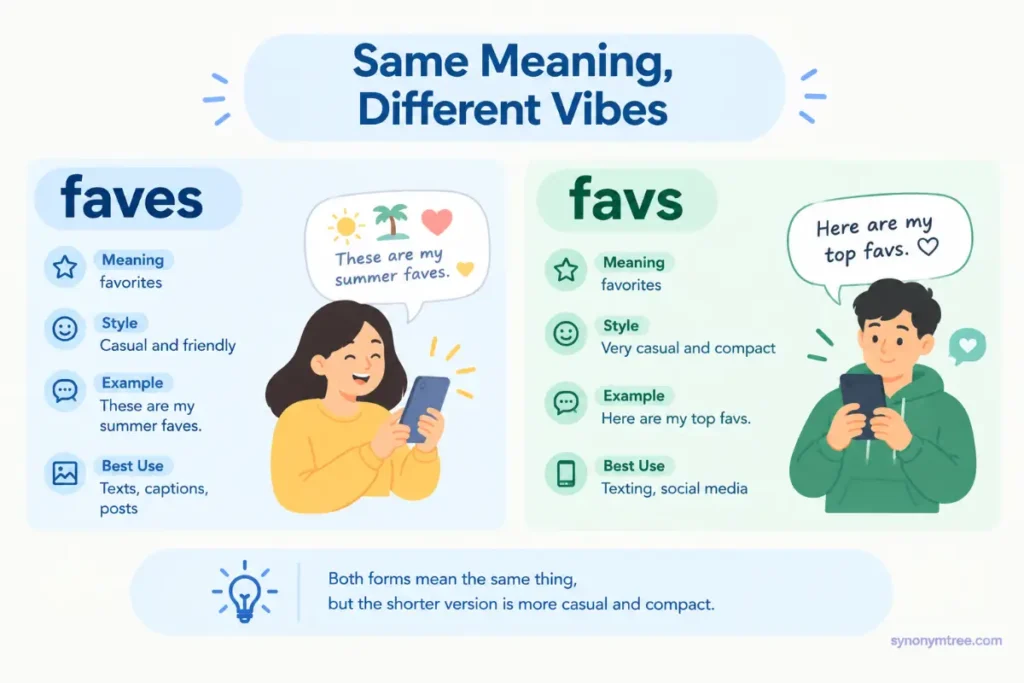
Quick Comparison Of Faves Or Favs
| Form | Meaning | Style | Example | Best Use |
|---|---|---|---|---|
| faves | favorites | Casual and friendly | These are my summer faves. | Texts captions posts |
| favs | favorites | Very casual and compact | Here are my top favs. | Texting social media |
| fave | favorite | Casual singular | This is my fave song. | Informal conversation |
| fav | favorite | Very casual singular | This is my fav. | Texts chats captions |
| favorites | favorite things or people | Standard | These are my favorite books. | Formal and informal writing |
The table shows why the two shortened forms can both work. They carry the same basic meaning. The main difference is style.
Faves usually gives the reader a stronger visual connection to favorite. Favs removes even more letters and therefore looks more like a quick abbreviation.
Why Is Favorite Shortened In Different Ways
Favorite is commonly shortened because informal communication rewards speed and simplicity. People often shorten familiar words when the meaning remains obvious from context.
English has many examples of this habit. Words such as information, advertisement, application, and photograph have all developed shorter forms in casual use. Some shortened forms become so common that they eventually enter wider everyday language.
Fave developed as a shortened form of favorite and is widely recognized in informal English. The spelling keeps the long vowel sound and several key letters from the original word.
Fav takes a different approach. It keeps the first three letters and drops the rest. That makes it especially useful when space and typing speed matter.
Digital communication has helped both forms spread. Text messages, social platforms, comments, usernames, and captions often favor short words. Readers usually understand the meaning without needing the full form.
The important point is that shortening a word does not automatically create a formal word. A form can be common and widely understood while still being considered informal.
Where Did Fave Come From
The word fave developed as an informal shortening of favorite. It follows a common pattern in English where speakers reduce a longer familiar word while keeping enough of it for easy recognition.
Favorite comes from the Latin word favoritus, which means favored or preferred. English later adopted favorite through French and developed the word used today for something preferred over other choices.
Over time, speakers began using shorter forms in everyday conversation. Fave became one of those casual forms. Unlike a random abbreviation, it works as a word in ordinary informal speech.
You may hear someone say, That’s my fave, in the same way they might say, That’s my favorite. The shorter version sounds relaxed and friendly.
The spelling faves simply adds the normal plural ending to fave. Since the final e remains part of the shortened word, the plural becomes faves.
Why Do People Write Fav Instead Of Fave
Fav is even shorter than fave. People often use it because it saves one more letter and still communicates the same idea.
This style is especially common in fast digital communication. A message such as What’s your fav movie? is immediately understandable to most readers who are familiar with casual online English.
The form fav also appears in social media captions and comments. Short words can fit better into quick messages, labels, and casual posts.
Still, fav can look more abbreviated than fave. If you want the shortened word to resemble the original word more closely, fave may be the better choice.
Neither form changes the basic meaning. The difference is mostly one of tone, spelling preference, and context.
Are Faves And Favs Correct Words
Faves and favs are accepted informal forms of favorites. They are widely understood in casual English, but they should not be treated as replacements for the standard word in every situation.
Formal writing usually benefits from full words. A business report, academic essay, formal letter, or professional application should generally use favorites rather than an informal abbreviation.
Casual writing gives you more freedom. A social media post can say, These are my weekend faves. A friend can text, Send me your movie favs. Both sentences are clear.
The word correct can be tricky here because language has different levels of formality. A shortened form can be perfectly normal in conversation while still being unsuitable for a formal document.
That distinction matters when you write for different audiences. A word that sounds friendly in a text may sound too casual in a college paper.
When Should You Use Faves
Faves works well when you want a casual but readable tone. It is especially useful in social posts, personal messages, captions, and friendly writing.
For example, a food blogger might write, These are my brunch faves. A friend might say, What are your holiday faves? A social media user could post, Sharing some of my travel faves today.
The spelling also works nicely when you want the shortened form to remain visually close to favorite. Readers can easily connect fave with the full word.
Faves can sound slightly warmer than favs in some sentences. That difference is subtle, though. Both are casual forms.
If your audience includes people who may not spend much time online, faves can sometimes be easier to understand at first glance because the spelling contains more of the original word.
When Should You Use Favs
Favs works best in very casual communication. Text messages, short captions, online comments, group chats, and informal posts are natural places for it.
For example, someone might write, Drop your top five favs below. Another person might text, What are your favs from the menu?
The short form can make a message sound quick and relaxed. It also fits the style of online communication where people often shorten words.
Favs is less suitable for formal writing. A sentence such as Our customers selected their top favs in the survey sounds too casual for a professional report. Our customers selected their favorite products in the survey would be more polished.
The key is audience. If the message is personal and relaxed, favs can work. If the message represents a company, school, or formal organization, the full word is usually safer.
Which Form Works Better In Text Messages
Both forms can work in text messages. Your choice depends on the tone you want.
Faves can sound casual while still being easy to read. Favs can sound shorter and more like quick texting language.
Consider these examples. What are your weekend faves? sounds friendly and natural. What are your weekend favs? sounds even more abbreviated.
A close friend probably won’t care which form you use. The meaning is clear from the sentence.
Texting also allows personal style. Some people naturally write fave and faves, while others prefer fav and favs. Neither choice creates a serious grammar problem in a casual message.
Which Form Works Better On Social Media
Both forms are common choices for social media. Faves often works well in captions because it looks like a casual word rather than a strict abbreviation.
You might write, My fall faves are here. Another caption could say, A few of my current favs.
Short captions often benefit from simple language. The reader should understand the meaning without stopping to think about it.
Social media also changes quickly. Slang and shortened forms can rise and fall in popularity. That means your choice can depend on the platform, audience, and style of the post.
If you want a friendly lifestyle or personal tone, faves is a solid choice. If you want something very short and casual, favs works well.
Which Form Works Better In An Email
The answer depends on the type of email. Personal emails give you much more freedom than professional emails.
A message to a friend could say, Here are some of my travel faves. That sounds natural and relaxed.
A workplace email is different. If you are sending a formal recommendation, use favorite or favorites instead. For example, Our team selected these as the favorite options for the next campaign sounds more professional.
Even in a friendly workplace, full words are usually safer when you are unsure about the audience. Informal abbreviations can make a message sound less polished.
When writing to clients, managers, customers, teachers, or people you do not know well, the full form is the stronger choice.
Which Form Works Better In An Essay
Use favorite or favorites in an essay. Fave and fav are informal shortenings, so they usually do not fit academic writing.
For example, avoid writing, My faves are several classic novels. Instead, write, My favorite novels include several classic works.
The full form gives your writing a more polished tone. It also avoids the need for your reader to interpret casual language.
Academic writing usually values clarity and consistency. Informal abbreviations can make an otherwise serious paragraph sound too conversational.
There can be exceptions in creative writing. If you are writing dialogue and a character naturally uses casual language, fave may fit the character’s voice. In that case, the informal spelling serves a purpose.
Which Form Works Better In A Resume
Use favorite or favorites on a resume. Shortened forms such as fave and fav can make professional writing sound too casual.
A resume should show clear and polished communication. If you are describing interests, you might write, Favorite activities include hiking, photography, and volunteer work.
Another option is to avoid the word entirely. You could write, Interests include hiking, photography, and volunteer work. That version is concise and professional.
The same rule applies to cover letters and job applications. Full words are usually the best choice when the writing represents your professional skills.
Can You Use Faves In A Sentence
Yes, you can use faves in informal sentences. The form functions as a casual plural noun.
My summer faves include fresh fruit and outdoor concerts.
Those are two of my all time faves.
The cafe is one of my neighborhood faves.
These books are among my personal faves.
The word works because the reader can easily understand that it means favorite things.
You can also use fave as a singular noun. This is my fave. That song is my current fave. She is one of my favorite singers, and that album is my fave.
The form is flexible in casual speech. Still, the same sentence may need the full word in formal writing.
Can You Use Favs In A Sentence
Yes, favs works in informal sentences too. It usually functions as a plural noun meaning favorites.
Here are some natural examples.
These are my top movie favs.
Send me your coffee shop favs.
I’m sharing some of my travel favs.
Those three songs are still my favs.
The meaning is easy to understand because the context makes the abbreviation clear.
The singular form fav can also work. That’s my fav. This is my fav book. She’s my fav character in the show.
Some readers may prefer fave because it looks more complete. Others use fav because it is shorter. Personal style often decides the choice.
Is Faves More Natural Than Favs
Faves can sound more natural in some sentences because it preserves more of the original word. Favs can sound more compact and more strongly associated with texting.
There is no universal rule that makes one form correct and the other incorrect in casual English. Both are understood as shortened forms of favorites.
The best choice often depends on your writing style. If you want casual language that still looks close to the original word, choose faves. If you want a very short abbreviation, choose favs.
Audience matters too. A broad public audience may find faves slightly easier to recognize. A social media audience is likely to understand favs immediately.
Faves Vs Favs And Tone
The tone difference is small but worth understanding. Faves often has a friendly and conversational appearance. Favs can look quicker and more abbreviated.
Compare these two captions.
My summer faves are finally back.
My summer favs are finally back.
Both captions mean the same thing. The first has a slightly fuller appearance. The second has a shorter digital style.
Neither one creates a major change in meaning. The choice is mostly about how you want the writing to sound.
If tone matters, read the whole sentence aloud. The form that matches the rest of your wording will usually work best.
Fave Vs Favorite
Fave is a shortened informal version of favorite. The two words have the same basic meaning, but their levels of formality differ.
Favorite is the standard form. It works in almost any setting.
Fave is casual. It works best in conversation, texts, captions, personal posts, and friendly messages.
Compare these sentences.
This is my favorite restaurant.
This is my fave restaurant.
The first sentence works in a formal review or professional piece. The second sounds more personal and relaxed.
Neither sentence is confusing. The difference comes from tone rather than meaning.
Fav Vs Favorite
Fav is also a shortened form of favorite. It is even more compact than fave.
This is my favorite song.
This is my fav song.
The second sentence is perfectly clear in a casual message. It would be less suitable in a formal article or business document.
Fav often appears in digital communication because it is fast to type. It can also work well in short labels or informal lists.
If you are writing for a formal audience, though, favorite remains the better choice.
Faves Vs Favorites In Formal Writing
Favorites is the safest choice in formal writing. The full word has no special restriction based on tone and can be used in professional and academic contexts.
For example, a report might say, The survey asked participants to identify their favorite products.
A school assignment might say, My favorite book explores the value of friendship.
A business email might say, These were the customers’ favorite options.
Replacing favorite with fave in these sentences would make the writing more casual. That may not match the purpose of the document.
Professional writing should usually favor clarity and standard forms. Casual abbreviations can be useful, but they are not always appropriate.
Common Mistakes With These Shortened Forms
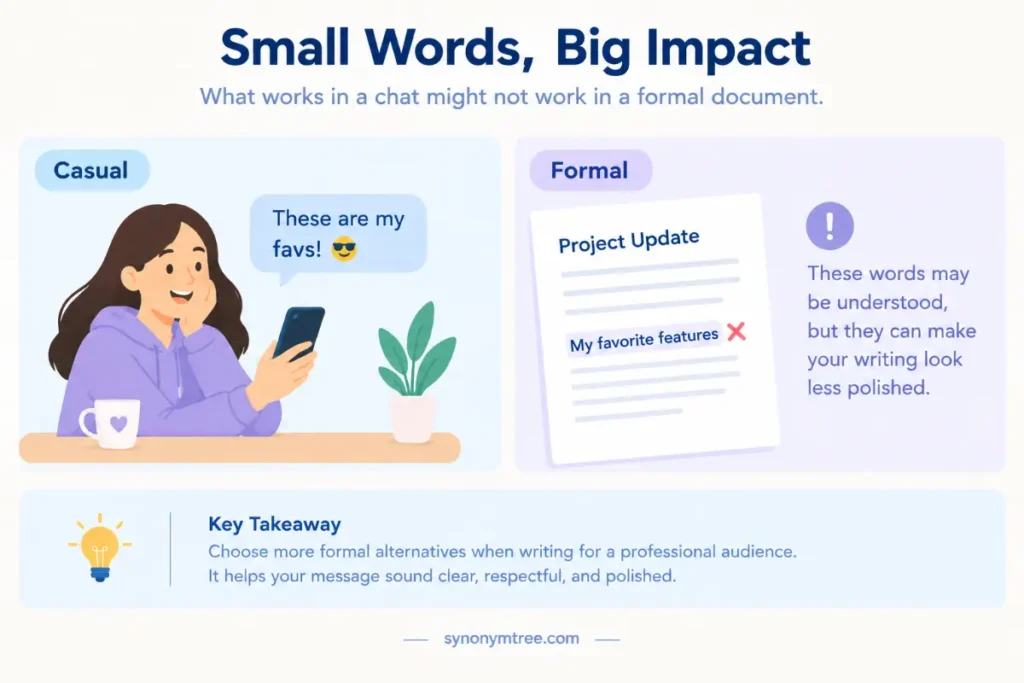
One common mistake is using faves or favs in a formal document without considering the audience. The words may be understood, but they can make the writing look less polished.
Another mistake is assuming that one form must always be right and the other must always be wrong. Both are used in informal English. The real issue is context.
Some writers also confuse singular and plural forms. Fave and fav refer to one favorite. Faves and favs refer to more than one.
For example, This is my fave uses the singular form. These are my faves uses the plural form.
The same pattern applies to fav. This is my fav is singular. These are my favs is plural.
A final mistake is treating these abbreviations as standard replacements in every sentence. Informal language has its place. Formal writing has different expectations.
How Do You Make The Plural Form
The plural form depends on the spelling you choose.
If you use fave, add s to get faves. If you use fav, add s to get favs.
The process is simple because neither form requires a special plural ending.
For example, one favorite becomes a fave. Several favorites become faves.
Likewise, one favorite becomes a fav. Several favorites become favs.
This makes the pattern easy to remember. The spelling changes only by adding s for the plural.
Can Faves Be Used As A Verb
No. Faves and favs are normally used as nouns in informal English.
You might say, These are my faves, because you are naming things you like most.
You would not normally say, I faves that song. The standard verb is favor in some meanings, but that creates a different sentence and meaning.
On some digital platforms, favorite can also function as a verb. For example, someone may say, I favorited the post. That use is connected to the platform action rather than the casual noun fave.
Understanding the part of speech helps prevent awkward sentences.
Can Fave Be Used As An Adjective
Fave is mainly used as an informal noun. However, it can appear before another noun in casual expressions.
For example, someone might write, my fave movie, my fave restaurant, or my fave song.
In these phrases, fave works much like an informal adjective because it describes the noun that follows it. The full form would be my favorite movie, my favorite restaurant, or my favorite song.
This use is common in casual writing. Formal writing should normally use favorite instead.
US And UK English Differences
American and British English both use favorite and favourite as the standard forms. American English uses favorite, while British English normally uses favourite.
The informal forms fave and faves can appear in both varieties of English. Digital communication has also made informal abbreviations easy to share across regions.
Fav and favs can also be understood by English speakers in different countries. However, usage can vary based on age, platform, and personal style.
If you are writing specifically for a US audience, favorite and favorites are the standard spellings. Fave and fav remain casual shortenings.
If you are writing for a British audience, favourite and favourites are the standard formal forms. Informal digital language can still use shortened versions.
How Context Changes The Best Choice
Context is the biggest factor in choosing among these forms. The same idea can sound polished, friendly, or extremely casual depending on the word you select.
Imagine you are writing a restaurant review for a major publication. You might say, The restaurant is one of my favorite places in the city.
Now imagine sending a text to a friend. You could say, This place is one of my faves.
A social media caption might say, One of my current favs.
All three sentences communicate the same basic idea. The wording changes because the audience and purpose change.
Good writing is not only about knowing what a word means. It is also about knowing when that word fits.
Real Examples Of Faves
My weekend faves include long walks and homemade pizza.
These are some of my favorite books and a few personal faves.
That little bakery has become one of my neighborhood faves.
I’m sharing my spring faves in today’s post.
Those three movies are still among my all time faves.
This song is one of my current faves.
Her travel faves include quiet beaches and small towns.
The new cafe quickly became one of his faves.
These are my top dessert faves from the menu.
My family knows that chocolate cake is one of my faves.
Each sentence uses the shortened form in a casual way. The meaning stays clear because the surrounding words provide enough context.
Real Examples Of Favs
Send me your top movie favs.
These are my current music favs.
I saved a list of my favorite travel favs for the trip.
Those restaurants are some of my weekend favs.
Here are five of my book favs.
The playlist is full of my old school favs.
She posted her holiday favs online.
These are my top three coffee shop favs.
I’m making a list of my skincare favs.
His favorite game characters are among his biggest favs.
These examples show how the shorter spelling fits casual digital communication. The form is especially natural in captions, comments, and messages.
How To Choose Between The Two
Start by asking what kind of writing you are creating. If the writing is formal, use favorite or favorites.
Next, consider your audience. Friends and social media followers are more likely to welcome informal forms.
Then think about the visual style of the sentence. Faves looks slightly fuller and closer to favorite. Favs looks shorter and more abbreviated.
Finally, stay consistent. If you use faves throughout a casual post, switching randomly to favs can make the writing look less deliberate.
Consistency helps even informal writing look polished.
What Are The Antonyms Of Favorite
Favorite does not have one perfect opposite in every sentence. Common opposites include least favorite, disliked, unwanted, or unpopular, depending on the meaning.
For example, My least favorite movie describes the movie someone likes the least.
The word disliked focuses on a negative opinion. Unpopular focuses on something that many people do not prefer.
These words cannot always replace one another. A least favorite item may still be liked. A disliked item may be strongly rejected.
That is why context matters when choosing an opposite.
Why Full Words Still Matter
Shortened language has a useful place in everyday communication. It makes messages quick and can give writing a relaxed personality.
Still, full words remain valuable. They remove doubt about tone and work across almost every writing situation.
Favorite is clear in a text, an email, an essay, a report, or a professional document. Fave and fav have a narrower range.
That does not make the informal forms bad. It simply means they serve a different purpose.
Strong writers know how to adjust language to fit the reader. The goal is not to avoid casual language. The goal is to use it intentionally.
A Simple Memory Trick
Think of fave as favorite with the middle letters removed. The spelling keeps the beginning and the final e.
Then think of fav as the even shorter version. It keeps only the first three letters.
For plural forms, simply add s.
Fave becomes faves.
Fav becomes favs.
Favorite becomes favorites.
This pattern is easy to remember because each form follows a simple structure.
If you are writing something formal, skip the shortcut and use favorite or favorites. If you are writing casually, choose the shortened form that best matches your style.
What Should You Use In Different Situations
For an academic essay, use favorite or favorites. The full form keeps the tone polished.
For a resume, use favorite or favorites. Professional documents usually benefit from standard vocabulary.
For a formal email, use favorite or favorites unless the message is intentionally very casual.
For a text message, fave or fav can work naturally.
For a social media caption, faves or favs can both work.
For a message to a close friend, either informal form is fine.
For creative dialogue, choose the form that matches the character’s speech.
For a business report, use favorite or favorites.
For a personal blog, you can use faves or favs if the tone is relaxed.
For a classroom assignment, the full form is usually the safest choice.
What Should You Remember About These Forms
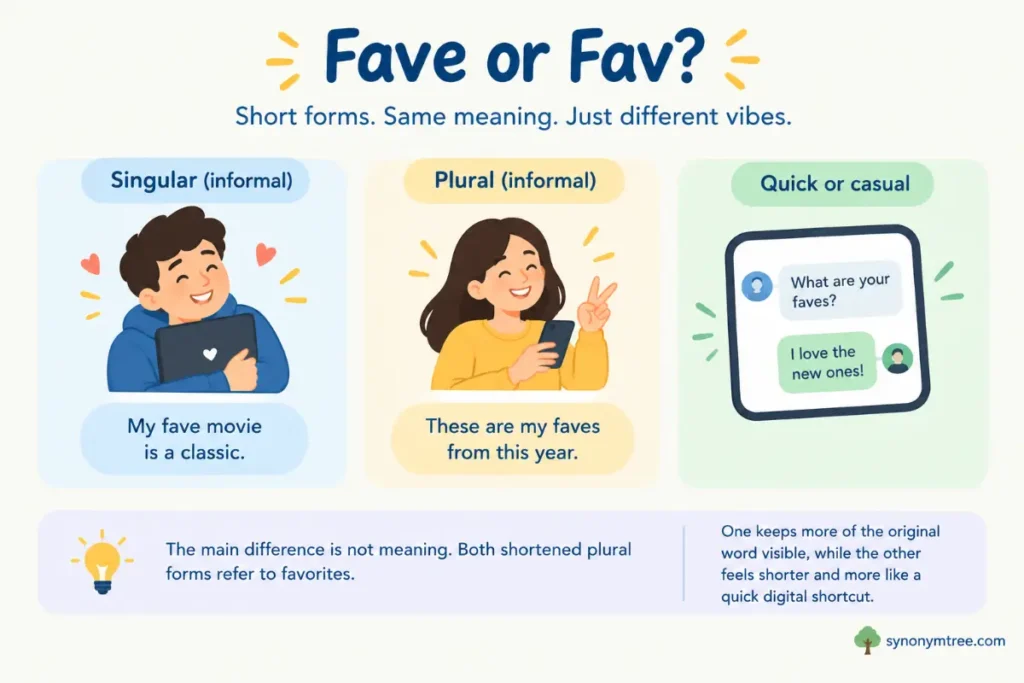
Fave and fav are singular informal forms. Faves and favs are their plural versions.
The main difference is not meaning. Both shortened plural forms refer to favorites.
Faves keeps more of the original word visible and can look slightly more natural in casual prose. Favs is shorter and can feel more like a quick digital abbreviation.
Formal writing calls for the full form. Casual writing gives you room to use either shortened version.
That simple distinction solves most of the confusion.
Conclusion
The best choice between faves or favs depends on the setting and the tone you want. Both are informal ways to refer to favorites, and both are easy for most readers to understand.
Faves can work well when you want a casual word that still looks close to favorite. Favs is shorter and fits quick texts, captions, comments, and other digital messages. Neither form is the standard choice for formal writing.
For essays, resumes, reports, and professional communication, stick with favorite or favorites. For friendly messages and casual posts, choose faves or favs based on your personal style.
The easiest rule is simple. Use the full word when the writing needs a polished tone. Use a shortened form when the setting is relaxed and the meaning is already clear.
FAQs
Is faves a correct spelling?
Yes. Faves is a common informal plural form of fave. It means favorites and works best in casual writing.
Is favs short for favorites?
Yes. Favs is an informal abbreviation of favorites. It is especially common in texts and online communication.
Which is better faves or favs?
Neither is always better. Faves can look more natural because it resembles favorite more closely, while favs is shorter and more compact.
Can I use faves in formal writing?
You generally should use favorites in formal writing. Faves is casual and can make an academic or professional sentence sound too informal.
What’s another way to say favorites?
You can simply use favorites. In casual writing, faves or favs can also work when the tone allows an informal abbreviation.
Is fave singular or plural?
Fave is singular. Faves is plural. For example, This is my fave is singular, while These are my faves is plural.
Do faves and favs mean the same thing?
Yes. Both forms mean favorites. The main difference is spelling and informal style rather than meaning.
