
Have you ever stopped while writing an email or report because you could not decide between imbed vs embed? Both spellings appear in English, and both can refer to placing something firmly inside something else. That makes the choice confusing, especially when you are writing about videos, images, links, or digital content.
The good news is that you do not need to memorize two different meanings. In most situations, embed is the preferred spelling in modern American English. You will see it in technology, business writing, education, and everyday communication.
The word has several uses. You can embed a video on a website, embed a photo in a document, or embed a small object in a larger material. In each case, something becomes part of a larger whole or is placed inside something else.
This guide explains the difference between the two spellings, shows how to use the word in real sentences, and covers common mistakes. You will also learn why both forms exist, how the word works in technology, and how to choose the right spelling for your writing.
Quick Definition
Embed means to place something inside something else so it becomes part of it or stays firmly in place. It can describe a physical object, an idea, a piece of information, or digital content such as a video. Imbed is an accepted variant with the same basic meaning, but embed is generally the better choice in modern American English.
Direct Answer
Embed is the preferred spelling in modern American English. Imbed is also a recognized spelling, but it is less common. For most school assignments, business documents, websites, and technical writing, choose embed.
Comparison Table
| Word | Meaning | Example Sentence | When to Use It |
|---|---|---|---|
| Embed | To place something inside another thing or make it part of a larger whole. | Please embed the video in the article. | Use it in general writing, technology, education, and professional communication. |
| Imbed | An accepted variant of embed with the same basic meaning. | The thorn became imbedded in his skin. | Use it when following a source, quotation, style guide, or established spelling preference that uses this form. |
The two words do not have separate standard meanings. The main difference is spelling preference and frequency. If you are unsure which one to choose, use embed.
What Embed Means
The verb embed describes the act of putting something inside another thing or making it an integrated part of a larger structure. The object can be physical, such as a stone in a wall, or less tangible, such as a lesson in a training program.
Think of a small object placed firmly in a larger object. A piece of glass may become embedded in a window frame. A seed may become embedded in soft soil. In both cases, the smaller item is located within something larger.
The word also works outside physical situations. A teacher can embed a reading activity into a lesson. A company can embed its values in its workplace policies. A website owner can embed a video directly into a page.
These examples share one basic idea. Something is placed within a larger thing or becomes a meaningful part of it.
The Main Meaning in Everyday English
In everyday English, embed often means to put something inside another thing so that the two become connected.
For example, a writer might embed a short explanation in a paragraph instead of placing it in a separate section. A designer might embed a logo in the footer of a website. A builder might embed metal supports in concrete.
The word does not always mean that the object is impossible to remove. A video can be removed from a webpage, and a photo can be deleted from a document. In these situations, embed describes how the content is included or displayed, not how difficult it is to take out.
Context helps you understand the exact meaning. When the sentence refers to a physical object, the word may describe something lodged inside a material. When it refers to digital content, it usually describes an item that appears within a page or file.
Embed as a Verb
Embed is most often used as a verb. A verb tells the reader what someone or something does.
Here are several examples.
- The editor will embed the chart in the final report.
- The teacher embedded a short quiz in the online lesson.
- Please embed the image below the first heading.
- The engineer embedded a sensor inside the device.
- The coach tried to embed good habits in the team.
- The journalist embedded a link in the article.
- The artist embedded tiny pieces of glass in the sculpture.
- The company wants to embed safety rules in every training session.
In each sentence, embed describes an action. Someone places an item inside another thing or makes it part of a larger whole.
The verb can appear in several forms, including embed, embeds, embedded, and embedding. These forms follow ordinary English grammar rules.
Embed as a Past Tense Verb
The past tense of embed is embedded.
For example, you could write, The developer embedded a video in the homepage yesterday. The action happened in the past, so embedded is the correct form.
You can also use embedded as a participle in a sentence such as, The video is embedded in the page. Here, the word describes the video’s placement.
The spelling doubles the final letter before adding the ending. That pattern can confuse writers who expect a simpler form. In standard usage, write embedded, not embeded.
Embed as a Noun Modifier
The word embedded can also describe a person, object, or feature that is placed within a larger setting.
For example, an embedded image is an image stored within a document rather than simply referenced from another location. An embedded reporter may work closely with a military unit or another group to observe its activities.
In these examples, embedded describes the relationship between one thing and its larger environment. It does not change the core meaning of the verb.
Why Imbed and Embed Both Exist
English has many words with more than one accepted spelling. Some forms develop through changes in pronunciation, regional preferences, historical usage, or the influence of other words.
Imbed and embed are examples of spelling variation. Both have been used to describe placing something inside another thing. The spelling with the initial letter e is now the more common choice in general American English.
The existence of the less common form does not mean that writers must treat the two spellings as separate words. Their basic definitions overlap. The practical question is which form will be clearest and most familiar to the reader.
The Prefix Does Not Create a New Meaning
Writers sometimes assume that the first letters of a word determine its meaning. That assumption does not work well here.
The spelling imbed is not a separate technical term that always refers to one special action. It generally carries the same meaning as embed. You should not use one form to mean placing an object inside something and the other to mean adding digital content.
For example, both spellings have been used in sentences about an object lodged in a surface. Both have also appeared in writing about ideas or information that become part of a larger structure.
Modern usage favors embed, so it is the safer default for most readers.
Why Dictionaries May Show Both Spellings
A dictionary may list embed as the main entry and imbed as a variant. A variant is another accepted form of a word. It does not automatically have a different definition.
The exact presentation can differ from one dictionary to another. Some dictionaries may provide a separate entry for the less common spelling. Others may direct readers to the more common form.
This does not mean that every style guide recommends both spellings equally. A dictionary records word usage, while a style guide helps writers choose consistent forms for a particular type of content.
For everyday American English, the practical rule remains simple. Use embed unless you have a good reason to follow another established spelling.
Is Imbed Incorrect
It is too strong to say that imbed is always incorrect. The spelling has a history of use and is recognized as a variant of embed.
However, accepted does not always mean preferred. A word can be valid and still be less common in current writing. Readers may recognize imbed, but embed is more likely to match the spelling they expect.
If you use imbed in a personal note, the meaning will usually be clear. If you are preparing a school paper, company report, website, or technical guide, embed is generally the better option.
The same principle applies to many spelling choices in English. When two forms share a meaning, the more widely used form is often the safest choice for a broad audience.
How to Use Embed in Real Sentences
Understanding a definition is helpful, but examples show how the word works in everyday writing. The meaning stays close to placing something inside a larger thing, although the details change with the situation.
Examples in Everyday Writing
- I will embed the photo in the letter before sending it.
- The author embedded a personal story in the first chapter.
- Please embed the link in the final paragraph.
- The designer embedded the company logo in the page header.
- We embedded the instructions in the form to help users complete it.
- The teacher embedded a spelling exercise in the reading lesson.
- The software allows users to embed charts in their presentations.
- The builder embedded steel rods in the concrete wall.
- The artist embedded small shells in the clay bowl.
- The team embedded its new rules in the employee handbook.
Each sentence shows an item becoming part of a larger object, document, or process. The item may be physical, digital, or an idea.
Examples in School Assignments
Students may use embed when discussing literature, research, presentations, or digital projects.
For example, a student could write, The author embedded clues throughout the story. This means the clues appear within the story rather than in a separate explanation.
Another example is, I embedded a chart in my science presentation. The chart appears as part of the presentation.
A student might also write, The teacher embedded vocabulary practice in the reading activity. The vocabulary work forms part of the larger lesson.
These uses are suitable for school writing because the word expresses a clear relationship between one part and a larger whole. Still, students should make sure the sentence explains what is being placed inside what.
Examples in Business Writing
Business writing often uses embed to describe processes, information, media, and company practices.
- The marketing team embedded a product video on the sales page.
- Our report embeds customer feedback in the final analysis.
- The manager wants to embed clear safety steps in the daily routine.
- The presentation includes an embedded chart that shows quarterly sales.
- The company embedded the new policy in its staff training program.
- The analyst embedded a link to the original data in the report.
The word can make these sentences more precise than a vague verb such as add. Adding something may mean placing it at the end of a document. Embedding it usually suggests that it becomes part of the document or larger system.
However, embed should not replace every use of add, insert, include, or place. Choose it when it describes the relationship you mean.
Examples in Physical Situations
The word is not limited to computers or writing. It has long been useful for describing physical objects.
- A small piece of metal became embedded in the wooden board.
- The gardener embedded the seeds in the soil.
- The jeweler embedded a blue stone in the ring.
- The workers embedded metal supports in the concrete.
- A sharp fragment was embedded in the tire.
- The sculptor embedded colored glass in the finished artwork.
These examples show the physical meaning clearly. An item sits within another material or object.
The word can also suggest that the item is held firmly in place. In a sentence about a fragment in a tire, for example, embedded tells the reader that the fragment is lodged in the rubber.
Examples About Ideas and Habits
An idea can become embedded in a person’s thinking or in the practices of a group.
For example, The school aims to embed respect into its daily routines. The school wants respect to become a regular part of how students and staff act.
Another sentence might be, Years of practice embedded the skill in her memory. This means the skill became deeply established through repeated use.
A business could say, We want to embed honesty in every customer interaction. The company wants honest behavior to become part of its normal work.
This use is figurative. The idea is not a physical object placed inside a material. Instead, it becomes part of a person’s thinking, behavior, or system.
Embed in Technology and Digital Content
Technology is one of the clearest areas where embed is the preferred spelling. Writers use it to describe media or features that appear inside a webpage, document, message, or application.
You may have seen an embedded video on a news page or a chart inside an online report. The content appears in the surrounding page instead of requiring the reader to visit a separate page to see it.
The word also appears in software guides, website instructions, online courses, and product documentation. In these settings, embed usually describes a feature that becomes part of a larger digital item.
What Does It Mean to Embed a Video
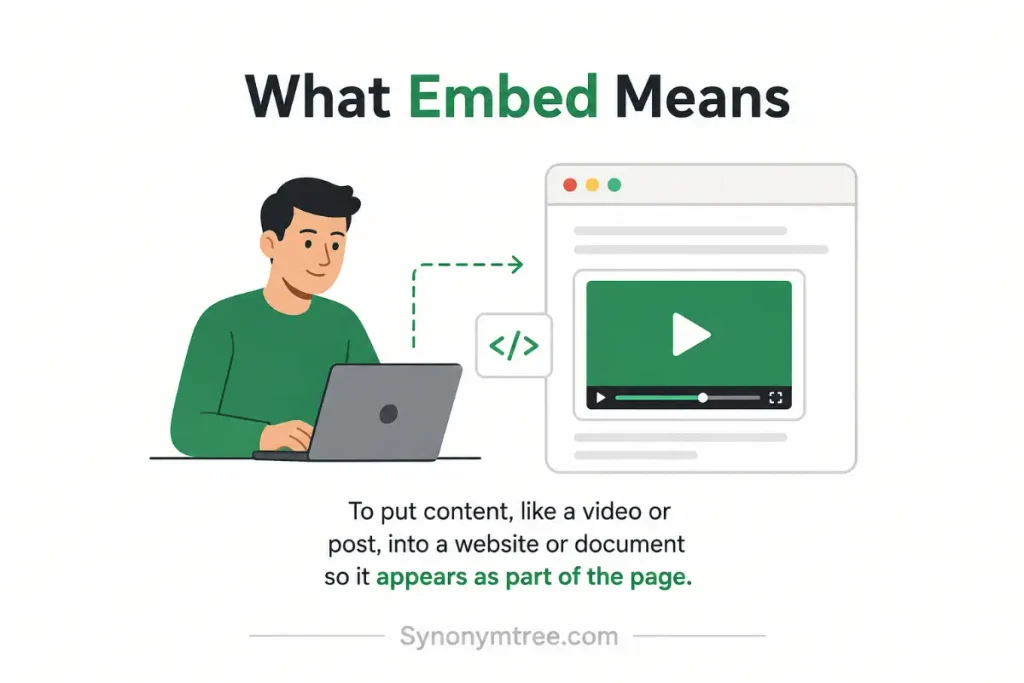
To embed a video means to make the video appear within another page or digital document. For example, a website may display a video player directly inside an article.
The video itself may be hosted by another service. The webpage uses a supported method to display the player in the page. Readers can then watch the video without first opening a separate page for the video.
A sentence such as, Please embed the tutorial in the help page, tells the person doing the work to make the video appear within that page.
Embedding a video does not always mean copying the full video file into the website. In many cases, the page displays content from an outside platform. The exact method depends on the service and the website.
What Does It Mean to Embed an Image
An embedded image appears as part of a document, message, presentation, or webpage. The image may be stored within the file or displayed through a link to another location.
For example, a report may contain an embedded chart that readers can see as they read the text. A presentation may contain embedded photographs on several slides.
The technical details matter when you need to share or edit a file. Some documents store image data inside the file itself. Others refer to an image stored somewhere else. Both arrangements may make an image appear inside the document, but they can behave differently when the file moves to another computer.
In everyday writing, you can use embed to describe the action of adding the image as part of the larger item. If the storage method matters, explain it more precisely.
What Does It Mean to Embed a Link
To embed a link means to attach a web address to text or another page element so that a reader can open the linked destination.
For example, a writer might turn the words product guide into a clickable link. The link appears within the sentence instead of displaying a long web address on its own.
You could write, I embedded a link to the user manual in the email. The sentence tells the reader that the email contains a link within its content.
People sometimes use insert a link and embed a link to describe similar actions. The best choice depends on the context. Embed is common when the link becomes part of the surrounding content, while insert is also a natural and widely understood option.
What Is an Embed Code
An embed code is a piece of code that helps display content within a webpage or another supported digital space. Video platforms, map services, and other online tools may provide code for this purpose.
A website editor may copy the code into a page so that the content appears in the right place. The details depend on the platform and the website’s rules.
For example, a support page might say, Copy the embed code and paste it into your page editor. Here, embed is used as part of the name for the code that makes embedded content possible.
The phrase is common in web design and publishing. It does not require a special spelling. Use embed code, not imbed code, unless you are reproducing a source that uses the less common form.
What Is an Embedded File
An embedded file is included within another file or digital item. A presentation might contain an audio clip. A document might contain a spreadsheet object. A training module might include a video.
The exact behavior depends on the application. Some embedded items can be opened or edited from within the main file. Others are displayed as content without giving the reader full access to the original source.
For example, The presentation contains an embedded spreadsheet. This means the spreadsheet is included as part of the presentation in a way supported by the software.
In technical writing, be clear about the relationship between the files. Embedded content and linked content are not always the same. A linked item may depend on a separate file or online location, while an embedded item may be stored within the main document.
Embed Compared With Similar Words
Several words can describe putting one thing inside another. They overlap in meaning, but they are not always interchangeable. Understanding the differences helps you choose the clearest verb.
Embed vs Insert
Insert means to put something into a space, object, or sequence. It often focuses on the action of putting the item in place.
For example, Insert the card into the slot tells someone to put a card into a particular opening. Embed the card in the display could suggest that the card becomes part of the larger display.
In everyday use, the two verbs can overlap. You can insert an image into a document, and you can embed an image in a document. The difference is often about the relationship between the item and the larger whole.
Use insert when you want to stress the act of putting something in. Use embed when you want to stress that it becomes part of the larger item.
Embed vs Add
Add is a broad verb that means to put something extra with something else. It does not necessarily suggest that the new item is placed inside or integrated into the original thing.
For example, Add another paragraph to the report is clear and natural. Embed the paragraph in the report suggests that the paragraph becomes part of the existing content.
Both sentences can describe a similar action, but the emphasis changes. Add works in many situations. Embed is more specific when the item is integrated into a page, document, process, or structure.
Do not use embed just because it sounds more technical. If add gives the reader the exact meaning you intend, it may be the better word.
Embed vs Include
Include means to make something part of a group, list, document, or collection. It is often the simplest choice when the main point is that something is present.
For example, The report includes three charts tells the reader what the report contains. The report embeds three charts suggests that the charts are placed within the report itself.
The difference is subtle in some sentences. Both forms may be correct, but embed gives more attention to the way the content is integrated.
Use include when you want to list the contents of something. Use embed when the placement or integration matters.
Embed vs Incorporate
Incorporate means to combine something with a larger whole. It often describes ideas, methods, features, or materials that become part of a system.
For example, The teacher incorporated group work into the lesson means group work became one part of the lesson. The teacher embedded group work in the lesson also works, with greater emphasis on making it part of the lesson structure.
Incorporate may sound more formal in some contexts. Embed can be more direct when the idea is that one thing sits within another.
The words are close in meaning, but they do not fit every sentence in exactly the same way. Read the sentence aloud and choose the verb that states the relationship most clearly.
Embed vs Attach
Attach usually means to connect one thing to another. An email attachment, for example, is a file sent along with a message.
Embed often means that the content appears within the message or document itself. If you attach a photo to an email, the recipient may need to open the attached file. If you embed a photo in the email body, the photo appears within the message content.
The difference depends on the software and the way the content is handled. In casual conversation, people may use the terms loosely, but technical instructions should be precise.
Use attach for a file connected to a message or object. Use embed when the content is placed within the larger item.
Embed vs Enclose
Enclose means to surround something or place it inside an area or container. The word often focuses on the boundaries around the item.
For example, The wall encloses the garden describes a boundary around the garden. The builder embedded metal supports in the wall describes supports placed within the wall material.
The words can both refer to an inside location, but their meanings are different. Embed focuses on placing something within another thing or making it part of a whole. Enclose focuses on surrounding or containing something.
Common Spelling Mistakes With Embed
Knowing the preferred spelling is only part of writing the word correctly. Writers also make mistakes when they change its form, add endings, or use it in technical instructions.
Writing Imbed in Formal American English
The most common choice to reconsider is imbed itself. Because the spelling is recognized, it is not always fair to label it a misspelling. Still, embed is the more common and widely preferred form in modern American English.
If you are editing a report, article, school assignment, or website, use embed for consistency. If you are quoting a source that uses imbed, preserve the source’s wording when accuracy requires it.
The same rule applies to related forms. Embedded and embedding are the standard choices for most American writing.
Spelling Embedded as Embeded
A frequent mistake is writing embeded with only one d before the ending. The correct spelling is embedded.
The final consonant is doubled when the word takes the ending in this form. This spelling pattern also appears in words such as planned and stopped.
Correct examples include:
- The video is embedded in the article.
- The designer embedded the logo in the footer.
- The sensor was embedded in the device.
- The report includes an embedded chart.
Remember that the word has two d letters before the ending. That detail makes the spelling easy to check during proofreading.
Spelling Embedding as Embeding
The correct spelling of the present participle is embedding. The incorrect form embeding leaves out one of the two d letters.
For example, write, We are embedding the video in the course page. Do not write, We are embeding the video in the course page.
The same form can act as a noun in some contexts. In technical writing, embedding may describe the process of placing content inside another system or document.
A quick spelling check can prevent this small mistake from appearing in otherwise polished writing.
Confusing Embed With Embedded
Embed is the base form of the verb. Embedded is the past tense and past participle, and it can also describe something that is already part of a larger item.
Use embed after words such as to, can, will, or should when the sentence calls for the base verb.
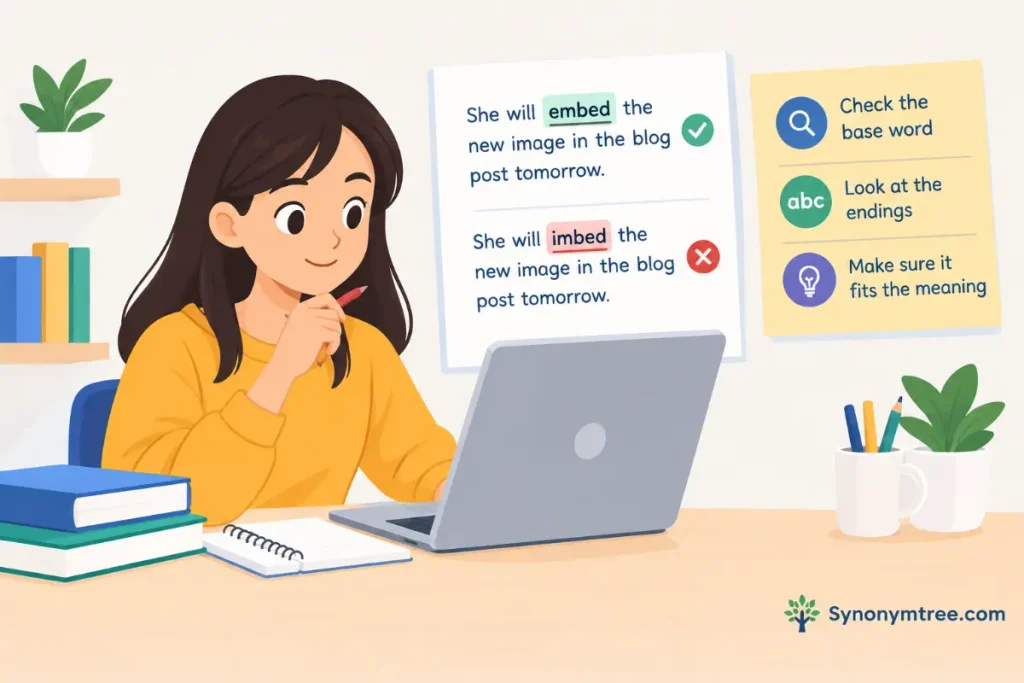
For example, We will embed the chart in the report is correct. We will embedded the chart in the report is not correct.
Use embedded when the grammar requires a past form or a description of the item’s placement. The image is embedded in the report is correct.
Using Embed When Add Is Clearer
Not every object placed in a document needs to be described as embedded. Sometimes writers choose a more technical word when a simpler one would communicate the idea better.
For example, I added a note to the document is clear. I embedded a note in the document may also work, but it gives extra emphasis to the note’s place within the content.
The goal is not to use the most impressive sounding word. The goal is to choose the word that communicates the action accurately.
If the item becomes an integrated part of a larger thing, embed may be the right choice. If you simply put something extra into a list, add may be enough.
Easy Ways to Remember the Correct Spelling
Spelling rules are easier to use when you connect them to a practical habit. You do not need a complicated memory trick for this word. A few simple reminders can help you choose the standard form and write it correctly.
Remember the Common Form
For modern American English, remember embed as the default. It is the spelling you are most likely to need in school, business, technology, and everyday writing.
When the less common spelling appears, recognize that it may be a variant rather than assuming the writer has created a new word. Then use embed in your own work unless a specific style requirement tells you otherwise.
This method works because it focuses on the choice you actually need to make. You do not have to settle the full history of both spellings every time you write a sentence.
Connect the Word With Digital Content
Many people encounter embed while working with websites, videos, images, and documents. Think of the instruction to embed a video in a webpage.
That familiar phrase can help you recall the preferred spelling. Once you know the base form, the related forms are easier to remember.
For example, embed a video, embedded video, and embedding a video all use the same spelling pattern. The two d letters remain in embedded and embedding.
Check the Verb Form
If you are unsure about the spelling, first decide how the word functions in the sentence.
Use embed in a sentence such as, I need to embed the chart. Use embedded in a sentence such as, I embedded the chart yesterday.
Checking the grammar can reveal spelling mistakes at the same time. It also helps you avoid using a past tense form after a word that requires the base verb.
Read the Full Sentence
A spelling choice should make sense within the sentence. If you are writing about a video, photo, object, or idea that becomes part of something larger, embed will usually fit.
For example, The editor will embed the video in the article is clear. The editor will insert the video into the article is also possible, but it places more emphasis on the action of putting it there.
Reading the sentence helps you check both meaning and grammar. It also shows you when a simpler verb would be more natural.
Regional Usage and Style Guide Choices
Spelling preferences can differ across regions and publications. American English, British English, and other varieties of English do not always use the same preferred forms.
For this particular word, embed is a strong default across modern English writing. Imbed remains a recognized variant, but it is less common. You should not assume that the two spellings are equally common just because both appear in dictionaries.
American English Usage
In American English, embed is the preferred spelling for general use. It is common in newspapers, websites, software instructions, educational materials, and professional documents.
If you are writing for an American audience, choose embed unless you have a specific reason to preserve another spelling. This choice helps your writing match common usage and avoids distracting readers who expect the standard form.
The same preference applies to the related forms embedded and embedding.
British English Usage
Embed is also widely used in British English. You may encounter imbed in older material or in sources that follow a particular spelling preference, but it is not necessary to use the less common form for British readers.
If you are writing for a British publication, check its house style when spelling consistency matters. A house style is a set of rules that a publication follows for spelling, punctuation, and other writing choices.
Following one consistent form is more useful than switching between spellings without a reason.
Following a Company or Publication Style
Organizations sometimes maintain their own writing guides. These guides help writers use the same terms and spellings across articles, reports, instructions, and marketing materials.
If your workplace guide specifies embed, use that form throughout your document. If you are editing an older source that consistently uses imbed, follow the project’s instructions about preserving or updating the original spelling.
Do not change a direct quotation just to match your preferred spelling. A quotation should accurately represent the source. Outside quotations, however, consistency is usually the best approach.
Editing Older Text
Older books, articles, and technical documents may use spellings that are less common today. Finding imbed in an older text does not automatically mean the text is wrong.
When editing historical material, consider the purpose of the project. A modern article may benefit from using the current preferred form. A faithful reproduction may need to retain the spelling found in the original.
The important point is to make a deliberate choice. Do not switch spellings at random within the same piece of writing.
When the Less Common Spelling May Appear
Although embed is the safer choice, imbed may still appear in published text, older records, names, and specialized contexts. Seeing it does not mean the writer intended a different meaning.
In Names and Branding
A company, product, website, or creative project may use Imbed as part of its official name. In that case, preserve the spelling when referring to that specific name.
Names follow their own conventions. A brand may choose a nonstandard spelling to distinguish itself from other businesses or products.
This does not make imbed the preferred spelling in ordinary sentences. It simply means that proper names should be written as their owners use them.
In Historical Documents
Some historical sources use imbed because spelling preferences have changed over time or because different writers followed different conventions.
If you are transcribing a historical letter or document, preserving the original spelling may be important. Readers may expect an accurate record rather than a modernized version.
For a new article or general explanation, though, there is usually no need to copy an older spelling preference. Embed remains the practical choice.
When Quoting Another Writer
Direct quotations should preserve the source’s wording when accuracy matters. If a source uses imbed, you may retain it in the quotation rather than silently changing it.
Outside the quotation, use your chosen standard spelling. This keeps your own writing consistent while respecting the source.
If the spelling difference might confuse readers, you can explain briefly that the quoted source uses a less common variant. In most everyday writing, that extra explanation is not necessary.
Proofreading Routine
A short proofreading routine can help you catch spelling errors before you publish. Focus on the base word, its endings, and the meaning of the sentence.
Search for Both Spellings
If you are editing a long document, use the search function to find both embed and imbed. Review each result instead of replacing every instance automatically.
A blanket replacement may change a proper name or a direct quotation that needs to stay accurate. Review the context before making the change.
Also search for embedded, imbedded, embedding, and imbedding if your document is long or has passed through several editors. This can help you spot inconsistent forms.
Check the Meaning
Ask yourself what the word is describing. Is an object placed inside a material? Does a video appear within a webpage? Has an idea become part of a routine or system?
If the sentence expresses one of these meanings, embed may be suitable. If you only mean to add something to a list, another verb might be clearer.
A good edit improves both spelling and meaning. Correct spelling matters, but clear writing depends on the full sentence.
Check the Ending
Look closely at the final letters when the word appears in a different form. Embedded needs two d letters before the ending. Embedding follows the same pattern.
The sentence also determines which form you need. A sentence with will usually takes embed, while a sentence describing an action completed in the past may take embedded.
This check is especially useful in technical writing because the word may appear many times in a single guide.
Keep the Spelling Consistent
Consistency helps readers move through a document without noticing unnecessary differences. If you choose embed, use it throughout your writing unless a quotation, proper name, or source requirement calls for another form.
A consistent spelling also makes editing easier. Your colleagues can review the content without spending time deciding if each variation was intentional.
For most American English documents, the simplest policy is to use embed, embedded, and embedding.
Conclusion
When comparing imbed vs embed, the main point is simple. Both spellings have been used with the same basic meaning, but embed is the preferred form in modern American English. It is the spelling most readers will expect in school assignments, business documents, online articles, and technical instructions.
The word describes placing something inside another thing or making it part of a larger whole. You can embed a video in a webpage, embed a photo in a report, or embed a useful habit in a daily routine. The meaning stays consistent even when the situation changes.
Remember the related forms as well. The correct past tense is embedded, and the present participle is embedding. Avoid embeded and embeding because both leave out a required d.
For everyday writing, use embed unless you are following a specific source, proper name, or style guide that requires another form. This small choice keeps your writing clear, consistent, and easy for readers to understand.
FAQs
Is Imbed a Real Word?
Yes, imbed is a recognized spelling variant of embed. It has the same basic meaning, which is to place something inside another thing or make it part of a larger whole. However, embed is more common and is the preferred choice in modern American English.
Which Spelling Is Correct in American English?
Embed is the preferred spelling in American English. Imbed is also recognized, but it is less common. For schoolwork, professional writing, websites, and most general content, use embed.
Do Imbed and Embed Mean the Same Thing?
Yes, the two forms generally have the same meaning. Both can describe placing an object inside a material or making information, an idea, or digital content part of something larger. The main difference is that embed is more widely used.
Should I Write Embed or Imbed a Video?
Write embed a video. This is the common spelling used in website instructions, software guides, and digital publishing. For example, You can embed the video directly in the lesson page.
Is It Embedded or Embeded?
The correct spelling is embedded, with two d letters before the ending. Embeded is a misspelling. For example, The chart is embedded in the report is correct.
What Is the Past Tense of Embed?
The past tense is embedded. For example, The designer embedded the image in the document yesterday. The same form is also used as a past participle, as in The image is embedded in the document.
What Does Embedded Mean in Technology?
In technology, embedded usually means that a piece of content or a feature is included within a larger digital item or system. An embedded video appears inside a webpage, while an embedded chart appears within a document or presentation. The exact technical setup depends on the software.
Can I Use Imbed in Formal Writing?
You can encounter imbed in formal writing because it is a recognized variant. Still, embed is the safer choice for most formal documents, especially when writing for a broad American audience. Follow your organization’s style guide if it gives a specific instruction.
