
If you are unsure about hustle or hussle, the correct spelling in standard English is hustle. The word with one S after the U and another S before the L is the accepted spelling. Hussle is a common misspelling, although you may see it used in names, brand names, or creative writing.
The confusion makes sense because English spelling does not always match the way a word sounds. When people say hustle quickly, the middle sounds can blend together. This can make it hard to remember how many letters belong in the word.
The word hustle has several meanings. It can describe working hard to reach a goal, moving quickly, encouraging someone to act, or earning money through business activity. It can also describe pushing or moving someone in a forceful way. The meaning depends on the sentence.
This guide explains the correct spelling, the meaning of the word, its history, and how to use it in everyday writing. You will also learn the difference between hustle and similar words, see natural examples, and find simple ways to remember the spelling.
Quick Definition
Hustle is the correct standard English spelling. It can mean to work hard, move quickly, push someone to act, or earn money through active effort. Hussle is generally a misspelling when you intend to use the common English word.
Direct Answer
The correct spelling is hustle, not hussle. Use hustle when writing about hard work, ambition, quick movement, or active efforts to earn money.
Hustle vs Hussle Comparison Table
| Word or Phrase | Meaning | Example Sentence | When to Use It |
|---|---|---|---|
| Hustle | To work hard, move quickly, or make an active effort. | I hustle every day to build my business. | Use it in standard English writing and speech. |
| Hussle | A common misspelling of hustle. | She wrote hussle on her school paper by mistake. | Avoid it in ordinary writing unless it is part of a proper name or a deliberate creative choice. |
| Hustler | A person who works hard to reach a goal or uses clever methods to earn money. | He is a skilled hustler who finds new customers. | Use it to describe a person, keeping the positive or negative meaning clear from context. |
| Hustling | Working hard, moving quickly, or actively trying to earn money. | They are hustling to finish the project on time. | Use it when describing an ongoing action. |
| Hustled | Worked quickly, pushed, or moved someone or something. | We hustled to catch the last bus. | Use it for a completed action in the past. |
| Hustles | Works hard, moves quickly, or makes an active effort. | She hustles after school to grow her online shop. | Use it with he, she, or it in the simple present tense. |
Why Hustle Is the Correct Spelling
English spelling follows patterns, but those patterns are not always easy to predict. Some words contain doubled consonants, while others use a single consonant in a similar position. That is one reason people sometimes write hussle instead of hustle.
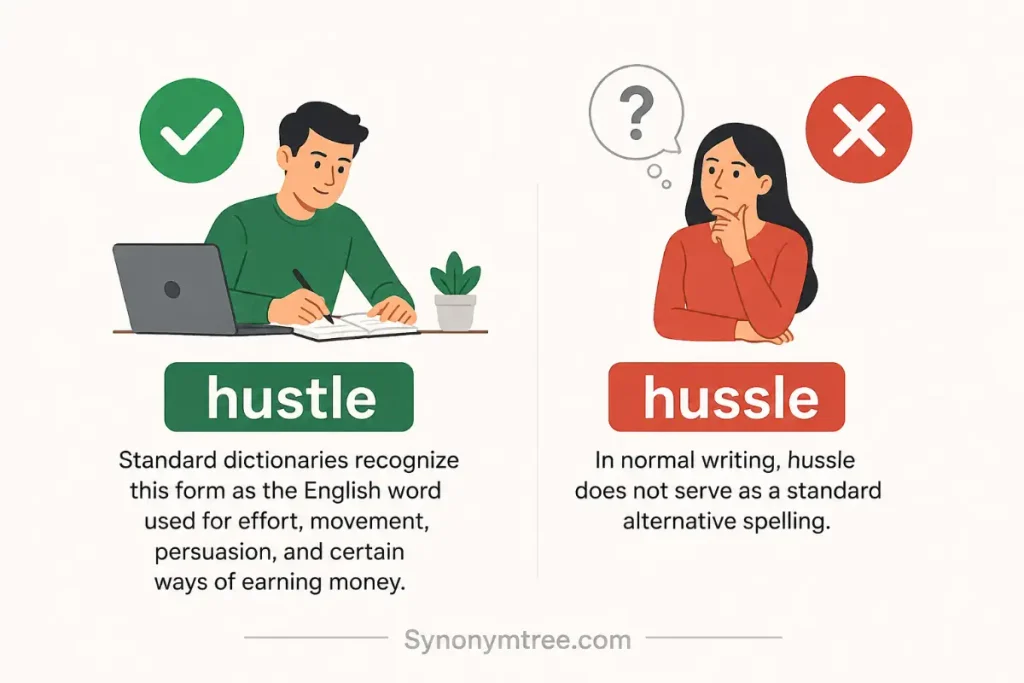
The accepted spelling is hustle. Standard dictionaries recognize this form as the English word used for effort, movement, persuasion, and certain ways of earning money. In normal writing, hussle does not serve as a standard alternative spelling.
You may still encounter the other form online. People make spelling mistakes in social media posts, comments, text messages, and informal advertisements. Some also use unusual spellings to create a memorable username or business identity. Seeing a spelling on a website does not automatically make it correct in standard English.
For example, a sentence such as She hustles every day to support her family uses the accepted spelling. Writing She hussles every day would be a spelling error in ordinary English.
The same rule applies across related forms of the word. Write hustling, hustled, hustler, and hustles. These forms keep the same basic spelling pattern.
Why People Write Hussle by Mistake
One reason is sound. When people speak quickly, they may not clearly notice the spelling pattern inside a word. They often write what they think they hear instead of checking the standard written form.
Another reason is that English has many words with double consonants. Words such as hassle, hustle, and tussle look similar. A writer may remember the doubled S in hassle and accidentally transfer that pattern to hustle.
Typing habits can also cause the mistake. A person who has written the incorrect form several times may start to recognize it as familiar. Familiarity, however, is not proof that a spelling is correct.
Online language adds another source of confusion. A social media account, music title, or company may use Hussle as a chosen name. Proper names can follow personal or artistic choices that differ from standard spelling rules. That does not change the usual spelling of the English word.
Is Hussle Ever Acceptable?
It can be acceptable as a proper name, a brand name, a username, or a deliberate creative spelling. Names do not always follow the usual rules of English spelling. If a business or artist officially uses Hussle, preserve that spelling when referring to the name.
For example, a person might name a clothing brand Hussle to give it a distinctive identity. In that case, the spelling is part of the brand name. It should not be silently changed when you write about the business.
The same applies to a stage name, song title, or social media handle. Copy the name as its owner presents it. If you are writing a formal report or article, you can explain that the name uses a nonstandard spelling when that detail matters.
Outside those specific uses, choose hustle. It is the form readers expect in schoolwork, professional emails, essays, reports, and everyday writing.
What Does Hustle Mean?
The word hustle has several related meanings. It can describe effort, speed, pressure, or a way of earning money. The sentence around it tells readers which meaning you intend.
In casual speech, people often use hustle to describe working hard toward a goal. Someone who studies after work, builds a small business, or trains for a competition might say they are hustling. The word suggests action and effort rather than simply having a wish.
Hustle can also mean moving quickly. A coach might tell players to hustle back onto the field. A parent might say, We need to hustle or we will miss the train. In both cases, the word encourages people to move without wasting time.
A third meaning involves persuading, pressuring, or pushing someone. For example, a salesperson might hustle customers into making quick decisions. Depending on the situation, this can sound forceful or dishonest.
The word can also refer to making money through a series of small jobs, deals, or business activities. A person who sells handmade items online, tutors students, and works a weekend job might call those activities side hustles.
These meanings overlap, but they are not identical. Working hard is not always the same as rushing. Earning money is not always dishonest. A clear sentence helps readers understand the intended meaning.
Hustle as Hard Work
This is one of the most common modern uses of the word. When someone says they are hustling, they often mean they are putting in time and effort to reach a goal.
For example, a student might hustle to earn good grades while holding a part time job. A new business owner might hustle to find customers and keep costs low. An athlete might hustle during practice to improve speed and skill.
In this sense, hustle often carries a positive tone. It suggests discipline, action, and a willingness to work. Still, the word does not guarantee that the effort will succeed. A person can work hard and still face setbacks.
The term can also describe steady effort rather than constant rushing. Someone who spends an hour each morning improving a skill may have a strong work ethic even if they are not working every minute of the day.
Hustle as Quick Movement
In another common meaning, hustle describes moving fast or making people move faster. This use appears in everyday conversation, sports, work settings, and emergencies.
A teacher might tell a class to hustle because the next lesson is about to start. A manager might ask staff to hustle before a store opens. A friend might say, We have five minutes, so hustle.
Here, the word is close to hurry, rush, or move quickly. It often suggests that time is limited and action is needed now.
The tone depends on how it is said. A coach may use it as encouragement. A person who shouts it at a worker may sound impatient or demanding. The word itself does not always express anger, but the situation can change how it feels to the listener.
Hustle as a Way to Earn Money
Hustle is also common in conversations about jobs, small businesses, and extra income. A side hustle is an activity someone does to earn money outside their main job or regular source of income.
Examples include tutoring, selling crafts, repairing bicycles, editing videos, delivering food, or offering design services. These activities can be small or large. Some people use them to cover everyday costs, while others hope to turn them into full time businesses.
The word can suggest initiative because the person actively looks for ways to earn. However, a side hustle is not automatically profitable. It may require equipment, supplies, travel, training, or unpaid time.
For that reason, the word should not be treated as a promise of easy money. It describes an activity or approach, not a guaranteed financial result.
Hustle as Pressure or Deception
The word has a less positive meaning too. To hustle someone can mean to pressure that person, trick them, or take advantage of them for personal gain.
For example, a dishonest seller might hustle a tourist by charging far more than an item is worth while giving false information about it. In this context, hustle is not praise. It points to unfair or deceptive behavior.
A hustler can also mean someone who uses clever methods to get what they want. That description may be positive, negative, or mixed. Context is especially important when describing a person with this word.
If you want to praise someone’s effort without suggesting dishonesty, consider words such as hardworking, driven, resourceful, or determined. These alternatives make the intended meaning clearer.
The Origin of the Word Hustle
Hustle has been part of English for centuries. Its history is connected with ideas of shaking, pushing, jostling, and moving with force. Over time, its meanings grew to include quick action, effort, and ways of making money.
The word entered English from Dutch, where a related word carried the sense of shaking or tossing. Its early English uses were associated with pushing or moving in a rough or hurried way. Later uses developed around energetic activity and effort.
Modern American English uses the word in many settings. Sports coaches use it to encourage quick action. Workers use it to describe hard work. Business owners use it when discussing sales and extra income. In informal speech, hustle can describe the skill of finding opportunities and acting on them.
The word also became strongly linked with music, sports, street culture, and popular business advice. Those uses helped spread phrases such as work hard and hustle, keep hustling, and side hustle.
Even with these changes, the standard spelling has stayed the same. The history of a word can explain its meaning, but it does not support adding another S to the ordinary spelling.
How to Use Hustle in a Sentence
The easiest way to use hustle correctly is to identify the action you want to describe. Are you talking about hard work, quick movement, earning money, or pressuring someone? Choose a sentence that makes that meaning clear.
Here are natural examples from different situations.
Examples About Hard Work
- Maya hustles every evening to finish her college assignments.
- The team hustled all week to prepare for the final match.
- He built his business through patience, skill, and years of hustle.
- If you want to improve your writing, you need to practice and hustle.
- They hustled to meet the deadline without lowering the quality of their work.
- Her daily hustle helped her gain experience and find better clients.
- I respect people who hustle for their goals while treating others fairly.
- The young designer is hustling to build a strong portfolio.
- Our staff hustled before the event so every guest could be welcomed on time.
- He believes steady effort matters more than talking about success.
These examples show that hustle can describe a person, a group, or a pattern of effort. It can also work as a noun, as in years of hustle or daily hustle.
Examples About Moving Quickly
- We need to hustle if we want to catch the early train.
- The coach told the players to hustle back on defense.
- She hustled through the airport to reach her gate.
- Please hustle, because the meeting starts in ten minutes.
- The workers hustled to move the boxes before the rain began.
- He hustled downstairs when he heard the doorbell.
- The children hustled into class after the bell rang.
- I had to hustle home before the shops closed.
- The crew hustled to clear the stage between performances.
- Everyone hustled to find shelter when the storm arrived.
In these sentences, hustle focuses on speed and action. It does not necessarily mean that the people are working toward a long term goal. They simply need to move quickly.
Examples About Earning Money
- She started a side hustle selling handmade cards online.
- My brother hustles on weekends by repairing old computers.
- He uses his design skills to build a small freelance hustle.
- Their family business began as a simple way to earn extra money.
- She is hustling to find new customers for her tutoring service.
- His side hustle pays for his evening classes.
- They turned a weekend baking project into a small business.
- I respect the effort it takes to run a business after a full day at work.
- The photographer built her client list through referrals and steady work.
- A useful side hustle should fit your skills, schedule, and budget.
These examples use the word in a business or money related setting. They also show that earning extra income often involves planning, service, and regular effort.
Examples About Pressure or Dishonesty
- The salesman tried to hustle us into buying an expensive package.
- Tourists should take time to check prices before paying a stranger.
- She realized the seller was trying to hustle her with false claims.
- The scammer used a friendly tone to hustle people out of their money.
- He refused to hustle customers and chose to explain the costs honestly.
These sentences have a negative meaning. They show why it helps to understand the full context before calling someone a hustler.
Hustle as a Noun and a Verb
Hustle can function as both a noun and a verb. The part of speech depends on how you use it in the sentence.
A verb describes an action. A noun names a person, place, thing, idea, or activity. Learning this difference helps you form correct sentences and choose the right related word.
Hustle as a Verb
As a verb, hustle can mean to work hard, hurry, push, or persuade someone. It changes form to match the tense and subject.
In the present tense, you might write, I hustle every morning. For an action happening now, use hustling, as in They are hustling to finish the job.
For a completed action, use hustled. For example, We hustled to catch the bus. These forms follow the usual spelling pattern, so the double S in the misspelling is not needed.
Hustle as a Noun
As a noun, hustle often means energetic effort, determination, or the work involved in reaching a goal.
For example, Her hustle helped the small shop attract more customers. The sentence treats hustle as a quality or type of effort. Another example is, The team showed hustle during the final minutes of the game.
The noun can also refer to a business activity that earns extra money. In the phrase side hustle, the noun identifies work done alongside a main job or another regular responsibility.
Related Forms of the Word
The main forms are easy to remember.
| Form | Part of Speech | Example |
|---|---|---|
| Hustle | Noun or verb | I hustle to finish my work. |
| Hustles | Verb | She hustles after class. |
| Hustled | Verb in the past tense | They hustled to the station. |
| Hustling | Verb form | He is hustling to find customers. |
| Hustler | Noun | The hustler found a new way to earn money. |
| Hustling | Noun or adjective in some contexts | Hustling workers filled the busy market. |
The meaning of hustler depends on context. It can describe a hard worker or someone who uses dishonest methods. If you want to avoid that possible negative meaning, choose a more specific term.
Hustle vs Similar Words
Many words share one meaning with hustle, but each has its own tone. Choosing the right alternative can make your writing more exact.
Hustle vs Hurry
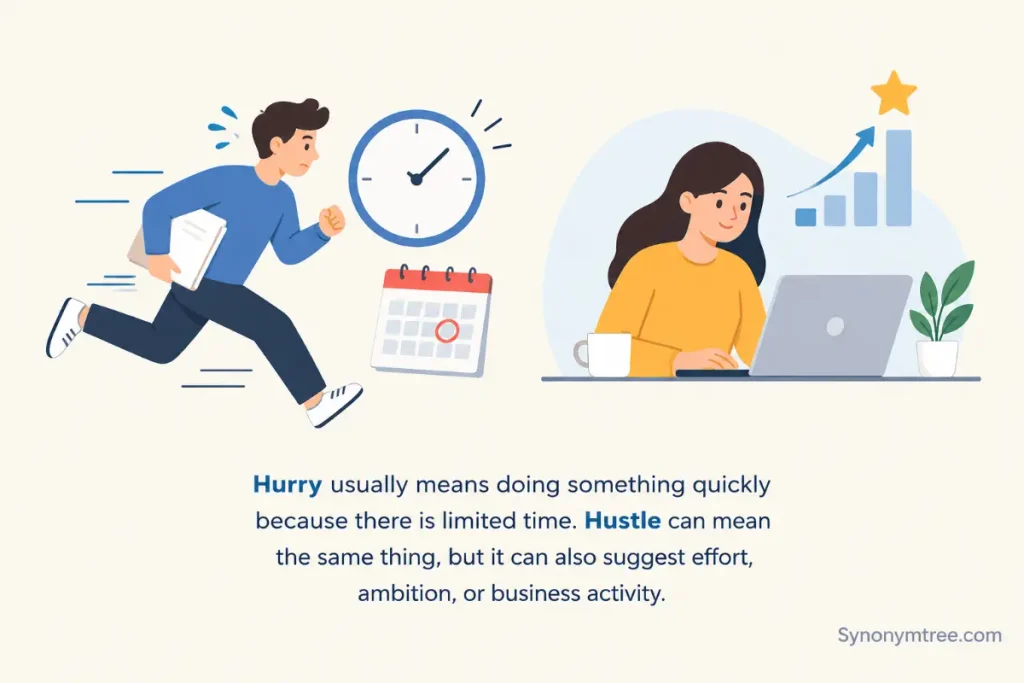
Hurry usually means doing something quickly because there is limited time. Hustle can mean the same thing, but it can also suggest effort, ambition, or business activity.
For example, Hurry up and finish your breakfast focuses on speed. Keep hustling toward your goal focuses on effort over time.
Use hurry when time is the main issue. Use hustle when you want to stress active effort or energetic movement.
Hustle vs Hard Work
Hard work refers to effort that requires time, attention, or physical or mental strength. Hustle often adds a sense of movement, urgency, initiative, or ambition.
A person can do hard work quietly over many months. Someone who hustles may actively search for opportunities, take action, and keep moving toward a target.
The phrases overlap, but they are not exact substitutes in every sentence. Her hard work improved the project sounds calm and direct. Her hustle helped the project move forward adds a sense of drive and action.
Hustle vs Grind
Grind is informal language for steady, tiring, or repeated effort. People often use it when talking about demanding work, long hours, or the slow process of building success.
Hustle can sound more active and focused on taking action or finding opportunities. Grind often draws attention to the effort itself and the fact that it can be difficult.
For example, He is grinding through his studies suggests a long and demanding process. He is hustling to find new clients suggests active efforts to create business opportunities.
Both words are common in casual speech. In formal writing, steady effort, persistent work, or sustained effort may be clearer.
Hustle vs Bustle
Bustle usually describes busy movement and activity around a place or group. It does not normally mean working hard to reach a personal goal.
The bustle of the market describes the movement, noise, and activity in the market. She hustled through the market describes a person moving quickly through it.
This difference matters because hustle often centers on a person’s action, while bustle often describes the general activity of a place.
Hustle vs Strive
Strive means to make a serious effort to achieve something. It is common in formal writing and can sound more measured than hustle.
For example, The company strives to improve customer service sounds suitable for a business report. The company hustles to win new customers sounds more informal and action focused.
Use strive in essays, reports, and professional statements when you want a calm and formal tone. Choose hustle for casual writing or when the idea of fast action and initiative matters.
Hustle vs Scam
A scam is a dishonest plan designed to trick someone, often to take money or private information. Hustle can refer to a scam in some contexts, but it also has positive meanings.
The sentence He has a strong work hustle suggests effort. The sentence He tried to hustle the buyer suggests pressure or possible dishonesty. The surrounding words help readers identify the meaning.
Do not assume that every hustle is a scam. A person who runs a legal side business is not doing something dishonest simply because the activity is called a hustle.
Common Phrases That Use Hustle
The word appears in several everyday expressions. Learning them helps you understand online posts, conversations, work advice, and casual writing.
Side Hustle
A side hustle is work someone does to earn extra money outside a main job or regular source of income. It might involve freelance work, tutoring, selling products, or providing a service.
For example, Aisha runs a side hustle making custom invitations. The phrase tells readers that this is an additional income activity rather than her main job.
A side hustle can be small or serious. It may remain a few hours of work each week, or it may grow into a full time business. The phrase does not tell you how much money the person earns.
Daily Hustle
Daily hustle refers to the work and effort someone puts into everyday responsibilities or goals. It can include a job, family duties, study, or business tasks.
For example, His daily hustle includes working at the shop and studying at night. The phrase emphasizes the effort involved in managing several responsibilities.
The expression is informal. In a formal report, daily work, regular responsibilities, or ongoing effort may fit better.
Keep Hustling
Keep hustling is an encouragement to continue working or making an effort. It is often used to support someone who is building a skill, pursuing a business goal, or trying to improve their situation.
For example, Keep hustling, and keep learning from each project. The phrase is friendly and energetic, but it may sound too casual in a formal letter.
It is also worth remembering that effort needs rest and planning. Working constantly is not the only path to progress. A more balanced message might encourage someone to stay consistent and take care of their health and responsibilities.
Hustle Culture
Hustle culture is a way of thinking that places strong value on constant work, productivity, and career success. It can encourage people to take initiative and build skills. However, it can also create pressure to work long hours and treat rest as wasted time.
For example, The company is trying to move away from hustle culture by setting clear work hours. This sentence uses the term to describe workplace expectations.
The phrase often appears in discussions about burnout, work life balance, ambition, and business. It is not a spelling variant. It uses the standard form of the word.
Work Hustle
Work hustle can refer to the effort someone puts into a job or career. It is an informal expression, and its exact meaning can change from one speaker to another.
For example, Her work hustle helped her earn the trust of her team. A more formal version would be Her strong work ethic helped her earn the trust of her team.
Use the casual expression in conversation or social posts. For a resume or business report, work ethic, initiative, or consistent performance is often more precise.
Is Hustle Formal or Informal?
Hustle is widely understood, but it is often informal. It works well in everyday conversation, social media captions, sports talk, and discussions about side businesses. In formal writing, it depends on the sentence and the intended meaning.
In a school essay, you can use hustle when discussing its meaning in culture or language. If you are writing an academic paper about employment, however, phrases such as sustained effort, self employment, or additional income activity may communicate the point more clearly.
On a resume, the word is usually less effective than a clear statement of your skills and results. Instead of writing I hustle hard, explain what you did. For example, Increased weekly sales by improving customer follow up gives a reader useful information about your work.
In a text message to a friend, the word is natural. You might write, I am hustling to finish this project before Friday. In a professional email, a more direct line may be better, such as I am working to complete the project before Friday.
The key is not to avoid the word entirely. Match it to your audience, purpose, and tone.
Better Choices for Formal Writing
If you want to sound professional, choose a word that names the action more precisely.
Use hardworking when describing a person’s steady effort. Use motivated when describing a person’s desire to achieve a goal. Use resourceful when someone finds practical ways to solve problems. Use persistent when someone continues despite difficulty.
For a resume, action verbs such as developed, organized, improved, managed, created, and increased are often stronger than a general statement about hustle. They show what the person actually did.
For example, instead of writing I hustled to improve customer service, write I improved customer service by responding to requests within one business day. The second sentence gives a specific result and a clear action.
Common Spelling Mistakes to Avoid
The main mistake is writing hussle when you mean hustle. Other errors can appear when people add endings or form related words.
The correct forms include hustle, hustles, hustled, hustling, and hustler. Keep the letters in the same order when adding the ending. For example, hustling does not become hussling, and hustled does not become hussled.
Another common problem is using a noun when the sentence needs a verb. In She hustle every day, the verb does not agree with the subject. The correct sentence is She hustles every day. With I, you, we, or they, the base form is usually correct, as in They hustle every day.
Writers can also use the word without enough context. Saying He is a hustler may praise his business skill or suggest that he tricks people. If the meaning matters, explain what the person does.
Finally, do not assume that a spelling is correct just because it appears in a post, advertisement, or username. Online writing contains errors, and names may use creative spellings. Check a standard dictionary when you need a reliable answer.
Easy Ways to Remember the Correct Spelling
A simple memory trick can help you avoid the mistake. Think of hustle as the standard word for hard work and quick action. Remember the spelling as H U S T L E. There is only one S after the U and one S before the T is not part of the word. The correct sequence is H U S T L E.
You can also connect the word to familiar phrases such as side hustle and hustle hard. Seeing the same spelling in several common expressions helps you remember it.
Another useful method is to practice with a complete sentence. Write, I hustle to reach my goals. Then write, She hustles after work. Finally, write, He started a side hustle. Each example uses the correct form in a different way.
If you are editing a document, use a spell checker, but do not rely on it alone. A spell checker may not flag every error, especially when a misspelling looks like a proper name or a word in a custom dictionary. Read the sentence and check the intended meaning too.
The strongest habit is to learn the correct spelling once and use it consistently. When in doubt, choose hustle for standard English.
Antonyms and Opposite Meanings
An antonym is a word with an opposite or contrasting meaning. Since hustle has several meanings, it does not have one perfect opposite for every sentence.
When hustle means to work hard, possible contrasts include slack off, loaf, or avoid effort. These expressions have different tones. Slack off is informal, while avoid effort is more neutral.
When hustle means to move quickly, words such as linger, dawdle, or move slowly may express the opposite. For example, We hustled to the station contrasts with We lingered at the station.
When hustle means to pressure or deceive someone, honest dealing or fair treatment may provide the contrast. These phrases focus on the behavior rather than speed or effort.
When hustle refers to an extra income activity, there is no single direct antonym. You might say main job to contrast a side hustle with a person’s primary employment, but the terms describe different roles rather than strict opposites.
Choose the opposite based on the meaning you want to express. This is more accurate than treating every use of hustle as the same idea.
Conclusion
The correct spelling is hustle. Use it when you mean hard work, quick movement, active effort, or an attempt to earn money. The form hussle is usually a spelling error in standard English, even though it may appear in creative names or branding.
The word can have a positive meaning when it describes effort and ambition. It can also carry a negative meaning when it refers to pressure or deception. A clear sentence helps readers understand which meaning you intend.
Remember the standard spelling when writing emails, school assignments, social posts, business documents, or everyday messages. If you need a more formal word, try effort, initiative, persistence, or work ethic. For a quick spelling check, choose hustle and keep the extra S out.
FAQs
Is hustle or hussle the correct spelling?
Hustle is the correct spelling in standard English. Hussle is usually a spelling mistake when you mean hard work, quick movement, or an active effort to earn money. A business or artist may still use Hussle as an official name.
Why do people spell hustle as hussle?
People may write hussle because the word sounds different when spoken quickly or because they confuse it with words that contain double consonants. Online posts and creative names can add to the confusion. The standard spelling remains hustle.
What does hustle mean in simple English?
Hustle can mean working hard, moving quickly, or making an active effort to reach a goal. It can also mean pressuring or tricking someone in certain situations. The sentence tells you which meaning applies.
Is hustle a positive or negative word?
Hustle can be positive or negative. It often praises effort, ambition, and initiative, but it can also describe pressure or dishonest behavior. Look at the context before deciding how the word is being used.
What is the past tense of hustle?
The past tense is hustled. For example, We hustled to catch the bus. The spelling keeps one S before the T and does not use the incorrect form hussled.
What is a side hustle?
A side hustle is an activity someone does to earn extra money outside their main job or regular income source. Common examples include tutoring, freelancing, selling handmade goods, and offering local services. It can remain a small extra job or grow into a larger business.
Is hustle appropriate for a resume?
Hustle is usually too informal for a resume when used as a general claim. Words such as motivated, resourceful, persistent, and results focused may communicate your strengths more clearly. Even better, describe a specific action and the result it produced.
Is Hussle ever a correct spelling?
Hussle can be correct as part of a proper name, brand, username, or deliberate creative choice. In ordinary English writing, however, the standard word is hustle. Preserve the spelling of an official name, but use hustle when writing about the common word.

1 thought on “Hustle or Hussle Which Spelling Is Correct”