
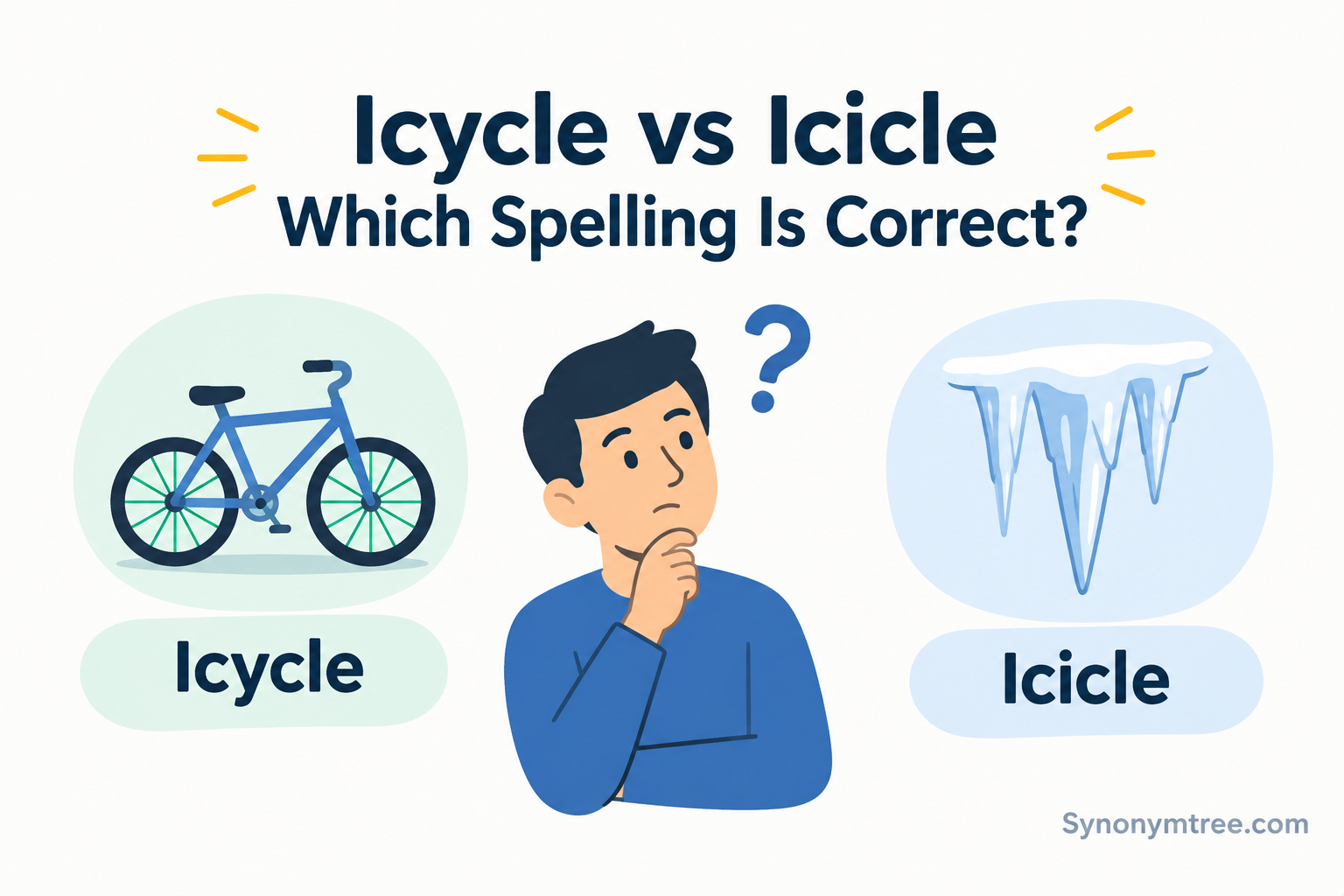
If you are confused about icycle vs icicle, the correct spelling for the pointed piece of ice that hangs from a roof or tree is icicle. The word icycle is not a standard spelling of this noun. Although both forms may look possible at first, only icicle is the accepted word for this common winter sight.
An icicle forms when dripping water freezes in cold weather. You might see one hanging from a roof edge, a tree branch, a gutter, or a rock. These frozen shapes often appear after snow melts slightly and the water freezes again.
The spelling can be confusing because the word begins with the letter I and contains several letters that are easy to mix up. Some people write icycle because they connect the word with ice or think the ending should sound like cycle. That guess is understandable, but it does not match standard English spelling.
This guide explains the correct spelling, the meaning of the word, how icicles form, and how to use the term in everyday writing. You will also find example sentences, related words, common mistakes, memory tips, and answers to frequently asked questions.
Quick Definition
An icicle is a narrow piece of ice that forms when water drips and freezes, often hanging from a roof, gutter, branch, or other surface. The word icycle is not the standard spelling for this object.
Direct Answer
The correct spelling is icicle, not icycle. Use icicle when writing about a pointed piece of ice that hangs from a surface in cold weather.
Icycle vs Icicle Comparison Table
| Word | Meaning | Example Sentence | When to Use It |
|---|---|---|---|
| Icicle | A hanging piece of ice formed by freezing water. | A long icicle hung from the roof. | Use this spelling in standard English. |
| Icycle | A nonstandard spelling of icicle. | He accidentally wrote icycle in his notebook. | Avoid it when referring to a piece of ice. |
| Ice | Frozen water. | The pond was covered with ice. | Use it for frozen water in general. |
| Icy | Covered with ice or very cold. | The sidewalk was icy after the storm. | Use it to describe a surface or condition. |
| Icing | A layer of ice or a sweet topping for food. | A thin layer of ice formed on the window. | Use it when describing a coating or a cake topping, depending on context. |
| Icicle shaped | Shaped like a long, narrow piece of hanging ice. | The glass ornament had an icicle shaped tip. | Use it to describe an object with a similar shape. |
Why Icicle Is the Correct Spelling
The accepted English spelling is icicle. Standard dictionaries use this form for the pointed piece of ice that forms as water freezes while dripping. The spelling does not change just because the word is related to ice.
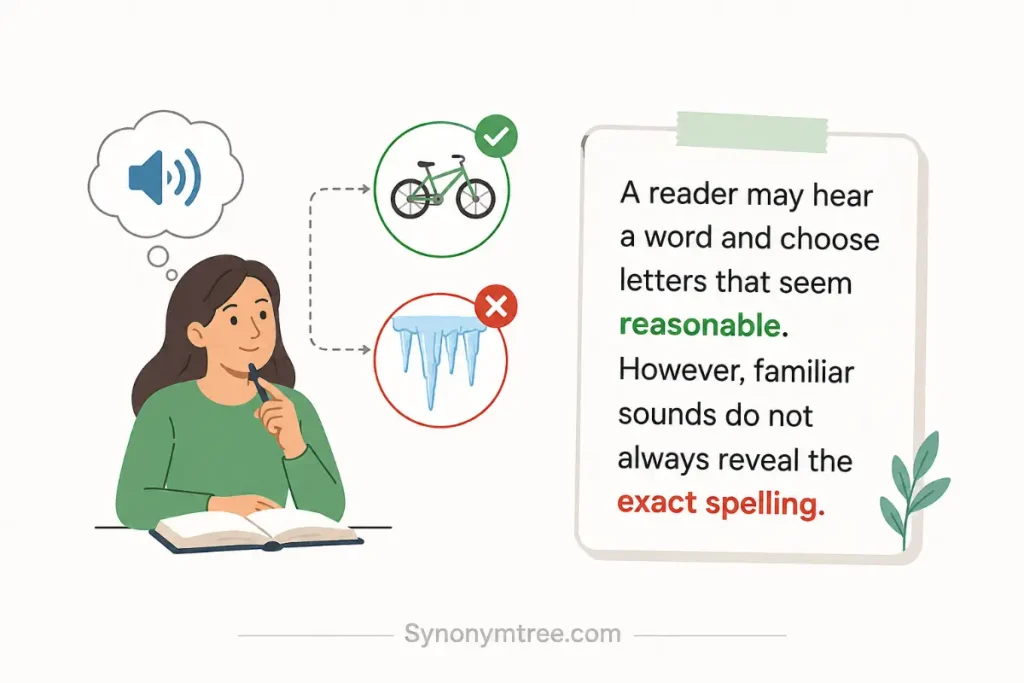
English has many words whose spelling is not easy to predict from their sound. A reader may hear a word and choose letters that seem reasonable. However, familiar sounds do not always reveal the exact spelling.
The word icicle is a good example. It begins with the same letters as ice, but its ending is not written as cycle. The correct form is I C I C L E. Remembering that pattern can help prevent the common mistake.
For example, write The icicle fell from the gutter when the weather warmed. Do not write The icycle fell from the gutter if you mean a piece of frozen water.
The same rule applies in school assignments, weather reports, stories, emails, and everyday messages. If you are writing about the ice hanging from a roof, choose icicle every time.
Why People Write Icycle
People often make spelling mistakes when a word sounds different from the way they expect it to look. The ending of icicle may remind some readers of cycle, which is a separate English word. That connection can lead them to write icycle by mistake.
The spelling of ice may also cause confusion. Since icicle contains the idea of ice, a writer may try to build the longer word directly from the spelling of ice. English does not always form related words in a way that seems obvious, so this approach can fail.
Another cause is simple typing error. Someone may type quickly and choose a familiar sequence of letters without noticing that the result is incorrect. If the word is not flagged by a spell checker, the error can remain in the final text.
Online posts can spread mistakes, too. A misspelled word may appear in a comment, a caption, or an informal message. Seeing it several times can make the spelling look familiar, but repeated use does not make it standard.
The best solution is to remember the full spelling rather than guess from the sound. When you mean a hanging piece of ice, write icicle.
Is Icycle Ever Correct?
In standard English, icycle is not the accepted spelling of the common noun for a hanging piece of ice. If you use it in an essay, report, or ordinary sentence with that meaning, it will usually be treated as a spelling mistake.
There can be special cases involving names. A company, product, username, fictional character, or creative project might use Icycle as a chosen name. Proper names can use unusual spellings for branding or artistic reasons.
For example, a fictional winter village might contain a shop called Icycle. In that case, the spelling belongs to the shop’s name. It should be copied as the owner or creator presents it.
That special use does not change the spelling of the ordinary word. If you are writing about frozen water hanging from a roof, the correct term remains icicle.
What Does Icicle Mean?
An icicle is a long, narrow piece of ice that forms when water freezes as it drips or runs down a surface. It often has a pointed end and a wider upper part where the ice first begins to build up.
Icicles are common in places where temperatures drop below freezing. They may hang from roofs, gutters, tree branches, cliffs, fences, or other surfaces where water collects and drips. Their size depends on the amount of water, the temperature, and the length of time freezing conditions last.
A small icicle may be only a few inches long. A larger one can grow much longer when water continues to drip and freeze. Some icicles are thin and clear, while others look cloudy because they contain tiny air bubbles or other trapped material.
The word usually refers to a naturally formed piece of ice. People may also use it when describing decorations that copy the same shape. For example, a glass ornament with a narrow pointed end might be called an icicle ornament.
How an Icicle Forms
Icicles often begin when snow or ice melts slightly during the day. Water moves across a roof or branch and begins to drip from an edge. If the air and the surface are cold enough, the dripping water freezes.
As more water reaches the same spot, new ice forms around the growing shape. The icicle becomes longer as additional water freezes near its tip. This process can continue as long as the right conditions remain.
The shape is affected by several factors. The rate of dripping, wind, temperature, and the surface from which the water hangs can all change how an icicle grows. That is why icicles in the same area may have different lengths and shapes.
An icicle does not always form in a single period of cold weather. It may grow and shrink as temperatures rise and fall. A sunny afternoon can melt part of it, while a colder night can freeze the remaining water again.
Where Icicles Commonly Appear
Roofs and gutters are common places to find icicles. Meltwater runs toward the edge of the roof, where it can freeze as it drips. Poor drainage or blocked gutters may allow water to collect and freeze in ways that encourage ice buildup.
Tree branches can also support icicles. After snow melts or water runs down a branch, cold air can freeze the dripping water. The result may look like a row of narrow ice points hanging from the wood.
Icicles can form on cliffs and rocky surfaces when water seeps through cracks and freezes. They may also appear near fountains, outdoor pipes, and other places where water is exposed to freezing air.
In each case, the main idea is the same. Water reaches a cold area, freezes, and builds into a hanging shape. The spelling remains icicle regardless of where the ice forms.
Icicle in Real Sentences
Reading the word in natural sentences helps you understand its meaning and remember how to spell it. The following examples cover everyday situations, school writing, creative writing, and weather descriptions.
Everyday Examples
- A clear icicle hung from the corner of our roof.
- The children watched a tiny icicle form beside the back door.
- I noticed an icicle hanging from the gutter after the snow melted.
- The morning sun made the icicle sparkle.
- A long icicle dropped from the branch during the afternoon.
- We stayed away from the icicle because it looked ready to fall.
- The icicle grew longer as water continued to drip from the roof.
- She took a photograph of an icicle beside the window.
- Several icicles hung from the old wooden shed.
- The icicle melted when the temperature rose above freezing.
These sentences show the word used as a noun. It names a specific object, so it can appear with words such as a, the, long, small, clear, or pointed.
Examples for School Writing
- An icicle forms when dripping water freezes in cold conditions.
- The icicle became longer as more water froze around its tip.
- Icicles often form along roof edges during winter.
- A change in temperature can cause an icicle to melt.
- The science class studied how an icicle grows.
- Strong sunlight may melt the surface of an icicle.
- The photograph showed an icicle hanging from a tree branch.
- Water from melting snow helped form the icicle.
- Icicles can develop different shapes based on local conditions.
- The student used the word icicle correctly in her report.
These examples work well for basic science explanations and school assignments. They state clear facts without adding extra detail that distracts from the main point.
Examples for Creative Writing
- A silver icicle glittered beneath the frozen roof.
- The narrow icicle looked like a crystal spear in the morning light.
- One icicle trembled above the quiet path.
- The old cabin had icicles hanging from every corner.
- Moonlight shone through the clear icicle.
- A row of icicles framed the window like glass teeth.
- The icicle broke with a sharp crack and fell into the snow.
- A tiny icicle hung from the edge of the wooden sign.
- The frozen garden sparkled with ice and icicles.
- She watched the last icicle melt beside the porch.
Creative writing can use comparisons to help readers picture the shape, color, or movement of an icicle. The object itself remains a piece of ice, but the description gives the scene more detail.
Icicle as a Noun
Icicle is a countable noun. This means you can talk about one icicle or several icicles. The plural form is made by adding S to the singular word.
For example, One icicle hung from the gutter. Several icicles hung from the gutter. The spelling of the singular form does not change when you make it plural, except for the added S at the end.
You can use articles and describing words with the noun. Examples include an icicle, the icicle, a long icicle, a clear icicle, and several large icicles. These combinations help identify a particular piece of ice or describe its appearance.
The word can also work as part of a longer noun phrase. An icicle formation describes a group or arrangement of icicles. An icicle ornament describes a decoration shaped like one. In these phrases, icicle helps explain the form or type of the object.
Singular and Plural Forms
| Form | Use | Example Sentence |
|---|---|---|
| Icicle | One hanging piece of ice. | An icicle formed near the roof. |
| Icicles | More than one hanging piece of ice. | Icicles covered the edge of the shed. |
| Icicle shaped | Describes an object with a similar shape. | The lamp had an icicle shaped glass piece. |
| Icicle like | Compares something to an icicle. | A narrow icicle like point hung from the branch. |
When writing about more than one, remember the plural form icicles. Do not write icycle or icycles when you mean the ordinary noun.
Icicle vs Ice
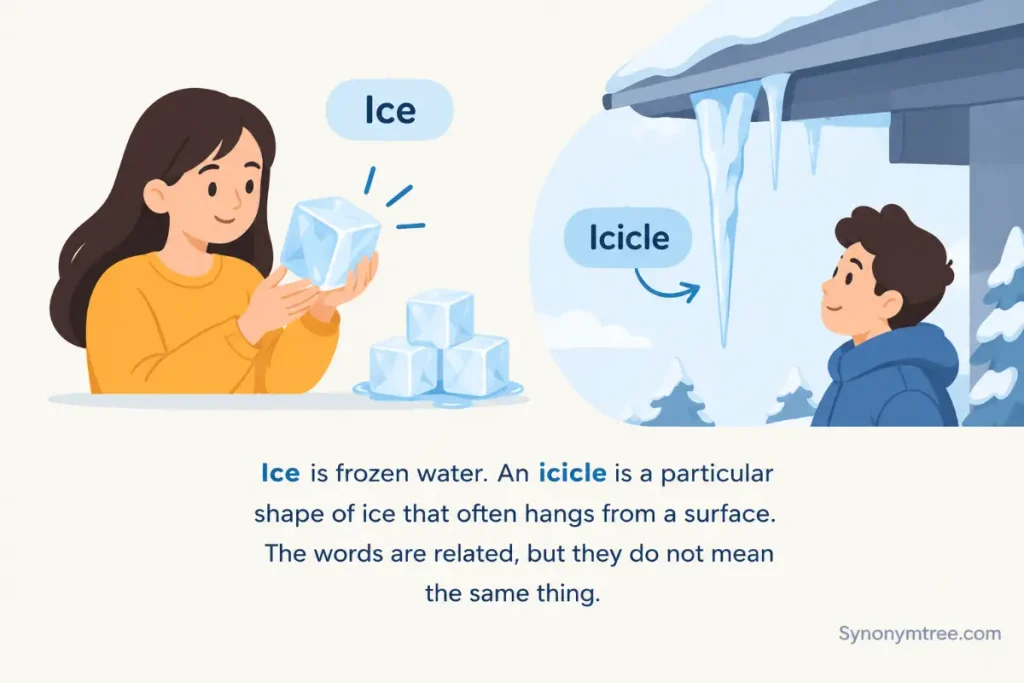
Ice is frozen water. An icicle is a particular shape of ice that often hangs from a surface. The words are related, but they do not mean the same thing.
You can find ice in a glass, on a frozen pond, or across a road. An icicle usually forms when water freezes while dripping or running down an edge. Every icicle is made of ice, but not every piece of ice is an icicle.
Consider these examples. The pond was covered with ice describes a broad frozen surface. A pointed icicle hung from the roof describes one hanging piece.
This difference helps you choose the right word. Use ice for frozen water in general. Use icicle when you want to name the narrow, hanging formation.
Icicle vs Icy
Icy is an adjective. It describes something that is covered with ice, slippery because of ice, or very cold in a figurative sense.
For example, The road was icy means the road had ice on it or was slippery because of freezing conditions. The icicle hung from the roof means a specific piece of ice was hanging there.
You can use both words in one sentence. An icicle hung above the icy steps. Here, icicle names the object, while icy describes the steps.
This is a useful distinction for writers. A noun names a thing, while an adjective describes a person, place, object, or condition.
Icicle vs Ice Cube
An ice cube is a small piece of ice, often shaped in a square or rectangle and made in a freezer tray. An icicle is usually long and narrow, with a pointed end, and forms as water freezes while dripping.
Both words refer to frozen water, but the objects are different. You would put an ice cube in a drink. You might see an icicle hanging from the roof outside.
The terms are not interchangeable. If you are describing a hanging piece of natural ice, use icicle. If you are describing the small pieces used to cool a drink, use ice cubes.
Common Mistakes With Icicle
The most common error is writing icycle instead of icicle. Since the words look similar, it is easy to overlook the difference while typing or proofreading. Remember the standard letter sequence: I C I C L E.
A second mistake is writing the plural incorrectly. The plural is icicles, not icycle s or icycles. Adding S to the correct singular form gives you the standard plural.
Another problem is confusing the noun with the adjective icy. The sentence The roof was icy describes a condition. The sentence An icicle hung from the roof names an object. Using the wrong form can make the meaning unclear.
Writers sometimes use icicle when they mean ice in general. For example, The drink had an icicle in it may be inaccurate if the drink contains an ordinary cube of ice. A better sentence would be The drink had an ice cube in it.
Finally, do not assume a word is correct simply because it appears in a search result or social media post. People make spelling errors online, and some names use creative spellings. For normal writing, choose icicle.
How to Correct the Mistake While Editing
When you proofread, look for the letter sequence I C Y C L E or other forms that may have appeared by accident. If the sentence refers to a hanging piece of frozen water, replace the incorrect form with icicle.
Read the whole sentence after making the correction. This helps you confirm that the word fits the meaning. For example, The icicle melted in the sun makes sense because a piece of ice can melt. The icy melted in the sun does not express the same idea.
A spell checker can help, but it should not be your only tool. Some programs may miss a mistake if the incorrect form appears in a name or has been added to a personal dictionary. Checking the meaning and spelling together is more reliable.
If you write the word often, save a correct example in your notes. A sentence such as A sharp icicle hung from the roof gives you a simple model to remember.
Easy Ways to Remember Icicle
A memory trick works best when it connects the spelling to a picture or a short phrase. Since an icicle is made of ice, you can begin by remembering that it contains the letters I and C at the start. Then focus on the full spelling rather than guessing the ending.
One helpful method is to break the word into spoken parts: eye, sih, kuhl. This is only a rough sound guide, but it can help you connect the letters with the word. The spelling itself is still I C I C L E.
You can also picture a long piece of ice hanging from a roof. Imagine writing the word icicle underneath the picture. Repeating the image and spelling together can make the correct form easier to recall.
Another method is to compare it with ice. The word ice is short, while icicle names a particular formation made of ice. Do not add the letters from cycle to create a new spelling. Learn icicle as a complete word.
Practice With Short Sentences
Try reading these sentences and noticing the spelling.
- The icicle hung from the roof.
- The icicle melted in the afternoon sun.
- Two icicles formed beside the window.
- The child pointed at a clear icicle.
- Icicles can form when dripping water freezes.
You can also cover the word and try to spell it from memory. Check your answer afterward. A few short practice rounds can be more useful than repeatedly reading a long explanation.
When to Use Icicle in Different Types of Writing
The word is suitable for many kinds of writing because it names a common natural object. The main thing to consider is the level of detail your audience needs.
In School Assignments
Use icicle in science reports, spelling exercises, descriptive writing, and reading responses. If you are explaining how one forms, give a simple definition and describe the freezing process.
For example, An icicle forms when water drips from a surface and freezes in cold air. This sentence is direct and suitable for a basic school report.
In Stories and Poems
The word can help create a clear picture of a winter setting. Writers may describe an icicle as clear, sharp, long, sparkling, or pointed. Such details tell readers what the object looks like without changing its meaning.
For example, A narrow icicle shone beside the dark window. The sentence uses the correct noun and gives the reader a simple visual detail.
In Emails and Everyday Messages
You can use icicle naturally when talking about cold weather or a problem around a building. For example, There is a large icicle hanging above the front steps, so please use the other entrance.
That message also shows why the word can matter in practical situations. A falling icicle can cause injury, so clear wording helps people understand the concern.
In Professional or Technical Writing
Use icicle when the term fits the subject. A building maintenance report might mention icicles near gutters or roof edges. A weather report might describe icicle formation during freezing conditions.
If you are writing for a specialist audience, add details that help explain the cause or risk. However, there is no need to replace the ordinary word with a complicated term when icicle says exactly what you mean.
Icicles and Safety
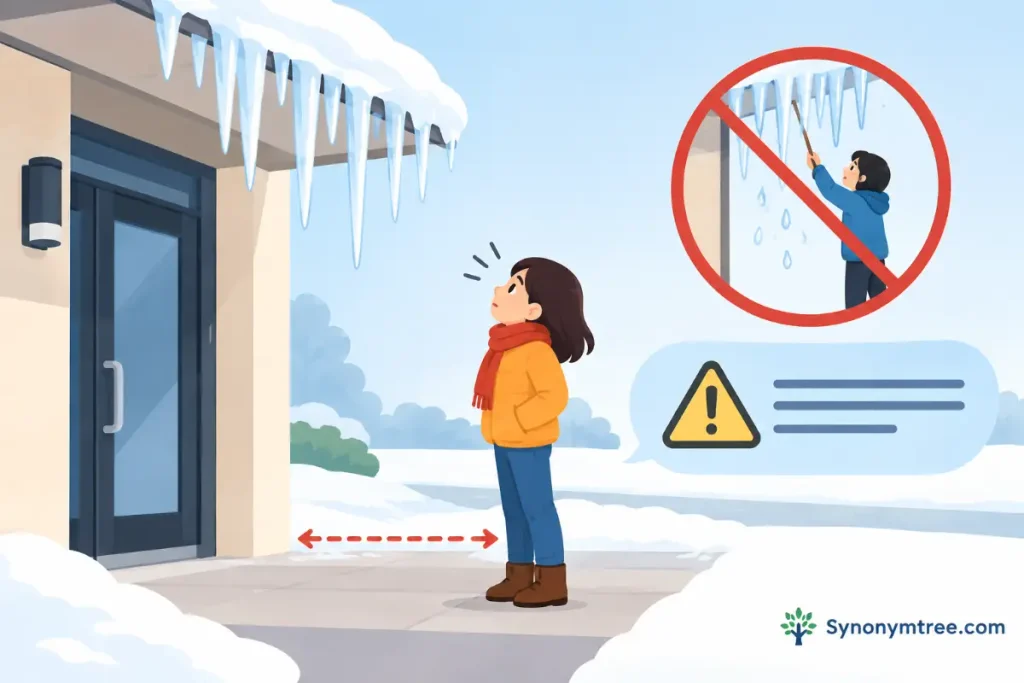
Icicles can look beautiful, but large ones may be dangerous. A heavy icicle can fall without much warning, especially when temperatures change or the ice begins to melt. It is wise to avoid standing directly under large formations.
If you notice large icicles above a doorway, walkway, or parking area, keep a safe distance. Do not try to knock them down while standing underneath. Ice can fall in unexpected directions, and a person may be injured.
Homeowners may also need to check roof edges and gutters during freezing weather. Blocked drainage can contribute to ice buildup. If a large formation creates a hazard, it may be safer to contact a qualified professional rather than attempt removal alone.
This safety information is useful when describing icicles in a practical setting. The word is not only part of winter vocabulary. It can help people explain a real condition around a home, school, or workplace.
Conclusion
The correct spelling is icicle, not icycle. An icicle is a narrow piece of ice that forms when dripping water freezes, often hanging from a roof, gutter, tree branch, or rock. The standard spelling stays the same in singular and plural forms, with icicles used for more than one.
The mistake usually happens because the word can be hard to spell from sound alone. Some readers also connect its ending with the word cycle. Instead of guessing, remember the full letter sequence and use the word in a short sentence.
When writing about frozen water in general, choose ice. When describing a surface covered with ice, use icy. When you mean the long, hanging formation, use icicle. This simple distinction will help you choose the right word and avoid the spelling error in your next message, assignment, or article.
FAQs
Is it icycle or icicle?
The correct spelling is icicle. It refers to a narrow piece of ice that hangs from a roof, branch, or another surface. Icycle is not the standard spelling for this object.
What is the meaning of icicle?
An icicle is a pointed or narrow piece of ice formed when dripping water freezes. It often hangs from a roof edge, gutter, tree branch, or rocky surface. Icicles commonly appear during freezing weather.
Why is icycle incorrect?
Icycle is not the standard English spelling of the noun for hanging ice. The accepted spelling is icicle. People may confuse the forms because the word sounds similar to other familiar words.
What is the plural of icicle?
The plural is icicles. For example, Several icicles hung from the roof. Add S to the singular word to form the plural.
How do you use icicle in a sentence?
You can write, A long icicle hung from the gutter after the snow melted. The word names a piece of ice that forms as water freezes while dripping. It can be used in everyday writing, stories, and school assignments.
Is an icicle the same as ice?
No. Ice is frozen water in general, while an icicle is a particular shape of ice that often hangs from a surface. An ice cube and an icicle are both made of ice, but they have different shapes and usually form in different ways.
Can icycle be used as a name?
Yes, a person or business could choose Icycle as a brand name, username, or creative name. In that case, the spelling belongs to the name. For the ordinary English word, use icicle.
What is an easy way to remember icicle?
Remember the full spelling I C I C L E. Picture a long piece of ice hanging from a roof and write the word underneath it. Practicing a short sentence such as The icicle melted in the sun can help you recall the spelling.

2 thoughts on “Icycle vs Icicle Which Spelling Is Correct”