
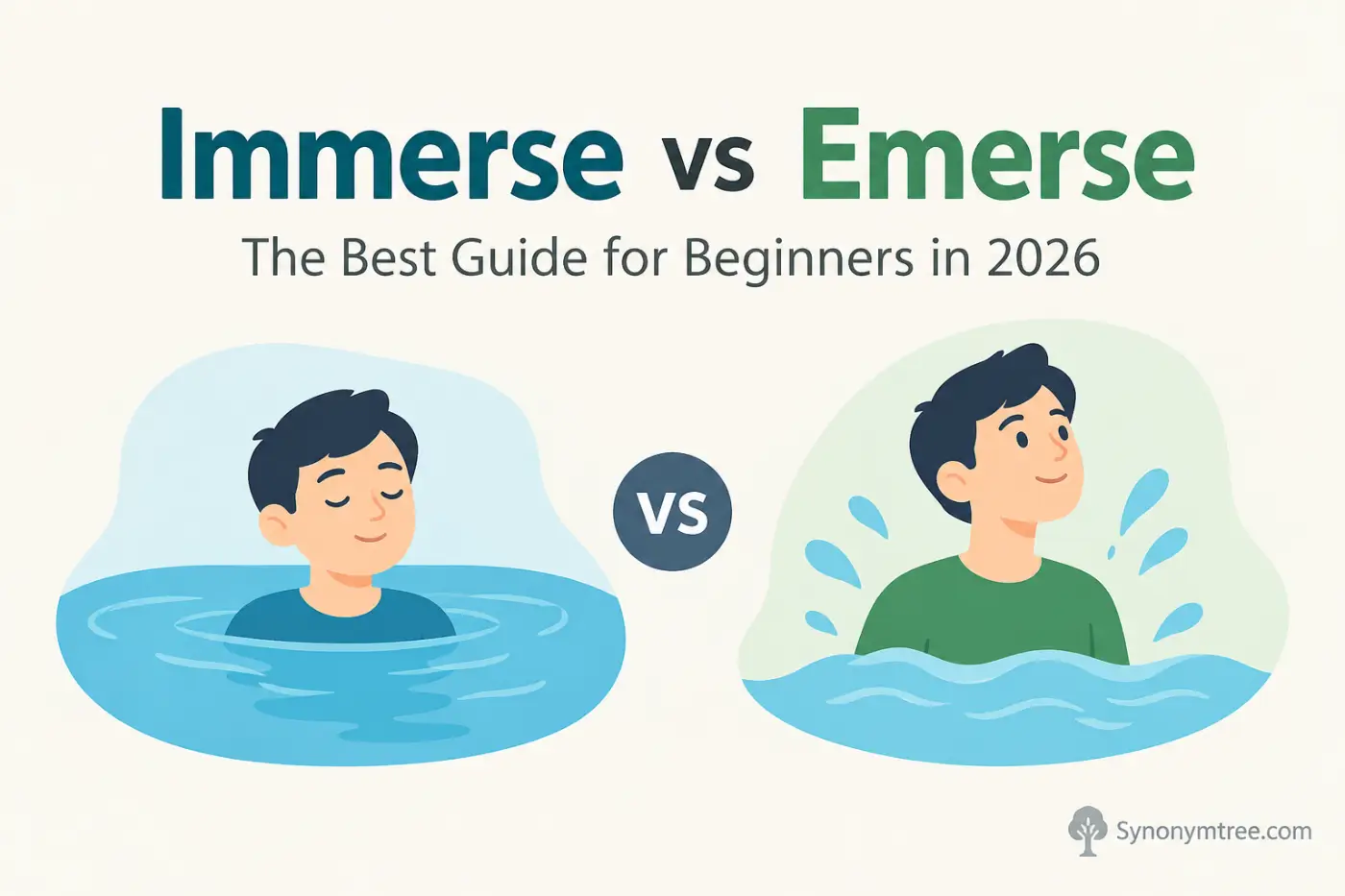
Have you ever learned a new English word and wondered if another word with a similar spelling means the same thing? Immerse vs emerse is a good example of this kind of confusion. The words look almost alike, but only one is commonly used in everyday English.
The correct word in most situations is immerse. It means to put something into a liquid or become deeply involved in an activity, subject, or experience. For example, you can immerse a cloth in water or immerse yourself in a good book.
The word emerse is much less common. It appears mainly in specialized scientific writing and describes something emerging from water or another surrounding substance. If you want to speak and write natural English, learning the difference between these words will help you choose the right one.
Simple Answer in One Look
Immerse is the word you should use when you mean to put something into a liquid or become deeply involved in something. Emerse is a rare technical word related to coming out of water or another surrounding substance.
For everyday writing, learning, and conversation, immerse is almost always the word you need.
What Does Immerse vs Emerse Mean in Simple English?
Let’s understand both words with simple examples. Imagine you have a cup of water and a small sponge. When you push the sponge into the water, you immerse it. Now imagine a plant growing in a pond. When part of the plant comes above the water, that part has emerged from the water.
These two actions move in different directions. One goes into something, and the other comes out of it. That basic idea helps explain the difference between immerse and emerse.
What Does Immerse Mean?
The word immerse means to put something fully into a liquid or become deeply involved in an activity. You can use it for physical actions and experiences that involve your attention, time, or feelings.
For example, when you immerse your hands in warm water, you place them in the water. When you immerse yourself in learning English, you spend time reading, listening, speaking, and practicing the language. You give the activity your attention instead of doing it only once in a while.
The word also describes becoming deeply interested in something. A student who reads a story with full attention may become immersed in the story. The student might forget about the time because the story has captured their interest.
Here are some simple examples that show how to use immerse correctly.
- I immerse my hands in warm water.
- She likes to immerse herself in books.
- He wants to immerse himself in English practice.
- We immersed the cloth in a bucket of water.
- The children became immersed in the game.
Notice how the word works in each sentence. It can describe putting something into a liquid or giving your full attention to an activity.
What Does Emerse Mean?
Emerse is a rare word used mainly in scientific or specialized writing. It can describe something that rises out of water or becomes uncovered by water. You may find it in discussions about plants, land, or other natural objects.
For example, a scientific text might describe part of a plant as emerse when it grows above the water’s surface. This use is much less common than everyday words such as emerge, rise above, or come out of the water.
For most English learners, the key point is simple. You do not need to use emerse in normal conversation. If you mean that someone or something comes out of water, emerge is usually the more natural choice.
Compare these sentences to see the difference.
- I immerse the toy in water.
- The toy emerges from the water.
- The scientist describes the plant as emerse.
The first sentence describes going into water. The second describes coming out of water. The third uses a rare technical word to describe a condition or position.
This is why the spelling matters. A small change in letters can lead to a different meaning and a different use.
Why Do People Mix Up Immerse and Emerse?
People often mix up immerse and emerse because the words look and sound similar. Both contain the letters m, e, r, and s in a similar order. If you are still learning English, it is easy to think that both words are equally common or that one is simply another spelling of the other.
However, similar spelling does not always mean similar use. English has many pairs of words that look alike but have different meanings. The best way to learn them is to look at what each word does in a sentence.
The Words Look Almost the Same
When you read quickly, you may not notice the difference between the first few letters. Your brain may treat the words as the same because you recognize a familiar pattern.
This can lead to mistakes in schoolwork, emails, essays, and online posts. You might write emerse yourself in a book when you mean immerse yourself in a book.
The easiest way to avoid this mistake is to remember the common word first. Immerse is used in everyday English for learning, reading, travel, water, and many other activities.
Both Words Can Relate to Water
Another reason for confusion is that both words can appear in descriptions of water. Yet they do not express the same action.
Imagine placing a stone into a pond. You immerse the stone in the water. If the stone later rises out of the water, it emerges. The first action moves into the water, while the second moves out of it.
This simple picture can help you remember the difference. Think of immerse as going in and emerge as coming out.
People May Confuse Emerse With Emerge
A more useful comparison for everyday English is emerse versus emerge. The word emerge is common and means to come out, appear, or become known.
For example, a person may emerge from a room, a bird may emerge from its nest, or a new fact may emerge during a conversation. You can use this word in many daily situations.
By contrast, emerse is rare and mostly technical. If you are writing a school essay or having a normal conversation, emerge will usually be the better choice when you mean coming out or becoming visible.
Clear Difference Between Immerse and Emerse
The main difference between immerse and emerse is how people use them and how common they are. Immerse is a familiar English word with several everyday uses. Emerse is rare and mainly appears in specialized descriptions of things that rise above water.
The following comparison makes the difference easier to remember.
- Immerse. To put something into a liquid or become deeply involved in an activity. Example: I immerse myself in reading every evening.
- Emerge. To come out of something, appear, or become visible. Example: The swimmer emerged from the pool.
- Emerse. A rare technical word associated with rising above water or being above a surrounding substance. Example: A botanist may describe a plant part as emerse when it grows above the water’s surface.
Notice that emerge is the common opposite of immerse when you describe movement into and out of something. You will find it much more useful in everyday English than emerse.
A Simple Way to Remember the Difference
Imagine stepping into a swimming pool. As you lower yourself into the water, you immerse yourself. When you climb out of the pool, you emerge from the water.
This example gives you a clear picture of both actions. You do not need to memorize a difficult grammar rule. Just connect each word to the action it describes.
You can also use this idea when talking about learning. When you immerse yourself in English, you spend time using the language. When you emerge from a difficult lesson, you have finished it and can move on to something new.
Which Form Should You Use?
Use immerse when you want to describe putting something into a liquid or giving your full attention to an activity. In most everyday situations, this is the correct choice.
Use emerge when you want to say that something comes out, appears, or becomes visible. Use emerse only when you are working with a technical text that specifically requires this rare word.
Here are three simple rules to follow.
- If something goes into water, use immerse. For example, immerse the cloth in warm water.
- If something comes out of water, use emerge. For example, the swimmer emerged from the pool.
- If you are describing a plant or another object in a scientific context, check the source to see if emerse is the intended technical term.
These rules will help you avoid most mistakes. You do not need to use a rare word just because it looks similar to a familiar one.
Is Immerse the Correct Word for Learning?
Yes. Immerse is the correct and natural word when you mean to give your time and attention to learning.
For example, you might say, “I want to immerse myself in English.” This means you want to practice English often and make it part of your daily life.
You can do this by reading short stories, watching videos, listening to conversations, and speaking with other people. The goal is to spend enough time with the language that it starts to feel more familiar.
You can also immerse yourself in history, music, science, art, or another subject. The word works because it shows deep involvement rather than a quick look or a little bit of practice.
Can You Use Emerse in Everyday Conversation?
You can find emerse in specialized writing, but most people do not use it in normal conversation. If you want to describe something coming out of water, emerge is clearer and more familiar.
For example, you would normally say, “The turtle emerged from the water.” You would not need to use emerse to express this idea.
Good writing is not about choosing the rarest word. It is about choosing the word that gives your reader the right meaning without making them stop and guess.
Easy Real Life Sentences You Can Use
The best way to learn a word is to see how people use it in real situations. The following sentences show how immerse works in everyday English. Read them slowly and notice how the meaning changes with the situation.
- I immerse myself in a book before bed.
- She immersed her feet in warm water.
- He wants to immerse himself in American culture.
- We immersed the dirty clothes in soapy water.
- My teacher encouraged me to immerse myself in English.
- The children were immersed in their favorite game.
- I like to immerse myself in music while I study.
- She became immersed in the story and forgot about the time.
Each sentence uses the word naturally. Some describe a physical action, while others describe attention or interest.
Examples With Emerge
Now look at a few sentences with emerge. This word is useful when something comes out, appears, or becomes known.
- The cat emerged from under the bed.
- The sun emerged from behind the clouds.
- The swimmer emerged from the water.
- A new problem emerged during the meeting.
- The truth emerged after a long discussion.
These examples show why emerge is the better everyday word when you want to describe something coming out or appearing. It works for people, animals, objects, and even ideas.
Examples With Emerse
Because emerse is rare, you are less likely to need it in daily conversation. You may encounter it in botanical or scientific descriptions of objects that extend above water.
- A botanical guide may describe an emerse plant part as growing above the water’s surface.
- A scientific report may use emerse to describe a structure that remains above the surrounding water.
- A student reading about aquatic plants may see emerse used to describe a plant’s position in relation to water.
These examples show a specialized use rather than a common conversational pattern. If you come across the word in a science book, read the sentence around it to understand its exact meaning.
Where the Words Come From
Learning a little about a word’s history can make it easier to remember. You do not need to study long lists of old words. A simple connection is often enough.
The word immerse comes through Latin from a word meaning to plunge or dip into something. This history fits its modern meaning. When you immerse an object in water, you place it into the liquid. When you immerse yourself in a subject, you become deeply involved in it.
The word emerge also comes from Latin. Its history relates to rising or coming out. This connection fits the way we use it today. A person emerges from a room, a fish emerges from the water, and a new idea may emerge during a discussion.
The rare word emerse belongs to the same general group of words used to describe position or movement in relation to water. Its specialized use is much less familiar than the everyday use of immerse and emerge.
The easiest way to remember these words is to connect them to actions. Immerse means going into something. Emerge means coming out or appearing. Emerse is a rare technical term you may meet in scientific writing.
Moving From Basic Meaning to Deeper Understanding
Now you know the basic difference between immerse, emerge, and emerse. You also know why immerse is the right choice for most everyday situations involving learning, reading, water, and deep interest.
However, understanding a word means more than memorizing its definition. You also need to know how it fits into a sentence, how its meaning changes in different situations, and which similar words people commonly confuse with it.
In the next section, we will look more closely at these uses, explore common mistakes, and answer practical questions that can help you use the words with greater confidence.

How Immerse vs Emerse Is Understood in Culture and Stories
Words often carry more than one meaning. They can describe an action, but they can also help us explain feelings, choices, and life experiences. The difference between immerse and emerse becomes easier to understand when we connect the words to situations we see in books, movies, and everyday life.
The word immerse often appears when a person becomes deeply involved in something. A character might immerse herself in painting after a difficult day. A young student might immerse himself in learning a new language. In both cases, the word shows strong interest and attention.
Think about a character who loves reading. When the character opens a book and becomes so interested that the rest of the room seems to disappear, the writer might say the character is immersed in the story. This helps readers understand the character’s feelings without needing a long explanation.
In stories about travel, people may immerse themselves in a new culture. They might learn local customs, try new foods, listen to local music, and speak with people who live there. The word describes active involvement rather than simply visiting a place.
The word emerse has no widely established cultural meaning in everyday English. It mainly appears in specialized contexts. For ordinary storytelling, writers usually choose words such as emerge, rise, or come out when describing something becoming visible or leaving a place.
For example, a hero may emerge from a dark cave after facing a challenge. A person may emerge from a difficult period with new confidence. These examples show how the common word emerge can describe both a physical action and a change in someone’s life.
Biblical and Mythological Meaning of Immerse vs Emerse
The words immerse and emerse do not have special biblical or mythological meanings of their own. However, the ideas behind immersion and emergence can help readers understand scenes in religious stories and ancient myths.
In the Bible, water appears in many important stories. It can be connected with cleansing, change, danger, or a fresh start. Christian baptism is one familiar example. In many Christian traditions, baptism with water represents faith, spiritual cleansing, and a new life. Some forms of baptism involve immersion, in which a person is placed under water.
The word immerse can help describe the physical action of placing someone under water. However, its everyday meaning is broader than any one religious practice. People can immerse themselves in prayer, reading, study, or quiet thought without entering water.
Ancient myths also contain stories about people crossing rivers, rising from the sea, or returning from hidden places. These actions can represent a change in a character’s life. A hero who emerges from a dangerous journey may return wiser or stronger than before.
Still, we should keep the meanings clear. These are examples of how the ideas of immersion and emergence appear in stories. They do not mean that emerse has a special religious meaning or that the two words are interchangeable.
For English learners, the practical lesson remains the same. Use immerse when you mean to enter something or become deeply involved. Use emerge when you mean to come out, appear, or become known.
Symbolism Explained in Simple Words
Symbolism happens when a word, object, or action stands for a larger idea. For example, a sunrise can represent hope, while a closed door can represent a missed chance. Words connected with water can also suggest change, learning, and new beginnings.
When comparing immerse and emerse, remember that emerse is a rare technical word. It does not have a widely accepted symbolic meaning in ordinary English. The more useful comparison is between immerse and emerge.
What Immerse Represents
The word immerse can suggest deep attention, commitment, discovery, or personal growth. When someone immerses themselves in an activity, they give it more than a quick glance. They spend time and energy on it.
For example, a student who immerses herself in learning English may read every day, listen to conversations, and practice speaking. This action can represent patience and a desire to improve.
In a story, immersion can also show that a character is escaping from daily worries by focusing on something meaningful. A person might immerse himself in music to relax after a hard day. Another might immerse herself in gardening because it brings her peace.
These meanings come from the context of the sentence. The word itself does not always represent a particular feeling. It simply describes deep involvement, and the situation tells readers what that involvement means.
What Emerse Represents
The rare word emerse does not carry a common emotional or cultural meaning. In specialized descriptions, it relates to being above water or another surrounding substance.
If a writer wants to describe a person coming out of a difficult situation, emerge is usually the right word. It can suggest recovery, discovery, or a fresh start.
For example, someone who emerges from a challenging year may feel stronger and more confident. A hidden fact that emerges during an investigation becomes known. A plant that emerges above the soil becomes visible.
These examples show why emerge is useful in both everyday speech and storytelling. It can describe a physical action or a change in someone’s situation.
Related Words You Should Know
Learning related words helps you choose the right expression without guessing. The words below are especially useful because some of them share meanings with immerse or emerge, while others describe actions that are almost the opposite.
- Immerse. To put something into a liquid or become deeply involved in an activity. Example: She wants to immerse herself in French.
- Immersion. The act of putting something into a liquid or becoming deeply involved in an experience. Example: Language immersion helps students practice a language regularly.
- Immersed. Deeply involved in an activity or surrounded by a liquid. Example: He was immersed in his homework.
- Immersive. Something that makes you feel deeply involved in an experience. Example: The museum offered an immersive tour.
- Emerge. To come out, appear, or become known. Example: The sun emerged from behind the clouds.
- Emergence. The act of appearing or coming into view. Example: The emergence of new ideas changed the project.
- Emerging. Starting to appear, grow, or become known. Example: She is an emerging artist.
- Submerge. To put something completely under water or another liquid. Example: Submerge the bottle in cold water.
- Immerse yourself. To give your attention to an activity or experience. Example: Immerse yourself in English by reading and listening every day.
- Engage. To take part in something or become involved with it. Example: Students engage in class discussions.
- Absorb. To take something in, such as liquid, information, or ideas. Example: Children absorb new words through practice.
- Participate. To take part in an activity. Example: I participate in an English speaking club.
One useful detail is that immerse and submerge can both describe placing something under water. However, immerse also has a common figurative meaning related to attention and involvement. Submerge often places more focus on being covered or pushed beneath a surface.
The word emerge is different from both. It describes something coming out or becoming visible. Knowing these related words gives you more choices and helps you express your meaning clearly.
How People Actually Use Immerse in Daily English
People use immerse in many situations. You might hear it in a classroom, at work, during travel, or in a conversation about hobbies. It often appears when someone wants to explain how they spend time learning, exploring, or enjoying an activity.
Here are some natural examples that show how the word fits into daily life.
- Learning English. “I want to immerse myself in English before my exam.” This means the speaker plans to spend plenty of time practicing the language.
- Reading. “She immersed herself in the novel all weekend.” This means she spent a lot of time reading and became deeply interested in the story.
- Travel. “We immersed ourselves in the local culture.” This means the travelers took part in local activities and learned about the people and their customs.
- Cooking. “Immerse the vegetables in cold water before cleaning them.” This describes placing the vegetables in water.
- Music. “He likes to immerse himself in music after work.” This means music receives his full attention and helps him relax.
- Work. “I need to immerse myself in this project today.” This means the speaker wants to focus closely on the project.
- Art. “The children immersed themselves in painting.” This means they spent time painting with interest and attention.
- Science. “The teacher immersed the object in water during the experiment.” This describes placing the object into the liquid.
- A new hobby. “She immersed herself in gardening after moving to the countryside.” This means she became deeply involved in gardening.
Notice that immerse can describe a physical action or a person’s attention. You can often understand which meaning applies by looking at the words around it.
How to Use Immerse Yourself Correctly
The expression immerse yourself in is especially common. It means to become deeply involved in an activity, subject, or experience.
The word yourself changes to match the person in the sentence. You use myself when talking about yourself, yourself when talking to one person, himself for a male person, herself for a female person, and themselves for more than one person.
Here are some examples.
- I want to immerse myself in learning English.
- You can immerse yourself in a good book.
- He immersed himself in his studies.
- She immersed herself in local traditions.
- They immersed themselves in the project.
The word in is important in these examples because it connects the action to the activity or experience. You immerse yourself in a subject, a book, a culture, or a task.
Common Mistakes People Make With Immerse vs Emerse
English learners often make small spelling mistakes when two words look similar. The best way to correct them is to understand the meaning first and then check the sentence.
Mistake One Using Emerse Instead of Immerse
A common mistake is writing emerse when you mean to become deeply involved in something. Since emerse is rare, it usually sounds unnatural in everyday writing.
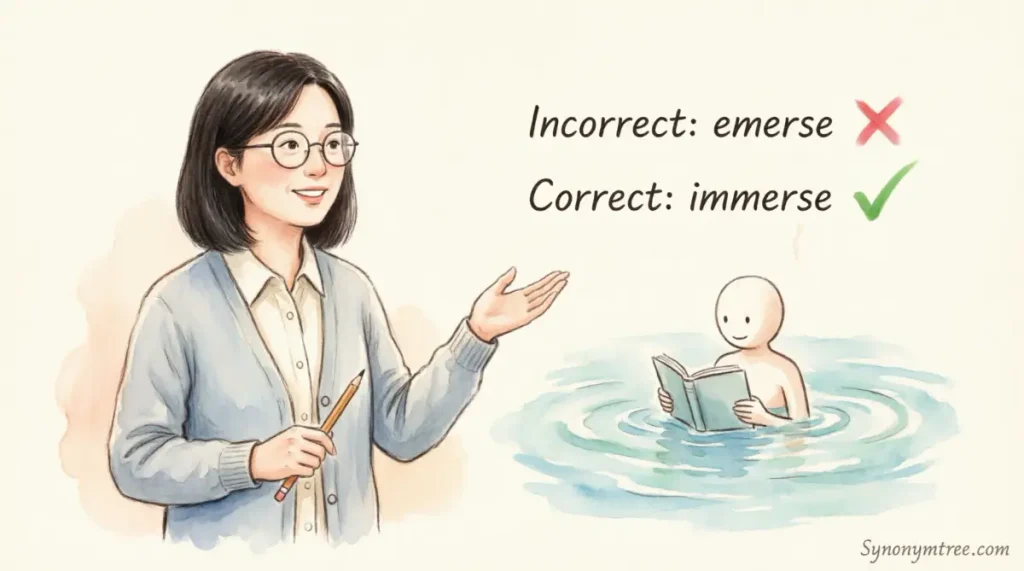
Incorrect: I want to emerse myself in learning English.
Correct: I want to immerse myself in learning English.
The corrected sentence tells the reader that you want to spend time and attention on learning. Remember that immerse is the common word for this meaning.
Mistake Two Using Immerse When You Mean Emerge
Another mistake is using immerse when something comes out of water or another place.
Incorrect: The swimmer immersed from the pool.
Correct: The swimmer emerged from the pool.
The swimmer is coming out of the water, so emerged is the right word. Immersed would describe going into water or becoming deeply involved in something.
Mistake Three Thinking Emerse and Emerge Are the Same
The words emerse and emerge look similar, but they are not equally common. In everyday English, emerge is the normal choice for appearing or coming out.
Incorrect for ordinary usage: The sun emersed from behind the clouds.
Correct: The sun emerged from behind the clouds.
If you see emerse in a scientific source, check the exact context before changing it. Specialized writing may use the rare word for a particular purpose. In general writing, however, emerge is usually the better choice.
Mistake Four Using Immerse Without Understanding the Meaning
Some learners memorize the spelling of immerse but use it in sentences where it does not fit.
For example, saying “I immersed from the room” does not express the normal meaning. If you mean that you left the room, say “I left the room.” If you want to describe coming out of a hidden or enclosed place, you might say “I emerged from the room,” depending on the context.
Choose the word that matches the action. That simple habit will make your writing clearer.
Mistake Five Forgetting the Correct Sentence Pattern
When you use the expression immerse yourself in, remember to include the correct form of the pronoun.
For example, “She immersed herself in the book” is correct. “She immersed himself in the book” is not correct because the pronoun does not match the subject.
Pay attention to the person doing the action. Small details like this make a sentence sound natural.
Final Teacher Explanation
Imagine we are in an English classroom and I ask you to explain the difference between immerse and emerse. You do not need a long answer. You only need to understand which word people normally use and what it means.
The word immerse is common. It means to put something into a liquid or become deeply involved in an activity. You can immerse your hands in water, immerse yourself in a book, or immerse yourself in learning English.
The word emerse is rare. It mainly appears in specialized writing related to things that rise above water or another surrounding substance. It is not a normal replacement for immerse.
For everyday English, it is also useful to learn the word emerge. It means to come out, appear, or become known. A swimmer emerges from a pool, a bird emerges from its nest, and a new idea may emerge during a discussion.
Here is the easiest way to remember everything. Think about entering and leaving a swimming pool. You immerse yourself when you go into the water. You usually do not need the rare word emerse in ordinary conversation.
As your teacher, I would encourage you to practice these words in short sentences instead of memorizing long definitions. Write one sentence about water, one about reading, and one about learning English. This will help you remember the words and use them naturally.
Final Answer for Immerse vs Emerse
Immerse is the correct word for putting something into a liquid or becoming deeply involved in an activity. Emerse is a rare technical word and is not normally used in everyday conversation.
When you mean to come out, appear, or become visible, use emerge. Remember this simple rule: immerse means go in, and emerge means come out.
Conclusion
The difference between immerse and emerse becomes simple once you focus on meaning rather than spelling. Immerse is the word you will use most often when talking about water, learning, reading, work, hobbies, and personal interests. It can describe a physical action or the feeling of being deeply involved in something.
Although emerse exists in specialized usage, it is not a common word for daily conversation. You will usually communicate more clearly by choosing immerse for deep involvement and emerge for coming out or appearing. When reading scientific material, always pay attention to the context because a rare word may have a specific meaning.
The best way to improve your English is to use the right word in real sentences. Practice a little every day, notice how writers use these expressions, and do not worry about memorizing every rare term. Clear meaning matters more than complicated vocabulary.
Frequently Asked Questions (FAQs)
What Is the Difference Between Immerse and Emerse?
Immerse means to put something into a liquid or become deeply involved in something. Emerse is a rare technical word related to being above water.
Is Immerse or Emerse Correct?
Immerse is the correct choice for most everyday situations involving water, learning, reading, or deep involvement. Emerse has limited specialized use.
Can I Say Immerse Myself in English?
Yes. “I want to immerse myself in English” is correct. It means you want to spend time reading, listening, speaking, and practicing English.
Is Emerse a Real English Word?
Yes. Emerse appears in specialized writing, particularly in descriptions of plants or structures above water. It is uncommon in everyday English.
Is Emerge the Opposite of Immerse?
In many situations, yes. Immerse describes going into something, while emerge describes coming out or becoming visible.
Can I Use Immerse and Emerge in the Same Sentence?
Yes. For example, “The swimmer immersed himself in the water and later emerged from the pool.” Each word describes a different action.
Why Do People Confuse Immerse and Emerse?
The words have similar spellings, so learners may mistake them for interchangeable forms. Their meanings and everyday uses are different.
What Is Another Word for Immerse?
Depending on the sentence, you can use submerge, engage, or absorb. However, these words do not fit every situation in the same way as immerse.

1 thought on “Immerse vs Emerse The Best Guide for Beginners in 2026”