
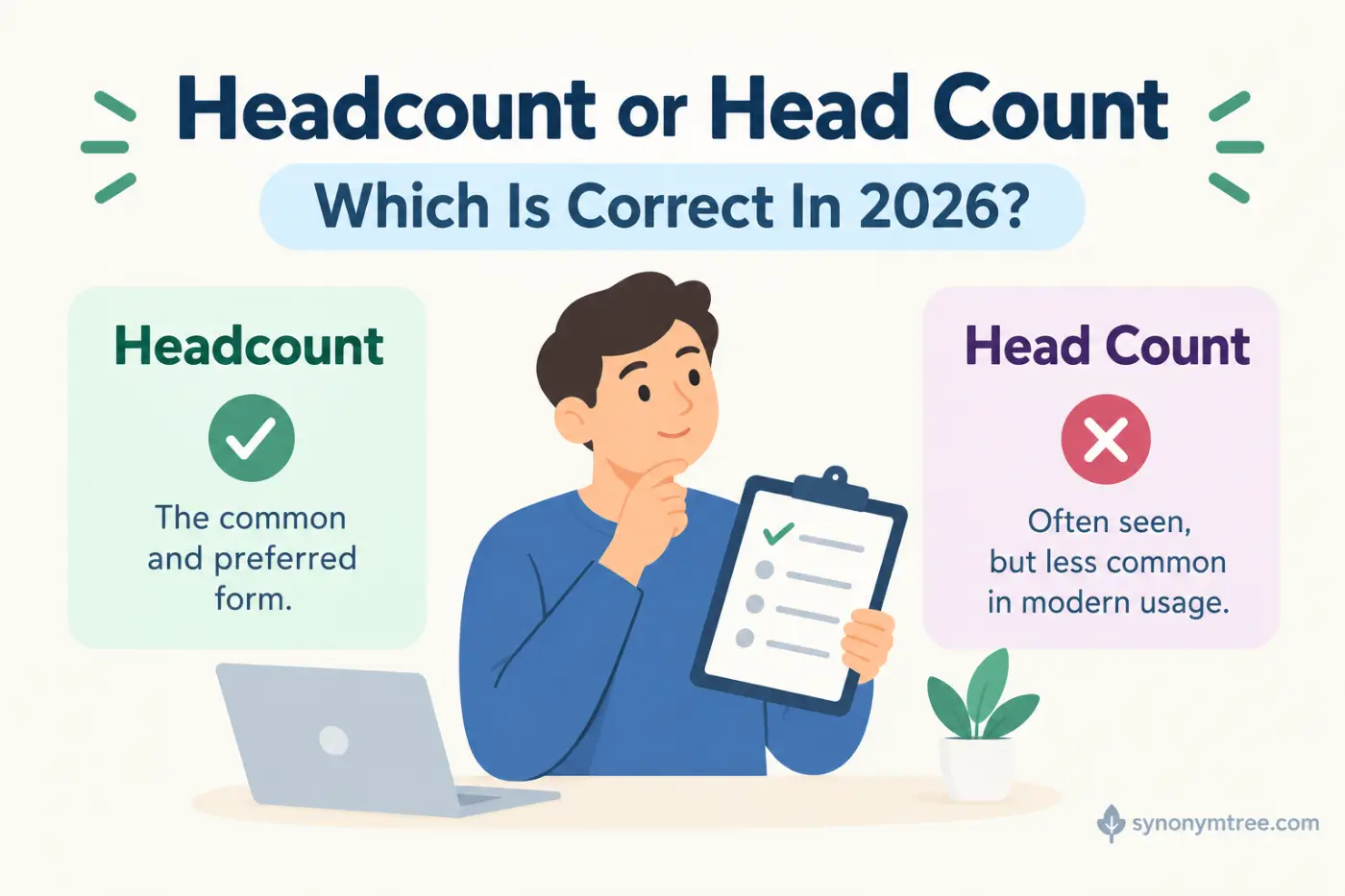
If you are writing a report, email, job post, or workplace update, you may stop at the same small spelling question: is it headcount or head count? Both forms appear in English, but they do not always work in the same way. The difference depends mainly on how you are using the term in a sentence.
The good news is that headcount is usually the better choice when you mean the total number of people in a group, company, team, or organization. Head count can also be correct, especially when the words are being used more literally or when count works as a separate noun.
Quick answer: Use headcount as a noun when you mean the number of people in a group. Use head count when count is being used more literally as the act or process of counting people.
This guide explains the difference, shows how each form works in real sentences, and covers common workplace examples. You will also see the history of the term, common mistakes, style tips, related expressions, and answers to questions people often ask.
Quick Definition
Headcount is a noun that means the total number of people in a group, especially in a workplace, organization, team, or event. For example, a company might increase its headcount by hiring ten new employees.
Head count is the open form of the same basic expression. It can refer to the act of counting people or to a literal count of the people present. In modern business writing, headcount is often the more natural choice when the meaning is employee numbers or staffing levels.
Direct Answer
When you mean the number of employees or people in a group, headcount is generally the preferred form. Head count is still understandable and can be correct when you are talking about the actual process of counting people.
The key is to look at the role of the phrase in your sentence. If you could replace it with total number of people, the closed form headcount will usually be the better choice.
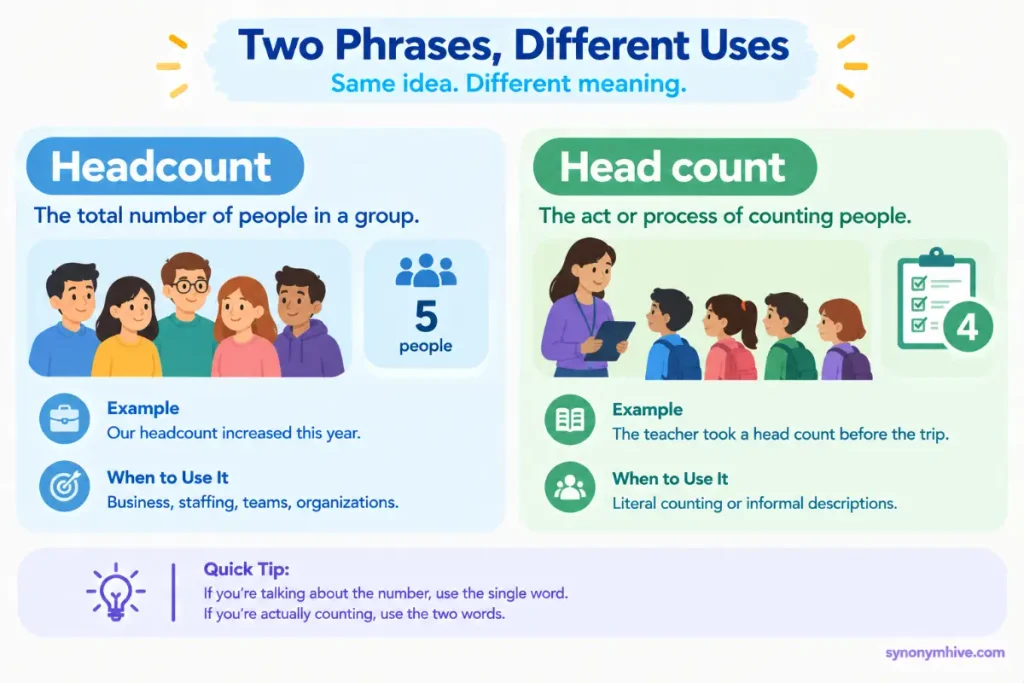
Headcount or Head Count Compared
| Word or Phrase | Meaning | Example Sentence | When to Use It |
|---|---|---|---|
| Headcount | The total number of people in a group | Our headcount increased this year. | Business, staffing, teams, organizations |
| Head count | The act or process of counting people | The teacher took a head count before the trip. | Literal counting or informal descriptions |
| Employee headcount | The number of employees | Employee headcount reached 250. | Human resources and business |
| Current headcount | The number of people currently in a group | Our current headcount is 48. | Reports, planning, staffing |
| Head count total | A literal count of people | The staff recorded the head count. | Situations focused on counting |
The distinction is not absolute in every variety of English. English spelling can change over time as common phrases become established compounds. That is one reason you may see both forms in real writing.
For most modern workplace uses, however, headcount is the cleanest choice.
Why Is Headcount Usually Written as One Word
English often turns a group of words into a compound noun when the expression develops a stable meaning of its own. A compound noun is a noun made from two or more words that work together as one idea.
Headcount follows this pattern. The word combines head, meaning a person in this context, with count, meaning the number being counted. Together, headcount refers to the number of people in a group.
You can see a similar pattern in other English words. Workforce refers to the people who work for an organization. Classroom refers to a room used for teaching. Headcount follows the same general movement from a phrase to a single established term.
The closed form is especially common in business English. Human resources teams use it when discussing staffing. Managers use it when planning budgets. Recruiters may discuss the number of open positions in relation to current staffing levels.
For example, a manager might write:
Our headcount is expected to reach 120 by December.
The word is acting as one noun. It names a specific business concept, not simply the act of counting someone’s head.
What Does Headcount Mean in Business
In business, headcount usually means the number of people employed by an organization, department, team, or project.
A company may track its headcount for many reasons. It may need to plan salaries, benefits, office space, equipment, hiring, or staffing needs. Leaders may also compare current staffing with planned staffing.
For example, a company with 80 employees has a headcount of 80. If it hires 15 more people and nobody leaves, its headcount becomes 95.
The term can describe a whole organization or a smaller group.
Our company headcount is 600.
The sales team headcount is 24.
The department plans to increase headcount next quarter.
The project does not have enough headcount to meet the deadline.
These examples all use the word as a business noun.
Headcount can also appear in discussions about hiring limits. A company might have approval for five additional employees. In that case, a manager could say that the department has room for five more people in its planned headcount.
This meaning makes the word especially common in human resources, finance, management, recruiting, and workforce planning.
Where Did the Word Headcount Come From
The term comes from the literal idea of counting people’s heads. Historically, counting heads was a simple way to determine how many people were present in a group.
The word head has long been used in English to refer to a person or individual in certain contexts. We still see this meaning in expressions such as per head, meaning for each person.
Count refers to determining how many people or things there are. When the two ideas came together, the expression head count could describe the number of people present.
Over time, the expression became increasingly common as a single business term. Today, headcount has a strong connection with employment and staffing.
The older literal idea has not disappeared completely. You can still talk about counting heads at a meeting, classroom, event, or field trip. However, the business meaning has become especially strong in modern English.
This shift explains why the closed spelling feels natural in workplace writing. It has developed into a recognized noun with a specific meaning.
When Should You Use Headcount
Use headcount when you mean the total number of people in a group.
This is the best choice in many workplace sentences. It is also useful when discussing staffing, hiring, employees, teams, and organizational size.
Consider these examples.
The company reduced its headcount last year.
Our headcount is currently 175 employees.
The new office can support a larger headcount.
Management approved an increase in headcount.
The department needs more headcount before it can take on another project.
The phrase is especially natural when it works as a measurable business figure. You can increase headcount, reduce headcount, track headcount, calculate headcount, report headcount, or compare headcount.
This makes the word useful in reports and professional documents.
A sentence such as The company plans to increase its headcount by 20 is clear and natural. The reader immediately understands that the company plans to add 20 people.
When Can Head Count Be Used
Head count can be used when you are focusing on the actual process of counting people.
Imagine a teacher preparing students for a field trip. The teacher may count the students before leaving, after arriving, and before returning.
The teacher took a head count before the bus left.
Here, the focus is on the act of counting people.
The same idea can apply at a large event.
Staff members took a head count before the doors opened.
The organizer asked for a quick head count.
These sentences focus on counting people rather than describing an organization’s staffing level.
That distinction is useful because it helps you choose the form without memorizing a long list of rules.
If the sentence means how many employees or members there are, choose headcount in most modern business writing.
If the sentence focuses on physically counting people, head count may work naturally.
Headcount in Human Resources
Human resources teams use headcount frequently because employee numbers affect many parts of a business.
A human resources report might show the current number of employees, planned hires, departures, and staffing changes. Headcount can help managers understand how large each department is.
For example, an HR report might say:
The marketing department has a headcount of 18.
This does not describe the act of counting. It gives the number of people working in the department.
Another common sentence is:
We expect headcount to increase by 12 employees next year.
Again, the term refers to staffing levels.
The word can also appear in discussions about full time and part time employees. Companies may have different ways of measuring workforce size, so a report may define exactly what its headcount includes.
For example, one organization may count only active employees. Another may include employees on certain types of leave. Contractors may be tracked separately.
Because of this, professional reports should explain the measurement when precision matters.
Headcount in Finance and Budget Planning
Staffing costs are often one of the largest expenses for a company. That makes headcount useful in financial planning.
A budget may estimate salary and benefit costs based on the expected number of employees. If headcount rises, labor costs may rise as well.
For example:
The budget assumes a year end headcount of 300.
This sentence tells the reader that the financial plan expects the company to have 300 employees at the end of the year.
Another example is:
The finance team is reviewing the cost of the planned headcount increase.
Here, headcount refers to additional employees.
The term can also appear in workforce forecasts. A company may compare current headcount with projected headcount to understand how quickly it is growing.
This is one reason the closed form is strongly associated with business writing.
Headcount in Recruiting
Recruiters and hiring managers also use headcount when discussing approved positions.
A company might have permission to hire ten people. Those ten positions are part of its planned staffing level.
For example:
We have approval for five additional headcount positions.
In casual workplace speech, people may shorten this idea and simply say five headcount. However, polished writing should be clearer.
A better sentence might be:
We have approval to hire five additional employees.
Or:
The department has approval for five additional positions.
These versions tell the reader exactly what the company means.
Headcount is useful when the number itself matters. It should not replace a clearer phrase every time.
Headcount in Reports and Formal Writing
Headcount is common in business reports, but writers should still think about clarity.
A report might say:
The company ended the year with a headcount of 1,200.
That is concise and professional.
However, a general audience may understand employees or staff more quickly than headcount.
For example:
The company employs 1,200 people.
This sentence is often clearer for readers who are not familiar with business language.
That does not make headcount wrong. It simply means that word choice should match the audience.
If you are writing for HR professionals, business leaders, or financial teams, headcount is familiar and useful.
If you are writing for the general public, employees, workers, or staff may sometimes be simpler.
Headcount or Number of Employees
Headcount and number of employees are closely related, but they are not always identical in every business context.
Headcount is a compact business term. It can refer to the number of people counted in a workforce.
Number of employees is more direct. It tells the reader exactly what is being measured.
Compare these sentences.
The company has a headcount of 500.
The company has 500 employees.
Both sentences can communicate the same basic fact.
The first sounds more like business or HR language. The second is more direct and accessible.
If your audience knows business terminology, headcount is perfectly natural. If you are writing for a broad audience, number of employees may be easier to understand.
Headcount or Staffing Level
Staffing level is another close term.
Headcount usually focuses on the number of people. Staffing level can also suggest whether a team has enough people to handle its workload.
For example:
Our headcount is 20.
This simply tells you there are 20 people.
Our staffing level is too low.
This suggests a problem. The team may not have enough people to do the required work.
A company can have a high headcount and still have poor staffing for a specific task. The number of employees alone does not always tell you how well staffed a team is.
That difference matters in reports and workplace discussions.
Headcount or Workforce
Workforce is broader than headcount.
A workforce refers to the people who work for an organization, industry, region, or economy. Headcount focuses more directly on the number of people.
For example:
The company expanded its workforce.
This can suggest that the organization hired more people or grew its group of workers.
The company increased its headcount by 40.
This gives a more specific numerical idea.
Workforce can also refer to the overall working population in a region or industry. Headcount usually sounds more like a count of people within a particular organization or group.
Headcount or Head Count in Everyday Speech
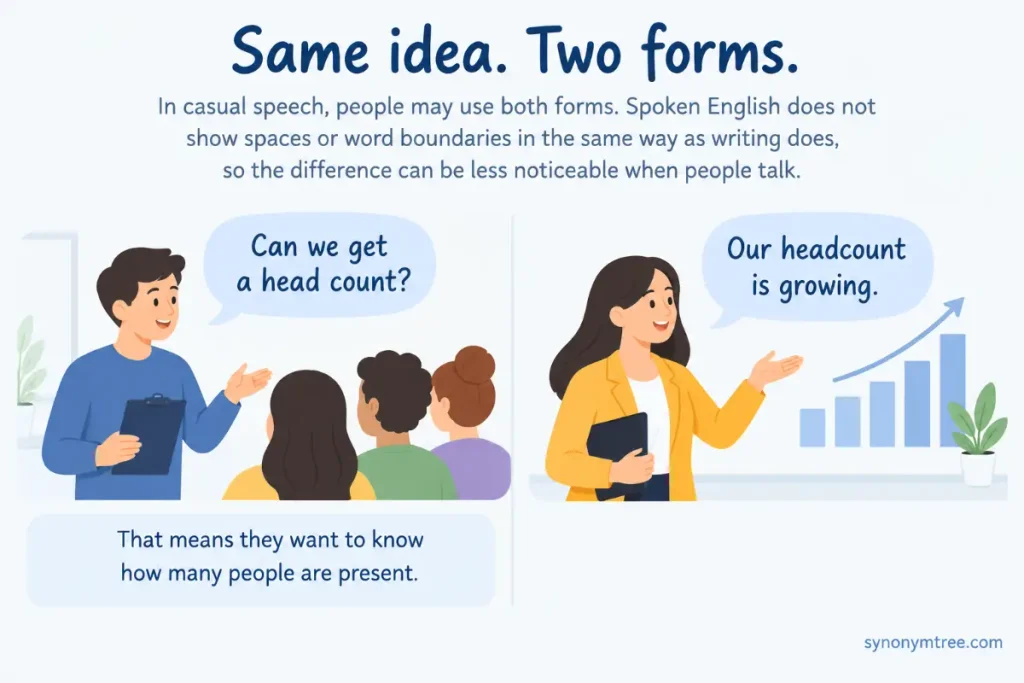
In casual speech, people may use both forms. Spoken English does not show spaces or word boundaries in the same way writing does, so the difference can be less noticeable when people talk.
Someone might say:
Can we get a head count?
That means they want to know how many people are present.
Someone else might say:
Our headcount is growing.
That means the number of people in the organization is increasing.
The meanings overlap, but the context tells you what the speaker means.
In writing, the closed form is generally the safer choice for the business meaning.
Common Examples of Headcount
Here are natural examples that show how the word works in professional writing.
The company increased its headcount by 25 people.
Our current headcount is higher than last year.
The department needs additional headcount to support the new project.
Management expects headcount to remain stable through the summer.
The hiring plan is based on a projected headcount of 400.
The company froze headcount during the budget review.
Our regional headcount grew after the merger.
The new office has enough space for the expected headcount.
The HR team tracks headcount each month.
The department reduced its headcount after several employees left.
Each sentence uses the term as a noun connected to the number of people in a group.
Examples Using Head Count
The open form works naturally when the focus is on counting people.
The teacher took a head count before the students boarded the bus.
Please take a head count before we leave.
The coach did a quick head count after practice.
The event staff completed a head count before opening the doors.
We need a head count so we know how many meals to order.
In these examples, the phrase describes a count of people. The context is usually a group that needs to be physically counted.
Notice the difference between these two sentences.
The company increased its headcount.
The manager took a head count before the meeting.
The first sentence describes staffing numbers. The second describes an act of counting people.
What Are the Most Common Mistakes
One common mistake is assuming that one spelling is always correct and the other is always wrong.
English does not always work that way. Compound nouns often have different forms depending on how established the term has become and how the writer is using it.
Another mistake is using headcount when a simpler word would be clearer.
For example, if you are writing for customers, saying The company has 2,000 employees may be easier than The company has a headcount of 2,000.
A third mistake is using head count when you clearly mean business staffing.
For example:
The company plans to increase its head count by 50 employees.
This may be understood, but headcount is generally cleaner for this meaning.
A fourth mistake is using headcount as a replacement for employees in every sentence. Repetition can make business writing sound stiff.
Good writing varies naturally between terms such as employees, staff, workers, team members, and headcount when the meanings allow it.
Is Headcount One Word in American English
Yes. Headcount is widely used as a single word in American business English.
It is especially common in discussions about employees, staffing, hiring, and organizational size.
You will often see phrases such as current headcount, employee headcount, total headcount, planned headcount, and headcount growth.
The closed form is also easy to use in compound expressions.
For example:
Our current headcount is 85.
The headcount report is due Friday.
The company announced a headcount reduction.
These examples show how strongly the word functions as an established business noun.
Is Headcount One Word in British English
British English also uses headcount as a noun, especially in business contexts.
English spelling can vary across regions, but this particular compound is widely understood in both American and British English.
You may still encounter head count in British writing when the writer is describing the act of counting people. The distinction is more about meaning and style than a strict US versus UK spelling rule.
For international business writing, headcount is a safe and familiar choice when discussing staffing numbers.
How to Use Headcount in a Resume
Job seekers usually do not need to use headcount often on a resume. However, it can be useful when describing management or leadership experience.
For example:
Managed a team of 35 employees across three locations.
This is often stronger than simply saying:
Managed headcount of 35.
The first sentence clearly tells the reader what you managed.
Headcount can still be useful when the number is part of a larger business result.
For example:
Led workforce planning for a 200 person organization.
Or:
Supported hiring plans that increased department headcount from 40 to 65.
The second example shows growth and gives useful context.
When writing a resume, focus on what you did and what changed. Do not use headcount just because it sounds professional.
How to Use Headcount in an Email
In a workplace email, headcount is useful when discussing staffing or planning.
For example:
We need to confirm the current headcount before finalizing the budget.
Another natural sentence is:
Please send me the updated headcount for each department.
You can also avoid the term when a simpler phrase is clearer.
Please send me the number of employees in each department.
Both versions work. Choose based on your audience and the tone of the message.
How to Use Headcount in an Essay
An academic essay may use headcount when discussing employment, organizations, demographics, or workforce data.
For example:
The company increased its headcount after opening two new offices.
However, academic writing should favor clear wording over business jargon.
If the essay is about employment trends, number of employees may be more precise.
The company increased its number of employees after opening two new offices.
That sentence is slightly longer, but it may be easier for a general academic audience.
The best word depends on the subject and audience.
How to Use Headcount in Speaking
In workplace speech, headcount is common and natural.
A manager might ask:
What is our current headcount?
A recruiter might say:
We are trying to increase headcount in the engineering team.
A finance leader might say:
The budget does not support additional headcount.
These examples sound normal in professional settings.
In casual conversation, people may prefer simpler expressions.
How many people work there?
How many employees are on the team?
How many people are coming?
Simple language often works better when the business term adds no useful meaning.
Headcount as a Countable or Uncountable Noun
Headcount usually refers to a number or staffing measure, so it often behaves differently from ordinary countable nouns.
You can say:
Our headcount is 100.
You can also say:
The company increased its headcount.
But expressions such as a headcount can refer to a specific count or measurement.
For example:
The manager gave us a headcount of 35.
This means the manager reported that 35 people were counted.
The exact grammar depends on the sentence, but the central meaning remains the same.
How Plural Forms Work
Headcount usually refers to the overall number of people, so writers often do not need a plural form.
For example:
The company tracks headcount across five offices.
You normally would not need to write headcounts unless you are referring to multiple separate counts or measurements.
A sentence such as The report contains headcounts for several departments is possible, but it may sound more technical than necessary.
Often, you can write:
The report contains headcount figures for several departments.
That version is clearer because it tells the reader exactly what is being compared.
Headcount Reduction and Headcount Increase
Business writing often uses headcount with words that describe staffing changes.
Headcount reduction means a decrease in the number of employees.
Headcount increase means a rise in the number of employees.
A company might announce a headcount reduction after closing a division.
Another company might report a headcount increase after expanding into a new market.
These expressions are common in corporate communication, financial reports, and workforce planning.
Still, they can sound impersonal when used to discuss job losses. In communication with employees, clearer and more human wording may be better.
For example:
The company plans to reduce its workforce by 20 employees.
That can be clearer than:
The company plans a headcount reduction of 20.
The best choice depends on the purpose and audience.
Headcount Freeze Meaning
A headcount freeze is a workplace policy that limits or stops new hiring.
For example, a company may decide not to add new employees for several months.
Management announced a headcount freeze for the rest of the year.
The phrase is common in business writing. It refers to staffing levels rather than freezing the people already employed.
A headcount freeze does not always mean that nobody can be hired. Some companies may allow exceptions for critical roles. The exact policy depends on the organization.
How to Remember the Difference
A simple memory trick is to connect headcount with a number.
If you are talking about the number of people in a company or team, think of headcount as one business word.
If you are talking about the act of counting people in a room, on a bus, or at an event, think of head count as two words.
You can also use a replacement test.
Replace the word with employee total.
If the sentence still makes sense, headcount is likely the better choice.
For example:
Our headcount is 150.
Our employee total is 150.
The meaning stays clear.
Now try:
The teacher took a head count.
The teacher took an employee total.
That replacement does not work. The sentence is about counting people, so the open form fits better.
Related Words You Should Know
Several terms are closely related to headcount.
Workforce refers to the people who work for an organization or within a larger employment group.
Staff refers to the employees who work for a company, school, office, or organization.
Employees are people who work for an employer.
Personnel is a more formal term for employees or staff.
Staffing refers to the process or level of providing enough workers for a job or organization.
Hiring means bringing new employees into an organization.
Workforce planning means deciding how many workers and what skills an organization will need.
Employee count is a plain and direct alternative to headcount.
These terms overlap, but they are not perfect substitutes. Choosing the right one can make your writing more precise.
When Should You Avoid Headcount
Avoid headcount when the word makes a simple sentence sound more complicated than it needs to be.
For example:
The school has a headcount of 900 students.
This is understandable, but the school has 900 students is simpler.
Similarly:
The event had a headcount of 75 guests.
The event had 75 guests is more natural for many readers.
Headcount is most useful when the number itself is being treated as a business or planning measure.
If you only want to tell someone how many people are involved, a direct phrase may be better.
Strong writing does not use specialized words just because they sound formal. It uses the clearest word for the reader.
How to Choose the Best Form
Use these practical questions when you are unsure.
Are you talking about the number of employees in a company? Use headcount.
Are you discussing the size of a department or team? Use headcount.
Are you reporting a staffing figure? Use headcount.
Are you physically counting people at an event? Head count may be natural.
Are you writing for a general audience? Consider number of employees or number of people.
Are you writing a business report for HR or finance professionals? Headcount is usually a good fit.
Are you talking about a field trip or classroom? Head count may be more natural when describing the counting process.
This approach is more useful than trying to memorize a single rule because English compounds can depend on context.
Headcount or Head Count in Common Sentences
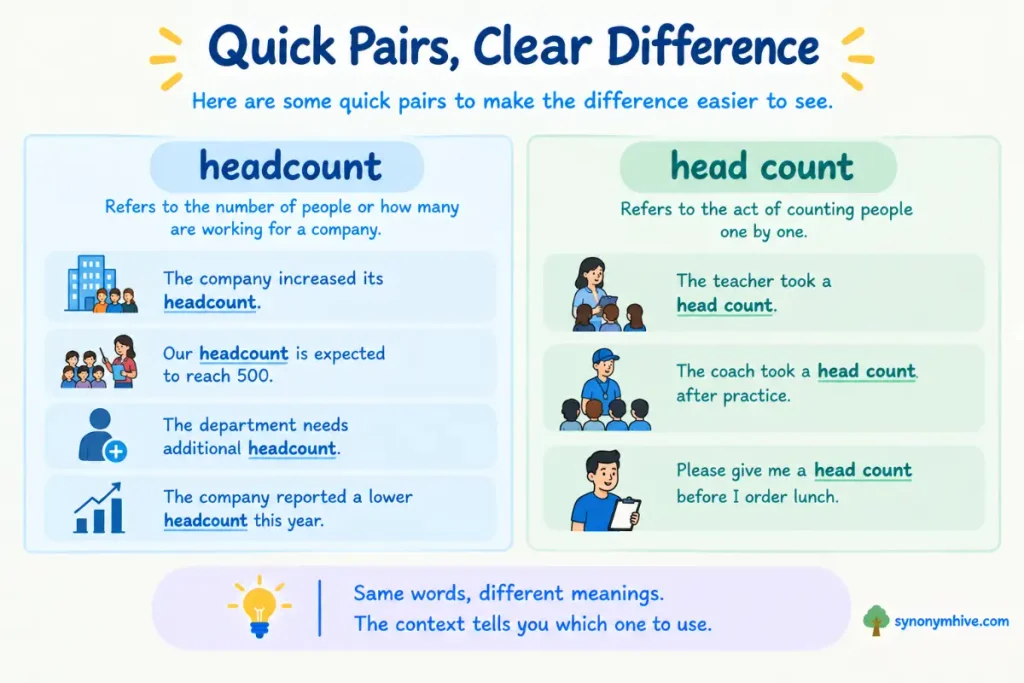
Here are some quick pairs to make the difference easier to see.
The company increased its headcount.
The teacher took a head count.
Our headcount is expected to reach 500.
The coach took a head count after practice.
The department needs additional headcount.
Please give me a head count before I order lunch.
The company reported a lower headcount this year.
The event staff completed a head count before the show.
The first group uses headcount as a business noun. The second group uses head count for the act of counting people.
The difference becomes much easier once you focus on meaning instead of spelling alone.
Conclusion
The choice between headcount or head count depends on what you mean. When you are talking about the number of employees, workers, or members in a group, headcount is usually the best form. It is a well established business noun used in HR, finance, recruiting, and workforce planning.
Head count can still be useful when you mean the actual process of counting people. A teacher can take a head count before a trip, and event staff can take a head count before guests enter.
For most workplace documents, reports, and staffing discussions, choose headcount when you mean employee numbers. If your sentence is about physically counting people, head count may fit better. When a simpler phrase works, number of employees or number of people can make your writing even clearer.
Frequently Asked Questions
Is headcount one word or two words?
Headcount is usually one word when it means the number of people in a company, team, or organization. Head count can be used when you mean the act of counting people.
Is headcount or head count correct in business writing?
Headcount is generally the better choice in modern business writing when you mean employee numbers. It is common in HR, finance, recruiting, staffing, and workforce planning.
What does headcount mean at work?
Headcount means the number of people employed or included in a particular group. For example, a company with 250 employees may report a headcount of 250.
Can I use headcount on a resume?
Yes, but use it only when it adds useful information. A resume is often clearer when you describe the number of employees you managed or supported directly.
Is headcount formal English?
Headcount is standard English and is especially common in professional and business settings. In general writing, number of employees or number of people may be simpler.
What is the difference between headcount and workforce?
Headcount focuses on the number of people, while workforce refers to the people who make up an organization or employment group. Workforce is broader, while headcount is more directly tied to a numerical staffing measure.
Is head count still correct?
Yes, head count can still be correct when the phrase refers to counting people. For example, a teacher may take a head count before a field trip.
What is another way to say headcount?
Useful alternatives include number of employees, employee total, staff size, staffing level, and number of people. The best option depends on what you are measuring and who will read the sentence.
