
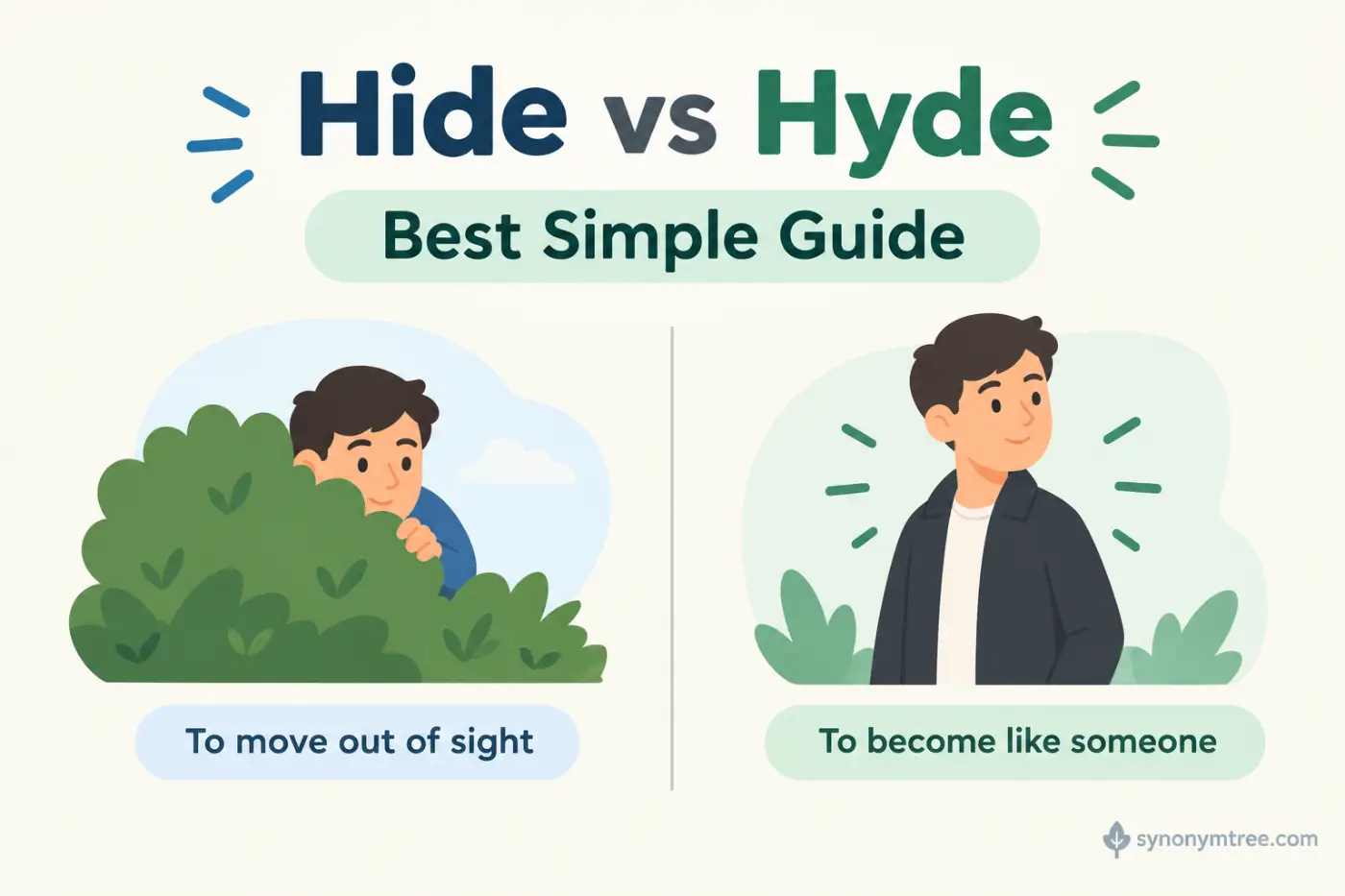
If you are writing an email, finishing an essay, checking a text, or looking up a name, you may stop at the same question: which spelling is correct? The confusion between hide and hyde is easy to understand because the two forms can sound alike in some names and accents. They are not interchangeable, though.
Hide is the standard English word when you mean to put something out of sight or to stay where others cannot see you. Hyde is usually a proper name, a surname, or part of a place name. Knowing that basic difference will help you choose the right spelling in normal writing.
The key is to look at the meaning and the role of the word in the sentence. One form is a common English verb and noun. The other is mainly used for names and specific titles. This guide explains the difference, shows how each form works, and gives plenty of examples you can use in real writing.
You will also learn where the spelling confusion comes from, how hide changes in different forms, when Hyde is correct, which common phrases use hide, and how to avoid mistakes in school, work, and everyday communication.
Quick Definition
Hide is a common English word meaning to put something where it cannot be seen, to keep something secret, or to stay out of sight. Hyde is generally a proper name or part of a proper name, such as a surname or place name.
Direct Answer
Use hide when you mean conceal, cover, or stay out of sight. Use Hyde when it is part of a specific name, such as Hyde Park or a person whose surname is Hyde.
Hide And Hyde At A Glance
| Word | Meaning | Example Sentence | When to Use It |
|---|---|---|---|
| hide | To keep something or someone out of sight | I tried to hide the gift. | Use it as a normal English word |
| Hyde | A proper name or name element | We walked through Hyde Park. | Use it for a specific name |
The most useful rule is simple. If you can replace the word with conceal, hide is probably the spelling you need. If the word identifies a person, place, title, or other named thing, Hyde may be correct.
That rule covers most everyday situations. There are also a few details worth knowing because English uses hide in several different ways.
What Does Hide Mean
Hide is one of the most common verbs in English. It usually means to place something somewhere it cannot easily be seen. It can also mean to move yourself somewhere others cannot see you.
For example, a child might hide behind a sofa during a game. A person might hide a birthday present in a closet. Someone might hide important information from another person.
The word can describe physical actions and less visible ideas. You can hide an object, hide a person, hide a feeling, hide the truth, or hide your disappointment.
The basic idea stays the same. Something is being kept from view, attention, or knowledge.
Hide can also work as a noun. In this use, it can refer to an animal skin, or in some contexts it can refer to a shelter used for watching wildlife. For example, a photographer may sit in a wildlife hide while waiting for birds to appear.
The verb is much more common in everyday American English.
What Are The Main Meanings Of Hide
The first meaning is to keep something out of sight.
She hid the keys under the cushion.
The second meaning is to stay somewhere that prevents other people from seeing you.
The children hid behind the tree.
The third meaning is to keep information, feelings, or facts from being known.
He tried to hide his disappointment.
The fourth meaning appears in expressions where something is difficult to see.
The house was hidden by thick trees.
These meanings are related. In every case, something is being kept away from normal view or awareness.
Why Do Hide And Hyde Cause Confusion
The confusion usually comes from sound and spelling. English has many words and names that sound similar but have different spellings and meanings.
Hide is an ordinary vocabulary word. You learn it as part of basic English because it describes a common action.
Hyde is different. It is normally connected to a name. You may see it in a surname, a place name, a street name, or a title.
A reader who hears the two forms without seeing them written down may not know which spelling is intended. This can happen during conversation, dictation, or speech recognition.
Names create another source of confusion. Once you see a name such as Hyde, you may start wondering if the same spelling can be used as the ordinary verb. It cannot.
English capitalization gives you another clue. Hyde normally begins with a capital letter when it is used as a proper name. Hide normally begins with a lowercase letter unless it appears at the beginning of a sentence.
For example, these sentences use the words differently.
I need to hide the package.
We visited Hyde Park.
The first sentence uses an ordinary verb. The second uses a place name.
When Should You Use Hide
Use hide when you are talking about concealing something or staying out of sight.
The verb works in many everyday situations. You can hide a present, hide your phone, hide behind a wall, hide your feelings, or hide information.
It can also describe something that naturally blocks another thing from view.
Tall trees hid the cabin from the road.
The clouds hid the moon.
A curtain hid the window.
Notice that the word does not need to describe a person deliberately concealing something. It can describe one object blocking another.
Hide is also common in informal speech.
Where did you hide my shoes?
I am going to hide in my room.
She tried to hide her smile.
The word is flexible, natural, and widely understood.
When Should You Use Hyde
Use Hyde when you are writing a specific name that is spelled that way.
Hyde is commonly found in surnames and place names. One familiar example is Hyde Park, a name used for several parks and locations. Another well known example is Dr. Jekyll and Mr. Hyde, the fictional character created by Robert Louis Stevenson.
You should preserve the spelling of a proper name. Changing Hyde to hide can change the identity of the person, place, or fictional character.
For example, if someone’s surname is Hyde, write:
Mr. Hyde sent the email.
Do not change the surname to Hide just because the two forms sound similar.
The same rule applies to named places.
We stayed near Hyde Park.
The name should keep its established spelling.
How Does Hide Work In A Sentence
Hide can appear in several grammatical forms. Understanding these forms makes the word easier to use correctly.
The base form is hide.
I hide the keys in the drawer.
The third person singular present form is hides.
She hides her notebook under the bed.
The present participle is hiding.
They are hiding behind the door.
The past tense is hid.
He hid the letter in a box.
The past participle is hidden.
The letter was hidden in a box.
This is an irregular verb. You do not normally form the past tense by adding ed.
Incorrect usage would be something like this.
He hided the letter.
The standard form is:
He hid the letter.
For the past participle, use hidden.
He has hidden the letter.
This pattern is worth remembering because it is one of the most common grammar points connected to the word.
Hide Forms You Should Know
| Form | Example |
|---|---|
| hide | I hide my wallet here. |
| hides | She hides the gift. |
| hiding | He is hiding behind the door. |
| hid | They hid the box yesterday. |
| hidden | The box was hidden under the bed. |
These forms have different grammatical jobs, but they all come from the same basic verb.
The word Hyde does not change in this way when it is a name. A surname remains Hyde. A place called Hyde remains Hyde. You do not turn it into hid or hidden.
That difference is another useful clue.
Hide Vs Hyde In Real Sentences
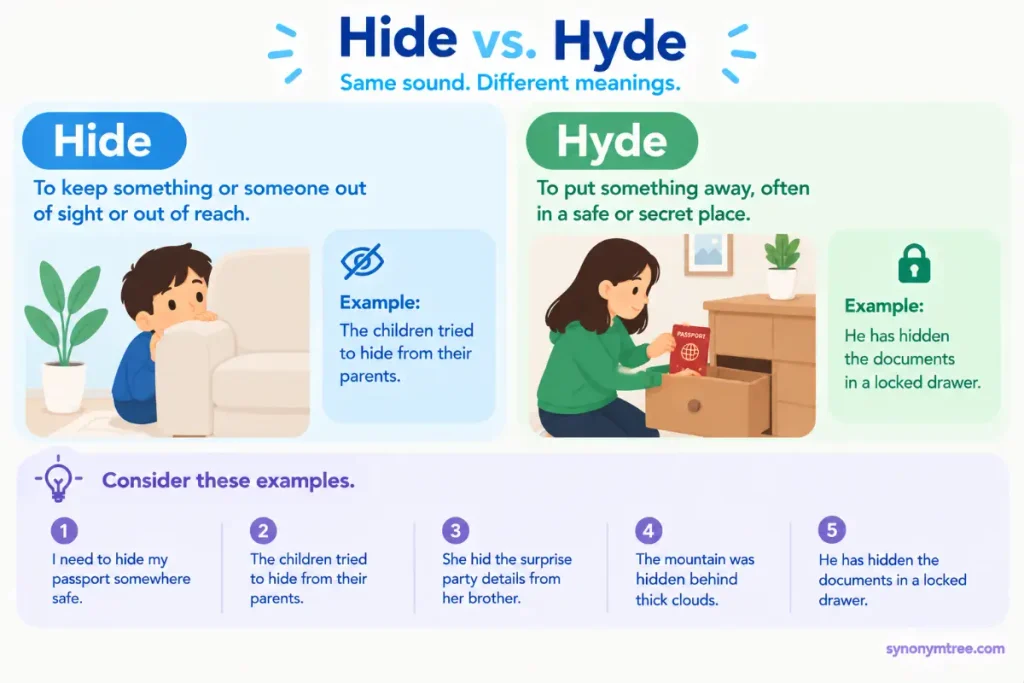
Consider these examples.
I need to hide my passport somewhere safe.
The children tried to hide from their parents.
She hid the surprise party details from her brother.
The mountain was hidden behind thick clouds.
He has hidden the documents in a locked drawer.
We visited Hyde Park during our trip.
The author uses the name Hyde for an important character.
Mr. Hyde arrived at the office early.
Each sentence makes the distinction clear through context.
The first five examples describe concealment. The last three use Hyde as a name.
Is Hide A Verb Or A Noun
Hide can be both a verb and a noun.
As a verb, it describes an action.
Please hide the gift before she arrives.
As a noun, hide can refer to animal skin.
The leather was made from cowhide.
A hide can also mean a sheltered place used for observing wildlife.
The photographer waited quietly in the hide.
This noun use is less common in everyday American conversation, but it still appears in English.
Hyde does not normally function as a common noun. It is mainly a proper name.
That distinction helps when you are deciding which spelling belongs in a sentence. If you are describing an action, hide is usually the word you need. If you are identifying a person or place, check the proper name.
What Does Hide Mean In Everyday English
The most common idea behind hide is keeping something away from sight.
A child may hide during a game.
A person may hide from danger.
Someone may hide a mistake.
A shopper may hide a gift until a special occasion.
A writer may hide a clue inside a story.
The word can also describe emotions.
She tried to hide her sadness.
He could not hide his excitement.
I tried to hide my nervousness before the interview.
Here, nothing physical is necessarily hidden. The person is trying to prevent others from noticing an emotion.
Hide can also describe facts.
The company cannot hide the problem forever.
He hid the truth from his family.
The report revealed information that had been hidden for years.
This broader use makes hide a useful word in both everyday and formal writing.
Hide In Common Phrases
English has many common expressions that use hide.
Hide and seek is a familiar children’s game in which one person closes their eyes while others hide.
Hide away means to stay somewhere private or put something in a place where it will not be noticed.
She likes to hide away with a good book.
Hide out means to stay somewhere secretly or avoid being found.
They decided to hide out at a friend’s house.
Hide behind can describe physical position or an excuse.
The child hid behind the curtain.
He keeps hiding behind excuses.
Hide from means to stay away from someone or something.
She was trying to hide from the rain.
He could not hide from the truth.
These expressions all use hide with its standard spelling.
What Is The Difference Between Hide And Conceal
Hide and conceal have similar meanings, but they do not always sound the same.
Hide is the more common and natural choice in everyday English. Conceal is more formal and can sound more deliberate.
For example:
I hid the gift in my closet.
I concealed the evidence.
The first sentence sounds normal in daily conversation. The second sounds more formal and serious.
You can use hide in almost any casual situation. Conceal is often better when the writing is formal, legal, technical, or serious.
The difference is not about correctness. Both words can describe keeping something from view. The choice depends on tone and context.
Hide And Cover Are Not Always The Same
Hide and cover overlap, but they describe different actions.
To hide something means to keep it from being seen or discovered.
To cover something means to place something over it or protect its surface.
For example:
She hid the keys in a drawer.
She covered the table with a cloth.
The keys are hidden because they are out of sight. The table is covered because something is placed over it.
You can also use cover when something blocks visibility.
The fog covered the road.
In that case, the road may still be visible in part. The main idea is that the fog is over it or blocking it.
Hide focuses more strongly on lack of visibility or discovery.
Hide And Disguise Are Not The Same
A disguise changes how something looks so it is harder to recognize.
Hiding simply keeps something from being seen or found.
A person can hide behind a wall. A person can also disguise themselves by changing their clothes, hair, makeup, or appearance.
For example:
He hid behind the door.
He disguised himself as a delivery worker.
The first action removes the person from view. The second changes the person’s appearance.
This distinction matters in stories, essays, and descriptions. Use hide when the main idea is absence from sight. Use disguise when the main idea is changed appearance.
Is Hyde Always A Name
In normal modern English, Hyde is mainly encountered as a proper name or part of a proper name.
It can be a family name. It can appear in geographic names. It can also appear in fictional names and titles.
Because proper names are specific, their spelling needs to be preserved.
If a person writes their surname as Hyde, you should not correct it to Hide.
If a place officially uses Hyde in its name, keep that spelling.
This is different from a normal vocabulary word. Common words can have standard dictionary spellings. Proper names belong to the people, places, or works they identify.
Why Capitalization Matters
Capitalization can help you spot the difference.
Hide is usually lowercase when it appears in the middle of a sentence.
I will hide the present.
Hyde is normally capitalized when it is a proper name.
We walked through Hyde Park.
Mr. Hyde appears in the story.
A capital letter does not prove that a word is Hyde because hide can also appear at the beginning of a sentence.
For example:
Hide the package.
The word is still hide even though it is capitalized because it starts the sentence.
Context matters more than capitalization alone.
Hide In School Writing
Hide is perfectly acceptable in school writing when the meaning is correct.
You might use it in a narrative, descriptive paragraph, book report, or essay.
For example:
The fox tried to hide beneath the bushes.
The character hides his fear from the people around him.
The thick fog hid the road from view.
In formal school writing, you may sometimes choose a more precise word. Conceal, obscure, mask, or protect can work in specific contexts. Still, hide is not an incorrect or childish word.
A common mistake is trying to make writing sound more advanced by replacing every simple word with a formal one. Clear writing is usually better than complicated writing.
If hide expresses your meaning clearly, there is no need to replace it.
Hide In Professional Writing
Hide can also appear in business writing, but the right choice depends on what you mean.
For neutral situations, hide is natural.
The menu hides several useful settings.
The graphic hides part of the text.
The system automatically hides inactive files.
For serious situations involving information, conceal may be more precise.
The report states that the company concealed important information.
That wording suggests intentional secrecy.
In a professional email, choose the word that matches the action. Do not use Hyde unless you are referring to a name.
Hide In Text Messages
Texting often uses simple forms of hide.
Where did you hide my charger?
I am hiding from everyone today.
Hide the cake before the kids see it.
These are natural uses.
A text may also mention a person named Hyde.
I met Hyde at the event.
The capitalization and context make the difference clear.
Because texting is informal, people sometimes make spelling mistakes without noticing. Autocorrect can also replace one word with another. Checking the meaning before sending a message can prevent confusion.
Common Mistakes With Hide And Hyde
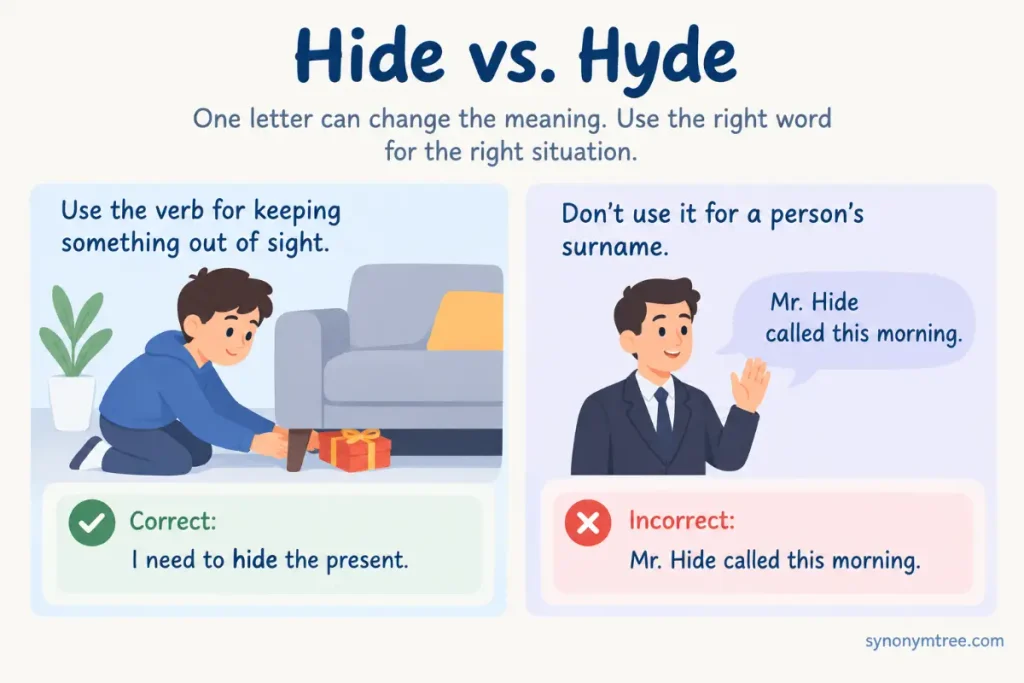
One common mistake is using Hyde as the ordinary verb.
Incorrect:
I need to Hyde the present.
Correct:
I need to hide the present.
Another mistake is changing a person’s surname.
Incorrect:
Mr. Hide called this morning.
Correct:
Mr. Hyde called this morning.
A third mistake is changing the spelling of a place.
Incorrect:
We visited Hide Park.
Correct:
We visited Hyde Park.
Another error involves the past tense.
Incorrect:
She hided the keys.
Correct:
She hid the keys.
The past participle also causes trouble.
Incorrect:
She has hid the keys.
Correct:
She has hidden the keys.
These mistakes involve different issues, but they become easier to avoid once you separate the common verb from the proper name.
How To Remember The Difference
The easiest memory trick is to connect hide with hiding.
Hide is an action.
You hide something.
You hide yourself.
You hid something yesterday.
You have hidden something.
Hyde is usually a name.
If you are naming a person or place, check for the capital letter and the established spelling.
Another useful test is to ask what the word is doing in the sentence.
If it describes an action, hide is probably correct.
If it identifies someone or somewhere, Hyde may be correct.
This test works better than trying to remember the pronunciation because sound alone may not tell you the spelling.
Examples You Can Copy And Adapt
Here are natural examples showing the difference in everyday contexts.
I had to hide the birthday gift in the garage.
The puppy tried to hide under the couch.
She hid her phone in her backpack.
The curtains hid the bright sunlight.
He could not hide his surprise.
The documents were hidden in a locked cabinet.
The children were hiding behind the fence.
We walked through Hyde Park after lunch.
Mr. Hyde signed the form before leaving.
The story introduces a character named Hyde.
I tried to hide my nervousness during the interview.
The trees hid the house from the road.
She has hidden the spare key somewhere safe.
The cat hid when the visitors arrived.
The guide told us about the history of Hyde.
These examples show why context is more useful than sound. Once you understand the sentence, the correct spelling becomes much easier to choose.
How Hide Changes Across Tenses
The verb has an irregular pattern.
In the present, use hide.
I hide my notes in this drawer.
For he, she, or it, use hides.
She hides her keys here.
For an action happening now, use hiding.
He is hiding behind the wall.
For a completed action in the past, use hid.
They hid the box yesterday.
With have, has, or had, use hidden.
They have hidden the evidence.
She had hidden the gift before the party.
This pattern is worth learning as a group rather than memorizing each form separately.
The key sequence is hide, hid, hidden.
Do not add ed to make the past form.
Is Hide A Regular Verb
No. Hide is an irregular verb.
Regular verbs often form the past by adding ed. For example, walk becomes walked.
Hide does not follow that pattern.
Hide becomes hid in the simple past.
The past participle is hidden.
This is why hided is not the standard form.
English has many common irregular verbs, including go, went, gone and write, wrote, written. Hide follows the same general idea of changing form instead of simply adding an ending.
Can Hide Be Used For Feelings
Yes. Hide often describes emotions that a person does not want others to notice.
She tried to hide her fear.
He hid his disappointment.
I could not hide my excitement.
The actor hid his nervousness behind a smile.
This use is common in both speech and writing.
The expression hide your feelings means to keep your emotions from being noticed or understood.
It does not mean that the emotion disappears. It means the person is trying not to show it.
That makes hide useful in personal writing, fiction, essays, and everyday conversation.
Can Hide Describe Information
Yes. Hide can describe information that someone keeps from another person.
He hid the truth from his parents.
The report hid important details.
She tried to hide the mistake.
The website hides advanced settings from new users.
The meaning changes slightly with context. In some cases, hide simply means keep something out of sight. In others, it suggests secrecy or an attempt to prevent discovery.
For formal writing, words such as conceal, withhold, suppress, or obscure may be more precise depending on the exact situation.
Still, hide remains the basic word behind many of these ideas.
Can Hide Describe Something Natural
Yes. Something does not have to be deliberately hidden.
Mountains hid the village from view.
Clouds hid the sun.
The tall grass hid the rabbit.
In these sentences, the subject blocks another thing from being seen.
This use is especially common in descriptive writing.
The difference is subtle but useful. A person may deliberately hide a wallet. Trees may hide a house without making any deliberate choice.
The word still works because the result is the same. The object is not easy to see.
Regional And American English Notes
The basic distinction between the ordinary word and the proper name is stable across American English and British English.
People in both varieties use hide as the common verb.
They also use Hyde in proper names that have that spelling.
Some place names may differ by region because local names have their own histories. That does not change the basic spelling rule.
If you are writing for a US audience, use hide for the common verb and preserve Hyde when it belongs to a name.
There is no standard American spelling rule that changes hide into Hyde.
What About Dr. Jekyll And Mr. Hyde
Hyde is especially familiar because of Robert Louis Stevenson’s novella Strange Case of Dr Jekyll and Mr Hyde.
In that work, Mr. Hyde is a fictional character. The spelling is part of the character’s proper name.
That means you should always write Hyde when referring to the character.
For example:
Mr. Hyde is a central figure in the story.
You should not replace the name with hide.
This is a good example of why spelling can depend on meaning. The two forms may sound similar, but one is a common English verb and the other is a name.
What About Hyde Park
Hyde Park is another familiar example.
The name refers to several places, most famously the large public park in London. There are also places called Hyde Park in the United States and other locations.
When writing the place name, keep the established spelling.
For example:
We visited Hyde Park during our vacation.
Do not write Hide Park if you mean the proper place name.
The same principle applies to streets, neighborhoods, schools, businesses, and other named locations.
When Should You Avoid Using Hide
You do not need to avoid hide simply because it is a simple word.
However, choose a more specific word when the meaning requires one.
Use conceal when something is deliberately kept from view.
Use obscure when something is difficult to see or understand.
Use disguise when the appearance of something is changed to hide its identity.
Use cover when something is placed over another thing.
Use withhold when information is deliberately not given.
Use suppress when something is actively prevented from being expressed or released.
These words overlap with hide, but they are not exact replacements in every sentence.
For example, you can hide your identity by wearing a disguise. You would not normally say that you hid your identity by disguise without more context.
Precise word choice makes writing clearer.
Antonyms Of Hide
The main opposite of hide is reveal.
Other useful opposites include show, expose, display, uncover, disclose, announce, and reveal.
For example:
She hid the letter.
She revealed the letter.
The trees hid the house.
The workers cleared the trees and exposed the house.
He hid the truth.
He disclosed the truth.
The best opposite depends on the context.
Reveal is useful when something previously unknown becomes known. Show is broader. Expose often suggests bringing something into view. Disclose is common for information.
Understanding the opposite can also help you understand the original word. If the action means making something visible or known, hide is not the right choice.
A Simple Test For Choosing The Right Spelling
When you are unsure, ask yourself three questions.
First, am I describing an action involving concealment or staying out of sight? If yes, use hide.
Second, am I naming a person, place, character, or other specific thing? If yes, check if the established name is Hyde.
Third, am I talking about the past form of the verb? If so, use hid for simple past and hidden after have, has, or had.
For example:
I want to hide the keys.
This describes an action, so hide is correct.
We visited Hyde Park.
This names a place, so Hyde is correct.
She hid the keys yesterday.
This uses the simple past.
She has hidden the keys.
This uses the past participle.
Once you run through these questions, most spelling problems disappear quickly.
Why Context Matters More Than Sound
English spelling cannot always be predicted from pronunciation.
Many words sound alike or nearly alike but have different meanings and spellings. This is why listening alone is not always enough.
When you hear someone say hide, you may need the rest of the sentence to know which word they mean.
Written English gives you more information. A capital letter, surrounding words, and the meaning of the sentence can reveal the intended form.
This is especially useful when using speech to text. Voice software may produce an incorrect spelling if it cannot identify a proper name from context.
If a name matters, proofread it after dictation.
How To Use These Words In An Essay
In an essay, hide is useful when discussing actions, themes, emotions, or descriptions.
For example:
The character tries to hide his fear from his family.
The dense forest hides the path from visitors.
The author uses secrecy to show how characters hide painful memories.
If you are discussing a character named Hyde, capitalize the name.
Mr. Hyde represents a darker side of the story’s central conflict.
The two uses can even appear in the same paragraph.
The character tries to hide his identity, while Hyde becomes increasingly difficult for others to understand.
That sentence shows why context and capitalization matter.
How To Use These Words In An Email
For most emails, hide will be the correct form if you are describing concealment.
Please hide the spare key somewhere secure.
Can you hide the gift before the meeting?
The menu hides several options until you open the settings.
If you are writing about a person or place named Hyde, preserve the proper name.
For example:
I spoke with Mr. Hyde this morning.
We will meet near Hyde Park.
Do not change a proper name to match the spelling of a common word.
Names should be copied carefully, especially in professional communication.
How To Use These Words In A Resume
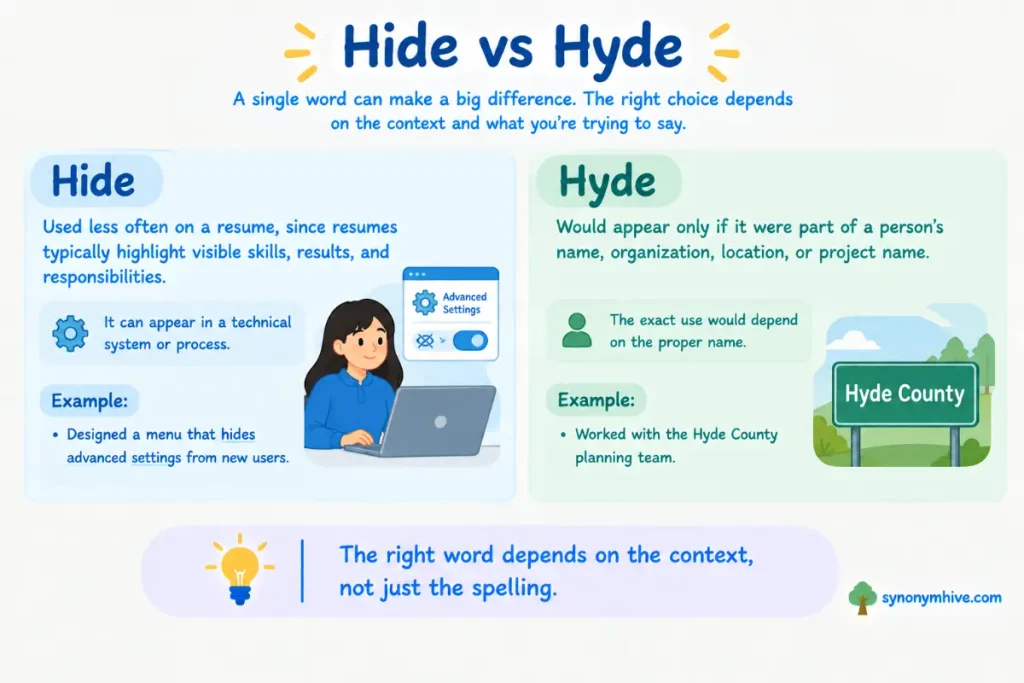
Hide is less common on a resume because resumes usually focus on visible skills, results, and responsibilities.
Still, it could appear in a description of a technical system or process.
For example:
Designed a menu that hides advanced settings from new users.
Hyde would appear only if it were part of a person’s name, organization, location, or project name.
For example:
Worked with the Hyde County planning team.
The exact use would depend on the proper name.
The larger lesson is that professional writing rewards accuracy. A small spelling change can turn a normal verb into a different word or alter a proper name.
How To Use These Words In Conversation
In everyday speech, hide is extremely common.
Hide the snacks.
Where did you hide my keys?
I am going to hide upstairs for a while.
The pronunciation may sound simple, but the written form still matters when you put the conversation into an email, text, caption, or document.
Hyde is mainly heard when people mention a person or place with that name.
Because both forms can sound alike, speakers rely on context. Writers need to rely on spelling and context together.
Final Takeaway
The difference between hide and Hyde becomes simple once you focus on meaning. Hide is the normal English word for keeping something out of sight, staying unseen, or keeping information from being noticed. Hyde is generally a proper name.
Grammar gives you another useful clue. The verb changes from hide to hid in the simple past and to hidden as a past participle. It does not become hided. The best habit is to check what the word is doing in the sentence. If you are describing concealment, choose hide. If you are naming a person, place, or character, preserve the spelling Hyde.
When you see hide vs hyde, remember one short rule: actions use hide, while specific names may use Hyde. That simple distinction will help you make the right choice in emails, essays, texts, and professional writing.
Common Questions
Is hide the correct spelling for conceal?
Yes, hide is the standard spelling when you mean conceal or keep something out of sight. The word can describe objects, people, information, and emotions.
Is Hyde a real English word?
Hyde is mainly used as a proper name or part of a proper name. You may see it in surnames, place names, and fictional names.
Which spelling should I use for the verb?
Use hide for the verb. For example, you can hide a gift, hide your keys, or hide from someone.
What is the past tense of hide?
The simple past tense is hid. The past participle is hidden, as in she hid the keys and she has hidden the keys.
Is Hyde Park spelled with a y?
Yes, Hyde Park is spelled with Hyde when referring to the established place name. Do not replace the y with an i.
Can hide be a noun?
Yes, hide can be a noun. It can refer to animal skin or a shelter used for watching wildlife.
What is the easiest way to remember hide and Hyde?
Think of hide as the action of keeping something out of sight. Think of Hyde as a name that usually identifies a person, place, or fictional character.

2 thoughts on “Hide vs Hyde Best Simple Guide”