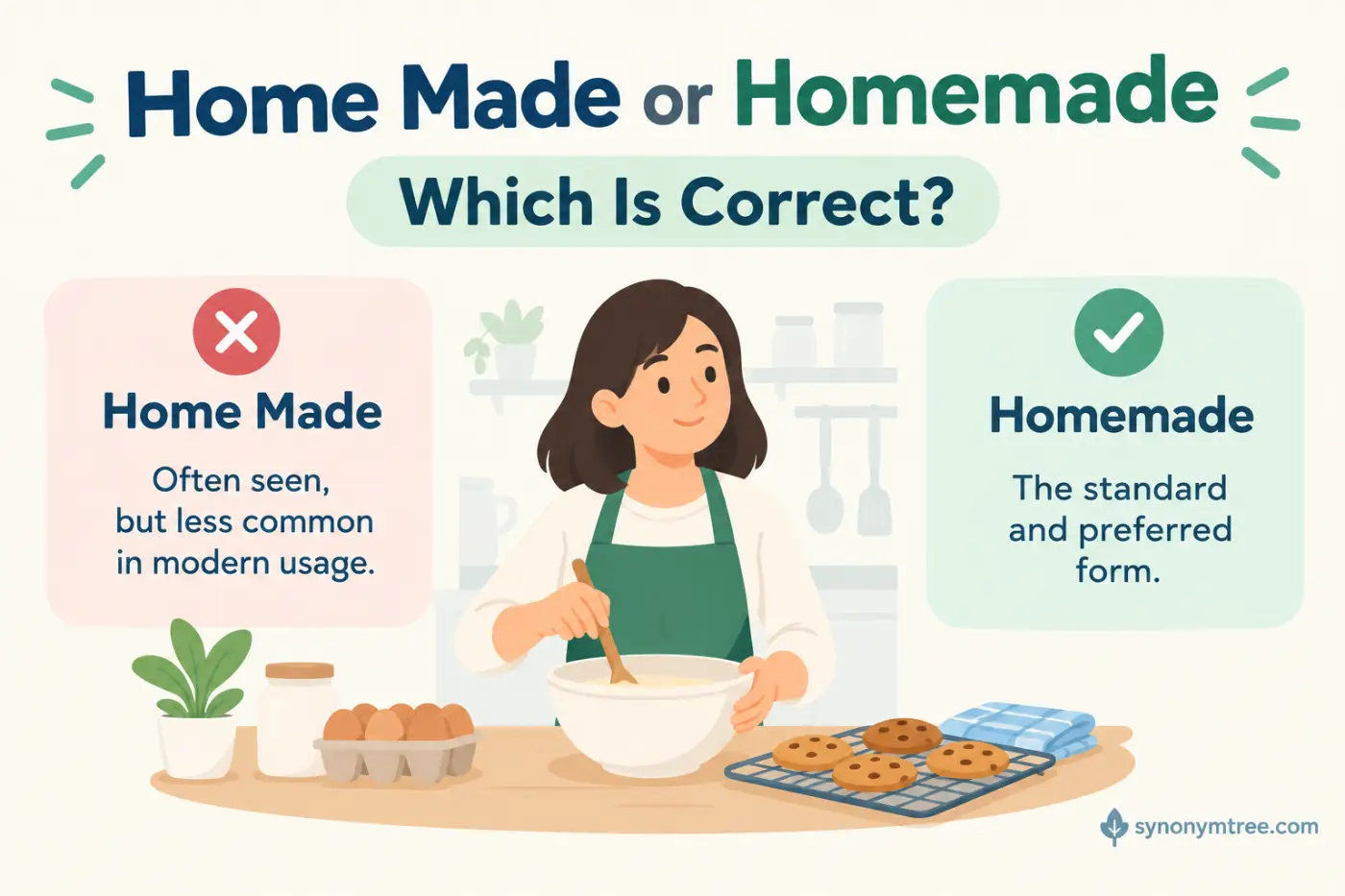
If you are unsure about home made or homemade, the correct form in most modern English is homemade. It is usually written as one word when it describes something made at home instead of being bought from a store or made in a factory. You will see it used for food, gifts, crafts, clothing, decorations, and many other things.
The confusion makes sense because the phrase comes from two simple words, home and made. English has many combinations that stay as two words, while others become one word over time. Homemade belongs to the second group in standard modern usage.
This guide explains why homemade is the usual choice, how to use it in a sentence, and when the two word form can appear. You will also see common mistakes, useful examples, related words, and simple memory tricks that make the spelling easier to remember.
Quick Definition
Homemade is an adjective that describes something made at home rather than bought ready made from a store or produced by a commercial company. It can describe food, objects, gifts, decorations, remedies, clothing, and other things created at home.
Home made can sometimes appear when home and made are being used as separate words in a different sentence structure. However, when you mean made at home, homemade is the standard modern form.
Direct Answer
Homemade is the standard spelling when you mean something made at home. Use it as one word in sentences such as Homemade bread tastes great and She gave me a homemade card.
Comparison Table
| Word or Phrase | Meaning | Example Sentence | When to Use It |
|---|---|---|---|
| Homemade | Made at home instead of being commercially produced. | We served homemade cookies at the party. | Use this standard one word form as an adjective. |
| Home made | Home and made function as separate words in a particular sentence structure. | The decorations were made at home. | Use this structure when the words are not forming the adjective homemade. |
Why Homemade Is Usually One Word
English often turns common word combinations into single words when people use them together often enough. Homemade is one of those established compounds. It has a clear meaning that most English speakers recognize immediately.
The word combines home with made, but its meaning is more specific than simply putting the two words beside each other. Homemade describes something created in a home setting. The word can suggest personal effort, small scale production, or a lack of commercial manufacturing.
For example, homemade soup means soup prepared at home. Homemade bread means bread baked at home. Homemade candles are candles made at home rather than purchased from a commercial producer.
The one word form is especially common before a noun. That position is one of the easiest ways to recognize it.
Consider these sentences.
She brought homemade brownies to the office.
We sell homemade jam at the local market.
He gave his mother a homemade birthday card.
They served homemade pasta for dinner.
I prefer homemade tomato sauce.
In every example, homemade works as an adjective. It tells us what kind of brownies, jam, card, pasta, or sauce the sentence describes.
The word can also describe things that are not related to food. A homemade gift can be a handmade present created at home. A homemade decoration may be something a person makes for a party or holiday.
This broad use is one reason the word has become so familiar in everyday English.
What Homemade Means
Homemade usually means made in a person’s home. It can also suggest that something was made by an individual rather than by a large commercial producer.
The exact meaning depends on context. Homemade cookies might be baked in someone’s kitchen. Homemade furniture might be built in a garage or workshop attached to a house.
The word does not always mean that every part of the item was created from raw materials at home. Someone might buy flour, butter, and sugar from a store and then use those ingredients to make cookies at home. The cookies can still be called homemade.
Likewise, a person can buy fabric and thread before making a dress at home. The finished dress can still be described as homemade.
The main idea is the place and manner of production. The item was made at home instead of being purchased as a finished commercial product.
Sometimes homemade also carries a warm or personal meaning. A homemade meal can suggest care and personal effort. A homemade gift may seem more personal because someone spent time making it. These associations are common, but they are not required for the word to be correct.
How Homemade Works In A Sentence
Homemade is usually an adjective. An adjective gives information about a noun.
In the sentence We ate homemade bread, the noun is bread. The adjective homemade tells us what kind of bread it was.
The same pattern works in many other sentences.
She made homemade cookies.
He brought homemade salsa.
We bought a homemade quilt at the craft fair.
My grandmother makes homemade soup.
They sell homemade candles online.
The company promotes homemade style desserts.
The last example shows an interesting point. Homemade itself is still one word, even when another word follows it.
You can also use homemade after a linking verb in some sentences.
The pie is homemade.
These decorations are homemade.
The sauce tastes homemade.
Here, homemade still describes the subject. The sentence structure changes, but the spelling stays the same.
This makes the word easy to use once you know its basic role.
When To Use Home Made
The two word form deserves a little attention because it is not always impossible. English can place home and made next to each other when they are functioning separately.
For example, instead of saying The bread is home made, standard modern English would normally say The bread is homemade. However, you can say The bread was made at home. This sentence expresses the same basic idea without treating home and made as one adjective.
There are also situations where home functions as a noun or modifier and made functions as a separate part of the sentence. The exact structure matters.
For most everyday writing, the safest rule is simple. If you want an adjective that means made at home, use homemade.
You do not need to create a special two word form just because the word contains two smaller words. Many English compounds work the same way.
Examples include breakfast, bedroom, classroom, homemade, notebook, and toothbrush. Their parts have separate meanings, but the combined words have become established forms.
That is why spelling the adjective as homemade is the natural choice in modern American English.
The Difference Between Homemade And Handmade
Homemade and handmade are related, but they do not mean exactly the same thing.
Homemade focuses on the place where something was made. Handmade focuses on the method used to make it.
A homemade cake was made at home. It may have been mixed and baked by hand, or the person may have used an electric mixer.
A handmade cake could mean that the cake was carefully decorated by hand. It does not automatically tell us where it was made.
The distinction becomes clearer with objects.
A homemade wooden table is a table made at home. It could also be handmade.
A handmade wooden table was made by hand. It could have been built in a home workshop, a professional studio, or a commercial craft space.
The two words can overlap, but they answer different questions.
Homemade tells you where or in what setting something was produced. Handmade tells you how it was produced.
This distinction can help you choose the right word when writing product descriptions, recipes, advertisements, or personal stories.
Homemade And Store Bought
Another common comparison is homemade and store bought.
Store bought describes something purchased from a store rather than prepared or produced at home. Homemade describes something made at home.
For example, you might say, I prefer homemade bread to store bought bread.
Both adjectives describe the type of bread. One tells the reader that it was made at home. The other tells the reader that it was purchased from a store.
The terms can apply to many products.
Homemade gifts can be compared with store bought gifts.
Homemade decorations can be compared with commercial decorations.
This contrast is common in everyday speech because people often talk about differences in cost, taste, effort, quality, or personal value.
Still, homemade does not automatically mean better. It only tells you how or where the item was made. A homemade product can be excellent, simple, expensive, inexpensive, attractive, or poorly made.
The context gives the rest of the meaning.
Common Examples Of Homemade
The word appears with many nouns. Food is probably the most familiar category.
Homemade bread is bread baked at home.
Homemade cookies are cookies prepared at home.
The word also works well with objects and creative projects.
She made a homemade birthday card.
He built a homemade bookshelf.
They created homemade decorations for the party.
I gave my friend a homemade gift.
The children made homemade ornaments.
We designed a homemade bird feeder.
My father built a homemade workbench.
These examples show that homemade is not limited to cooking. The word can describe almost anything that someone creates in a home setting.
Common Mistakes With Homemade
One common mistake is writing the adjective as two words.
People may write home made cookies when they mean cookies made at home. In standard modern American English, homemade cookies is the better choice.
Another mistake is adding a hyphen. Some writers may use home-made. That form can appear in older writing or in some style traditions, but homemade is the normal modern form for general American English.
A third mistake is confusing homemade with handmade. The words overlap, but they focus on different ideas. Homemade points to the home setting. Handmade points to the use of hand labor.
Another problem comes from using homemade for something that was not actually made at home. A product can be small batch, artisan, handmade, or locally produced without being homemade. The word should match the facts.
For example, a professional bakery may produce bread in a commercial kitchen. Calling that bread homemade could give the reader the wrong idea if the business is presenting it as a commercial product.
Clear writing depends on accurate word choice. Homemade should describe something that was made at home or is presented as home produced in the intended context.
Home Made Or Homemade In Product Descriptions
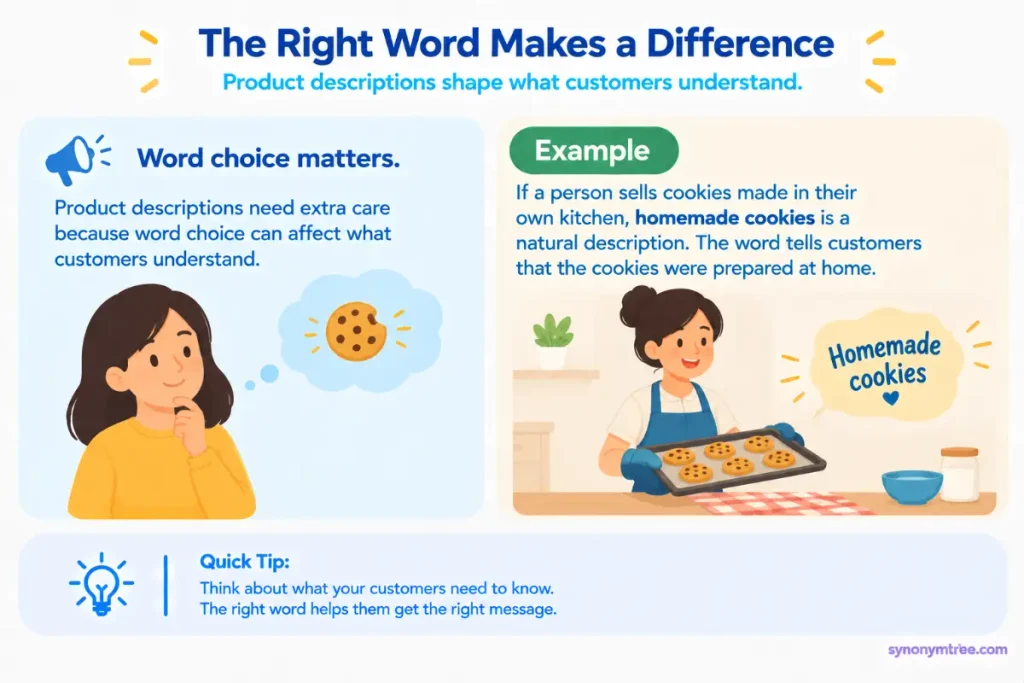
Product descriptions need extra care because word choice can affect what customers understand.
If a person sells cookies made in their own kitchen, homemade cookies is a natural description. The word tells customers that the cookies were prepared at home.
If a professional bakery makes the cookies, homemade may not be the best description. The business might use fresh baked, handcrafted, small batch, or bakery made, depending on the actual process.
The same rule applies to crafts.
Someone who makes candles at home can describe them as homemade candles. A professional candle company may choose handmade candles if the candles are produced by hand in a studio.
Accuracy matters more than choosing the word that sounds more appealing.
For online stores, social media posts, recipes, and advertisements, clear language helps readers understand exactly what they are buying or reading about.
Homemade In Recipes
Recipes use homemade very often.
A recipe may tell you to use homemade broth, homemade bread crumbs, homemade sauce, or homemade whipped cream. In these phrases, homemade identifies something prepared at home instead of bought as a ready made product.
For example, a recipe might say, Add two cups of homemade chicken broth.
The adjective appears before the noun and tells the reader which kind of broth to use.
You can also write, This recipe works well with homemade tomato sauce.
The word is useful because it can save space. Instead of writing sauce that was made at home, you can simply write homemade sauce.
That is one reason compound adjectives become useful in English. They allow writers to express a clear idea in a compact form.
Homemade As A Personal Description
Homemade can also describe something connected with personal effort.
A homemade gift may have special meaning because someone spent time creating it. A homemade meal may suggest that someone cooked instead of ordering food.
The word itself does not guarantee that the item is better or more valuable. Those ideas come from the context.
For example, Homemade bread can taste great is a neutral statement about bread prepared at home.
Her homemade card meant a lot to me adds an emotional idea. The feeling comes from the situation, not from the spelling of homemade.
This distinction is useful when writing naturally. Let the surrounding sentence provide the emotion instead of forcing the word to carry more meaning than it actually has.
The Grammar Behind Homemade
Homemade is a compound adjective. A compound adjective is made from two or more words that work together to describe a noun.
English has many compound adjectives and compound nouns. Some are written as one word. Some remain separate.
Homemade is normally written as one word in modern American English.
The word usually comes before the noun it describes.
We ate homemade bread.
She brought homemade cookies.
He sells homemade furniture.
They prepared a homemade meal.
The adjective can also come after a linking verb.
The bread is homemade.
The cookies are homemade.
The furniture is homemade.
The meal was homemade.
This makes the grammar fairly simple. The main challenge is remembering the spelling.
How Homemade Developed
The history of homemade follows a common pattern in English. A phrase made from separate words can gradually become a fixed compound when speakers use it often.
Home has been used for centuries to describe a place of living or a household. Made is the past participle of make. Together, the idea of something made at home became familiar enough to develop into the established compound adjective homemade.
English has many words that developed through similar patterns. Some combinations remain open phrases. Others become closed compounds. The form used today depends on common usage, dictionaries, style guides, and the history of the word.
You do not need to know the full history to spell homemade correctly. Still, understanding that the word is an established compound helps explain why the one word form is standard.
The spelling is not random. It reflects how English speakers have come to treat the term as a single adjective.
Homemade Compared With Homegrown
Homemade and homegrown are sometimes confused because both words can describe things produced at home.
Homegrown usually refers to plants, crops, or produce grown at home. It can also have a broader figurative meaning for something developed locally.
For example, homegrown tomatoes are tomatoes grown at home.
Homemade tomato sauce is sauce prepared at home.
The tomato may be homegrown, while the sauce is homemade. One word describes where the tomato was grown. The other describes where the sauce was prepared.
This difference is small but useful.
You can also use both words in the same sentence.
We made homemade salsa with homegrown tomatoes.
That sentence gives two different pieces of information. The tomatoes came from a home garden, and the salsa was prepared at home.
Homemade Compared With Homegrown And Handmade
These three words can appear together, but each one answers a different question.
Homemade describes something made at home.
Handmade describes something made by hand.
Homegrown describes something grown at home.
Imagine a bowl of salsa.
If you prepared it in your kitchen, it is homemade.
If you chopped and prepared the ingredients by hand, you could also describe the salsa as handmade in a broad sense, though handmade is much more common for crafts and objects.
The three words can describe different parts of the same project. Knowing these differences helps you avoid using a familiar word simply because it sounds right.
Memory Tricks For Homemade
The easiest memory trick is to connect the word with its meaning.
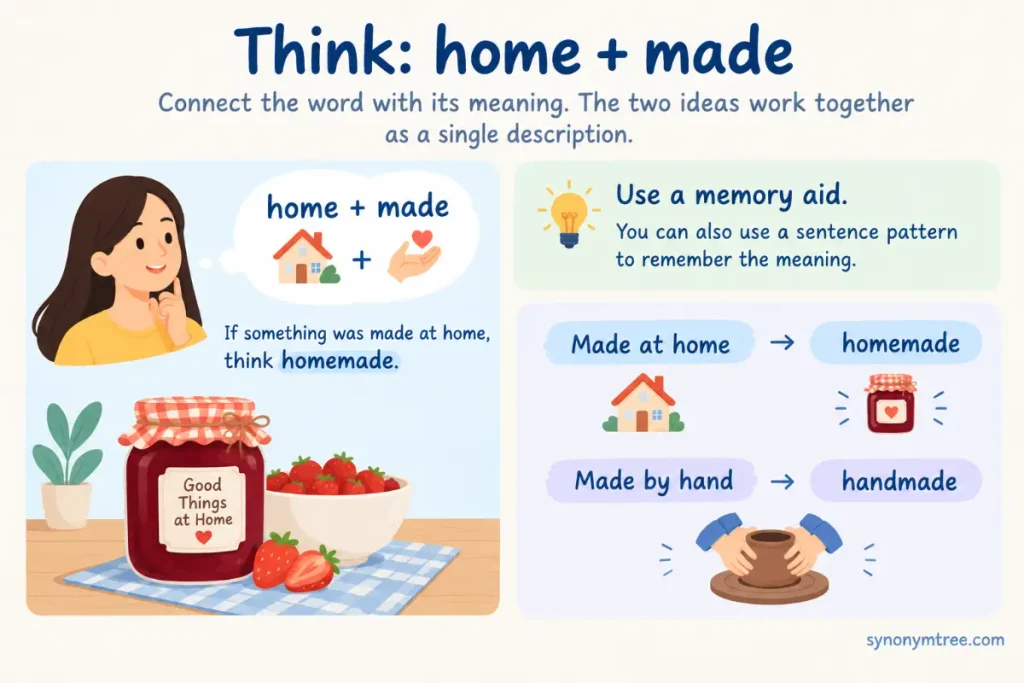
Think of homemade as home plus made, combined into one word because the two ideas work together as a single description.
If something was made at home, think homemade.
You can also use a sentence pattern as a memory aid.
Made at home becomes homemade.
Made by hand becomes handmade.
Grown at home becomes homegrown.
This three part pattern makes the differences easier to remember.
Another useful trick is to remember that homemade commonly appears directly before a noun.
Homemade soap.
Homemade furniture.
Seeing the word in these common phrases can make the spelling automatic over time.
If you are editing your own writing, ask one simple question. Am I using this word to describe something made at home? If the answer is yes, homemade is normally the form you want.
Real Sentence Examples
Natural examples are one of the best ways to learn a word. Notice how homemade changes the meaning of each noun that follows it.
My sister baked homemade bread for breakfast.
We brought homemade cookies to the school event.
The recipe calls for homemade chicken broth.
He gave his friend a homemade birthday card.
She sells homemade candles at the weekend market.
The children made homemade decorations for the holiday.
I prefer homemade tomato sauce with fresh pasta.
They served homemade ice cream after dinner.
My neighbor makes homemade soap.
We built a homemade shelf for the garage.
The family enjoyed a homemade meal together.
She packed homemade snacks for the trip.
He created a homemade gift for his parents.
The restaurant is known for its homemade pasta.
We used homemade stock in the soup.
These examples show how flexible the word is. It can describe food, crafts, household objects, and gifts.
The word also works naturally after a linking verb.
The bread is homemade.
The soup was homemade.
The decorations are homemade.
Her gift was homemade.
Those sentences are simple, but they show that the spelling stays the same even when the adjective moves after the noun or subject.
When The Phrase Can Be Written Separately
The exact sequence home and made can appear as separate words when they are not functioning as the compound adjective.
For example, the sentence The product was made at home uses home and made in a completely different structure. Here, made is the main verb, while at home is a phrase that tells us where the action happened.
You can also write sentences that contain both words separately without creating the adjective.
The home was made ready for the guests.
In that sentence, home is a noun and made belongs to the verb phrase was made.
This is why it is not accurate to say that the two words can never appear next to each other in any sentence. English grammar depends on how words function in a sentence.
The useful rule is narrower and more practical. When you mean the adjective that describes something produced at home, write homemade.
That rule will solve almost every everyday spelling question involving this word.
American English Usage
In American English, homemade is the standard spelling for the adjective.
You will see it in recipes, newspapers, product descriptions, personal writing, school assignments, advertisements, cookbooks, and everyday conversation.
The word is common enough that most readers recognize it immediately.
American English also uses homemade in familiar phrases such as homemade food, homemade bread, homemade cookies, homemade gifts, homemade crafts, and homemade sauce.
The one word spelling is therefore the safest choice for general American writing.
If you are writing for a school assignment, website, business, recipe blog, email, or social media post, homemade is the form you should normally choose.
British English Usage
British English also commonly uses homemade as one word.
This is useful to know because some spelling differences between American and British English can create confusion. Homemade is not one of the major differences. The same closed spelling is widely recognized in both forms of English.
Other words can change between American and British English, such as color and colour or center and centre. Homemade does not normally create that kind of regional spelling problem.
So if your audience includes readers from the United States, the United Kingdom, Canada, Australia, or other English speaking regions, homemade is generally easy to understand.
Is Homemade Always A Positive Word
Homemade can have a positive meaning, but the word itself is neutral.
In some contexts, homemade suggests care, effort, freshness, or personal attention. A homemade pie may sound inviting. A homemade gift may sound thoughtful.
In other contexts, the word can suggest that something was made without professional equipment or commercial production.
For example, someone might describe a homemade repair as temporary or simple. The word does not automatically tell the reader that the result is high quality.
This matters in careful writing. Do not assume that homemade means excellent. If quality matters, add a separate word that explains the quality.
You could say, She made a beautiful homemade quilt.
Here, beautiful tells the reader how the quilt looks. Homemade tells the reader where it was made.
That separation makes the sentence clear.
Common Phrases With Homemade
Learning common word combinations can make spelling much easier.
Homemade food is one of the most common phrases. It refers to food prepared at home.
Homemade products refer to products made in a home setting.
Homemade remedies refers to preparations made at home, though this phrase should be used carefully when discussing health because homemade does not mean medically proven or safe.
These phrases are useful because they show how naturally the word fits before many different nouns.
A Simple Editing Test
If you are proofreading your writing and cannot decide which form to use, replace the word with made at home.
Suppose your sentence says, We served home made bread.
Replace the phrase with made at home.
We served bread made at home.
The meaning still works. That tells you that homemade is the adjective you need.
Now consider a sentence such as The bread was made at home.
There is no reason to force the words into one word. The sentence already has a natural verb structure.
This test helps separate spelling from grammar.
If you need an adjective before a noun, homemade is usually the correct choice.
If you are writing a sentence with the verb made and a separate phrase that tells the reader where the action happened, use a normal sentence such as made at home.
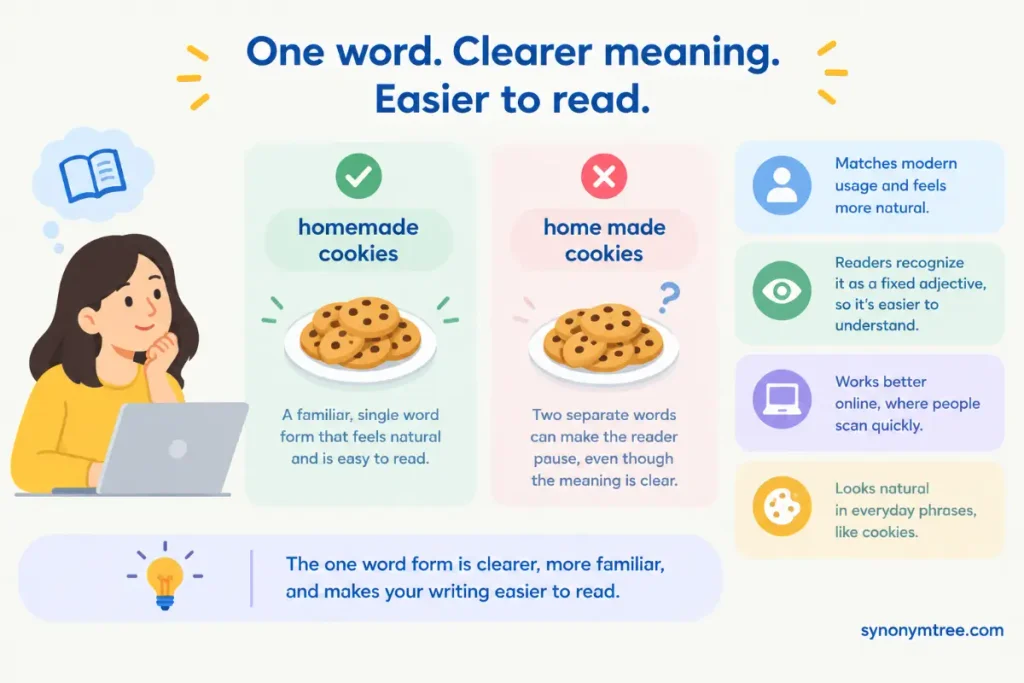
Why The One Word Form Is Better
The one word form is better because it matches standard modern usage and makes the intended meaning clear.
Readers are familiar with homemade as a fixed adjective. They do not have to stop and interpret two separate words.
This matters even more in online writing. People often scan web pages quickly. Familiar word forms make information easier to process.
A phrase such as homemade cookies looks natural because readers have seen it many times.
The form home made cookies may make the reader pause, even though the meaning can still be understood.
Good editing often means choosing the form that readers expect. In this case, homemade is that form.
Conclusion
When you are choosing between home made or homemade, use homemade when you mean something made at home. It is the standard one word adjective in modern American English and is also widely used in British English. You can use it before a noun, as in homemade bread, or after a linking verb, as in The bread is homemade.
The two word sequence home made can still appear when home and made have separate grammatical jobs. A sentence such as The bread was made at home uses a normal verb and location phrase. That is different from using homemade as one adjective.
The easiest rule is to remember the meaning rather than memorize a complicated spelling rule. Made at home becomes homemade. Made by hand becomes handmade. Grown at home becomes homegrown. These simple patterns can help you choose the right word quickly.
If you are editing a sentence and see home made before a noun, check the meaning. If you are describing something produced at home, change it to homemade. That small edit will usually give you the standard form your reader expects.
FAQs
Is home made or homemade correct?
Homemade is the standard spelling when you mean something made at home. It is normally written as one word in modern American English. Use homemade in phrases such as homemade bread, homemade gifts, and homemade sauce.
Is homemade one word or two words?
Homemade is one word when it works as an adjective meaning made at home. It can appear before a noun or after a linking verb. For example, you can write homemade cookies or The cookies are homemade.
Should homemade be hyphenated?
Homemade is normally not hyphenated in modern American English. The standard form is homemade as one word. The form home made may appear in older material or in special grammatical structures, but it is not the normal spelling for the adjective.
Is homemade the same as handmade?
No. Homemade means something was made at home, while handmade focuses on something being made by hand. A product can be homemade and handmade, but the two words highlight different details.
Can I say home made food?
For standard modern American English, homemade food is the better choice. Homemade is the established one word adjective for food prepared at home. You can also say food made at home when you want to use a full phrase instead.
Is homemade used in British English?
Yes. Homemade is also widely used as one word in British English. It is not a spelling difference that normally separates American and British English.
What is the opposite of homemade?
There is no single perfect opposite in every context. Common choices include commercially made, store bought, factory made, packaged, or commercially produced. The best choice depends on what you want to contrast with something made at home.
Can homemade describe things besides food?
Yes. Homemade can describe gifts, crafts, furniture, decorations, clothing, toys, candles, soap, and many other things. The basic idea stays the same because the word describes something made at home.

1 thought on “Home Made or Homemade Which Is Correct”