
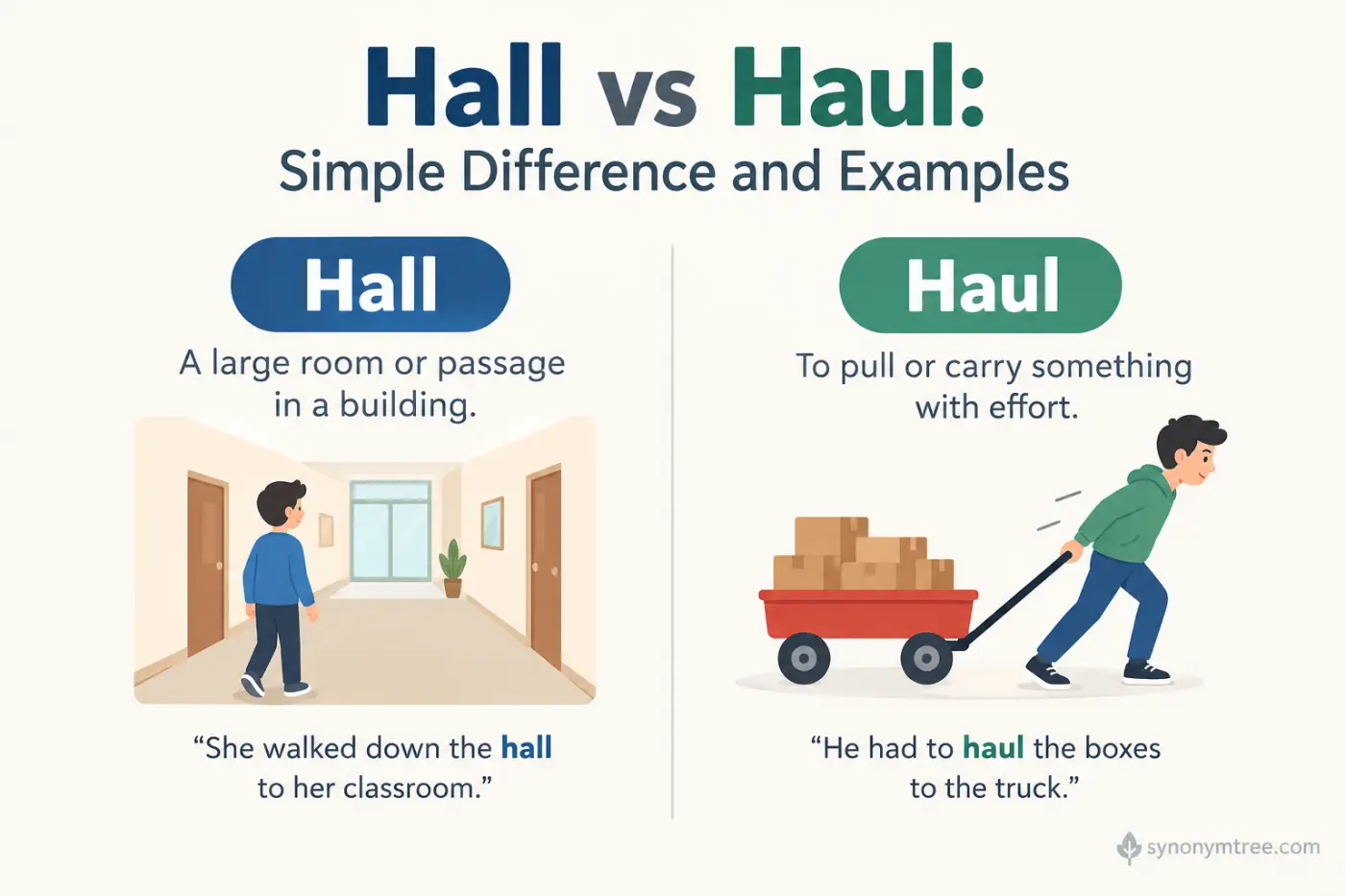
If you have ever heard the words “hall” and “haul” spoken aloud, you may have wondered which spelling belongs in your sentence. The confusion is easy to understand because hall vs haul sounds almost identical in most forms of American English. The spelling, however, changes the meaning completely.
Hall is usually a noun for a passage, large room, building area, or public place. Haul can be a verb meaning to pull, drag, carry, or transport something, and it can also be a noun for something that has been transported or collected.
Hall means a place or space, while haul usually means moving or carrying something. They sound alike, but they have different meanings, spellings, and uses.
This guide explains the difference in plain English. You will see clear definitions, real sentence examples, common mistakes, pronunciation tips, memory tricks, and answers to the questions people often ask about these two words.
Quick Definition
Hall is a noun that usually refers to a passage, room, building, or public place. Haul can be a verb meaning to pull or transport something, or a noun referring to something that has been collected or carried.
Direct Answer
Use hall when you mean a place, passage, room, or building. Use haul when you mean pulling, carrying, transporting, or collecting something.
Comparison Table
| Word | Meaning | Example Sentence | When to Use It |
|---|---|---|---|
| Hall | A passage or large room | She walked down the hall. | For a place or space |
| Hall | A public building or venue | The meeting was held in the town hall. | For certain buildings |
| Haul | To pull or carry something | They hauled the boxes upstairs. | For moving something |
| Haul | A quantity collected or transported | The fishermen had a large haul. | For something gathered or brought in |
| Haul | A group of purchased items | She showed us her shopping haul. | For collected purchases |
The simplest way to remember the difference is to connect each word with an image.
Think of hall as a place you can walk through.
Think of haul as something you have to move, pull, carry, or transport.
If you can picture a hallway, school hall, concert hall, or town hall, you need hall. If you can picture someone pulling a heavy box, carrying supplies, or bringing home a large group of purchases, you need haul.
What Does Hall Mean?
Hall is most often a noun. It can describe a passage inside a building, a large room, or a building used for a particular purpose.
One of the most common meanings is a hallway.
For example:
The bedrooms are at the end of the hall.
Here, hall means the passage that connects different rooms.
The word can also describe a large room used for meetings, performances, events, or other activities.
For example:
Everyone gathered in the school hall.
In this sentence, hall refers to a large room in a school.
The word also appears in the names of buildings and public spaces.
Examples include:
town hall
city hall
concert hall
dining hall
lecture hall
sports hall
assembly hall
The exact meaning depends on the phrase, but the central idea is usually a place or space.
What Does Haul Mean?
Haul has several related meanings, but they all connect to the idea of moving or carrying something.
As a verb, haul means to pull, drag, carry, or transport something, often with effort.
For example:
We had to haul the boxes into the garage.
The boxes were heavy, so moving them required effort.
You can also haul something from one place to another.
The truck hauled the equipment across the state.
Here, haul means transport.
The word can also describe bringing in a large amount of something.
The fishing boat returned with a huge haul.
In that sentence, a haul is the amount of fish caught or brought in.
Modern informal English also uses haul for a collection of things someone has bought.
She posted a video showing her makeup haul.
Here, haul means the group of products she purchased.
Why Do Hall and Haul Sound the Same?
The main reason people confuse these words is pronunciation.
In many forms of American English, hall and haul are pronounced the same or very close to the same. Both commonly have the pronunciation represented as /hɔːl/.
That means you cannot always identify the correct spelling by listening.
You have to use the meaning and the surrounding words.
This is a common feature of English. Some words sound alike but have different spellings and meanings. These are called homophones when they have the same pronunciation but different meanings.
Other familiar examples include:
pair and pear
right and write
sea and see
brake and break
Hall and haul can create the same kind of spelling problem.
When you hear “hall” or “haul,” ask yourself what the speaker means. Are they talking about a place, or are they talking about moving something?
That question usually gives you the answer.
Hall vs Haul in Everyday English
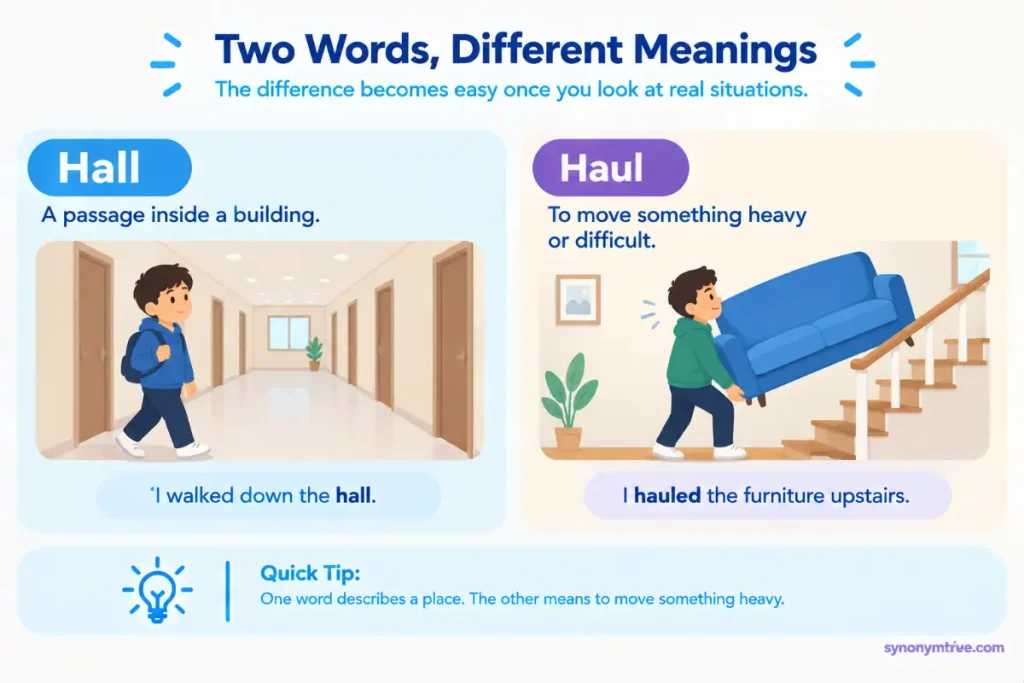
The difference becomes easy once you look at real situations.
Imagine someone says:
I walked down the hall.
They are talking about a passage inside a building.
Now imagine:
I hauled the furniture upstairs.
They are talking about moving furniture.
The two sentences have completely different meanings even though the key words sound alike.
Here are more examples:
The students waited in the hall.
The workers hauled the equipment inside.
We met in the town hall.
They hauled the old sofa to the curb.
The concert was held in a large hall.
The truck hauled the supplies to the warehouse.
The first group refers to places. The second group refers to movement.
When Should You Use Hall?
Use hall when you are talking about a physical space, passage, room, or building.
Hall as a Passage
This is one of the most common uses.
My office is down the hall.
She ran down the hall to answer the phone.
The lights in the hall were off.
We heard a noise coming from the hall.
Here, hall means an interior passage.
Hall as a Large Room
Hall can also mean a large room used for a gathering.
The students gathered in the assembly hall.
The wedding reception was held in a beautiful hall.
Everyone entered the lecture hall.
The audience filled the concert hall.
The word does not always mean a narrow hallway. Context tells you which meaning applies.
Hall as a Building
Hall can also refer to a building or institution.
For example:
The town council met at city hall.
The ceremony took place at the town hall.
We went to the student union hall.
Some names have a long history, so the exact use can vary by place.
When Should You Use Haul?
Use haul when the idea involves moving something from one place to another, especially when the movement takes effort.
Haul as a Verb
For example:
They hauled the table outside.
We hauled the bags into the car.
The workers hauled the heavy machine across the floor.
She hauled the boxes up the stairs.
The word often suggests that the object is heavy, awkward, difficult to move, or moved in a large amount.
However, haul does not always require great physical effort.
You can also use it for transportation:
The train hauled several freight cars.
The truck hauled supplies to the construction site.
In these cases, haul means carry or transport.
Haul as a Noun
Haul can also be a noun.
The fishermen returned with a good haul.
The haul is what they brought back.
The word is common in fishing, hunting, mining, trade, and other settings where people collect or transport things.
It also has a modern informal use:
I bought a lot of books, so this is my weekend book haul.
Here, haul means a collection of things purchased during a shopping trip or similar activity.
Hall vs Haul in Sentences
A direct comparison can make the difference much clearer.
| Hall Sentence | Haul Sentence |
|---|---|
| I left my coat in the hall. | I hauled my coat and bags upstairs. |
| The children ran down the hall. | The workers hauled the boxes away. |
| We met in the dining hall. | We hauled the furniture into the room. |
| The concert hall was packed. | The truck hauled the equipment. |
| She waited in the school hall. | They hauled the old table outside. |
The key is not pronunciation. The key is meaning.
If the sentence needs a place, hall may be the correct word.
If the sentence needs an action involving movement or transportation, haul may be correct.
How Does Hall Work in Compound Words?
Hall appears in many familiar compound expressions.
Hallway
A hallway is a passage inside a building.
The bathroom is at the end of the hallway.
Town Hall
Town hall can refer to a local government building or a meeting held there.
The council met at town hall.
City Hall
City hall is the main administrative building of a city.
The mayor spoke at city hall.
Dining Hall
A dining hall is a large place where people eat.
Students ate lunch in the dining hall.
Concert Hall
A concert hall is a building or room designed for musical performances.
The orchestra performed at the concert hall.
Lecture Hall
A lecture hall is a large room used for teaching or presentations.
The professor spoke to hundreds of students in the lecture hall.
These phrases all relate to a place or room.
How Does Haul Work in Common Expressions?
Haul also appears in many useful expressions.
Haul Away
To haul something away means to remove or transport it.
The workers hauled away the broken furniture.
Haul In
To haul something in means to bring or pull it into a place.
The fishermen hauled in the nets.
Haul Out
To haul something out means to pull or remove it.
They hauled the old equipment out of storage.
Shopping Haul
A shopping haul is a collection of things someone bought.
She shared her holiday shopping haul online.
Big Haul
A big haul means a large amount collected, caught, bought, or transported.
The team came back with a big haul of supplies.
These expressions all connect to movement, collection, or transportation.
What Is the Difference Between Hall and Hallway?
Hall and hallway are closely related, but they are not always identical.
A hallway is specifically a passage inside a building.
Hall can also mean a hallway, but it has broader meanings.
For example:
My room is down the hall.
Here, hall means hallway.
But:
The concert hall holds 2,000 people.
This does not mean a narrow passage. It means a large room or building used for concerts.
So, hallway has a narrower meaning, while hall can describe several kinds of spaces.
What Is the Difference Between Haul and Carry?
Haul and carry are both verbs related to moving something, but they are not always equal in tone.
Carry is a very general word.
I carried the bag upstairs.
Haul often suggests that the object is heavy, large, awkward, or difficult to move.
I hauled the heavy suitcase upstairs.
The second sentence gives a stronger sense of effort.
You can think of carry as the general word and haul as a word that often adds a sense of physical work.
What Is the Difference Between Haul and Pull?
Pull means to move something toward you or in a particular direction by using force.
Pull the door open.
Haul can mean pull, but it often suggests carrying or transporting something over a distance.
They hauled the boat onto the trailer.
So haul is often broader than pull.
A person can haul a box across a room, haul equipment in a truck, or haul supplies over a long distance.
What Is the Difference Between Haul and Drag?
Drag means to pull something along a surface.
He dragged the chair across the floor.
Haul can also describe difficult movement, but it does not always involve pulling an object along the ground.
The truck hauled the furniture across the country.
You would not normally replace hauled with dragged in that sentence.
Drag focuses on the manner of movement. Haul focuses more on the act of moving or transporting something, often with effort.
Common Mistakes With Hall vs Haul
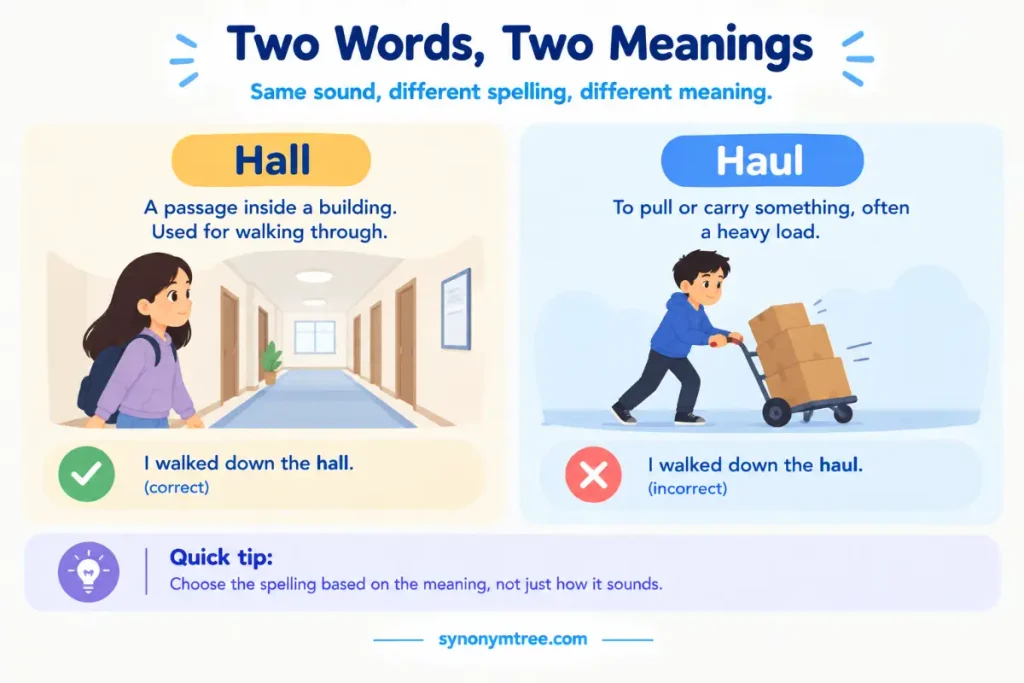
The most common mistake is choosing the spelling based on sound alone.
For example, someone may write:
I walked down the haul.
That is incorrect if they mean a passage in a building.
The correct sentence is:
I walked down the hall.
Another common mistake is writing:
We hall the boxes into the truck.
If you mean that you moved the boxes, the correct form is:
We haul the boxes into the truck.
The pronunciation cannot help you much here. You need to identify the meaning.
Mistake One
Incorrect:
Meet me in the haul.
Correct:
Meet me in the hall.
You are referring to a place.
Mistake Two
Incorrect:
We hall the furniture outside.
Correct:
We haul the furniture outside.
You are describing movement.
Mistake Three
Incorrect:
The fishing boat returned with a large hall.
Correct:
The fishing boat returned with a large haul.
Here, haul means the amount of fish caught.
How to Remember Hall
A simple memory trick is to connect hall with hallway.
Both contain the idea of a place inside a building.
You can picture:
hall → hallway → place
If you can walk through it, enter it, stand in it, or meet someone there, hall may be the word you need.
Think about these examples:
school hall
concert hall
dining hall
hallway
town hall
They all refer to spaces or places.
How to Remember Haul
Think about effort and movement.
Haul has an “au” spelling, and you can connect it with the idea of pulling or carrying something heavy.
Picture someone saying:
We have to haul this sofa upstairs.
The sofa is being moved, and the task may require effort.
Think:
haul → pull → carry → transport
That mental chain can help you remember the spelling.
A Quick Test for Hall vs Haul
When you are writing and cannot decide, ask one question.
Is this word describing a place or movement?
If it describes a place, choose hall.
If it describes movement, transportation, or a collection that was brought in, choose haul.
For example:
The children are waiting in the hall.
Place.
The workers are hauling the boxes.
Movement.
The fishermen had a large haul.
Collected amount.
That three step check works in most everyday situations.
Hall and Haul in Formal Writing
Both words are perfectly acceptable in formal English. The challenge is using the correct one.
Hall is common in formal writing about buildings, institutions, meetings, education, and events.
For example:
The committee met in the main hall.
Haul can appear in formal writing about transportation, fishing, agriculture, construction, shipping, and other industries.
For example:
The truck was used to haul construction materials.
In casual writing, haul also appears in phrases like shopping haul or makeup haul.
The context changes, but the spelling does not.
Hall and Haul in School Writing
Students often encounter hall in school settings.
You might write:
The students gathered in the hall.
Our class met in the lecture hall.
The principal walked down the hall.
Haul may appear in stories or descriptions of physical work.
The workers had to haul the equipment inside.
We helped haul the boxes into the storage room.
If you are writing an essay, check the meaning before choosing the spelling.
Hall and Haul in Emails
The words can both appear in professional emails.
For example:
The meeting will take place in the main hall.
Here, hall refers to the location.
Or:
Please arrange for the staff to haul the equipment to the loading area.
Here, haul describes transportation.
If you hear these sentences aloud, the difference may not be obvious. In writing, the spelling makes the meaning clear.
Hall and Haul in Text Messages
Texting can make spelling mistakes more common because people often write quickly.
You might see someone type:
Im waiting in the haul.
They probably mean:
I’m waiting in the hall.
The context may make the meaning obvious, but the spelling is still wrong.
Likewise:
Can you hall these boxes upstairs?
Should be:
Can you haul these boxes upstairs?
The mistake is easy to make because the words sound alike.
Related Words That Sound Similar
Hall and haul belong to a larger group of English words that can cause spelling problems because pronunciation does not always reveal spelling.
Examples include:
hall and haul
whole and hole
hear and here
right and write
pair and pear
one and won
brake and break
The lesson is useful beyond these two words. When two words sound alike, do not choose a spelling based only on pronunciation. Think about what the sentence means.
Hall vs Haul for Writers
Writers can avoid this mistake by building a habit of checking the word’s role.
Before writing the word, ask:
- Am I talking about a place?
- Am I talking about moving something?
- Am I talking about something collected or brought in?
The first question points toward hall.
The second and third usually point toward haul.
This takes only a second, but it can prevent a spelling error.
More Example Sentences With Hall
Here are several natural examples using hall.
The children lined up in the hall.
My office is just down the hall.
We decorated the hall for the event.
The hotel has a beautiful entrance hall.
She waited in the hallway.
The school hall was full of students.
The audience entered the concert hall.
The town hall was built many years ago.
We ate lunch in the dining hall.
The professor entered the lecture hall.
Each sentence refers to a place, room, passage, or building.
More Example Sentences With Haul
Now look at haul.
We had to haul the boxes upstairs.
The truck will haul the materials tomorrow.
They hauled the old furniture to the curb.
The workers hauled the machine into the building.
The fishermen returned with a large haul.
She posted a video about her shopping haul.
The horses helped haul the heavy load.
We need a stronger vehicle to haul the trailer.
He hauled the bags across the parking lot.
The company uses trucks to haul supplies.
These examples all involve movement, transportation, effort, or collected items.
Can Haul Be a Noun?
Yes. Haul can be both a verb and a noun.
As a verb:
They hauled the boxes outside.
As a noun:
The fishermen had a good haul.
The noun refers to something brought in, collected, caught, or transported.
Modern informal English also uses haul for a group of purchases.
Her clothing haul was popular online.
This use is common in social media and casual speech.
Can Hall Be a Verb?
Hall is mainly used as a noun in modern standard English.
You will normally use it to name a place, room, passage, or building.
Haul, on the other hand, is commonly used as both a verb and a noun.
This difference can be another useful memory clue.
If you need a word for an action involving moving something, haul is the likely choice.
Pronunciation Tips
In many American accents, hall and haul sound the same.
That means pronunciation is not a reliable way to choose between them.
Some speakers may pronounce the vowel sounds differently depending on their regional accent. In some varieties of English, the words can have a slightly different sound. Still, spelling by meaning is the safest approach.
Do not worry too much about trying to hear the difference. Instead, train yourself to recognize the meaning.
If you hear:
“I left my jacket in the hall.”
Think place.
If you hear:
“We need to haul these boxes.”
Think movement.
The surrounding words usually provide enough information.
When Hall Is the Better Word
Choose hall when you can replace the word with a term like:
- hallway
- room
- building
- venue
- passage
- public building
For example:
We met in the hall.
You might replace hall with room or venue, depending on the context.
The students walked down the hall.
You could use hallway.
These substitutions can help you check your spelling.
When Haul Is the Better Word
Choose haul when you can replace it with a word like:
- carry
- pull
- drag
- transport
- move
- bring
- collect
For example:
They hauled the boxes upstairs.
You could say:
They carried the boxes upstairs.
Or:
They moved the boxes upstairs.
If one of those meanings fits, haul is likely correct.
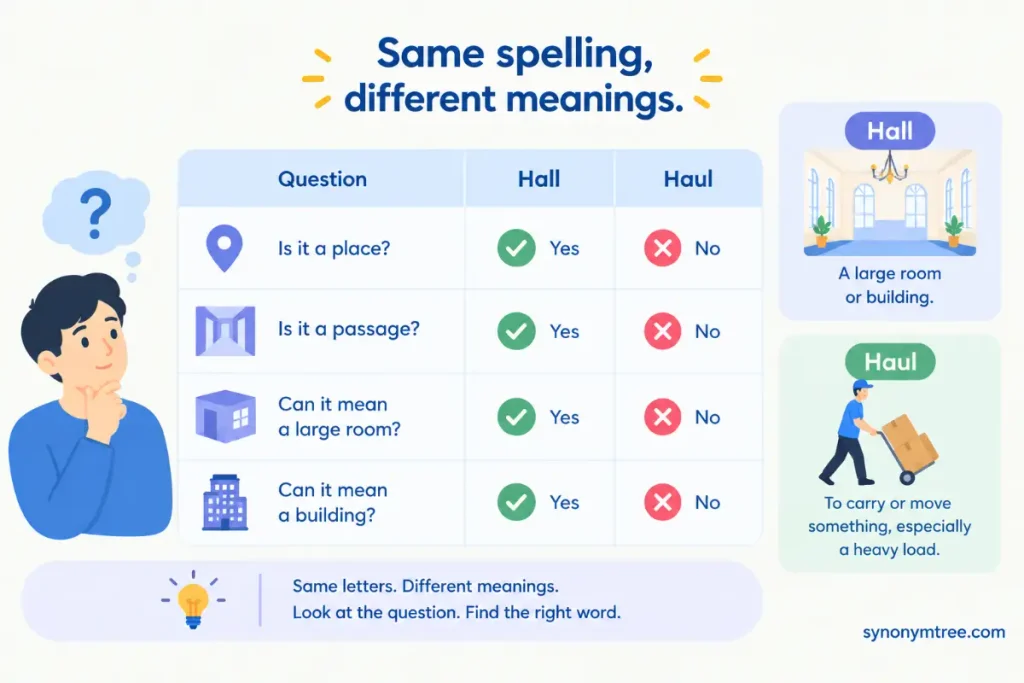
A Final Side by Side Check
| Question | Hall | Haul |
|---|---|---|
| Is it a place? | Yes | No |
| Is it a passage? | Yes | No |
| Can it mean a large room? | Yes | No |
| Can it mean a building? | Yes | No |
| Can it mean pull? | No | Yes |
| Can it mean carry? | No | Yes |
| Can it mean transport? | No | Yes |
| Can it mean a collection brought in? | No | Yes |
| Is it commonly a verb? | No | Yes |
| Is it commonly a noun? | Yes | Yes |
This table captures the core difference.
Conclusion
The difference between hall vs haul is simple once you focus on meaning instead of sound. Hall refers to a place, passage, room, or building. Haul refers to pulling, carrying, moving, transporting, or collecting something.
If you can picture yourself walking through a hallway, entering a concert hall, or meeting someone at city hall, use hall. If you are moving boxes, transporting equipment, pulling a heavy object, or talking about a collection of items, use haul.
The two words sound alike in many accents, so spelling can be tricky. When you are unsure, replace the word with a simpler synonym. If you mean hallway or room, choose hall. If you mean carry, pull, move, or transport, choose haul. That quick check will help you choose the right spelling every time.
Frequently Asked Questions
What is the difference between hall and haul?
Hall usually means a place, passage, large room, or building. Haul usually means to pull, carry, transport, or collect something.
Is hall and haul a homophone pair?
Yes, in many forms of English, hall and haul are pronounced the same or very similarly. Their different meanings and spellings make them easy to confuse.
Is it hall or haul a box?
Use haul when you mean moving a box. For example, “We need to haul the box upstairs.”
Is it hall or haul for a hallway?
Use hall when you mean a hallway or passage. For example, “She walked down the hall.”
Can haul be a noun?
Yes. A haul can mean something that has been collected, caught, transported, or purchased. For example, “The fishermen returned with a large haul.”
What is an easy way to remember hall and haul?
Think of hall as a place and haul as movement. A hall is somewhere you can walk, while you haul something from one place to another.
Why do hall and haul sound alike?
In many accents, the two words have the same or nearly the same pronunciation. English has many words with different spellings and meanings that sound alike, so context is often the best guide.

1 thought on “Hall vs Haul: Simple Difference and Examples”